Welcome TO My
Presentation
Mahee ANAM
ID:1612111030
Presented by-
Mechanism of enzyme action
Enzyme & Substrates :
 Enzyme: A substance produced by a living organism that acts as a catalyst to bring
about a specific biochemical reaction.
 Substrates: In biochemistry, the substrate is a molecule upon which an enzyme acts.
Enzymes catalyze chemical reactions involving the substrate(s).
 Enzyme are highly specific in their active site.
 Enzymes and substrates are bind together in a model called “lock and key”.
Mechanism of enzyme action:
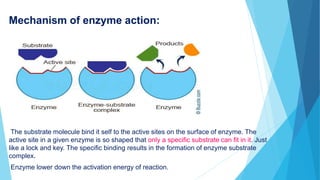
The substrate molecule bind it self to the active sites on the surface of enzyme. The
active site in a given enzyme is so shaped that only a specific substrate can fit in it. Just
like a lock and key. The specific binding results in the formation of enzyme substrate
complex.
Enzyme lower down the activation energy of reaction.
Example:
Activation energy of acid hydrolysis of sucrose is 6.22 kj/mol. But activation
energy in only 2.15 kj/mol. When hydrolysis take place in presence of sucrose
enzyme.
Cont.…
 At finally product are produce.
 The active site of the enzyme change shape and can no longer bind to
the substrate. It been denatured.
Enzyme action
Enzyme action

Enzyme action

  • 1.
  • 2.
  • 3.
  • 4.
    Enzyme & Substrates:  Enzyme: A substance produced by a living organism that acts as a catalyst to bring about a specific biochemical reaction.  Substrates: In biochemistry, the substrate is a molecule upon which an enzyme acts. Enzymes catalyze chemical reactions involving the substrate(s).  Enzyme are highly specific in their active site.  Enzymes and substrates are bind together in a model called “lock and key”.
  • 5.
    Mechanism of enzymeaction: The substrate molecule bind it self to the active sites on the surface of enzyme. The active site in a given enzyme is so shaped that only a specific substrate can fit in it. Just like a lock and key. The specific binding results in the formation of enzyme substrate complex. Enzyme lower down the activation energy of reaction.
  • 6.
    Example: Activation energy ofacid hydrolysis of sucrose is 6.22 kj/mol. But activation energy in only 2.15 kj/mol. When hydrolysis take place in presence of sucrose enzyme.
  • 7.
    Cont.…  At finallyproduct are produce.  The active site of the enzyme change shape and can no longer bind to the substrate. It been denatured.