Cofactor Binding
 Cofactor bind with the inactive enzyme/Apo enzyme
to activate the enzyme OR the binding of cofactor
with Apo enzyme convert it to Holo enzyme
 Some cofactors are inorganic, such as the metal atoms
zinc, iron, and copper in various oxidation states.
 Others, such as most vitamins, are
organic. Cofactors are generally either bound tightly to
active sites, or may bind loosely with the enzyme
Cofactor
 Cofactor
 Non protein chemical copound
 Required for enzyme activity as catalyst
 Considered as helper molecules
 Assist the biochemical transformation
 Cofactors may be organic or inorganic
.
 ChEBI Name: “ cofactor”
 ChEBI ID : CHEBI:23357
 Gene ontology ( 0048037)
 Gene ontology Annotation ( 905 annotation)
Classification
 Classification of cofactor
These are classified
into two types of cofactors
 Inorganic cofactors
 Organic cofactors
1.Inorganic cofactors
These are also devided into two group
 Metal ions
 Iron –sulfur clusters
Metal ions
 Metal ions are common cofactors
 Some enzymes, referred to as metalloenzymes, cannot
function without a bound metal ion in the active site
..
 In nutrition, the list of essential trace elements reflects
their role as cofactors.
 In humans these are
includes iron, magnesium, manganese, cobalt, copper,
zinc, and molybdenum.
 Although chromium deficiency causes impaired
glucose tolerance, no human enzyme that uses this
metal as a cofactor has been identified
 Iodine is also an essential trace element, but this
element is used as part of the structure of thyroid
hormones rather than as an enzyme cofactor
Example
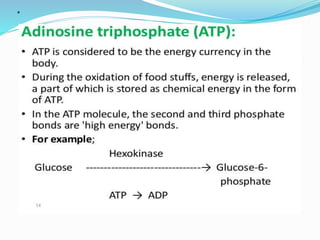
 Mg2+ is used in glycolysis.
 In the first step of converting glucose to glucose 6-
phosphate
 before ATP is used to give ADP and one phosphate
group,
 ATP is bound to Mg2+ which stabilizes the other two
phosphate groups so it is easier to release only one
phosphate group.
.
ChEBI Name: magnesium(2+)
ChEBI ID : CHEBI:18420
Secondary ChEBI IDs CHEBI:49736
CHEBI:6635
CHEBI:13379
CHEBI:25112
Gene ontology GO:0015444
Iron –sulfur clusters
 Iron-sulfur clusters are complexes of iron and sulfur atoms
held within proteins by cysteinyl residues.
 They play both structural and functional roles, including
electron transfer, redox sensing, and as structural modules.
 These clusters have many unique properties that are not
found in amino acids or other organic compounds.
 [Fe-S] clusters participate in electron transfer, substrate
binding/activation, iron/sulfur storage, regulation of gene
expression, and enzyme activity
 Definition
An iron-sulfur cluster is a unit comprising two or
more iron atoms and bridging sulfur ligands.
.
ChEBI Name: iron-sulfur cluster
ChEBI ID : CHEBI:30408
Secondary ChEBI IDs: CHEBI:5976, CHEBI:24878
Gene Ontology : GO:0051536
2.Organic cofactors
 Organic cofactors also called as coenzyme
 Coenzyme are non-protein ,low molecular weight
organic compound that participating in enzymatic
reaction
 Can not function alone
 Can be used several time when paired with enzyme
,
They have two groups or sides
 prosthetic group
 cosubstrate
 Prosthetic group is tightly covalently and permanently
bound to protein
 Cosubstrate is transiently bound to protein may be
released from protein at some time and then rebind
 Vitamin and essential nutrients are common example
of coenzyme
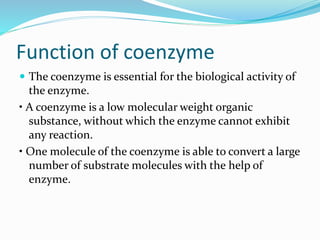
Function of coenzyme
 The coenzyme is essential for the biological activity of
the enzyme.
• A coenzyme is a low molecular weight organic
substance, without which the enzyme cannot exhibit
any reaction.
• One molecule of the coenzyme is able to convert a large
number of substrate molecules with the help of
enzyme.
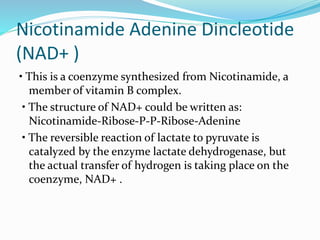
Nicotinamide Adenine Dincleotide
(NAD+ )
• This is a coenzyme synthesized from Nicotinamide, a
member of vitamin B complex.
• The structure of NAD+ could be written as:
Nicotinamide-Ribose-P-P-Ribose-Adenine
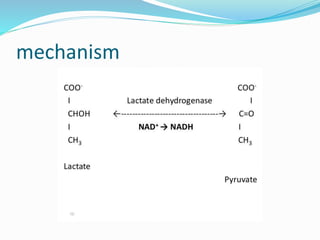
• The reversible reaction of lactate to pyruvate is
catalyzed by the enzyme lactate dehydrogenase, but
the actual transfer of hydrogen is taking place on the
coenzyme, NAD+ .
mechanism
.

Cofactor binding bioinformatics

  • 1.
    Cofactor Binding  Cofactorbind with the inactive enzyme/Apo enzyme to activate the enzyme OR the binding of cofactor with Apo enzyme convert it to Holo enzyme  Some cofactors are inorganic, such as the metal atoms zinc, iron, and copper in various oxidation states.  Others, such as most vitamins, are organic. Cofactors are generally either bound tightly to active sites, or may bind loosely with the enzyme
  • 2.
    Cofactor  Cofactor  Nonprotein chemical copound  Required for enzyme activity as catalyst  Considered as helper molecules  Assist the biochemical transformation  Cofactors may be organic or inorganic
  • 3.
    .  ChEBI Name:“ cofactor”  ChEBI ID : CHEBI:23357  Gene ontology ( 0048037)  Gene ontology Annotation ( 905 annotation)
  • 4.
    Classification  Classification ofcofactor These are classified into two types of cofactors  Inorganic cofactors  Organic cofactors
  • 5.
    1.Inorganic cofactors These arealso devided into two group  Metal ions  Iron –sulfur clusters Metal ions  Metal ions are common cofactors  Some enzymes, referred to as metalloenzymes, cannot function without a bound metal ion in the active site
  • 6.
    ..  In nutrition,the list of essential trace elements reflects their role as cofactors.  In humans these are includes iron, magnesium, manganese, cobalt, copper, zinc, and molybdenum.  Although chromium deficiency causes impaired glucose tolerance, no human enzyme that uses this metal as a cofactor has been identified  Iodine is also an essential trace element, but this element is used as part of the structure of thyroid hormones rather than as an enzyme cofactor
  • 7.
    Example  Mg2+ isused in glycolysis.  In the first step of converting glucose to glucose 6- phosphate  before ATP is used to give ADP and one phosphate group,  ATP is bound to Mg2+ which stabilizes the other two phosphate groups so it is easier to release only one phosphate group.
  • 8.
    . ChEBI Name: magnesium(2+) ChEBIID : CHEBI:18420 Secondary ChEBI IDs CHEBI:49736 CHEBI:6635 CHEBI:13379 CHEBI:25112 Gene ontology GO:0015444
  • 9.
    Iron –sulfur clusters Iron-sulfur clusters are complexes of iron and sulfur atoms held within proteins by cysteinyl residues.  They play both structural and functional roles, including electron transfer, redox sensing, and as structural modules.  These clusters have many unique properties that are not found in amino acids or other organic compounds.  [Fe-S] clusters participate in electron transfer, substrate binding/activation, iron/sulfur storage, regulation of gene expression, and enzyme activity  Definition An iron-sulfur cluster is a unit comprising two or more iron atoms and bridging sulfur ligands.
  • 10.
    . ChEBI Name: iron-sulfurcluster ChEBI ID : CHEBI:30408 Secondary ChEBI IDs: CHEBI:5976, CHEBI:24878 Gene Ontology : GO:0051536
  • 11.
    2.Organic cofactors  Organiccofactors also called as coenzyme  Coenzyme are non-protein ,low molecular weight organic compound that participating in enzymatic reaction  Can not function alone  Can be used several time when paired with enzyme
  • 12.
    , They have twogroups or sides  prosthetic group  cosubstrate  Prosthetic group is tightly covalently and permanently bound to protein  Cosubstrate is transiently bound to protein may be released from protein at some time and then rebind  Vitamin and essential nutrients are common example of coenzyme
  • 13.
    Function of coenzyme The coenzyme is essential for the biological activity of the enzyme. • A coenzyme is a low molecular weight organic substance, without which the enzyme cannot exhibit any reaction. • One molecule of the coenzyme is able to convert a large number of substrate molecules with the help of enzyme.
  • 14.
    Nicotinamide Adenine Dincleotide (NAD+) • This is a coenzyme synthesized from Nicotinamide, a member of vitamin B complex. • The structure of NAD+ could be written as: Nicotinamide-Ribose-P-P-Ribose-Adenine • The reversible reaction of lactate to pyruvate is catalyzed by the enzyme lactate dehydrogenase, but the actual transfer of hydrogen is taking place on the coenzyme, NAD+ .
  • 15.
  • 16.