Enzymology :Enzyme specificity-Types & applications
Dr. Rohini C Sane
Enzyme specificity
 Types of Enzyme specificity
1. Absolute
2. Broad
 Absolute Specificity of Enzymes
eg Fumarase & Aspartase exhibits rigid & geometrical
specificity
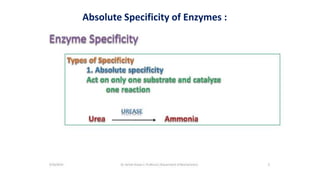
Absolute Specificity of Enzymes :
Enzyme specificity
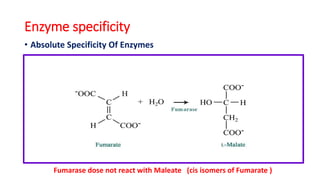
• Absolute Specificity Of Enzymes
Fumarase dose not react with Maleate (cis isomers of Fumarate )
Enzyme specificity
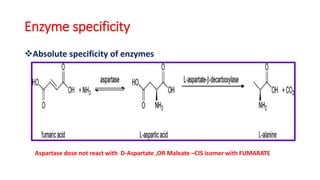
Absolute specificity of enzymes
Aspartase dose not react with D-Aspartate ,OR Maleate –CIS isomer with FUMARATE
Enzyme specificity
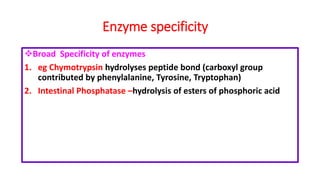
Broad Specificity of enzymes
1. eg Chymotrypsin hydrolyses peptide bond (carboxyl group
contributed by phenylalanine, Tyrosine, Tryptophan)
2. Intestinal Phosphatase –hydrolysis of esters of phosphoric acid
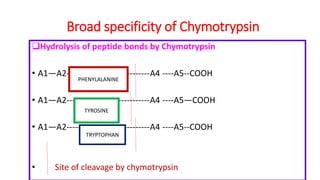
Broad specificity of Chymotrypsin
Hydrolysis of peptide bonds by Chymotrypsin
• A1—A2-----------------------------A4 ----A5--COOH
• A1—A2-----------------------------A4 ----A5—COOH
• A1—A2-----------------------------A4 ----A5--COOH
• Site of cleavage by chymotrypsin
PHENYLALANINE
TYROSINE
TRYPTOPHAN
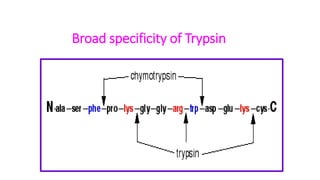
Broad specificity of Trypsin
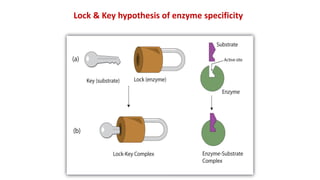
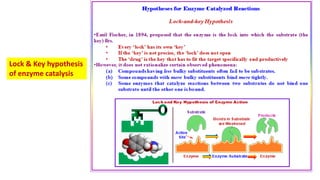
Lock & Key hypothesis of enzyme specificity
Lock & Key hypothesis
of enzyme catalysis
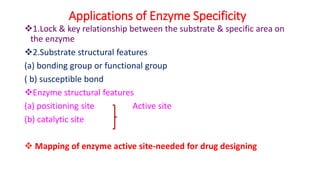
Applications of Enzyme Specificity
1.Lock & key relationship between the substrate & specific area on
the enzyme
2.Substrate structural features
(a) bonding group or functional group
( b) susceptible bond
Enzyme structural features
(a) positioning site Active site
(b) catalytic site
 Mapping of enzyme active site-needed for drug designing
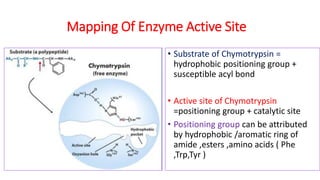
Mapping Of Enzyme Active Site
• Substrate of Chymotrypsin =
hydrophobic positioning group +
susceptible acyl bond
• Active site of Chymotrypsin
=positioning group + catalytic site
• Positioning group can be attributed
by hydrophobic /aromatic ring of
amide ,esters ,amino acids ( Phe
,Trp,Tyr )
Enzyme specificity types and applications

Enzyme specificity types and applications

  • 1.
    Enzymology :Enzyme specificity-Types& applications Dr. Rohini C Sane
  • 2.
    Enzyme specificity  Typesof Enzyme specificity 1. Absolute 2. Broad  Absolute Specificity of Enzymes eg Fumarase & Aspartase exhibits rigid & geometrical specificity
  • 3.
  • 4.
    Enzyme specificity • AbsoluteSpecificity Of Enzymes Fumarase dose not react with Maleate (cis isomers of Fumarate )
  • 5.
    Enzyme specificity Absolute specificityof enzymes Aspartase dose not react with D-Aspartate ,OR Maleate –CIS isomer with FUMARATE
  • 6.
    Enzyme specificity Broad Specificityof enzymes 1. eg Chymotrypsin hydrolyses peptide bond (carboxyl group contributed by phenylalanine, Tyrosine, Tryptophan) 2. Intestinal Phosphatase –hydrolysis of esters of phosphoric acid
  • 7.
    Broad specificity ofChymotrypsin Hydrolysis of peptide bonds by Chymotrypsin • A1—A2-----------------------------A4 ----A5--COOH • A1—A2-----------------------------A4 ----A5—COOH • A1—A2-----------------------------A4 ----A5--COOH • Site of cleavage by chymotrypsin PHENYLALANINE TYROSINE TRYPTOPHAN
  • 8.
  • 9.
    Lock & Keyhypothesis of enzyme specificity
  • 10.
    Lock & Keyhypothesis of enzyme catalysis
  • 11.
    Applications of EnzymeSpecificity 1.Lock & key relationship between the substrate & specific area on the enzyme 2.Substrate structural features (a) bonding group or functional group ( b) susceptible bond Enzyme structural features (a) positioning site Active site (b) catalytic site  Mapping of enzyme active site-needed for drug designing
  • 12.
    Mapping Of EnzymeActive Site • Substrate of Chymotrypsin = hydrophobic positioning group + susceptible acyl bond • Active site of Chymotrypsin =positioning group + catalytic site • Positioning group can be attributed by hydrophobic /aromatic ring of amide ,esters ,amino acids ( Phe ,Trp,Tyr )