Enzyme classification and properties
ENZYMES
Definitions--
 A biomolecule either Protein or RNA, that catalyse a
specific chemical reaction, enhance the rate of a
reaction by providing a reaction path with a lower
activation energy
Fundamental Properties
1) Catalytic power-speeding up reactions 108 to
1020 fold.
They speed up reactions without being
used up.
2) Specificity
a) for substrate - ranges from absolute to relative
b) for reaction catalyzed
3) Regulated-- some enzymes can sense metabolic
signals.
Catalytic Power
Catalytic Power is defined as the Ratio of the Enzyme-Catalyzed Rate of a
Reaction to the Uncatalyzed Rate
e.g. Urease-
 At 20°C, the rate constant for the enzyme-
catalyzed reaction is 3 X 10⁴/sec
 the rate constant for the uncatalyzed hydrolysis
of urea is 3 X 10¹⁰/sec
 1014 is the ratio of the catalyzed rate to the
uncatalyzed rate of reaction
Specificity
Defined as the Selectivity of Enzymes for the Reactants Upon which They Act
 In an enzyme-catalyzed reaction, none of the substrate is diverted into
nonproductive side reactions, so no wasteful by-products are produced.
The substances upon which an enzyme acts are
traditionally called- substrates
The selective qualities of an enzyme are collectively
recognized- specificity
The specific site on the enzyme where substrate binds and
catalysis occurs is called- active site
Regulation
Regulation of Enzyme Activity Ensures That the Rate of Metabolic Reactions Is
Appropriate to Cellular Requirements
 essential to the integration and regulation of metabolism
Achieved by various ways
 Inhibitor
 Activator
 Hormonal
 Rate of synthesis
2. Names bearing little resemblance to their activity
e.g. catalase - the peroxide-decomposing enzyme
Proteolytic enzymes (proteases) of the digestive tract
Trypsin- Gr. Word Tryein means to wear down
Pepsin- Pepsis means digestion
IUB nomemclature
1956 - to create a systematic basis for enzyme nomenclature
 4 digit numbered code
 first digit - major class
 Second digit - sub class
 third digit - sub sub class
 final digit - specific enzyme
2.7.1.1
ATP: glucose phosphotransferase
2- class name (transferase)
7- subclass name (phosphotransferase)
1- sub sub class (hydroxyl group as acceptor)
1- specific enzyme (D- glucose as phosphoryl group
acceptor)
Enzyme classification
 Six classes
1. Oxidoreductase- transfer of reducing equivalents from
one redox system to another
e.g. Alcohol Dehydrogenase
Lactate dehydrogenase
cytochrome oxidase
2. Transferase
functional group is transferred from one compound to
another
e.g. kinases
transaminase
phosphorylase
3. Hydrolase
cleave C-O, C-N, C-S or P-O etc bonds by adding water
across the bond
e.g. lipase
acid phosphatase
(important in digestive process)
4. Lyases
cleave C-O, C-N, or C-S bonds but do so without addition of
water and without oxidizing or reducing the substrates
e.g. aldolase
fumarase
Carbonic anhydrase
5. Isomerase
catalyze intramolecular rearrangements of functional
groups that reversibly interconvert to optical or
geometric isomers
e.g. Triose isomerase
phosphohexose isomerase
mutase
6. Ligase
catalyze biosynthetic reactions that form a covalent bond
between two substrates utilizing ATP-ADP
interconversion
e.g. glutamine synthetase
DNA- ligase
Specificity
 highly specific compared to other catalyst
 catalyzes only specific reaction
3 types
1. Stereospecificity/ optical specificity
2. Reaction specificity
3. Substrate specificity
Optical specificity
 able to recognise optical isomers of the substrate
 Act only on one isomer
e.g. enzymes of amino acid metabolism (D & L Amino acid
oxidase)
Isomerase do not exhibit stereospecificity
Reaction Specificity
 catalyze only one specific reaction over substrate
e.g. amino acid can undergo deamination, transamination,
decarboxylation and each is catalysed by separate
enzyme
Substrate specificity
specific towards their substrates
e.g. glucokinase and galactokinase- both transfer phophoryl
group from ATP to different molecule
3 types
a. Absolute
b. Relative substrate
c. broad
Absolute substrate specificity
 Act only on one substrate
e.g. urease
Relative substrate specificity
 act on structurally related substrates
 Further divide into
i. Group dependent- act on specific group e.g. trypsin-
break peptide bond between lysine and arginine,
Chymotripsin act on aromatic AA
ii. Bond specificity- act on specific bond e.g. proteolytic
enzyme, glycosidase
Broad specificity
 Act on closely related substrates
e.g. hexokinase- act on many hexoses
Chemical Nature &
Properties of Enzyme
 Protein or RNA
 Tertiary structure and specific conformation- essential
for catalytic power
 Holoenzyme- functional unit
 Apoenzyme & coenzyme
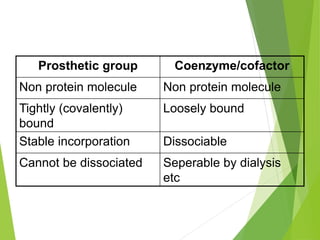
Prosthetic group Coenzyme/cofactor
Non protein molecule Non protein molecule
Tightly (covalently)
bound
Loosely bound
Stable incorporation Dissociable
Cannot be dissociated Seperable by dialysis
etc
 Monomeric Enzyme- made of a single
polypeptide e.g. ribonuclease, trypsin
 Oligomeric Enzyme- more than one
polypeptide e.g. LDH, aspartate
carbamoylase
 Multienzyme complex- specific sites to
catalyse different reactions in sequence.
Only native conformation is active not
individual e.g. pyruvate dehydrogenase
Multienzyme Complexes and
Multifunctional Enzymes
 In a number of metabolic pathways, several
enzymes which catalyze different stages of
the process have been found to be
associated noncovalently, giving a
multienzyme complex.
 Examples: Pyruvate Dehydrogenase Complex;
Electron Respiratory Chain
 In other cases, different activities may be
found on a single multifunctional polypeptide
chain. The presence of multiple activities is
on a single polypeptide chain is usually the
result of a gene fusion event

specificity.ppt

  • 1.
  • 2.
    ENZYMES Definitions--  A biomoleculeeither Protein or RNA, that catalyse a specific chemical reaction, enhance the rate of a reaction by providing a reaction path with a lower activation energy
  • 3.
    Fundamental Properties 1) Catalyticpower-speeding up reactions 108 to 1020 fold. They speed up reactions without being used up. 2) Specificity a) for substrate - ranges from absolute to relative b) for reaction catalyzed 3) Regulated-- some enzymes can sense metabolic signals.
  • 4.
    Catalytic Power Catalytic Poweris defined as the Ratio of the Enzyme-Catalyzed Rate of a Reaction to the Uncatalyzed Rate e.g. Urease-  At 20°C, the rate constant for the enzyme- catalyzed reaction is 3 X 10⁴/sec  the rate constant for the uncatalyzed hydrolysis of urea is 3 X 10¹⁰/sec  1014 is the ratio of the catalyzed rate to the uncatalyzed rate of reaction
  • 5.
    Specificity Defined as theSelectivity of Enzymes for the Reactants Upon which They Act  In an enzyme-catalyzed reaction, none of the substrate is diverted into nonproductive side reactions, so no wasteful by-products are produced.
  • 6.
    The substances uponwhich an enzyme acts are traditionally called- substrates The selective qualities of an enzyme are collectively recognized- specificity The specific site on the enzyme where substrate binds and catalysis occurs is called- active site
  • 7.
    Regulation Regulation of EnzymeActivity Ensures That the Rate of Metabolic Reactions Is Appropriate to Cellular Requirements  essential to the integration and regulation of metabolism Achieved by various ways  Inhibitor  Activator  Hormonal  Rate of synthesis
  • 8.
    2. Names bearinglittle resemblance to their activity e.g. catalase - the peroxide-decomposing enzyme Proteolytic enzymes (proteases) of the digestive tract Trypsin- Gr. Word Tryein means to wear down Pepsin- Pepsis means digestion
  • 9.
    IUB nomemclature 1956 -to create a systematic basis for enzyme nomenclature  4 digit numbered code  first digit - major class  Second digit - sub class  third digit - sub sub class  final digit - specific enzyme
  • 10.
    2.7.1.1 ATP: glucose phosphotransferase 2-class name (transferase) 7- subclass name (phosphotransferase) 1- sub sub class (hydroxyl group as acceptor) 1- specific enzyme (D- glucose as phosphoryl group acceptor)
  • 11.
    Enzyme classification  Sixclasses 1. Oxidoreductase- transfer of reducing equivalents from one redox system to another e.g. Alcohol Dehydrogenase Lactate dehydrogenase cytochrome oxidase
  • 12.
    2. Transferase functional groupis transferred from one compound to another e.g. kinases transaminase phosphorylase
  • 13.
    3. Hydrolase cleave C-O,C-N, C-S or P-O etc bonds by adding water across the bond e.g. lipase acid phosphatase (important in digestive process)
  • 14.
    4. Lyases cleave C-O,C-N, or C-S bonds but do so without addition of water and without oxidizing or reducing the substrates e.g. aldolase fumarase Carbonic anhydrase
  • 15.
    5. Isomerase catalyze intramolecularrearrangements of functional groups that reversibly interconvert to optical or geometric isomers e.g. Triose isomerase phosphohexose isomerase mutase
  • 16.
    6. Ligase catalyze biosyntheticreactions that form a covalent bond between two substrates utilizing ATP-ADP interconversion e.g. glutamine synthetase DNA- ligase
  • 17.
    Specificity  highly specificcompared to other catalyst  catalyzes only specific reaction 3 types 1. Stereospecificity/ optical specificity 2. Reaction specificity 3. Substrate specificity
  • 18.
    Optical specificity  ableto recognise optical isomers of the substrate  Act only on one isomer e.g. enzymes of amino acid metabolism (D & L Amino acid oxidase) Isomerase do not exhibit stereospecificity
  • 19.
    Reaction Specificity  catalyzeonly one specific reaction over substrate e.g. amino acid can undergo deamination, transamination, decarboxylation and each is catalysed by separate enzyme
  • 20.
    Substrate specificity specific towardstheir substrates e.g. glucokinase and galactokinase- both transfer phophoryl group from ATP to different molecule 3 types a. Absolute b. Relative substrate c. broad
  • 21.
    Absolute substrate specificity Act only on one substrate e.g. urease
  • 22.
    Relative substrate specificity act on structurally related substrates  Further divide into i. Group dependent- act on specific group e.g. trypsin- break peptide bond between lysine and arginine, Chymotripsin act on aromatic AA ii. Bond specificity- act on specific bond e.g. proteolytic enzyme, glycosidase
  • 23.
    Broad specificity  Acton closely related substrates e.g. hexokinase- act on many hexoses
  • 24.
    Chemical Nature & Propertiesof Enzyme  Protein or RNA  Tertiary structure and specific conformation- essential for catalytic power  Holoenzyme- functional unit  Apoenzyme & coenzyme
  • 25.
    Prosthetic group Coenzyme/cofactor Nonprotein molecule Non protein molecule Tightly (covalently) bound Loosely bound Stable incorporation Dissociable Cannot be dissociated Seperable by dialysis etc
  • 26.
     Monomeric Enzyme-made of a single polypeptide e.g. ribonuclease, trypsin  Oligomeric Enzyme- more than one polypeptide e.g. LDH, aspartate carbamoylase  Multienzyme complex- specific sites to catalyse different reactions in sequence. Only native conformation is active not individual e.g. pyruvate dehydrogenase
  • 27.
    Multienzyme Complexes and MultifunctionalEnzymes  In a number of metabolic pathways, several enzymes which catalyze different stages of the process have been found to be associated noncovalently, giving a multienzyme complex.  Examples: Pyruvate Dehydrogenase Complex; Electron Respiratory Chain  In other cases, different activities may be found on a single multifunctional polypeptide chain. The presence of multiple activities is on a single polypeptide chain is usually the result of a gene fusion event