Environmental
Ethics
What is environmental ethics?
• Environmental ethics is a discipline in philosophy that studies the
moral relationship of human beings to, and also the value and moral
status of, the Environment and its non human-contents.
• Environmental ethics believe that humans are a part of society as well
as other living creatures, which includes plants and animals. These
items are a very important part of the world and are considered to
be a functional part of human life.
Do you know?
• Suppose putting out natural fires, culling feral animals or destroying
some individual members of overpopulated indigenous species is
necessary for the protection of the integrity of a certain ecosystem.
Will these actions be morally permissible or even required?
No its morally incorrect.............
• It is often said to be morally wrong for human beings to pollute and
destroy parts of the natural environment and to consume a huge
proportion of the planet’s natural resources, because natural
resources are beneficial for human beings.
• The “shallow ecology movement”, as Næss (1973) calls it, is the
“fight against pollution and resource depletion”, the central objective
of which is “the health and affluence of people in the developed
countries.” The “deep ecology movement”, in contrast, endorses
“biospheric egalitarianism”, the view that all living things are alike in
having value in their own right, independent of their usefulness to
others.
Natural resources
are materials
and energy
sources found in
nature that
humans need to
survive.
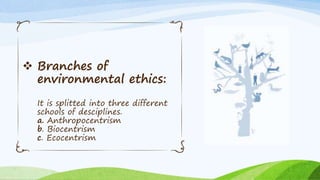
 Branches of
environmental ethics:
It is splitted into three different
schools of desciplines.
a. Anthropocentrism
b. Biocentrism
c. Ecocentrism
Continue……………….
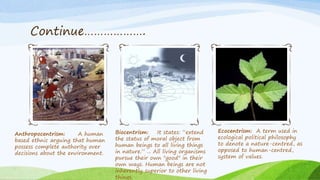
Anthropocentrism: A human
based ethnic arguing that human
possess complete authority over
decisions about the environment.
Biocentrism: It states: “extend
the status of moral object from
human beings to all living things
in nature.” ... All living organisms
pursue their own "good" in their
own ways. Human beings are not
inherently superior to other living
things.
Ecocentrism: A term used in
ecological political philosophy
to denote a nature-centred, as
opposed to human-centred,
system of values.
Relationship between Environmental
Ethics and Environmental Science:
• The relationship between environmental ethics and the environmental sciences,
however, is a complex and often contested one.
• For example, debates over whether ecologists and conservation biologists should also be
advocates for environmental protection — a role that goes beyond the traditional
profile of the "objective" scientist — have received much attention in these fields.
• Likewise, we will see that issues such as the place of animal welfare concerns in
wildlife management, the valuation and control of non-native species, and the
adoption of a more interventionist approach to conservation and ecological protection
(including proposals to relocate wild species and to geo engineer earth systems to
avoid the worst effects of global climate change) frequently divide environmental
scientists and conservationists.
• This split often has as much to do with different ethical convictions and values
regarding our responsibility to species and ecosystems as it does with scientific
disagreements over the interpretation of data or the predicted outcomes of societal
actions and policies.
Importance of Environmental Ethics:
• Make us aware of indescriminate and destructive human
activities.
• Inculcate moral values towards nature and learn to respect
various life forms through environmental ethics.
• Concerned with the issues of responsible personal conduct
with respect to natural landscape, resources, species and
non-human organisms
• Conduct with respect to person is, of course, the direct
concern of modern philosophy.
THANK
YOU

Environmental ethics

  • 1.
  • 2.
    What is environmentalethics? • Environmental ethics is a discipline in philosophy that studies the moral relationship of human beings to, and also the value and moral status of, the Environment and its non human-contents. • Environmental ethics believe that humans are a part of society as well as other living creatures, which includes plants and animals. These items are a very important part of the world and are considered to be a functional part of human life.
  • 3.
    Do you know? •Suppose putting out natural fires, culling feral animals or destroying some individual members of overpopulated indigenous species is necessary for the protection of the integrity of a certain ecosystem. Will these actions be morally permissible or even required?
  • 4.
    No its morallyincorrect............. • It is often said to be morally wrong for human beings to pollute and destroy parts of the natural environment and to consume a huge proportion of the planet’s natural resources, because natural resources are beneficial for human beings. • The “shallow ecology movement”, as Næss (1973) calls it, is the “fight against pollution and resource depletion”, the central objective of which is “the health and affluence of people in the developed countries.” The “deep ecology movement”, in contrast, endorses “biospheric egalitarianism”, the view that all living things are alike in having value in their own right, independent of their usefulness to others.
  • 5.
    Natural resources are materials andenergy sources found in nature that humans need to survive.
  • 6.
     Branches of environmentalethics: It is splitted into three different schools of desciplines. a. Anthropocentrism b. Biocentrism c. Ecocentrism
  • 7.
    Continue………………. Anthropocentrism: A human basedethnic arguing that human possess complete authority over decisions about the environment. Biocentrism: It states: “extend the status of moral object from human beings to all living things in nature.” ... All living organisms pursue their own "good" in their own ways. Human beings are not inherently superior to other living things. Ecocentrism: A term used in ecological political philosophy to denote a nature-centred, as opposed to human-centred, system of values.
  • 8.
    Relationship between Environmental Ethicsand Environmental Science: • The relationship between environmental ethics and the environmental sciences, however, is a complex and often contested one. • For example, debates over whether ecologists and conservation biologists should also be advocates for environmental protection — a role that goes beyond the traditional profile of the "objective" scientist — have received much attention in these fields. • Likewise, we will see that issues such as the place of animal welfare concerns in wildlife management, the valuation and control of non-native species, and the adoption of a more interventionist approach to conservation and ecological protection (including proposals to relocate wild species and to geo engineer earth systems to avoid the worst effects of global climate change) frequently divide environmental scientists and conservationists. • This split often has as much to do with different ethical convictions and values regarding our responsibility to species and ecosystems as it does with scientific disagreements over the interpretation of data or the predicted outcomes of societal actions and policies.
  • 9.
    Importance of EnvironmentalEthics: • Make us aware of indescriminate and destructive human activities. • Inculcate moral values towards nature and learn to respect various life forms through environmental ethics. • Concerned with the issues of responsible personal conduct with respect to natural landscape, resources, species and non-human organisms • Conduct with respect to person is, of course, the direct concern of modern philosophy.
  • 10.