INTRODUCTION TO
ENVIRONMENTAL SCIENCE
Lesson 1
UNDERSTANDING THE NATURE OF
ENVIRONMENTAL SCIENCE
I. Environmental Principles
II. Environmental Ethics
OBJECTIVES
1. State and reflect on the seven environmental principles.
2. Analyze the relationship between the individual, society, economy,
culture, and environmental issues.
3. Declare some philosophical and ethical views, issues, and arguments
as they relate to the environment.
4. Establish your critical thinking in an attempt to consider and
scrutinize arguments about different environmental problems.
ENVIRONMENTAL
PRINCIPLES
ENVIRONMENT
• The physical surroundings and factors -
living things (organisms) and nonliving
things (matter and energy).
• It means to encircle or surround an
organism and includes the social and
cultural conditions that may affect him.
• It is everything that affects an organism
during its lifetime.
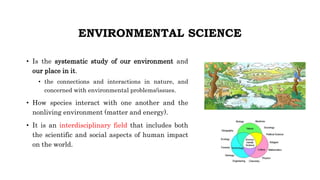
ENVIRONMENTAL SCIENCE
• Is the systematic study of our environment and
our place in it.
• the connections and interactions in nature, and
concerned with environmental problems/issues.
• How species interact with one another and the
nonliving environment (matter and energy).
• It is an interdisciplinary field that includes both
the scientific and social aspects of human impact
on the world.
THE 7 ENVIRONMENTAL PRINCIPLES
1. Nature knows best.
2. All forms of life are important.
3. Everything is connected to everything else.
4. Everything changes.
5. Everything must go somewhere.
6. Ours is finite earth.
7. Nature is beautiful, and we are stewards of God's creation.
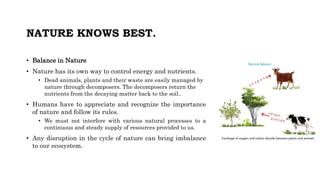
NATURE KNOWS BEST.
• Balance in Nature
• Nature has its own way to control energy and nutrients.
• Dead animals, plants and their waste are easily managed by
nature through decomposers. The decomposers return the
nutrients from the decaying matter back to the soil..
• Humans have to appreciate and recognize the importance
of nature and follow its rules.
• We must not interfere with various natural processes to a
continuous and steady supply of resources provided to us.
• Any disruption in the cycle of nature can bring imbalance
to our ecosystem.
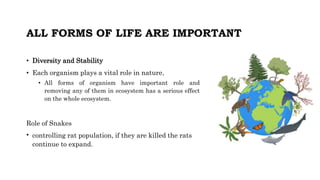
ALL FORMS OF LIFE ARE IMPORTANT
• Diversity and Stability
• Each organism plays a vital role in nature.
• All forms of organism have important role and
removing any of them in ecosystem has a serious effect
on the whole ecosystem.
Role of Snakes
• controlling rat population, if they are killed the rats
continue to expand.
EVERYTHING IS CONNECTED TO EVERYTHING ELSE.
• Interdependence
• Each organism has an
influence on another organism.
• Example: food chain , food web
EVERYTHING CHANGES.
• Change
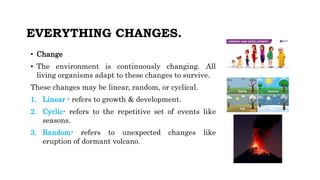
• The environment is continuously changing. All
living organisms adapt to these changes to survive.
These changes may be linear, random, or cyclical.
1. Linear - refers to growth & development.
2. Cyclic- refers to the repetitive set of events like
seasons.
3. Random- refers to unexpected changes like
eruption of dormant volcano.
EVERYTHING MUST GO SOMEWHERE.
• Material Cycles
• Everything ends up elsewhere.
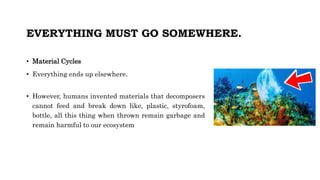
• However, humans invented materials that decomposers
cannot feed and break down like, plastic, styrofoam,
bottle, all this thing when thrown remain garbage and
remain harmful to our ecosystem
OURS IS FINITE EARTH.
• Finiteness of Resources
• Natural resources have a limit.
2 Types of Earth Resources
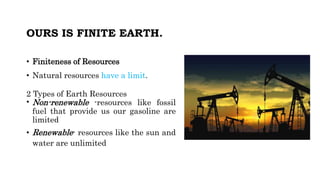
• Non-renewable -resources like fossil
fuel that provide us our gasoline are
limited
• Renewable- resources like the sun and
water are unlimited
NATURE IS BEAUTIFUL, AND WE ARE STEWARDS OF
GOD'S CREATION.
• Stewardship
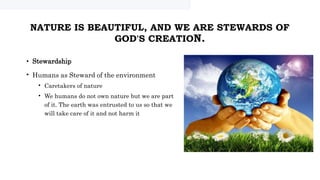
• Humans as Steward of the environment
• Caretakers of nature
• We humans do not own nature but we are part
of it. The earth was entrusted to us so that we
will take care of it and not harm it
ENVIRONMENTAL
ETHICS
SUPPOSE A NARRA TREE
NEAR YOUR HOUSE IS
SCHEDULED TO BE CUT
DOWN FOR A CIVIC
PROJECT SUCH AS
BASKETBALL COURT.
WOULD YOU SUPPORT THIS?
WHY OR WHY NOT?
ENVIRONMENTAL ETHICS
• Ethics is a field of philosophy that focuses on the study of value or
quality and seeks to define what is right and what is wrong
irrespective of the culture and society.
• Environmental ethics is the study of moral perspectives, beliefs,
attitudes, and issues concerning the environment. It applies ethical
thinking to the natural world and the relationship between humans
and the earth.
ENVIRONMENTAL ETHICS
Three fundamental propositions:
1. The earth and its components (natural resources, human beings, animals,
etc.) are worthy of ethical concern.
2. The earth and its components have inherent value because they exist, not
only because they provide resources for human needs.
3. Based on the concept of an ecosystem, human beings should consider
“wholes” that comprises other living organisms and the environment
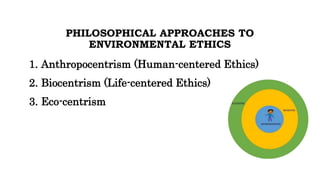
PHILOSOPHICAL APPROACHES TO
ENVIRONMENTAL ETHICS
1. Anthropocentrism (Human-centered Ethics)
2. Biocentrism (Life-centered Ethics)
3. Eco-centrism
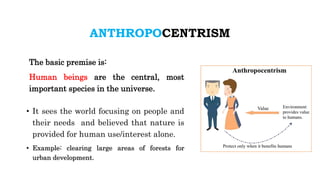
ANTHROPOCENTRISM
The basic premise is:
Human beings are the central, most
important species in the universe.
• It sees the world focusing on people and
their needs and believed that nature is
provided for human use/interest alone.
• Example: clearing large areas of forests for
urban development.
BIOCENTRISM
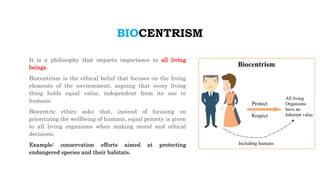
It is a philosophy that imparts importance to all living
beings.
Biocentrism is the ethical belief that focuses on the living
elements of the environment, arguing that every living
thing holds equal value, independent from its use to
humans.
Biocentric ethics asks that, instead of focusing on
prioritizing the wellbeing of humans, equal priority is given
to all living organisms when making moral and ethical
decisions.
Example: conservation efforts aimed at protecting
endangered species and their habitats.
ECOCENTRISM
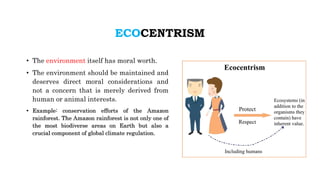
• The environment itself has moral worth.
• The environment should be maintained and
deserves direct moral considerations and
not a concern that is merely derived from
human or animal interests.
• Example: conservation efforts of the Amazon
rainforest. The Amazon rainforest is not only one of
the most biodiverse areas on Earth but also a
crucial component of global climate regulation.
ENVIRONMENTAL ATTITUDES
1. Developmental Approach
2. Conservationists Approach
3. Preservationists Approach
Developmental approach
• It tends to be the most anthropocentric and assumes that humanity is above all.
• It assumes that the human race is and should be the master of nature and that the earth
and its resources exist solely for our benefit and pleasure.
• It suggests that improvements in human condition require converting ever more of nature
to human use; thus, the environment has value only insofar as human beings
economically utilize it.
• It yields to industrialization and modernization.
• Example:
• The construction of the Chico River Dam Project in the 1970s.
• It was initiated to harness hydroelectric power for economic development.
• It faced criticism and opposition from indigenous communities and environmental advocates due to
its potential negative impact on the local ecosystem and displacement of communities.
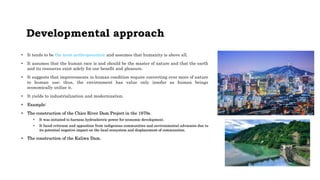
• The construction of the Kaliwa Dam.
THE CONSTRUCTION OF THE KALIWA DAM.
• There are two major components of the project, which are the tunneling and the
construction of the dam. It has started with tunneling and it will be complete by the
middle of 2026.
• Who benefits from Kaliwa Dam?
• Kaliwa Dam Project or the New Centennial Water Supply Project is a new water source to be
constructed to meet the increasing demand of the people of Metro Manila, Rizal and
Quezon (17.46M people o 3.49M household) by constructing another dam and to reduce total
dependence on the Angat Dam.
• The construction of this dam cause irreversible environmental damage to the Sierra
Madre, but it will also endanger numerous endemic wildlife, upset the biodiversity, and
displace so many indigenous people native to the area.
Conservationists approach
• It is concerned with using natural areas and wildlife (fauna,
flora, and microorganisms) to benefit present and future
generations of human races and other forms of life.
• People who believe that land should be used only to a certain
extent, to what needs to be used.
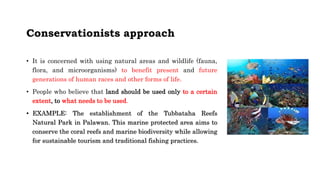
• EXAMPLE: The establishment of the Tubbataha Reefs
Natural Park in Palawan. This marine protected area aims to
conserve the coral reefs and marine biodiversity while allowing
for sustainable tourism and traditional fishing practices.
Preservationists approach
• Tends to be the most eco-centric towards the
environment.
• It is concerned with the preservation of natural areas.
• Their primary goal is to ensure those undisturbed
natural areas are free from harmful human activities.
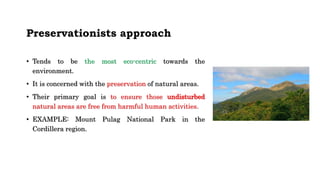
• EXAMPLE: Mount Pulag National Park in the
Cordillera region.
ENVIRONMENTAL ATTITUDES
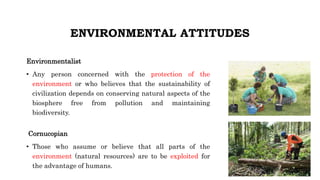
Environmentalist
• Any person concerned with the protection of the
environment or who believes that the sustainability of
civilization depends on conserving natural aspects of the
biosphere free from pollution and maintaining
biodiversity.
Cornucopian
• Those who assume or believe that all parts of the
environment (natural resources) are to be exploited for
the advantage of humans.
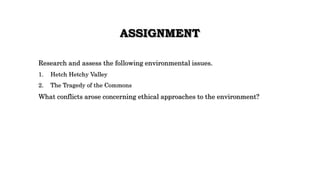
ASSIGNMENT
Research and assess the following environmental issues.
1. Hetch Hetchy Valley
2. The Tragedy of the Commons
What conflicts arose concerning ethical approaches to the environment?
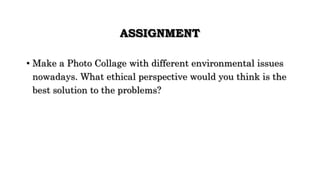
ASSIGNMENT
• Make a Photo Collage with different environmental issues
nowadays. What ethical perspective would you think is the
best solution to the problems?
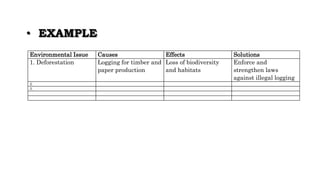
• EXAMPLE
Environmental Issue Causes Effects Solutions
1. Deforestation Logging for timber and
paper production
Loss of biodiversity
and habitats
Enforce and
strengthen laws
against illegal logging
2.
3.
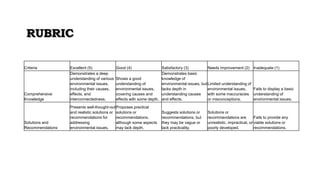
RUBRIC
Criteria Excellent (5) Good (4) Satisfactory (3) Needs Improvement (2) Inadequate (1)
Comprehensive
Knowledge
Demonstrates a deep
understanding of various
environmental issues,
including their causes,
effects, and
interconnectedness.
Shows a good
understanding of
environmental issues,
covering causes and
effects with some depth.
Demonstrates basic
knowledge of
environmental issues, but
lacks depth in
understanding causes
and effects.
Limited understanding of
environmental issues,
with some inaccuracies
or misconceptions.
Fails to display a basic
understanding of
environmental issues.
Solutions and
Recommendations
Presents well-thought-out
and realistic solutions or
recommendations for
addressing
environmental issues.
Proposes practical
solutions or
recommendations,
although some aspects
may lack depth.
Suggests solutions or
recommendations, but
they may be vague or
lack practicality.
Solutions or
recommendations are
unrealistic, impractical, or
poorly developed.
Fails to provide any
viable solutions or
recommendations.
RUBRIC FOR PHOTO COLLAGE

EnviSci-Lesson-1-INTRODUCTION-TO-ENVIRONMENTAL-SCIENCE.pptx

  • 1.
  • 2.
    UNDERSTANDING THE NATUREOF ENVIRONMENTAL SCIENCE I. Environmental Principles II. Environmental Ethics
  • 3.
    OBJECTIVES 1. State andreflect on the seven environmental principles. 2. Analyze the relationship between the individual, society, economy, culture, and environmental issues. 3. Declare some philosophical and ethical views, issues, and arguments as they relate to the environment. 4. Establish your critical thinking in an attempt to consider and scrutinize arguments about different environmental problems.
  • 4.
  • 5.
    ENVIRONMENT • The physicalsurroundings and factors - living things (organisms) and nonliving things (matter and energy). • It means to encircle or surround an organism and includes the social and cultural conditions that may affect him. • It is everything that affects an organism during its lifetime.
  • 6.
    ENVIRONMENTAL SCIENCE • Isthe systematic study of our environment and our place in it. • the connections and interactions in nature, and concerned with environmental problems/issues. • How species interact with one another and the nonliving environment (matter and energy). • It is an interdisciplinary field that includes both the scientific and social aspects of human impact on the world.
  • 7.
    THE 7 ENVIRONMENTALPRINCIPLES 1. Nature knows best. 2. All forms of life are important. 3. Everything is connected to everything else. 4. Everything changes. 5. Everything must go somewhere. 6. Ours is finite earth. 7. Nature is beautiful, and we are stewards of God's creation.
  • 8.
    NATURE KNOWS BEST. •Balance in Nature • Nature has its own way to control energy and nutrients. • Dead animals, plants and their waste are easily managed by nature through decomposers. The decomposers return the nutrients from the decaying matter back to the soil.. • Humans have to appreciate and recognize the importance of nature and follow its rules. • We must not interfere with various natural processes to a continuous and steady supply of resources provided to us. • Any disruption in the cycle of nature can bring imbalance to our ecosystem.
  • 9.
    ALL FORMS OFLIFE ARE IMPORTANT • Diversity and Stability • Each organism plays a vital role in nature. • All forms of organism have important role and removing any of them in ecosystem has a serious effect on the whole ecosystem. Role of Snakes • controlling rat population, if they are killed the rats continue to expand.
  • 10.
    EVERYTHING IS CONNECTEDTO EVERYTHING ELSE. • Interdependence • Each organism has an influence on another organism. • Example: food chain , food web
  • 11.
    EVERYTHING CHANGES. • Change •The environment is continuously changing. All living organisms adapt to these changes to survive. These changes may be linear, random, or cyclical. 1. Linear - refers to growth & development. 2. Cyclic- refers to the repetitive set of events like seasons. 3. Random- refers to unexpected changes like eruption of dormant volcano.
  • 12.
    EVERYTHING MUST GOSOMEWHERE. • Material Cycles • Everything ends up elsewhere. • However, humans invented materials that decomposers cannot feed and break down like, plastic, styrofoam, bottle, all this thing when thrown remain garbage and remain harmful to our ecosystem
  • 13.
    OURS IS FINITEEARTH. • Finiteness of Resources • Natural resources have a limit. 2 Types of Earth Resources • Non-renewable -resources like fossil fuel that provide us our gasoline are limited • Renewable- resources like the sun and water are unlimited
  • 14.
    NATURE IS BEAUTIFUL,AND WE ARE STEWARDS OF GOD'S CREATION. • Stewardship • Humans as Steward of the environment • Caretakers of nature • We humans do not own nature but we are part of it. The earth was entrusted to us so that we will take care of it and not harm it
  • 15.
  • 16.
    SUPPOSE A NARRATREE NEAR YOUR HOUSE IS SCHEDULED TO BE CUT DOWN FOR A CIVIC PROJECT SUCH AS BASKETBALL COURT. WOULD YOU SUPPORT THIS? WHY OR WHY NOT?
  • 17.
    ENVIRONMENTAL ETHICS • Ethicsis a field of philosophy that focuses on the study of value or quality and seeks to define what is right and what is wrong irrespective of the culture and society. • Environmental ethics is the study of moral perspectives, beliefs, attitudes, and issues concerning the environment. It applies ethical thinking to the natural world and the relationship between humans and the earth.
  • 18.
    ENVIRONMENTAL ETHICS Three fundamentalpropositions: 1. The earth and its components (natural resources, human beings, animals, etc.) are worthy of ethical concern. 2. The earth and its components have inherent value because they exist, not only because they provide resources for human needs. 3. Based on the concept of an ecosystem, human beings should consider “wholes” that comprises other living organisms and the environment
  • 19.
    PHILOSOPHICAL APPROACHES TO ENVIRONMENTALETHICS 1. Anthropocentrism (Human-centered Ethics) 2. Biocentrism (Life-centered Ethics) 3. Eco-centrism
  • 20.
    ANTHROPOCENTRISM The basic premiseis: Human beings are the central, most important species in the universe. • It sees the world focusing on people and their needs and believed that nature is provided for human use/interest alone. • Example: clearing large areas of forests for urban development.
  • 21.
    BIOCENTRISM It is aphilosophy that imparts importance to all living beings. Biocentrism is the ethical belief that focuses on the living elements of the environment, arguing that every living thing holds equal value, independent from its use to humans. Biocentric ethics asks that, instead of focusing on prioritizing the wellbeing of humans, equal priority is given to all living organisms when making moral and ethical decisions. Example: conservation efforts aimed at protecting endangered species and their habitats.
  • 22.
    ECOCENTRISM • The environmentitself has moral worth. • The environment should be maintained and deserves direct moral considerations and not a concern that is merely derived from human or animal interests. • Example: conservation efforts of the Amazon rainforest. The Amazon rainforest is not only one of the most biodiverse areas on Earth but also a crucial component of global climate regulation.
  • 23.
    ENVIRONMENTAL ATTITUDES 1. DevelopmentalApproach 2. Conservationists Approach 3. Preservationists Approach
  • 24.
    Developmental approach • Ittends to be the most anthropocentric and assumes that humanity is above all. • It assumes that the human race is and should be the master of nature and that the earth and its resources exist solely for our benefit and pleasure. • It suggests that improvements in human condition require converting ever more of nature to human use; thus, the environment has value only insofar as human beings economically utilize it. • It yields to industrialization and modernization. • Example: • The construction of the Chico River Dam Project in the 1970s. • It was initiated to harness hydroelectric power for economic development. • It faced criticism and opposition from indigenous communities and environmental advocates due to its potential negative impact on the local ecosystem and displacement of communities. • The construction of the Kaliwa Dam.
  • 25.
    THE CONSTRUCTION OFTHE KALIWA DAM. • There are two major components of the project, which are the tunneling and the construction of the dam. It has started with tunneling and it will be complete by the middle of 2026. • Who benefits from Kaliwa Dam? • Kaliwa Dam Project or the New Centennial Water Supply Project is a new water source to be constructed to meet the increasing demand of the people of Metro Manila, Rizal and Quezon (17.46M people o 3.49M household) by constructing another dam and to reduce total dependence on the Angat Dam. • The construction of this dam cause irreversible environmental damage to the Sierra Madre, but it will also endanger numerous endemic wildlife, upset the biodiversity, and displace so many indigenous people native to the area.
  • 26.
    Conservationists approach • Itis concerned with using natural areas and wildlife (fauna, flora, and microorganisms) to benefit present and future generations of human races and other forms of life. • People who believe that land should be used only to a certain extent, to what needs to be used. • EXAMPLE: The establishment of the Tubbataha Reefs Natural Park in Palawan. This marine protected area aims to conserve the coral reefs and marine biodiversity while allowing for sustainable tourism and traditional fishing practices.
  • 27.
    Preservationists approach • Tendsto be the most eco-centric towards the environment. • It is concerned with the preservation of natural areas. • Their primary goal is to ensure those undisturbed natural areas are free from harmful human activities. • EXAMPLE: Mount Pulag National Park in the Cordillera region.
  • 28.
    ENVIRONMENTAL ATTITUDES Environmentalist • Anyperson concerned with the protection of the environment or who believes that the sustainability of civilization depends on conserving natural aspects of the biosphere free from pollution and maintaining biodiversity. Cornucopian • Those who assume or believe that all parts of the environment (natural resources) are to be exploited for the advantage of humans.
  • 29.
    ASSIGNMENT Research and assessthe following environmental issues. 1. Hetch Hetchy Valley 2. The Tragedy of the Commons What conflicts arose concerning ethical approaches to the environment?
  • 30.
    ASSIGNMENT • Make aPhoto Collage with different environmental issues nowadays. What ethical perspective would you think is the best solution to the problems?
  • 31.
    • EXAMPLE Environmental IssueCauses Effects Solutions 1. Deforestation Logging for timber and paper production Loss of biodiversity and habitats Enforce and strengthen laws against illegal logging 2. 3.
  • 32.
    RUBRIC Criteria Excellent (5)Good (4) Satisfactory (3) Needs Improvement (2) Inadequate (1) Comprehensive Knowledge Demonstrates a deep understanding of various environmental issues, including their causes, effects, and interconnectedness. Shows a good understanding of environmental issues, covering causes and effects with some depth. Demonstrates basic knowledge of environmental issues, but lacks depth in understanding causes and effects. Limited understanding of environmental issues, with some inaccuracies or misconceptions. Fails to display a basic understanding of environmental issues. Solutions and Recommendations Presents well-thought-out and realistic solutions or recommendations for addressing environmental issues. Proposes practical solutions or recommendations, although some aspects may lack depth. Suggests solutions or recommendations, but they may be vague or lack practicality. Solutions or recommendations are unrealistic, impractical, or poorly developed. Fails to provide any viable solutions or recommendations.
  • 33.