Environmental Ethics
Prepared by: Eloisa A. Rivera
Professor: Dr. Wilfred Cabuatan
What is Environmental Ethics?
-the moral relationship of human
beings to and the value and moral
status of the environment and its
nonhuman content.
-Study of the ethical basis of
environment or discussion of the
ethical basis of environmental
protection.
Why need to study Environmental
Ethics?
To overcome the following questions.
1. What are the environment damage
produce by the present generation?
2. What acts must be give up to slow
such damage?
Environmental Damage
1) Pollution:
• Air pollution
• Water pollution
• Land pollution
2) Resource depletion:
• Depletion of Species & Habits
• Depletion of Fossil fuels etc..
Environmental Ethics Principles
We should have profound respect for
nature.
We must maintain a harmonious
relation with other species.
Everyone should take responsibility
for this impact on nature.
Environmental Ethics Principles
Local & indigenous environmental
knowledge should be respected.
We must plan for the long term.
The Ethical Values for Pollution
Control
 We should recognize our moral duty
to protect the welfare not only
human beings, but also of other non-
human parts of this system.
Usefulness of non-human world for
human purposes.
The Ethical Values for Pollution
Control
Humans have no rights to reduce
this richness & diversity expect to
satisfy vital needs.
The ideological changes is mainly
that of appreciating life quality, rather
than to increase higher standard of
living.
Ethical Values for Conserving
depletable resources
Proper utilisation of resources
i.e. the people should maintain
Ecological balance.
We should adopt voluntary
measures to conserve the
resources.
Ethical Values for Conserving
depletable resources
If we are to preserve enough scarce
resources, so that future generation
can maintain their quality of life at a
satisfactory level.
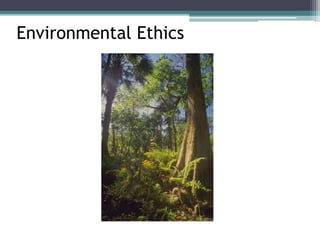
Environmental Ethics
Definitions
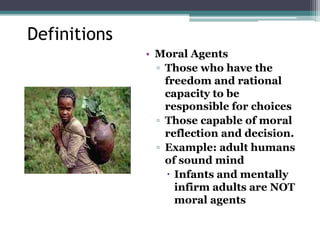
• Moral Agents
▫ Those who have the
freedom and rational
capacity to be
responsible for choices
▫ Those capable of moral
reflection and decision.
▫ Example: adult humans
of sound mind
 Infants and mentally
infirm adults are NOT
moral agents
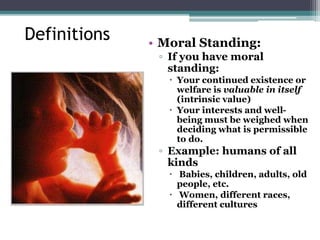
Definitions • Moral Standing:
▫ If you have moral
standing:
 Your continued existence or
welfare is valuable in itself
(intrinsic value)
 Your interests and well-
being must be weighed when
deciding what is permissible
to do.
▫ Example: humans of all
kinds
 Babies, children, adults, old
people, etc.
 Women, different races,
different cultures
Definitions
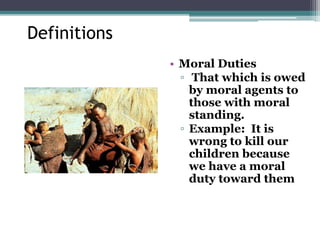
• Moral Duties
▫ That which is owed
by moral agents to
those with moral
standing.
▫ Example: It is
wrong to kill our
children because
we have a moral
duty toward them
Philosophical Issue
• Who or what has
moral standing, and
why?
▫ Does the environment
have moral standing?
▫ Must look at criteria
for moral standing
• What moral duty do
we (moral agents)
have toward those
with moral
standing?
▫ Different ethical
positions suggest
different moral duties.
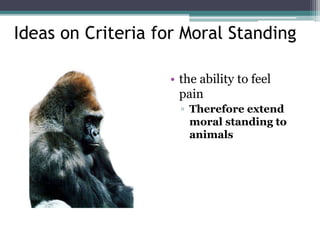
Ideas on Criteria for Moral Standing
• the ability to feel
pain
▫ Therefore extend
moral standing to
animals
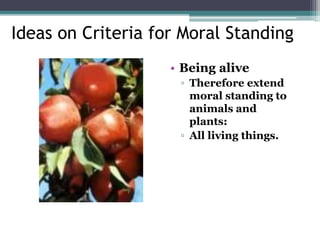
Ideas on Criteria for Moral Standing
• Being alive
▫ Therefore extend
moral standing to
animals and
plants:
▫ All living things.
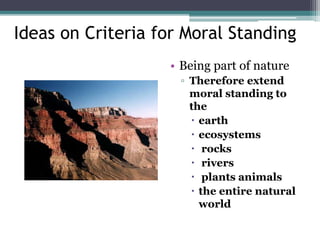
Ideas on Criteria for Moral Standing
• Being part of nature
▫ Therefore extend
moral standing to
the
 earth
 ecosystems
 rocks
 rivers
 plants animals
 the entire natural
world
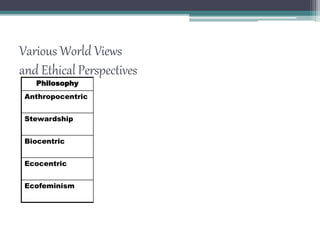
Various World Views
and Ethical Perspectives
Philosophy
Anthropocentric
Stewardship
Biocentric
Ecocentric
Ecofeminism
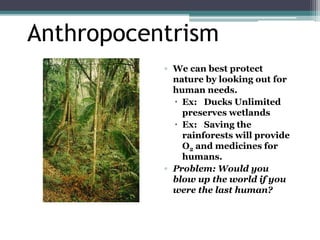
Anthropocentrism
▫ We can best protect
nature by looking out for
human needs.
 Ex: Ducks Unlimited
preserves wetlands
 Ex: Saving the
rainforests will provide
O2 and medicines for
humans.
▫ Problem: Would you
blow up the world if you
were the last human?
MAN AS STEWARD
A sense of responsibility to manage
and care for the environment
Stewardship
Stewardship = Moral Responsibility
Moral responsibility is nothing more
than our capacity to be human and
being able to take care of
everything around us.
Stewardship
Four Criteria of Moral
Responsibility
• The person has knowledge of the
consequences of the act.
• The person has the capacity to do the
act.
• The person has the choice to do it.
Man has moral responsibility towards
nature
• We know that we can cause permanent
damage to natural landscapes, resources and
ecosystems
• We know that we can cause them
• We know how we can prevent or remedy
them
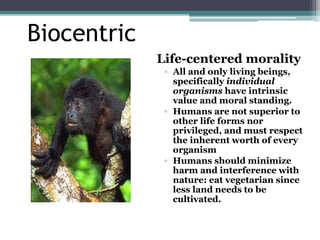
Biocentric
Life-centered morality
▫ All and only living beings,
specifically individual
organisms have intrinsic
value and moral standing.
▫ Humans are not superior to
other life forms nor
privileged, and must respect
the inherent worth of every
organism
▫ Humans should minimize
harm and interference with
nature: eat vegetarian since
less land needs to be
cultivated.
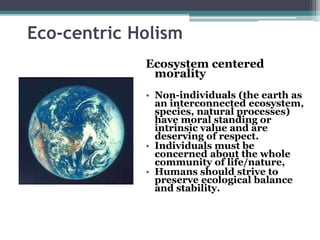
Eco-centric Holism
Ecosystem centered
morality
• Non-individuals (the earth as
an interconnected ecosystem,
species, natural processes)
have moral standing or
intrinsic value and are
deserving of respect.
• Individuals must be
concerned about the whole
community of life/nature,
• Humans should strive to
preserve ecological balance
and stability.
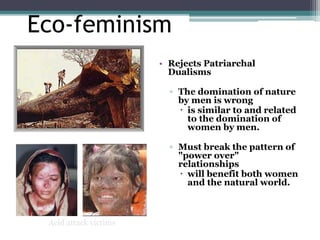
Eco-feminism
• Rejects Patriarchal
Dualisms
▫ The domination of nature
by men is wrong
 is similar to and related
to the domination of
women by men.
▫ Must break the pattern of
"power over"
relationships
 will benefit both women
and the natural world.
Acid attack victims
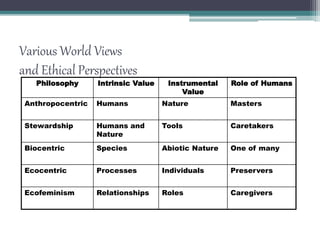
Various World Views
and Ethical Perspectives
Philosophy Intrinsic Value Instrumental
Value
Role of Humans
Anthropocentric Humans Nature Masters
Stewardship Humans and
Nature
Tools Caretakers
Biocentric Species Abiotic Nature One of many
Ecocentric Processes Individuals Preservers
Ecofeminism Relationships Roles Caregivers
Knowing all these exacts a moral
obligation to act with care,
foresight, forbearance and
constraint.
"The care of the Earth is our most ancient
and most worthy, and after all our most
pleasing responsibility. To cherish what
remains of it and to foster its renewal is
our only hope." ~ Wendell Berry
^_^

Environmental Ethics

  • 1.
    Environmental Ethics Prepared by:Eloisa A. Rivera Professor: Dr. Wilfred Cabuatan
  • 2.
    What is EnvironmentalEthics? -the moral relationship of human beings to and the value and moral status of the environment and its nonhuman content. -Study of the ethical basis of environment or discussion of the ethical basis of environmental protection.
  • 3.
    Why need tostudy Environmental Ethics? To overcome the following questions. 1. What are the environment damage produce by the present generation? 2. What acts must be give up to slow such damage?
  • 4.
    Environmental Damage 1) Pollution: •Air pollution • Water pollution • Land pollution 2) Resource depletion: • Depletion of Species & Habits • Depletion of Fossil fuels etc..
  • 5.
    Environmental Ethics Principles Weshould have profound respect for nature. We must maintain a harmonious relation with other species. Everyone should take responsibility for this impact on nature.
  • 6.
    Environmental Ethics Principles Local& indigenous environmental knowledge should be respected. We must plan for the long term.
  • 7.
    The Ethical Valuesfor Pollution Control  We should recognize our moral duty to protect the welfare not only human beings, but also of other non- human parts of this system. Usefulness of non-human world for human purposes.
  • 8.
    The Ethical Valuesfor Pollution Control Humans have no rights to reduce this richness & diversity expect to satisfy vital needs. The ideological changes is mainly that of appreciating life quality, rather than to increase higher standard of living.
  • 9.
    Ethical Values forConserving depletable resources Proper utilisation of resources i.e. the people should maintain Ecological balance. We should adopt voluntary measures to conserve the resources.
  • 10.
    Ethical Values forConserving depletable resources If we are to preserve enough scarce resources, so that future generation can maintain their quality of life at a satisfactory level.
  • 11.
  • 12.
    Definitions • Moral Agents ▫Those who have the freedom and rational capacity to be responsible for choices ▫ Those capable of moral reflection and decision. ▫ Example: adult humans of sound mind  Infants and mentally infirm adults are NOT moral agents
  • 13.
    Definitions • MoralStanding: ▫ If you have moral standing:  Your continued existence or welfare is valuable in itself (intrinsic value)  Your interests and well- being must be weighed when deciding what is permissible to do. ▫ Example: humans of all kinds  Babies, children, adults, old people, etc.  Women, different races, different cultures
  • 14.
    Definitions • Moral Duties ▫That which is owed by moral agents to those with moral standing. ▫ Example: It is wrong to kill our children because we have a moral duty toward them
  • 15.
    Philosophical Issue • Whoor what has moral standing, and why? ▫ Does the environment have moral standing? ▫ Must look at criteria for moral standing • What moral duty do we (moral agents) have toward those with moral standing? ▫ Different ethical positions suggest different moral duties.
  • 16.
    Ideas on Criteriafor Moral Standing • the ability to feel pain ▫ Therefore extend moral standing to animals
  • 17.
    Ideas on Criteriafor Moral Standing • Being alive ▫ Therefore extend moral standing to animals and plants: ▫ All living things.
  • 18.
    Ideas on Criteriafor Moral Standing • Being part of nature ▫ Therefore extend moral standing to the  earth  ecosystems  rocks  rivers  plants animals  the entire natural world
  • 19.
    Various World Views andEthical Perspectives Philosophy Anthropocentric Stewardship Biocentric Ecocentric Ecofeminism
  • 20.
    Anthropocentrism ▫ We canbest protect nature by looking out for human needs.  Ex: Ducks Unlimited preserves wetlands  Ex: Saving the rainforests will provide O2 and medicines for humans. ▫ Problem: Would you blow up the world if you were the last human?
  • 21.
    MAN AS STEWARD Asense of responsibility to manage and care for the environment Stewardship
  • 22.
    Stewardship = MoralResponsibility Moral responsibility is nothing more than our capacity to be human and being able to take care of everything around us.
  • 23.
    Stewardship Four Criteria ofMoral Responsibility • The person has knowledge of the consequences of the act. • The person has the capacity to do the act. • The person has the choice to do it.
  • 24.
    Man has moralresponsibility towards nature • We know that we can cause permanent damage to natural landscapes, resources and ecosystems • We know that we can cause them • We know how we can prevent or remedy them
  • 25.
    Biocentric Life-centered morality ▫ Alland only living beings, specifically individual organisms have intrinsic value and moral standing. ▫ Humans are not superior to other life forms nor privileged, and must respect the inherent worth of every organism ▫ Humans should minimize harm and interference with nature: eat vegetarian since less land needs to be cultivated.
  • 26.
    Eco-centric Holism Ecosystem centered morality •Non-individuals (the earth as an interconnected ecosystem, species, natural processes) have moral standing or intrinsic value and are deserving of respect. • Individuals must be concerned about the whole community of life/nature, • Humans should strive to preserve ecological balance and stability.
  • 27.
    Eco-feminism • Rejects Patriarchal Dualisms ▫The domination of nature by men is wrong  is similar to and related to the domination of women by men. ▫ Must break the pattern of "power over" relationships  will benefit both women and the natural world. Acid attack victims
  • 28.
    Various World Views andEthical Perspectives Philosophy Intrinsic Value Instrumental Value Role of Humans Anthropocentric Humans Nature Masters Stewardship Humans and Nature Tools Caretakers Biocentric Species Abiotic Nature One of many Ecocentric Processes Individuals Preservers Ecofeminism Relationships Roles Caregivers
  • 29.
    Knowing all theseexacts a moral obligation to act with care, foresight, forbearance and constraint.
  • 30.
    "The care ofthe Earth is our most ancient and most worthy, and after all our most pleasing responsibility. To cherish what remains of it and to foster its renewal is our only hope." ~ Wendell Berry ^_^