Bahauddin Zakariya University Lahore Campus
Department of Bs Biotechnology
Submitted to:
Miss MahwishBatoolKazmi
Submitted by:
Rizwan Abbas
BsBT-13-F-05
Assignment of Environmental Biology
Topic:
Environmental Ethics
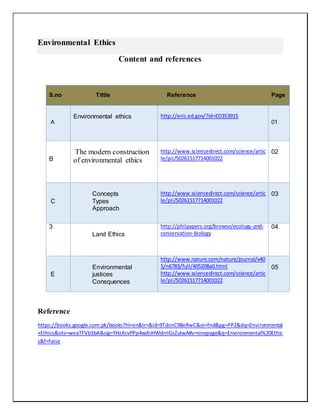
Content and references
S.no Tittle Reference Page
A
Environmental ethics http://eric.ed.gov/?id=ED353915
01
B
The modern construction
of environmental ethics
http://www.sciencedirect.com/science/artic
le/pii/S0261517714001022
02
C
Concepts
Types
Approach
http://www.sciencedirect.com/science/artic
le/pii/S0261517714001022
03
3
Land Ethics
http://philpapers.org/browse/ecology-and-
conservation-biology
04
E
Environmental
justices
Consquences
http://www.nature.com/nature/journal/v40
5/n6783/full/405208a0.html
http://www.sciencedirect.com/science/artic
le/pii/S0261517714001022
05
Reference
https://books.google.com.pk/books?hl=en&lr=&id=9TdcnC98eRwC&oi=fnd&pg=PP2&dq=Environmental
+Ethics&ots=weaTFVbSbA&sig=YHzXcvPPp4wdiiHWdrrIGsZuIwA#v=onepage&q=Environmental%20Ethic
s&f=false
What is environmental ethics?
Environmental ethics is a new sub-discipline of philosophy that deals with the
ethical problems surrounding environmental protection. It aims to provide ethical
justification and moral motivation for the cause of global environmental protection.
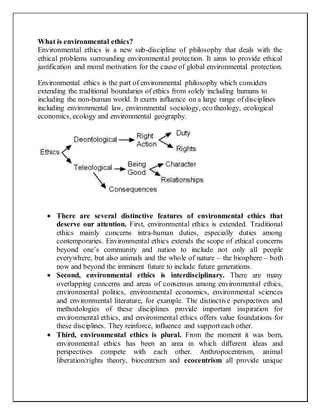
Environmental ethics is the part of environmental philosophy which considers
extending the traditional boundaries of ethics from solely including humans to
including the non-human world. It exerts influence on a large range of disciplines
including environmental law, environmental sociology, eco theology, ecological
economics, ecology and environmental geography.
 There are several distinctive features of environmental ethics that
deserve our attention. First, environmental ethics is extended. Traditional
ethics mainly concerns intra-human duties, especially duties among
contemporaries. Environmental ethics extends the scope of ethical concerns
beyond one’s community and nation to include not only all people
everywhere, but also animals and the whole of nature – the biosphere – both
now and beyond the imminent future to include future generations.
 Second, environmental ethics is interdisciplinary. There are many
overlapping concerns and areas of consensus among environmental ethics,
environmental politics, environmental economics, environmental sciences
and environmental literature, for example. The distinctive perspectives and
methodologies of these disciplines provide important inspiration for
environmental ethics, and environmental ethics offers value foundations for
these disciplines. They reinforce, influence and supporteach other.
 Third, environmental ethics is plural. From the moment it was born,
environmental ethics has been an area in which different ideas and
perspectives compete with each other. Anthropocentrism, animal
liberation/rights theory, biocentrism and ecocentrism all provide unique
and, in some sense, reasonable ethical justifications for environmental
protection.
 Fourth, environmental ethics is global. Ecological crisis is a global issue.
Environmental pollution does not respect national boundaries. To cope with
the global environmental crisis, human beings must reach some value
consensus and cooperate with each other at the personal, national, regional,
multi national and global levels. Global environmental protection depends
on global governance. An environmental ethic is, therefore, typically a
global ethic with a global perspective.
 Fifth, environmental ethics is revolutionary. At the level of ideas,
environmental ethics challenges the dominant and deep-rooted
anthropocentrism of modern mainstream ethics and extends the object of our
duty to future generations and non-human beings. It searches for an
economic arrangement that is sensitive to Earth’s limits and to concerns for
quality of life.
 In short, as the theoretical representation of a newly emerging moral idea
and value orientation, environmental ethics is the fullest extension of human
ethics. It calls on us to think and act locally as well as globally. It calls for a
new, deeper moral consciousness.
The modern constructionof environmental ethics
The 1960s and 1970s witnessed an ecological crisis brought about by industrial
civilization. This crisis was composed of environmental pollution (such as air
pollution, water pollution, soil pollution, toxic chemical pollution, solid waste
pollution), resource shortages (such as shortages of energy, cultivated land,
minerals and fresh water) and ecological imbalances (such as the rapid decrease of
forest and biodiversity, the rapid growth of population and the desertification of
land the world over).
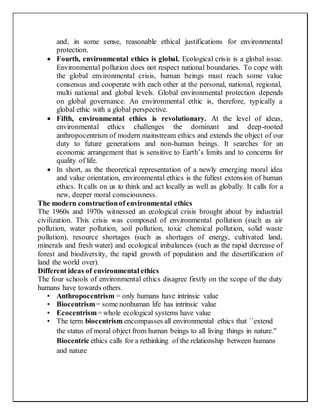
Different ideas of environmental ethics
The four schools of environmental ethics disagree firstly on the scope of the duty
humans have towards others.
• Anthropocentrism = only humans have intrinsic value
• Biocentrism= some nonhuman life has intrinsic value
• Ecocentrism= whole ecological systems have value
• The term biocentrism encompasses all environmental ethics that ``extend
the status of moral object from human beings to all living things in nature.''
Biocentric ethics calls for a rethinking of the relationship between humans
and nature
There are many ethical decisions that human beings make with respect to the
environment. Forexample:
• Should we continue to clear cut forests for the sake of human consumption?
• Why should we continue to propagate our species, and life itself?
• Should we continue to make gasoline powered vehicles?
• What environmental obligations do we need to keep for future generations?
• Is it right for humans to knowingly cause the extinction of a species for the
convenience of humanity?
• How should we best use and conserve the space environment to secure and
expand life?
• Approaches to environmental ethics Different schools of environmental
ethics use different ethical methodologies. Anthropocentrism directly
applies modern, dominant, Western ethics to environmental ethical issues. It
typically justifies its ethical norms in terms of utilitarianism and deontology.
Ecosystems:The Land Ethic
Aldo Leopold, a forester-ecologist and prophet of environmental ethics, claimed,
famously: 'A thing is right when it tends to preserve the integrity, stability, and
beauty of the biotic community. It is wrong when it tends otherwise.' 'That land is a
community is the basic concept of ecology, but that land is to be loved and
respected is an extension of ethics' . The appropriate unit for moral concern is the
fundamental unit of development and survival. That, we were just saying, is
species lines. But a species is what it is where it is, encircled by ecology.
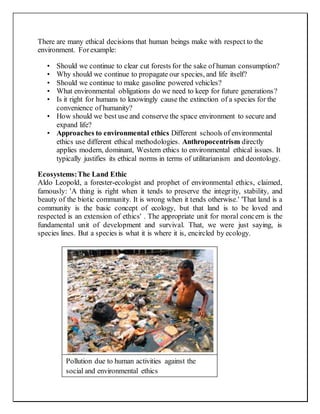
Pollution due to human activities against the
social and environmental ethics
People on Landscapes Environmental Policyand Managing Nature
Environmental ethics has to be directed to human dominated, managed, disturbed
(and often degraded) landscapes, Such a land ethic must be informed about
ecosystem health, but more focused on human ecology, on political ecology.
Government and business are large influences in our lives; both have vast amounts
of power to affect the environment for good or ill. Social systems make humans
behave as they do toward their environment, and any effective reformation will
have to be worked out in reformed, more environmentally sensitive social
institutions. Environmental ethics cannot be an ecosystem ethic pure and simple;
there is only an ethic about humans relating to their ecosystems, in the economies
in which they live.
Environmental ethics must be corporate; action must be taken in concert: green
politics, green business, The natural environment is crucially a 'commons', a public
good. Policies will need to relate such a commons to capitalism, ownership of the
means of production, market forces, the concerns of labour, real estate
development policies, propertyrights of individuals, population control,
Consensus regarding environmental ethics
Though there are many debates about the philosophical foundations of
environmental ethics, we can find much consensus at normative and practical
levels among environmental ethicists (Yang, 2000).
Three normative principles of environmental ethics
(1) Principles of environmental justice
Environmental justice is the minimum ethical stance of environmental ethics.
There are two dimensions to environmental justice. Distributive environmental
justice concerns the equal distribution of environmental benefits and burdens,
whereas participatory environmental justice focuses on opportunities to participate
in decision-making. While domestic environmental justice is easily understood and
accepted, the institutionalizing of global (international) environmental justice
remains a challenge to global society.
(2) Principle of intergenerationalequality
The principle of intergenerational equality is an extension of that of equality. Equal
rights constitute the core of the principle of equality. The rights to life, liberty and
happiness are basic human rights shared by everyone, future generations as well as
the present generation. Every generation should leave the following generation an
equal opportunity to live a happy life.
(3) Principle of respect for nature
Though they may come from different perspectives, most environmental ethicists
agree that we have a duty to conserve and protect the integrity of the ecosystem
and its biodiversity. No one doubts that the prosperity of human beings depends on
the prosperity of nature.
Establishing a committee on environmental ethics
A World Committee on Environmental Ethics needs to be established at UNESCO,
with UNESCO Member States setting up individual National Committees on
Environmental Ethics to evaluate major policies and projects that could have a
great impact on the environment. The membership of the National Committees
should include scholars, professors, teachers, officers, citizens, indigenous people
and representatives of environmental NGOs. The National Committee could
operate either as an independent NGO or as a sub-institution of the country’s
environmental protection agency.
Principles of Environmental Justice:
1. Environmental justice affirms the sacredness of Mother Earth, ecological unity
and the interdependence of all species.
2. Environmental justice demands that public policy be based on mutual respect
and justice for all peoples, free from any form of discrimination or bias.
3. Environmental justice mandates the right to ethical, balanced and responsible
uses of land and renewable resources in the interest of a sustainable planet for
humans and other living things.
4. Environmental justice calls for universal protection from nuclear testing,
extraction, production and disposal of toxic/hazardous wastes and poisons that
threaten the fundamental right to clean air, land, water and food.
5. Environmental justice affirms the fundamental right to political, economic,
cultural and environmental self-determination to all peoples.
6. Environmental justice demands the cessation of the production of all toxins,
hazardous wastes, and radioactive materials
7. Environmental justice demands the right to participate as equal partners at every
level of decision-making including needs assessment, planning, implementation,
enforcement and evaluation.
8. Environmental justice affirms the right of all workers to a safe and healthy work
environment.
9. Environmental justice protects the right of victims of environmental injustice to
receive full compensation and reparations for damages as well as quality health
care.
10. Environmental justice considers governmental acts of environmental injustice a
violation of international law, the Universal Declaration on Human Rights, and the
United Nations Convention on Genocide.
The End

Environmental ethics

  • 1.
    Bahauddin Zakariya UniversityLahore Campus Department of Bs Biotechnology Submitted to: Miss MahwishBatoolKazmi Submitted by: Rizwan Abbas BsBT-13-F-05 Assignment of Environmental Biology Topic: Environmental Ethics
  • 2.
    Environmental Ethics Content andreferences S.no Tittle Reference Page A Environmental ethics http://eric.ed.gov/?id=ED353915 01 B The modern construction of environmental ethics http://www.sciencedirect.com/science/artic le/pii/S0261517714001022 02 C Concepts Types Approach http://www.sciencedirect.com/science/artic le/pii/S0261517714001022 03 3 Land Ethics http://philpapers.org/browse/ecology-and- conservation-biology 04 E Environmental justices Consquences http://www.nature.com/nature/journal/v40 5/n6783/full/405208a0.html http://www.sciencedirect.com/science/artic le/pii/S0261517714001022 05 Reference https://books.google.com.pk/books?hl=en&lr=&id=9TdcnC98eRwC&oi=fnd&pg=PP2&dq=Environmental +Ethics&ots=weaTFVbSbA&sig=YHzXcvPPp4wdiiHWdrrIGsZuIwA#v=onepage&q=Environmental%20Ethic s&f=false
  • 3.
    What is environmentalethics? Environmental ethics is a new sub-discipline of philosophy that deals with the ethical problems surrounding environmental protection. It aims to provide ethical justification and moral motivation for the cause of global environmental protection. Environmental ethics is the part of environmental philosophy which considers extending the traditional boundaries of ethics from solely including humans to including the non-human world. It exerts influence on a large range of disciplines including environmental law, environmental sociology, eco theology, ecological economics, ecology and environmental geography.  There are several distinctive features of environmental ethics that deserve our attention. First, environmental ethics is extended. Traditional ethics mainly concerns intra-human duties, especially duties among contemporaries. Environmental ethics extends the scope of ethical concerns beyond one’s community and nation to include not only all people everywhere, but also animals and the whole of nature – the biosphere – both now and beyond the imminent future to include future generations.  Second, environmental ethics is interdisciplinary. There are many overlapping concerns and areas of consensus among environmental ethics, environmental politics, environmental economics, environmental sciences and environmental literature, for example. The distinctive perspectives and methodologies of these disciplines provide important inspiration for environmental ethics, and environmental ethics offers value foundations for these disciplines. They reinforce, influence and supporteach other.  Third, environmental ethics is plural. From the moment it was born, environmental ethics has been an area in which different ideas and perspectives compete with each other. Anthropocentrism, animal liberation/rights theory, biocentrism and ecocentrism all provide unique
  • 4.
    and, in somesense, reasonable ethical justifications for environmental protection.  Fourth, environmental ethics is global. Ecological crisis is a global issue. Environmental pollution does not respect national boundaries. To cope with the global environmental crisis, human beings must reach some value consensus and cooperate with each other at the personal, national, regional, multi national and global levels. Global environmental protection depends on global governance. An environmental ethic is, therefore, typically a global ethic with a global perspective.  Fifth, environmental ethics is revolutionary. At the level of ideas, environmental ethics challenges the dominant and deep-rooted anthropocentrism of modern mainstream ethics and extends the object of our duty to future generations and non-human beings. It searches for an economic arrangement that is sensitive to Earth’s limits and to concerns for quality of life.  In short, as the theoretical representation of a newly emerging moral idea and value orientation, environmental ethics is the fullest extension of human ethics. It calls on us to think and act locally as well as globally. It calls for a new, deeper moral consciousness. The modern constructionof environmental ethics The 1960s and 1970s witnessed an ecological crisis brought about by industrial civilization. This crisis was composed of environmental pollution (such as air pollution, water pollution, soil pollution, toxic chemical pollution, solid waste pollution), resource shortages (such as shortages of energy, cultivated land, minerals and fresh water) and ecological imbalances (such as the rapid decrease of forest and biodiversity, the rapid growth of population and the desertification of land the world over). Different ideas of environmental ethics The four schools of environmental ethics disagree firstly on the scope of the duty humans have towards others. • Anthropocentrism = only humans have intrinsic value • Biocentrism= some nonhuman life has intrinsic value • Ecocentrism= whole ecological systems have value • The term biocentrism encompasses all environmental ethics that ``extend the status of moral object from human beings to all living things in nature.'' Biocentric ethics calls for a rethinking of the relationship between humans and nature
  • 5.
    There are manyethical decisions that human beings make with respect to the environment. Forexample: • Should we continue to clear cut forests for the sake of human consumption? • Why should we continue to propagate our species, and life itself? • Should we continue to make gasoline powered vehicles? • What environmental obligations do we need to keep for future generations? • Is it right for humans to knowingly cause the extinction of a species for the convenience of humanity? • How should we best use and conserve the space environment to secure and expand life? • Approaches to environmental ethics Different schools of environmental ethics use different ethical methodologies. Anthropocentrism directly applies modern, dominant, Western ethics to environmental ethical issues. It typically justifies its ethical norms in terms of utilitarianism and deontology. Ecosystems:The Land Ethic Aldo Leopold, a forester-ecologist and prophet of environmental ethics, claimed, famously: 'A thing is right when it tends to preserve the integrity, stability, and beauty of the biotic community. It is wrong when it tends otherwise.' 'That land is a community is the basic concept of ecology, but that land is to be loved and respected is an extension of ethics' . The appropriate unit for moral concern is the fundamental unit of development and survival. That, we were just saying, is species lines. But a species is what it is where it is, encircled by ecology. Pollution due to human activities against the social and environmental ethics
  • 6.
    People on LandscapesEnvironmental Policyand Managing Nature Environmental ethics has to be directed to human dominated, managed, disturbed (and often degraded) landscapes, Such a land ethic must be informed about ecosystem health, but more focused on human ecology, on political ecology. Government and business are large influences in our lives; both have vast amounts of power to affect the environment for good or ill. Social systems make humans behave as they do toward their environment, and any effective reformation will have to be worked out in reformed, more environmentally sensitive social institutions. Environmental ethics cannot be an ecosystem ethic pure and simple; there is only an ethic about humans relating to their ecosystems, in the economies in which they live. Environmental ethics must be corporate; action must be taken in concert: green politics, green business, The natural environment is crucially a 'commons', a public good. Policies will need to relate such a commons to capitalism, ownership of the means of production, market forces, the concerns of labour, real estate development policies, propertyrights of individuals, population control, Consensus regarding environmental ethics Though there are many debates about the philosophical foundations of environmental ethics, we can find much consensus at normative and practical levels among environmental ethicists (Yang, 2000). Three normative principles of environmental ethics (1) Principles of environmental justice Environmental justice is the minimum ethical stance of environmental ethics. There are two dimensions to environmental justice. Distributive environmental justice concerns the equal distribution of environmental benefits and burdens, whereas participatory environmental justice focuses on opportunities to participate in decision-making. While domestic environmental justice is easily understood and accepted, the institutionalizing of global (international) environmental justice remains a challenge to global society. (2) Principle of intergenerationalequality The principle of intergenerational equality is an extension of that of equality. Equal rights constitute the core of the principle of equality. The rights to life, liberty and happiness are basic human rights shared by everyone, future generations as well as the present generation. Every generation should leave the following generation an equal opportunity to live a happy life. (3) Principle of respect for nature Though they may come from different perspectives, most environmental ethicists agree that we have a duty to conserve and protect the integrity of the ecosystem and its biodiversity. No one doubts that the prosperity of human beings depends on the prosperity of nature.
  • 7.
    Establishing a committeeon environmental ethics A World Committee on Environmental Ethics needs to be established at UNESCO, with UNESCO Member States setting up individual National Committees on Environmental Ethics to evaluate major policies and projects that could have a great impact on the environment. The membership of the National Committees should include scholars, professors, teachers, officers, citizens, indigenous people and representatives of environmental NGOs. The National Committee could operate either as an independent NGO or as a sub-institution of the country’s environmental protection agency. Principles of Environmental Justice: 1. Environmental justice affirms the sacredness of Mother Earth, ecological unity and the interdependence of all species. 2. Environmental justice demands that public policy be based on mutual respect and justice for all peoples, free from any form of discrimination or bias. 3. Environmental justice mandates the right to ethical, balanced and responsible uses of land and renewable resources in the interest of a sustainable planet for humans and other living things. 4. Environmental justice calls for universal protection from nuclear testing, extraction, production and disposal of toxic/hazardous wastes and poisons that threaten the fundamental right to clean air, land, water and food. 5. Environmental justice affirms the fundamental right to political, economic, cultural and environmental self-determination to all peoples. 6. Environmental justice demands the cessation of the production of all toxins, hazardous wastes, and radioactive materials 7. Environmental justice demands the right to participate as equal partners at every level of decision-making including needs assessment, planning, implementation, enforcement and evaluation. 8. Environmental justice affirms the right of all workers to a safe and healthy work environment. 9. Environmental justice protects the right of victims of environmental injustice to receive full compensation and reparations for damages as well as quality health care. 10. Environmental justice considers governmental acts of environmental injustice a violation of international law, the Universal Declaration on Human Rights, and the United Nations Convention on Genocide. The End