ENVIRONMENTAL ETHICS:
ISSUES AND POSSIBLE SOLLUTIONS
VETERINARY COLLEGEANDRESEARCH
INSTITUTENAMAKKAL.
BY
RAVI MOHAN SHUKLA,
BVN14055.
TAMILNADU VETERINARY ANDANIMALSCIENCES UNIVERSITY
What is Environmental Science?
 The Environment is everything around us. It
includes all the living and none living things we interact
with.
Environmental Science is an interdisciplinary study
of how humans interact with things. It involves
natural sciences (chemistry, biology, ecology,
geology, physics)
 social sciences (geography, economics, political
science, anthropology, and demography)
humanities (philosophy, and ethics).
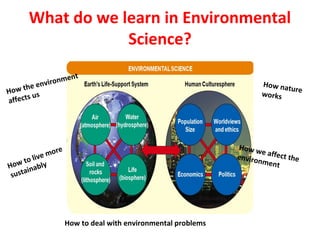
What do we learn in Environmental
Science?
How nature
works
How to deal with environmental problems
How to live more
sustainably
How we affect theenvironment
How the environment
affects us
ENVIRONMENTAL ETHICS
Ethics is a part of philosophy and guide us follow
righteous path which is in the larger interest of the
society as a whole.
Environmental ethics is related
to environmental philosophy
and defines what is right
and wrong at ecological level.
It is more a moral binding
than legal compulsions.
Modern philosophy on environmental
ethics has evolved in the second half of
twentieth century.
Population explosion, environmental
degradation, resource crisis etc problems drew
the attention towards the environmental
concerns.
However, it also raised some challenges
while deciding environmental ethics in
contemporary situation.
•Disparity among society, nations and region;
basic right to procure the resources for daily
livelihood; right to access to resources etc were
the key challenges in designing environmental
ethics.
• This has led to different views on
environmental ethics. And this also led to
formulation of different as led to different
approaches on environmental ethics.
Individuals Matter: Aldo Leopold’s
Environmental Ethics
•Humans should protect nature, not conquer
it
•Helped found U.S. Wilderness Society
– Leader of conservation/environmental movements
•“A thing is right when it tends to preserve
the integrity, stability, and beauty of the biotic
community. It is wrong when it tends
otherwise.”
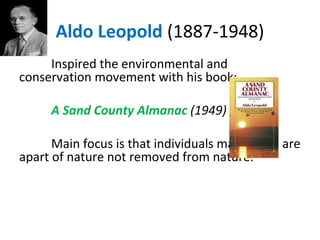
Aldo Leopold (1887-1948)
Inspired the environmental and
conservation movement with his book:
A Sand County Almanac (1949)
Main focus is that individuals matter and are
apart of nature not removed from nature.
THREE VIEWS ON
ENVIRONMENTAL ETHICS
1.LIBERTARIAN VIEW
2.ECOLOGICAL VIEW
3.CONSERVATION VIEW
1)LIBERTARIAN VIEW:
This view is correlated to the principle of
civil liberty. As civil liberty follows the commitment to equal
rights to every member of community, development of an ethics
to deal with men‘s relationship with land animal and plant is
absolutely essential. Social conscience from people to land and
nature is equally inevitable. It is not right to see the natural
world simply in the terms of its economic worth to human.
Equal rights or liberty to all human and nonhuman
members in the environment is the principle doctrine of
libertarian view.
2) ECOLOGICAL VIEW
•Ecological view demonstrates ecological
functioning.
•On ethical ground, it is believed that earth has its
own mechanism for functioning, growth and
development.
•Nature has its own purification processes and
recovery systems of life even in most adverse condition.
Moreover it is believed that whenever
the climatic change had taken place, it took
place within a very narrow range of region to
enable the life to recover before it gets totally
destroyed.
 This theory is in contrast to Darwinian
idea of survival of the fittest. In support of this
view, ecologist argue that there are many types
of algae that are resistance to ultraviolet
radiation,and life would continue and new life
would evolve even if the ultraviolet Radiation
posses the threat to the life on the earth.
3) CONSERVATION ETHIC
 Conservation ethic‘ is an extension of
instrumental value to the natural environment.
 It focuses only on the work of environment in
the terms of its utility and usefulness to humans
Conservation is the oldest form of ethic that lead to
creation of national parks, wildlife sanctuaries,
responsible use of non-renewable energy sources,
water conservation efforts.
Conservation is therefore a means to an end and
purely concerned with mankind and his future
generations.
 Most of the international treaties are outline as
consequences of this ethics.
URBAN & RURAL EQUITY
PROBLEM
One individual in urban area uses several folds of
natural resources compared to that of his counterpart in
rural area has access to.
An equitable sharing of resources is real basis of
sustainable development for the urban, rural & tribal
communities.
The problem of environmental degradation has its
roots in excessive consumption rates of the rich in
urban/rural areas. As a result poor become poorer still.
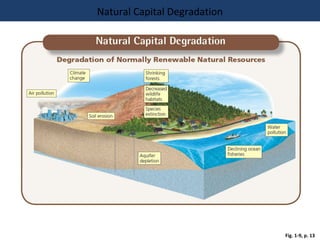
Natural Capital Degradation
Fig. 1-9, p. 13
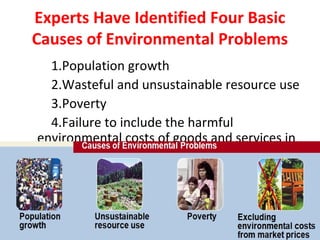
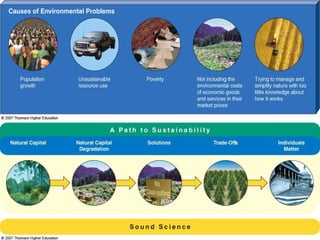
Experts Have Identified Four Basic
Causes of Environmental Problems
1.Population growth
2.Wasteful and unsustainable resource use
3.Poverty
4.Failure to include the harmful
environmental costs of goods and services in
market prices
PRESERVING RESOURCES FOR FUTURE
GENERATION
There are two conditions necessary:
1.Reduction in ecological foot print in the
developed world.
2.To secure satisfactory quality of life for all.
The cities must become less auto based &
more resource dependent. This may need resource
intense life style such as recycling of renewable energy,
low cost housing, co-operative housing and use of public
transport.
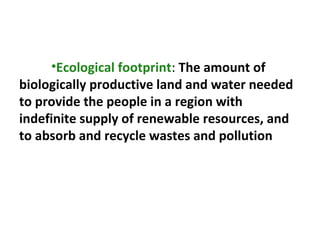
•Ecological footprint: The amount of
biologically productive land and water needed
to provide the people in a region with
indefinite supply of renewable resources, and
to absorb and recycle wastes and pollution
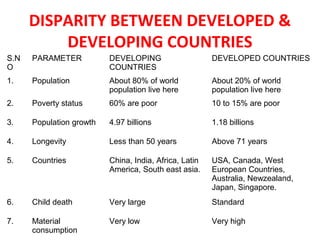
DISPARITY BETWEEN DEVELOPED &
DEVELOPING COUNTRIES
S.N
O
PARAMETER DEVELOPING
COUNTRIES
DEVELOPED COUNTRIES
1. Population About 80% of world
population live here
About 20% of world
population live here
2. Poverty status 60% are poor 10 to 15% are poor
3. Population growth 4.97 billions 1.18 billions
4. Longevity Less than 50 years Above 71 years
5. Countries China, India, Africa, Latin
America, South east asia.
USA, Canada, West
European Countries,
Australia, Newzealand,
Japan, Singapore.
6. Child death Very large Standard
7. Material
consumption
Very low Very high
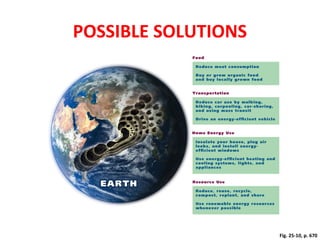
POSSIBLE SOLUTIONS
Fig. 25-10, p. 670
Different Views about Environmental
Problems and Their Solutions
•Environmental ethics: what is right and wrong with how
we treat the environment
•Planetary management worldview
– We are separate from and in charge of nature
•Stewardship worldview
– Manage earth for our benefit with ethical responsibility to be
stewards
•Environmental wisdom worldview
– We are part of nature and must engage in sustainable use
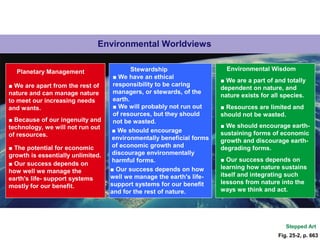
Environmental Worldviews
■ Resources are limited and
should not be wasted.
Environmental Wisdom
■ We are a part of and totally
dependent on nature, and
nature exists for all species.
■ We should encourage earth-
sustaining forms of economic
growth and discourage earth-
degrading forms.
■ Our success depends on
learning how nature sustains
itself and integrating such
lessons from nature into the
ways we think and act.
Stewardship
■ We have an ethical
responsibility to be caring
managers, or stewards, of the
earth.
■ We will probably not run out
of resources, but they should
not be wasted.
■ We should encourage
environmentally beneficial forms
of economic growth and
discourage environmentally
harmful forms.
■ Our success depends on how
well we manage the earth's life-
support systems for our benefit
and for the rest of nature.
Stepped Art
Planetary Management
■ We are apart from the rest of
nature and can manage nature
to meet our increasing needs
and wants.
■ Because of our ingenuity and
technology, we will not run out
of resources.
■ The potential for economic
growth is essentially unlimited.
■ Our success depends on
how well we manage the
earth's life- support systems
mostly for our benefit.
Fig. 25-2, p. 663
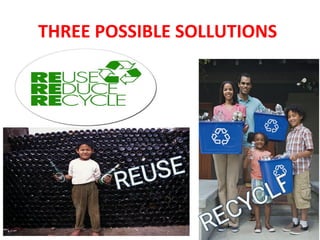
THREE POSSIBLE SOLLUTIONS
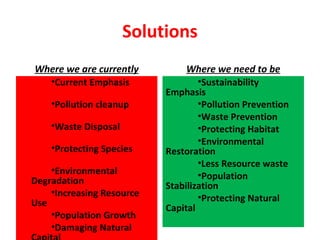
Solutions
Where we are currently
•Current Emphasis
•Pollution cleanup
•Waste Disposal
•Protecting Species
•Environmental
Degradation
•Increasing Resource
Use
•Population Growth
•Damaging Natural
Where we need to be
•Sustainability
Emphasis
•Pollution Prevention
•Waste Prevention
•Protecting Habitat
•Environmental
Restoration
•Less Resource waste
•Population
Stabilization
•Protecting Natural
Capital
Three Big Ideas
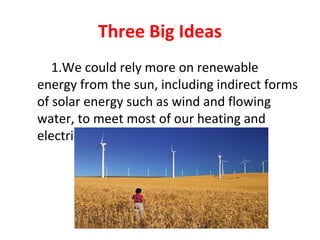
1.We could rely more on renewable
energy from the sun, including indirect forms
of solar energy such as wind and flowing
water, to meet most of our heating and
electricity needs.
Three Big Ideas
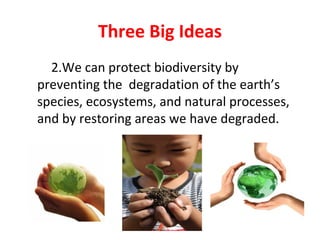
2.We can protect biodiversity by
preventing the degradation of the earth’s
species, ecosystems, and natural processes,
and by restoring areas we have degraded.
Three Big Ideas
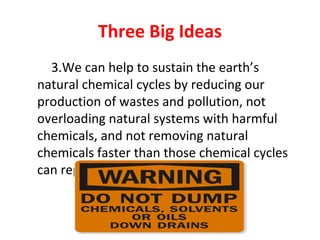
3.We can help to sustain the earth’s
natural chemical cycles by reducing our
production of wastes and pollution, not
overloading natural systems with harmful
chemicals, and not removing natural
chemicals faster than those chemical cycles
can replace them.
We only have one EARTH.
Should we protect it?
You decide.

Environmental ETHICS

  • 1.
    ENVIRONMENTAL ETHICS: ISSUES ANDPOSSIBLE SOLLUTIONS VETERINARY COLLEGEANDRESEARCH INSTITUTENAMAKKAL. BY RAVI MOHAN SHUKLA, BVN14055. TAMILNADU VETERINARY ANDANIMALSCIENCES UNIVERSITY
  • 2.
    What is EnvironmentalScience?  The Environment is everything around us. It includes all the living and none living things we interact with. Environmental Science is an interdisciplinary study of how humans interact with things. It involves natural sciences (chemistry, biology, ecology, geology, physics)  social sciences (geography, economics, political science, anthropology, and demography) humanities (philosophy, and ethics).
  • 3.
    What do welearn in Environmental Science? How nature works How to deal with environmental problems How to live more sustainably How we affect theenvironment How the environment affects us
  • 4.
    ENVIRONMENTAL ETHICS Ethics isa part of philosophy and guide us follow righteous path which is in the larger interest of the society as a whole. Environmental ethics is related to environmental philosophy and defines what is right and wrong at ecological level. It is more a moral binding than legal compulsions.
  • 5.
    Modern philosophy onenvironmental ethics has evolved in the second half of twentieth century. Population explosion, environmental degradation, resource crisis etc problems drew the attention towards the environmental concerns. However, it also raised some challenges while deciding environmental ethics in contemporary situation.
  • 6.
    •Disparity among society,nations and region; basic right to procure the resources for daily livelihood; right to access to resources etc were the key challenges in designing environmental ethics. • This has led to different views on environmental ethics. And this also led to formulation of different as led to different approaches on environmental ethics.
  • 7.
    Individuals Matter: AldoLeopold’s Environmental Ethics •Humans should protect nature, not conquer it •Helped found U.S. Wilderness Society – Leader of conservation/environmental movements •“A thing is right when it tends to preserve the integrity, stability, and beauty of the biotic community. It is wrong when it tends otherwise.”
  • 8.
    Aldo Leopold (1887-1948) Inspiredthe environmental and conservation movement with his book: A Sand County Almanac (1949) Main focus is that individuals matter and are apart of nature not removed from nature.
  • 9.
    THREE VIEWS ON ENVIRONMENTALETHICS 1.LIBERTARIAN VIEW 2.ECOLOGICAL VIEW 3.CONSERVATION VIEW 1)LIBERTARIAN VIEW: This view is correlated to the principle of civil liberty. As civil liberty follows the commitment to equal rights to every member of community, development of an ethics to deal with men‘s relationship with land animal and plant is absolutely essential. Social conscience from people to land and nature is equally inevitable. It is not right to see the natural world simply in the terms of its economic worth to human.
  • 10.
    Equal rights orliberty to all human and nonhuman members in the environment is the principle doctrine of libertarian view. 2) ECOLOGICAL VIEW •Ecological view demonstrates ecological functioning. •On ethical ground, it is believed that earth has its own mechanism for functioning, growth and development. •Nature has its own purification processes and recovery systems of life even in most adverse condition.
  • 11.
    Moreover it isbelieved that whenever the climatic change had taken place, it took place within a very narrow range of region to enable the life to recover before it gets totally destroyed.  This theory is in contrast to Darwinian idea of survival of the fittest. In support of this view, ecologist argue that there are many types of algae that are resistance to ultraviolet radiation,and life would continue and new life would evolve even if the ultraviolet Radiation posses the threat to the life on the earth.
  • 12.
    3) CONSERVATION ETHIC Conservation ethic‘ is an extension of instrumental value to the natural environment.  It focuses only on the work of environment in the terms of its utility and usefulness to humans Conservation is the oldest form of ethic that lead to creation of national parks, wildlife sanctuaries, responsible use of non-renewable energy sources, water conservation efforts. Conservation is therefore a means to an end and purely concerned with mankind and his future generations.  Most of the international treaties are outline as consequences of this ethics.
  • 13.
    URBAN & RURALEQUITY PROBLEM One individual in urban area uses several folds of natural resources compared to that of his counterpart in rural area has access to. An equitable sharing of resources is real basis of sustainable development for the urban, rural & tribal communities. The problem of environmental degradation has its roots in excessive consumption rates of the rich in urban/rural areas. As a result poor become poorer still.
  • 14.
  • 15.
    Experts Have IdentifiedFour Basic Causes of Environmental Problems 1.Population growth 2.Wasteful and unsustainable resource use 3.Poverty 4.Failure to include the harmful environmental costs of goods and services in market prices
  • 17.
    PRESERVING RESOURCES FORFUTURE GENERATION There are two conditions necessary: 1.Reduction in ecological foot print in the developed world. 2.To secure satisfactory quality of life for all. The cities must become less auto based & more resource dependent. This may need resource intense life style such as recycling of renewable energy, low cost housing, co-operative housing and use of public transport.
  • 18.
    •Ecological footprint: Theamount of biologically productive land and water needed to provide the people in a region with indefinite supply of renewable resources, and to absorb and recycle wastes and pollution
  • 20.
    DISPARITY BETWEEN DEVELOPED& DEVELOPING COUNTRIES S.N O PARAMETER DEVELOPING COUNTRIES DEVELOPED COUNTRIES 1. Population About 80% of world population live here About 20% of world population live here 2. Poverty status 60% are poor 10 to 15% are poor 3. Population growth 4.97 billions 1.18 billions 4. Longevity Less than 50 years Above 71 years 5. Countries China, India, Africa, Latin America, South east asia. USA, Canada, West European Countries, Australia, Newzealand, Japan, Singapore. 6. Child death Very large Standard 7. Material consumption Very low Very high
  • 21.
  • 22.
    Different Views aboutEnvironmental Problems and Their Solutions •Environmental ethics: what is right and wrong with how we treat the environment •Planetary management worldview – We are separate from and in charge of nature •Stewardship worldview – Manage earth for our benefit with ethical responsibility to be stewards •Environmental wisdom worldview – We are part of nature and must engage in sustainable use
  • 23.
    Environmental Worldviews ■ Resourcesare limited and should not be wasted. Environmental Wisdom ■ We are a part of and totally dependent on nature, and nature exists for all species. ■ We should encourage earth- sustaining forms of economic growth and discourage earth- degrading forms. ■ Our success depends on learning how nature sustains itself and integrating such lessons from nature into the ways we think and act. Stewardship ■ We have an ethical responsibility to be caring managers, or stewards, of the earth. ■ We will probably not run out of resources, but they should not be wasted. ■ We should encourage environmentally beneficial forms of economic growth and discourage environmentally harmful forms. ■ Our success depends on how well we manage the earth's life- support systems for our benefit and for the rest of nature. Stepped Art Planetary Management ■ We are apart from the rest of nature and can manage nature to meet our increasing needs and wants. ■ Because of our ingenuity and technology, we will not run out of resources. ■ The potential for economic growth is essentially unlimited. ■ Our success depends on how well we manage the earth's life- support systems mostly for our benefit. Fig. 25-2, p. 663
  • 24.
  • 25.
    Solutions Where we arecurrently •Current Emphasis •Pollution cleanup •Waste Disposal •Protecting Species •Environmental Degradation •Increasing Resource Use •Population Growth •Damaging Natural Where we need to be •Sustainability Emphasis •Pollution Prevention •Waste Prevention •Protecting Habitat •Environmental Restoration •Less Resource waste •Population Stabilization •Protecting Natural Capital
  • 26.
    Three Big Ideas 1.Wecould rely more on renewable energy from the sun, including indirect forms of solar energy such as wind and flowing water, to meet most of our heating and electricity needs.
  • 27.
    Three Big Ideas 2.Wecan protect biodiversity by preventing the degradation of the earth’s species, ecosystems, and natural processes, and by restoring areas we have degraded.
  • 28.
    Three Big Ideas 3.Wecan help to sustain the earth’s natural chemical cycles by reducing our production of wastes and pollution, not overloading natural systems with harmful chemicals, and not removing natural chemicals faster than those chemical cycles can replace them.
  • 29.
    We only haveone EARTH. Should we protect it? You decide.

Editor's Notes

  • #15 Figure 1.9: These are examples of the degradation of normally renewable natural resources and services in parts of the world, mostly as a result of rising populations and resource use per person. <number>
  • #16 Figure 1.17: Environmental and social scientists have identified four basic causes of the environmental problems we face (Concept 1-3). Question: For each of these causes, what are two environmental problems that result? <number>
  • #22 Figure 25.10: The sustainability eight is a list of eight ways in which people can live more lightly on the earth (Concept 25-3). Questions: Which of these things do you already do? Which, if any, do you hope to do? <number>
  • #27 Figure 1.24: Capturing wind power is one of the world’s most rapidly growing and least environmentally harmful ways to produce electricity.
  • #28 Figure 1.25: This young child—like the grandchild of Emily and Michael in our fictional scenario of a possible future (Core Case study)—is promoting sustainability by preparing to plant a tree. A global program to plant and tend billions of trees each year will help to restore degraded lands, promote biodiversity, and reduce the threat of climate change from atmospheric warming.