RELATIONSHIP BETWEEN PHYSICAL ENVIRONMENT
Presented by:
Mehwish Soomro
Rizwana Soomro
Ghulam Fatima
Komal Mohammad Moosa
Presented to:
Miss Nargis Shamim
CONTENT
Relation between physical environment
and human behavior
 Man-environment interaction
 Human activities in relationship with environment
 Human activities and their impact on environment
 Human activities, utilization of environmental
recourses and concept of sustainability
INTRODUCTION
 Environment means the surrounding condition
that effect the lifestyle of living things.
 Our surrounding includes natural and manmade
things.
 Human life gates effected by the environment
and hence we find differences in the human life
of different regions.
NATURAL ENVIRONMENT
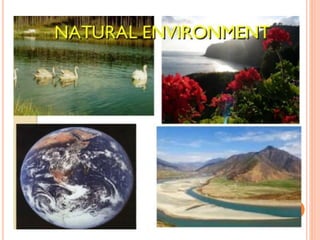
All component which come into existence
naturally are included in natural
environment .
The landforms on the earth , the climate ,
soils , minerals , sunlight etc are
component of our natural environment.
CULTURAL ENVIRONMENT
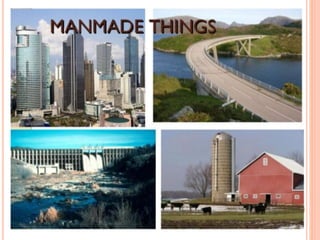
 In order to enrich his life man had used many
natural resources and in this process he has
brought many changes in natural environment .
Human settlements , roads , buildings , dams etc
have developed through this.
INTERACTION IN ENVIRONMENT
 There are many interaction between biotic (living) and a
biotic (non living) components.
 All the biotic component depend on each other.
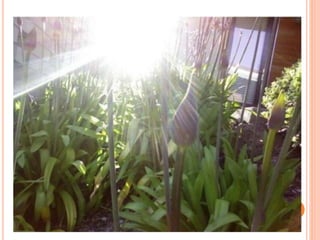
 Plants produce their food using solar energy. That means
there is an interaction between abiotic and biotic
components.
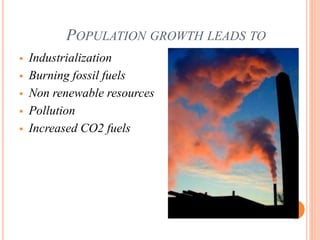
POPULATION GROWTH LEADS TO
 Industrialization
 Burning fossil fuels
 Non renewable resources
 Pollution
 Increased CO2 fuels
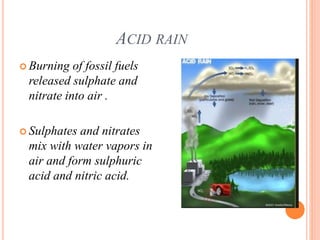
ACID RAIN
 Burning of fossil fuels
released sulphate and
nitrate into air .
 Sulphates and nitrates
mix with water vapors in
air and form sulphuric
acid and nitric acid.
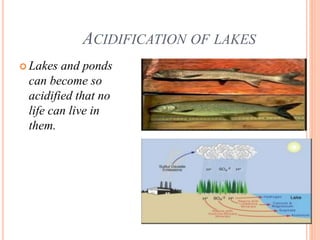
ACIDIFICATION OF LAKES
 Lakes and ponds
can become so
acidified that no
life can live in
them.
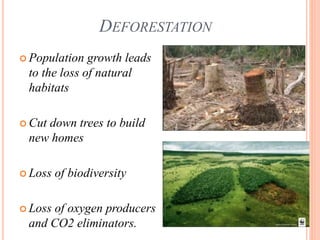
DEFORESTATION
 Population growth leads
to the loss of natural
habitats
 Cut down trees to build
new homes
 Loss of biodiversity
 Loss of oxygen producers
and CO2 eliminators.
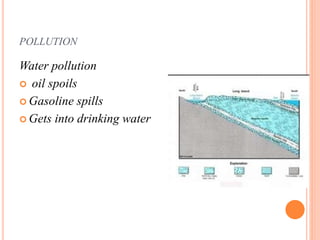
POLLUTION
Water pollution
 oil spoils
 Gasoline spills
 Gets into drinking water
HUMAN ACTIVITIES AND THEIR IMPACT ON
ENVIRONMENT.
Human impact on the environment or
anthropogenic impact on the environment
includes change to biophysical environment and
ecosystem biodiversity and natural resources
caused directly or indirectly by human
THERE ARE MANY CAUSES OF HUMAN
ACTIVITIES AND THEIR IMPACT ON
ENVIRONMENT
 Overpopulation
Pollution
Climate Change
Water Pollution
Deforestation
OVER POPULATION
 Overpopulation has grown into an epidemic,
since morality rates have decreased, medicine has
improved and methods of industrial forming were
introduced. The effects of overpopulation are
quite severe, with one of the most severe being the
degradation of the environment. An increased
population results in more) clear-cutting resulting
in severely damage ecosystem without enough
trees to filter the air , co2 level increases which
easier the potential to damage every single
organism on earth (Human continuously require
more space which devastates ecosystem and
increase co2 level.
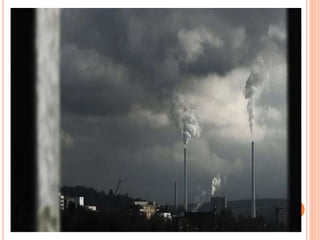
POLLUTION
 (Pollution is everywhere From the trash thrown
out on the freeway ,to the millions of metric tons
of pollution pumped into the atmosphere every
year. It also so bad that to date 2.4 billions
people do not have access to clean water
sources.
CLIMATE CHANGE
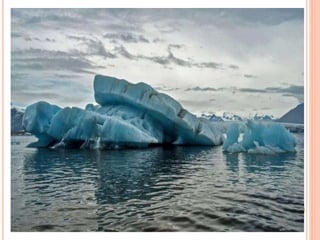
 Climate change is the closely connected to historical
development of industry and technology. As global
temperature increases. Earth weather patterns, will
drastically change. The increase will impact weather
patterns promising more intense hurricanes in both size
and frequency as well as intensifying and prolonging
droughts and heat waves . But air pollution does not just
affect the environment. The evidence is mounting that
poor air quality and rising temperature are running
delicate ecosystem even leading to increased asthma and
cancer rates in human.
WATER POLLUTION
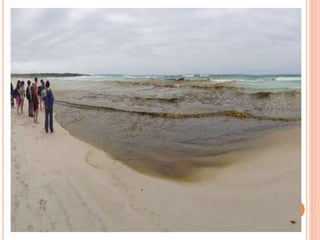
 Every year 8 millions tons of garbage
dumped into the ocean. Not only is garbage
introduce into the ocean but also the
excessive amount of fertilizer that find its way
into the ocean through rain flood , winds or
dumped in excess right into the larges
producer of oxygen we have . Year after year
millions of tons garbage is dumped into the
ocean since the garbage mainly consist of
plastic, it is largely indisoluble. Pollution is
the number one threat to all aquatic life and
is lead cause of reduced biodiversity.
DEFORESTATION
 With an exponential expansion in human beings, more
food,, materials, and shelter are being manufactured at
stupendous rates, mostly stemming from forestry. Forest
are cleared to make way for new humans , which in turns
, makes more humans you can see the problem.
According to international data , an estimated 18 million
areas of trees are clear cut each year to make way for
new development and wood products. So we should have
to stop deforestation Because with trees being one of the
largest producer of oxygen for human, So such human
activities need to stop if we will to survive
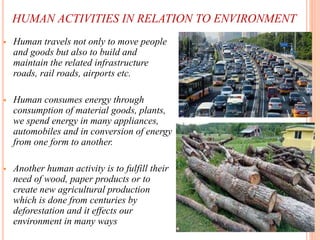
HUMAN ACTIVITIES IN RELATION TO ENVIRONMENT
 Human travels not only to move people
and goods but also to build and
maintain the related infrastructure
roads, rail roads, airports etc.
 Human consumes energy through
consumption of material goods, plants,
we spend energy in many appliances,
automobiles and in conversion of energy
from one form to another.
 Another human activity is to fulfill their
need of wood, paper products or to
create new agricultural production
which is done from centuries by
deforestation and it effects our
environment in many ways
UTILIZATION OF ENVIRONMENTAL RESOURSES
 An environmental resource is any
material service from the environment
that is valuable to society which in turn
humans utilize to fulfill their needs.
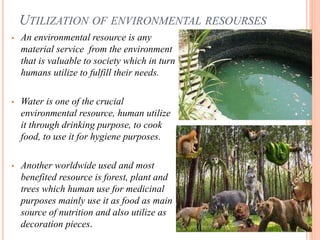
 Water is one of the crucial
environmental resource, human utilize
it through drinking purpose, to cook
food, to use it for hygiene purposes.
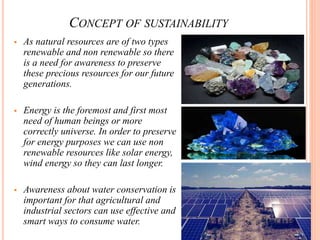
 Another worldwide used and most
benefited resource is forest, plant and
trees which human use for medicinal
purposes mainly use it as food as main
source of nutrition and also utilize as
decoration pieces.
CONCEPT OF SUSTAINABILITY
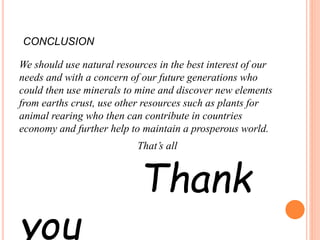
 As natural resources are of two types
renewable and non renewable so there
is a need for awareness to preserve
these precious resources for our future
generations.
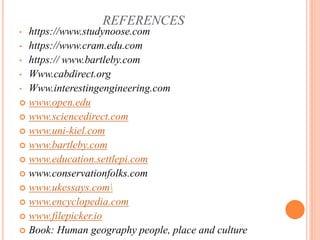
 Energy is the foremost and first most
need of human beings or more
correctly universe. In order to preserve
for energy purposes we can use non
renewable resources like solar energy,
wind energy so they can last longer.
 Awareness about water conservation is
important for that agricultural and
industrial sectors can use effective and
smart ways to consume water.
CONCLUSION
We should use natural resources in the best interest of our
needs and with a concern of our future generations who
could then use minerals to mine and discover new elements
from earths crust, use other resources such as plants for
animal rearing who then can contribute in countries
economy and further help to maintain a prosperous world.
That’s all
Thank
you
REFERENCES
• https://www.studynoose.com
• https://www.cram.edu.com
• https:// www.bartleby.com
• Www.cabdirect.org
• Www.interestingengineering.com
 www.open.edu
 www.sciencedirect.com
 www.uni-kiel.com
 www.bartleby.com
 www.education.settlepi.com
 www.conservationfolks.com
 www.ukessays.com
 www.encyclopedia.com
 www.filepicker.io
 Book: Human geography people, place and culture
Relationship between man and physical environment

Relationship between man and physical environment

  • 1.
    RELATIONSHIP BETWEEN PHYSICALENVIRONMENT Presented by: Mehwish Soomro Rizwana Soomro Ghulam Fatima Komal Mohammad Moosa Presented to: Miss Nargis Shamim
  • 2.
    CONTENT Relation between physicalenvironment and human behavior  Man-environment interaction  Human activities in relationship with environment  Human activities and their impact on environment  Human activities, utilization of environmental recourses and concept of sustainability
  • 3.
    INTRODUCTION  Environment meansthe surrounding condition that effect the lifestyle of living things.  Our surrounding includes natural and manmade things.  Human life gates effected by the environment and hence we find differences in the human life of different regions.
  • 4.
    NATURAL ENVIRONMENT All componentwhich come into existence naturally are included in natural environment . The landforms on the earth , the climate , soils , minerals , sunlight etc are component of our natural environment.
  • 6.
    CULTURAL ENVIRONMENT  Inorder to enrich his life man had used many natural resources and in this process he has brought many changes in natural environment . Human settlements , roads , buildings , dams etc have developed through this.
  • 8.
    INTERACTION IN ENVIRONMENT There are many interaction between biotic (living) and a biotic (non living) components.  All the biotic component depend on each other.  Plants produce their food using solar energy. That means there is an interaction between abiotic and biotic components.
  • 10.
    POPULATION GROWTH LEADSTO  Industrialization  Burning fossil fuels  Non renewable resources  Pollution  Increased CO2 fuels
  • 11.
    ACID RAIN  Burningof fossil fuels released sulphate and nitrate into air .  Sulphates and nitrates mix with water vapors in air and form sulphuric acid and nitric acid.
  • 12.
    ACIDIFICATION OF LAKES Lakes and ponds can become so acidified that no life can live in them.
  • 13.
    DEFORESTATION  Population growthleads to the loss of natural habitats  Cut down trees to build new homes  Loss of biodiversity  Loss of oxygen producers and CO2 eliminators.
  • 14.
    POLLUTION Water pollution  oilspoils  Gasoline spills  Gets into drinking water
  • 15.
    HUMAN ACTIVITIES ANDTHEIR IMPACT ON ENVIRONMENT. Human impact on the environment or anthropogenic impact on the environment includes change to biophysical environment and ecosystem biodiversity and natural resources caused directly or indirectly by human
  • 16.
    THERE ARE MANYCAUSES OF HUMAN ACTIVITIES AND THEIR IMPACT ON ENVIRONMENT  Overpopulation Pollution Climate Change Water Pollution Deforestation
  • 17.
    OVER POPULATION  Overpopulationhas grown into an epidemic, since morality rates have decreased, medicine has improved and methods of industrial forming were introduced. The effects of overpopulation are quite severe, with one of the most severe being the degradation of the environment. An increased population results in more) clear-cutting resulting in severely damage ecosystem without enough trees to filter the air , co2 level increases which easier the potential to damage every single organism on earth (Human continuously require more space which devastates ecosystem and increase co2 level.
  • 18.
    POLLUTION  (Pollution iseverywhere From the trash thrown out on the freeway ,to the millions of metric tons of pollution pumped into the atmosphere every year. It also so bad that to date 2.4 billions people do not have access to clean water sources.
  • 20.
    CLIMATE CHANGE  Climatechange is the closely connected to historical development of industry and technology. As global temperature increases. Earth weather patterns, will drastically change. The increase will impact weather patterns promising more intense hurricanes in both size and frequency as well as intensifying and prolonging droughts and heat waves . But air pollution does not just affect the environment. The evidence is mounting that poor air quality and rising temperature are running delicate ecosystem even leading to increased asthma and cancer rates in human.
  • 22.
    WATER POLLUTION  Everyyear 8 millions tons of garbage dumped into the ocean. Not only is garbage introduce into the ocean but also the excessive amount of fertilizer that find its way into the ocean through rain flood , winds or dumped in excess right into the larges producer of oxygen we have . Year after year millions of tons garbage is dumped into the ocean since the garbage mainly consist of plastic, it is largely indisoluble. Pollution is the number one threat to all aquatic life and is lead cause of reduced biodiversity.
  • 24.
    DEFORESTATION  With anexponential expansion in human beings, more food,, materials, and shelter are being manufactured at stupendous rates, mostly stemming from forestry. Forest are cleared to make way for new humans , which in turns , makes more humans you can see the problem. According to international data , an estimated 18 million areas of trees are clear cut each year to make way for new development and wood products. So we should have to stop deforestation Because with trees being one of the largest producer of oxygen for human, So such human activities need to stop if we will to survive
  • 25.
    HUMAN ACTIVITIES INRELATION TO ENVIRONMENT  Human travels not only to move people and goods but also to build and maintain the related infrastructure roads, rail roads, airports etc.  Human consumes energy through consumption of material goods, plants, we spend energy in many appliances, automobiles and in conversion of energy from one form to another.  Another human activity is to fulfill their need of wood, paper products or to create new agricultural production which is done from centuries by deforestation and it effects our environment in many ways
  • 26.
    UTILIZATION OF ENVIRONMENTALRESOURSES  An environmental resource is any material service from the environment that is valuable to society which in turn humans utilize to fulfill their needs.  Water is one of the crucial environmental resource, human utilize it through drinking purpose, to cook food, to use it for hygiene purposes.  Another worldwide used and most benefited resource is forest, plant and trees which human use for medicinal purposes mainly use it as food as main source of nutrition and also utilize as decoration pieces.
  • 27.
    CONCEPT OF SUSTAINABILITY As natural resources are of two types renewable and non renewable so there is a need for awareness to preserve these precious resources for our future generations.  Energy is the foremost and first most need of human beings or more correctly universe. In order to preserve for energy purposes we can use non renewable resources like solar energy, wind energy so they can last longer.  Awareness about water conservation is important for that agricultural and industrial sectors can use effective and smart ways to consume water.
  • 28.
    CONCLUSION We should usenatural resources in the best interest of our needs and with a concern of our future generations who could then use minerals to mine and discover new elements from earths crust, use other resources such as plants for animal rearing who then can contribute in countries economy and further help to maintain a prosperous world. That’s all Thank you
  • 29.
    REFERENCES • https://www.studynoose.com • https://www.cram.edu.com •https:// www.bartleby.com • Www.cabdirect.org • Www.interestingengineering.com  www.open.edu  www.sciencedirect.com  www.uni-kiel.com  www.bartleby.com  www.education.settlepi.com  www.conservationfolks.com  www.ukessays.com  www.encyclopedia.com  www.filepicker.io  Book: Human geography people, place and culture