Journalism
Journalism is a discipline of collecting,
verifying, reporting and analyzing
information gathered regarding current
events, including trends, issues and people.
Definition of Journalism on the Web
• Writing intended for publication in a newspaper
or magazine, or for broadcast on a radio,
television program or uploading news content on
a news portal featuring news, sports, business,
entertainment or other timely material
- The collection and editing of news for
presentation through the media;
- A style of writing for presenting bare facts to
describe news events;
- Process of collecting, writing, editing, and
publishing news, views etc.
NEWS – Concept and Definition
• “Anything that interests a large part of the community
and has never been brought to its attention before” –
Charles A. Dana, editor of the New York Sun.
• The Concise Oxford Dictionary of Current English
(1990) defines news as “Information about important
or interesting recent events especially when published,
broadcast or uploaded.
• The “News” in general may be defined as “An accurate
and objective account of significant facts of a timely
event or problem, that is of interest to the readers of
the newspapers, which print the account”
News in nut shell
• News is anything out of ordinary
• News is anything which interests a large
number of people
• Good news is not always news
News Values – Factors affecting the
Selection of News
• Timeliness
• Impact
• Prominence
• Proximity
• Conflict
• The Unusual
Types of News
• Hard News
• Soft News
- The “Hard News” usually refers to serious and timely
stories about important topics. The stories may include
a major crime or corruption, diplomatic, legal issues,
accident, labor dispute, political campaign etc. Hard
News is also familiar as “Spot News” or ‘Straight News”
- The term “Soft News” usually refers to feature or
human interest stories. Soft news entertains and
informs, and may appeal to its readers’ emotions.
Elements of News – the 5Ws and 1H
• Who – is involved?
• What – has happened?
• When – did it happen?
• Where – did it occur?
• Why – did it happen?
• How – did it happen?
Structure of a News Story
• A beginning also called Lead or the Intro
• A middle is known as Body or Development
• An end also known as Conclusion
The Chronological Style
- Lead
- Events in Sequence
- Additional Facts
Journalistic Values
• Accuracy and Truth
• Attribution
• Objectivity
• Balance and Fairness
News Organization
• Key Departments
- Editorial
- Printing
- Advertising
- Circulation
- Accounts and HR
Basic Qualities of a Reporter
• Smartness
• Quickness
• Curiosity
• Pleasantness
• Honesty
• Courage
Different forms of Reporters
• Stringers
• Staffers
• Special Correspondents
• Bureau Chiefs
• Foreign Correspondents
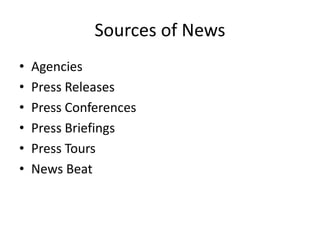
Sources of News
• Agencies
• Press Releases
• Press Conferences
• Press Briefings
• Press Tours
• News Beat

Print comparative ppt

  • 1.
    Journalism Journalism is adiscipline of collecting, verifying, reporting and analyzing information gathered regarding current events, including trends, issues and people.
  • 2.
    Definition of Journalismon the Web • Writing intended for publication in a newspaper or magazine, or for broadcast on a radio, television program or uploading news content on a news portal featuring news, sports, business, entertainment or other timely material - The collection and editing of news for presentation through the media; - A style of writing for presenting bare facts to describe news events; - Process of collecting, writing, editing, and publishing news, views etc.
  • 3.
    NEWS – Conceptand Definition • “Anything that interests a large part of the community and has never been brought to its attention before” – Charles A. Dana, editor of the New York Sun. • The Concise Oxford Dictionary of Current English (1990) defines news as “Information about important or interesting recent events especially when published, broadcast or uploaded. • The “News” in general may be defined as “An accurate and objective account of significant facts of a timely event or problem, that is of interest to the readers of the newspapers, which print the account”
  • 4.
    News in nutshell • News is anything out of ordinary • News is anything which interests a large number of people • Good news is not always news
  • 5.
    News Values –Factors affecting the Selection of News • Timeliness • Impact • Prominence • Proximity • Conflict • The Unusual
  • 6.
    Types of News •Hard News • Soft News - The “Hard News” usually refers to serious and timely stories about important topics. The stories may include a major crime or corruption, diplomatic, legal issues, accident, labor dispute, political campaign etc. Hard News is also familiar as “Spot News” or ‘Straight News” - The term “Soft News” usually refers to feature or human interest stories. Soft news entertains and informs, and may appeal to its readers’ emotions.
  • 7.
    Elements of News– the 5Ws and 1H • Who – is involved? • What – has happened? • When – did it happen? • Where – did it occur? • Why – did it happen? • How – did it happen?
  • 8.
    Structure of aNews Story • A beginning also called Lead or the Intro • A middle is known as Body or Development • An end also known as Conclusion The Chronological Style - Lead - Events in Sequence - Additional Facts
  • 9.
    Journalistic Values • Accuracyand Truth • Attribution • Objectivity • Balance and Fairness
  • 10.
    News Organization • KeyDepartments - Editorial - Printing - Advertising - Circulation - Accounts and HR
  • 11.
    Basic Qualities ofa Reporter • Smartness • Quickness • Curiosity • Pleasantness • Honesty • Courage
  • 12.
    Different forms ofReporters • Stringers • Staffers • Special Correspondents • Bureau Chiefs • Foreign Correspondents
  • 13.
    Sources of News •Agencies • Press Releases • Press Conferences • Press Briefings • Press Tours • News Beat