SEMINAR ON
INTRODUCTION
LAYER OF THE GEOSPHERE
 CRUST
 MANTLE
 CORE
MAJOR DOMAIN’S OF THE EARTH
 LITHOSPHERE
 ATMOSPHERE
 BIOSPHERE
 HYDROSPHERE
CONCLUSIONS
The geosphere is the solid earth, from the SURFACE TO CORE. Geosphere
consists of volcanoes, rocks and minerals. Large quantities of consumer
and industrial wastes have been discarded to the geosphere, a practice
that is ultimately unsustainable.
The geosphere interacts strongly with the hydrosphere, atmosphere
biosphere, and anthrosphere.
The geosphere is obviously a huge part of natural capital and managing
and preserving it is of utmost importance to achieve sustainability the
geosphere consists of an outer solid layer of the composed of rocks that
minerals that make up rocks, soil and sediments.
The geosphere is the densest parts of the world and consists mostly of
rock and regolith.
2. MANTIE (MESOSPHERE )
1.CRUST
3.CORE
(OUTER-CORE, INNER-CORE)
The crust is the thin outermost layer of the geosphere. The crust is
divided into plates that move slowly over earth surface.
The crust is made up of different types of rocks; igneous, metamorphic,
and sedimentary rocks.
The crust is the outer hard layer of the Earth. The crust is a part of the
lithosphere.
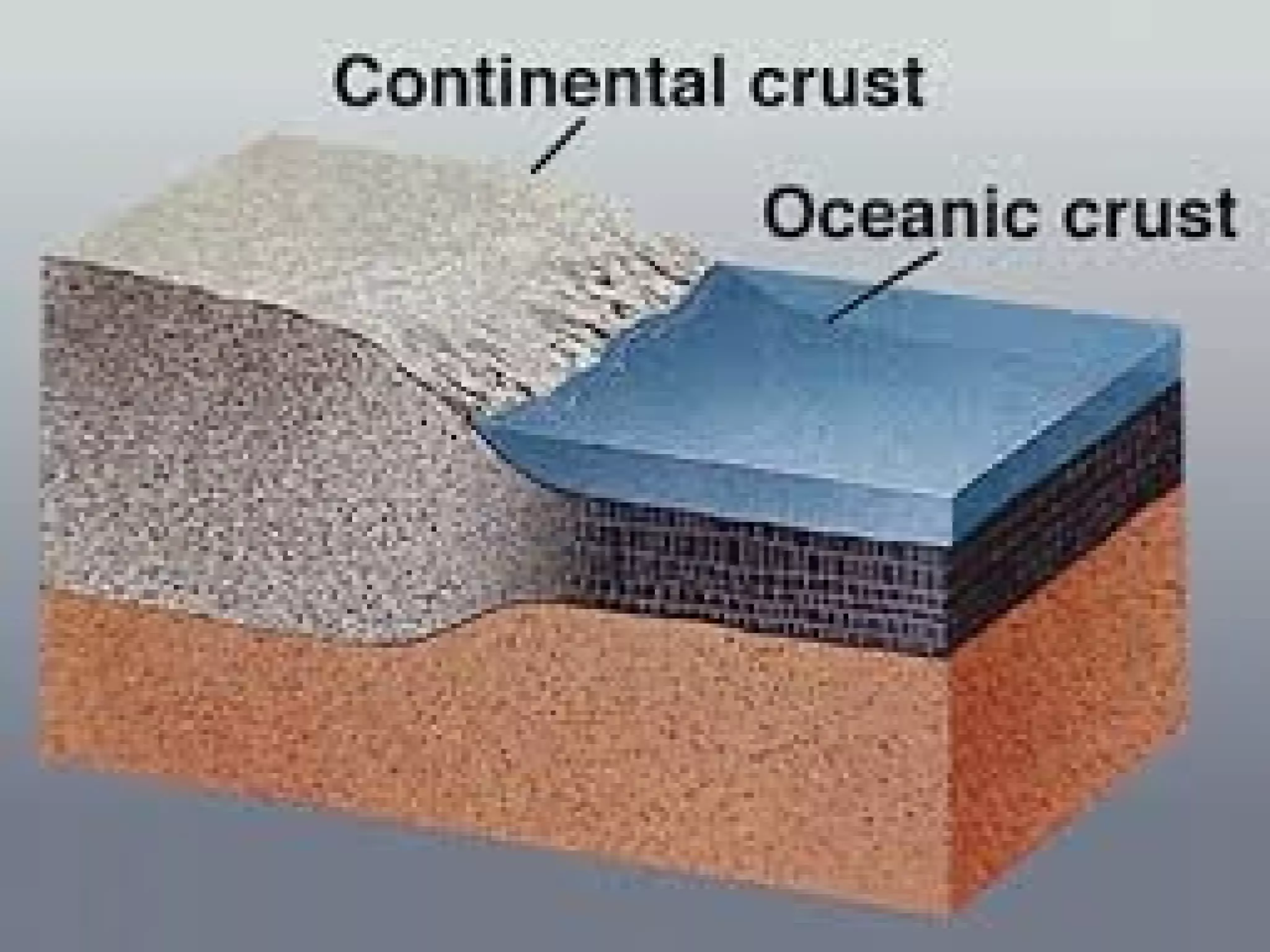
The crust has two different parts. One is the continental crust (under the
land) and the other is oceanic crust (under the ocean). The continental
crust is thicker, and the oceanic crust is thinner. Thicknesses of the crust
can be anywhere from 5–70 km.
The crust and the upper mantle make up the lithosphere.
CRUST:
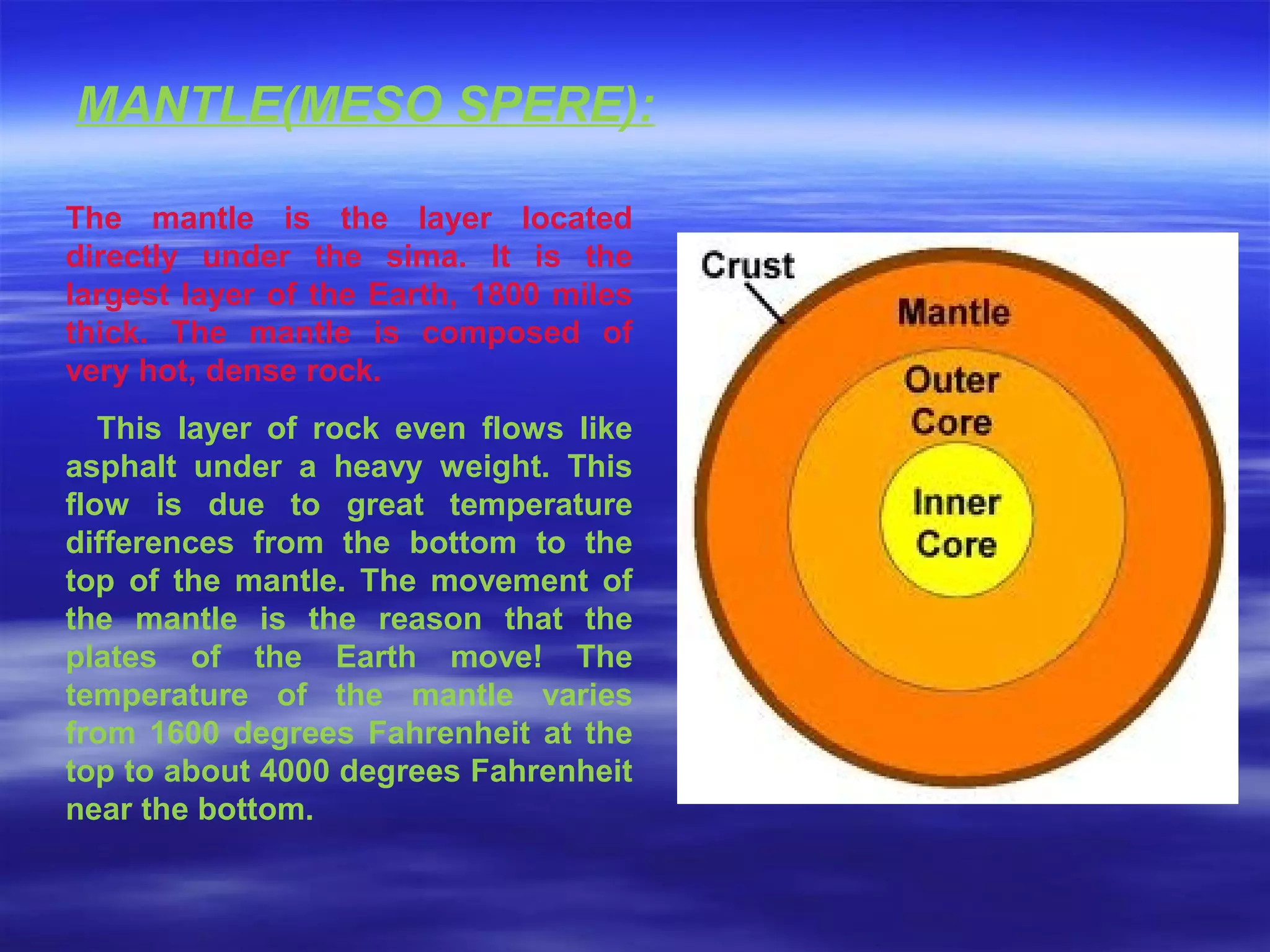
The mantle is the layer located
directly under the sima. It is the
largest layer of the Earth, 1800 miles
thick. The mantle is composed of
very hot, dense rock.
This layer of rock even flows like
asphalt under a heavy weight. This
flow is due to great temperature
differences from the bottom to the
top of the mantle. The movement of
the mantle is the reason that the
plates of the Earth move! The
temperature of the mantle varies
from 1600 degrees Fahrenheit at the
top to about 4000 degrees Fahrenheit
near the bottom.
MANTLE(MESO SPERE):
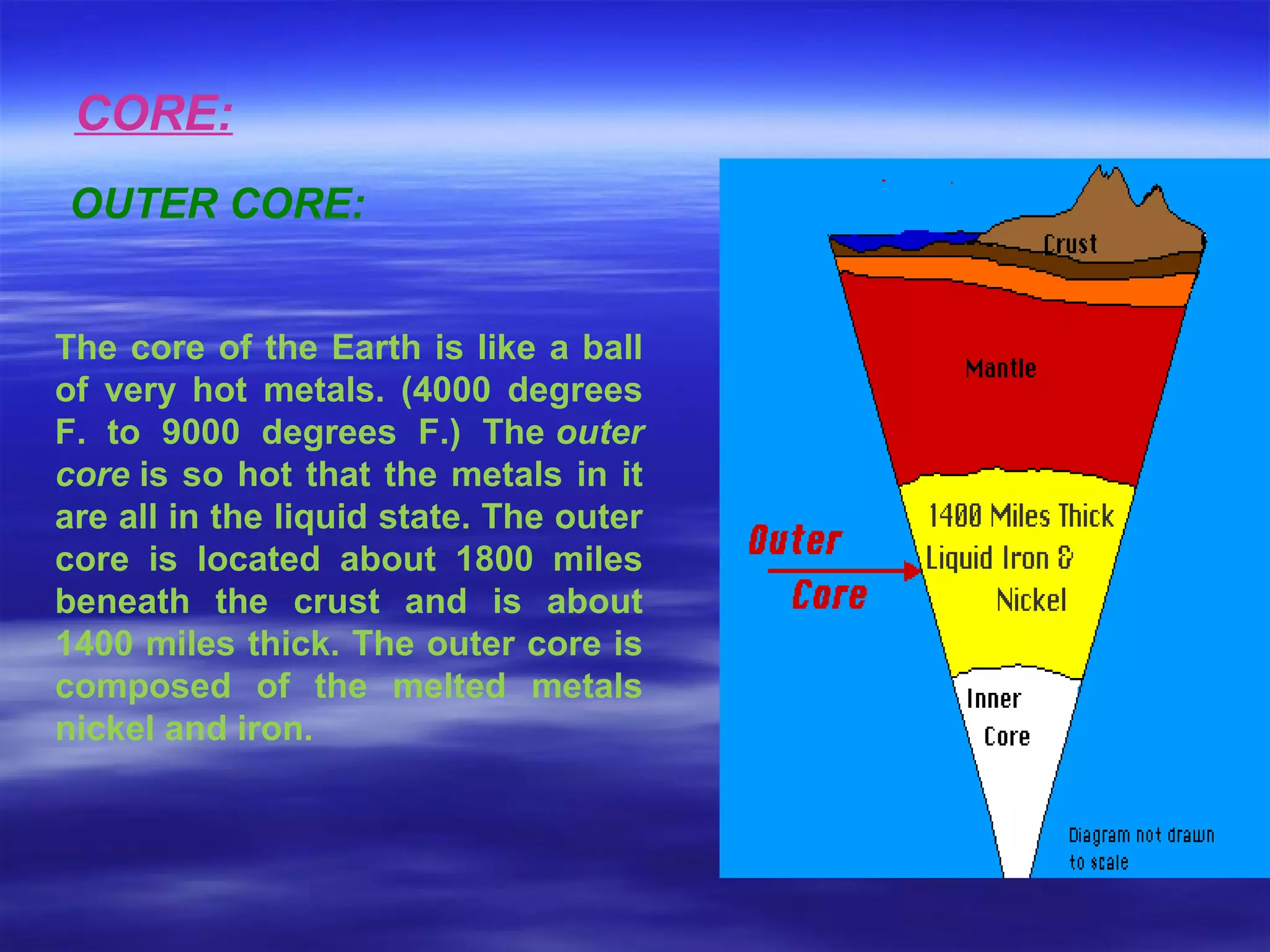
The core of the Earth is like a ball
of very hot metals. (4000 degrees
F. to 9000 degrees F.) The outer
core is so hot that the metals in it
are all in the liquid state. The outer
core is located about 1800 miles
beneath the crust and is about
1400 miles thick. The outer core is
composed of the melted metals
nickel and iron.
CORE:
OUTER CORE:
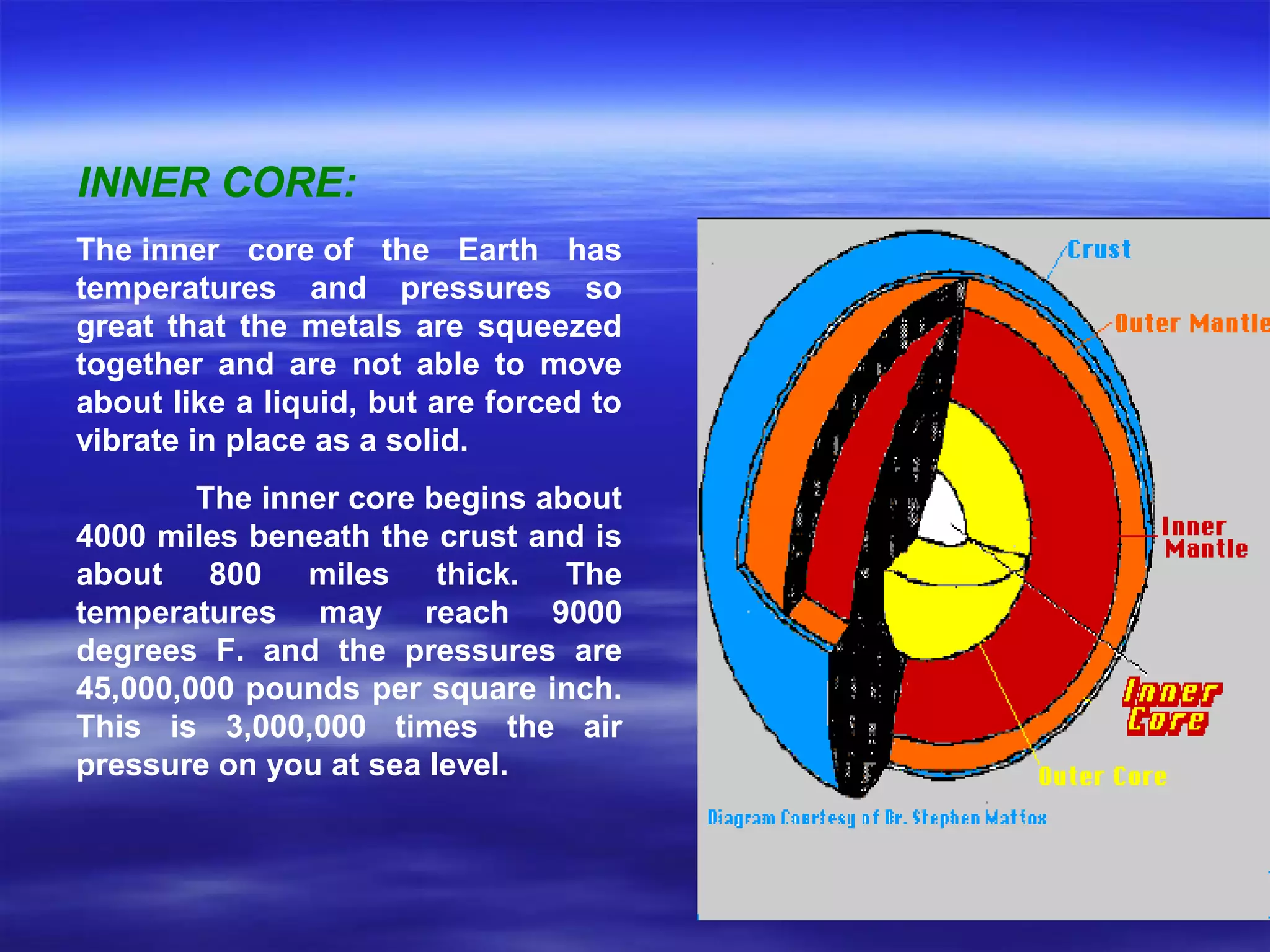
The inner core of the Earth has
temperatures and pressures so
great that the metals are squeezed
together and are not able to move
about like a liquid, but are forced to
vibrate in place as a solid.
The inner core begins about
4000 miles beneath the crust and is
about 800 miles thick. The
temperatures may reach 9000
degrees F. and the pressures are
45,000,000 pounds per square inch.
This is 3,000,000 times the air
pressure on you at sea level.
INNER CORE:
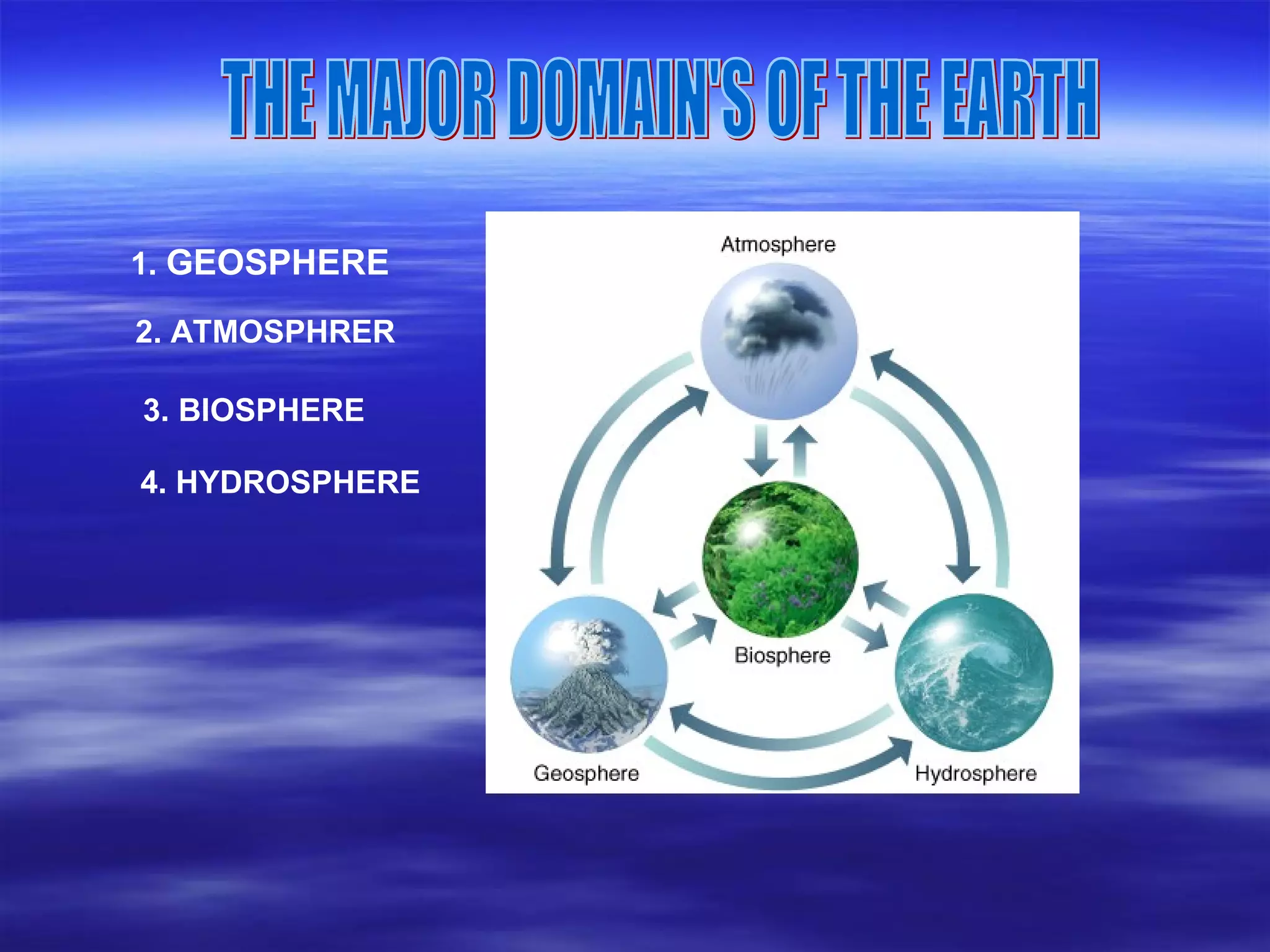
2. ATMOSPHRER
3. BIOSPHERE
4. HYDROSPHERE
1. GEOSPHERE
Although the lithosphere is around 100 km thick, only 1 km of it can be
considered in interaction with the biosphere
Main constituents are oxygen (47%), silicon (28%), aluminum (8%),
iron (5%), calcium (4%), sodium (3%), potassium (3%) and magnesium
(2%) in a crystalline state.
The lithosphere is the main source of pollutants and a permanent
accumulator.
The lithosphere is the thin crust between the mantle and the atmosphere.
Some are naturally released through sources like volcanic eruptions, while
others like fossil fuels are the result of artificial extraction and combustion.
The earth is surrounded by a blanket of air, which we call the
atmosphere
The atmosphere consists of four unique layers
1. Troposphere
2.Stratosphere
3. Mesosphere and
4.Thermosphere
The atmosphere reaches over 350 miles up from the surface of
the earth. The atmosphere is primarily composed of nitrogen
(about 78%) and oxygen (about 21%) other components exist in
small quantities
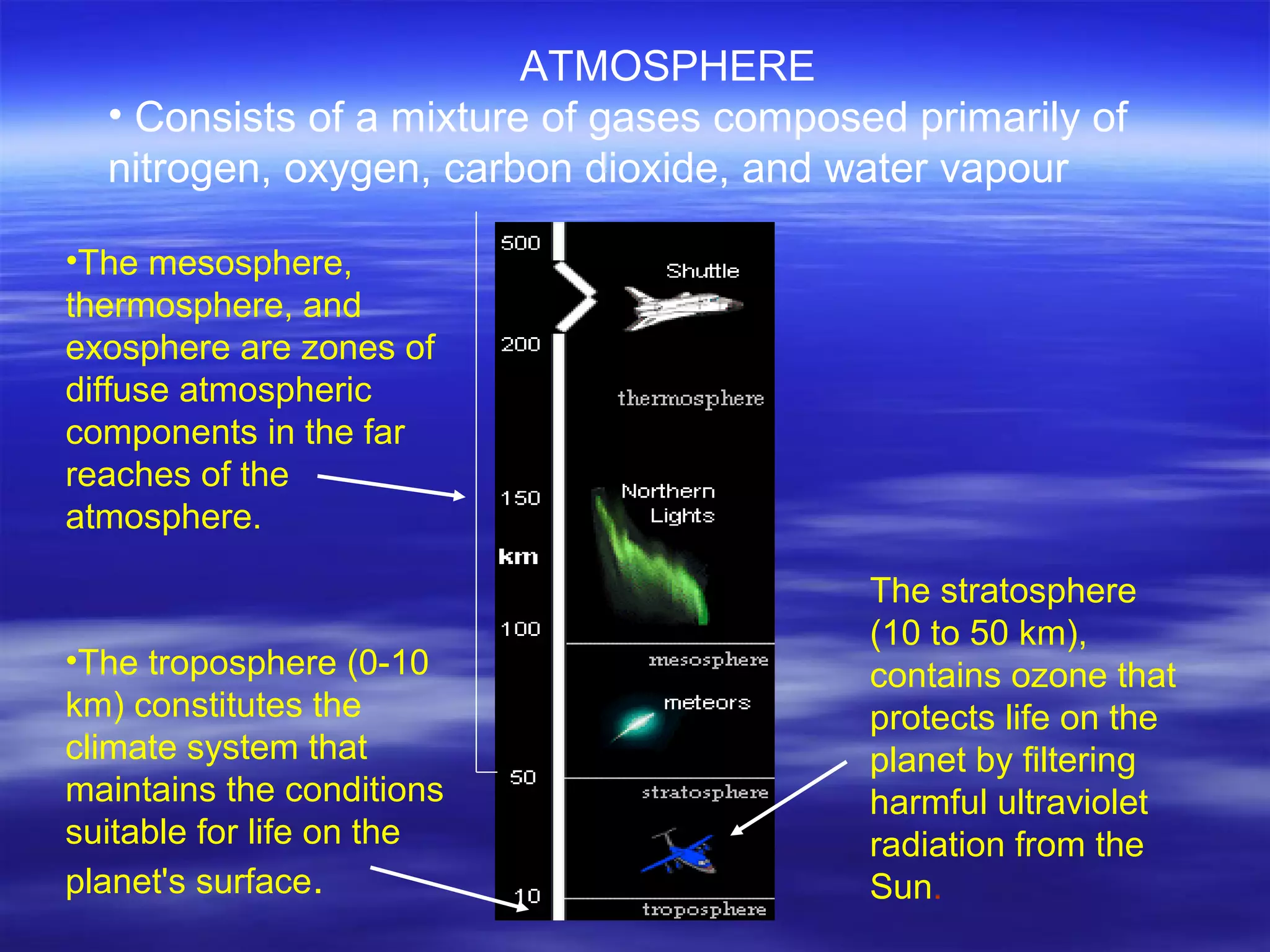
ATMOSPHERE
• Consists of a mixture of gases composed primarily of
nitrogen, oxygen, carbon dioxide, and water vapour
•The troposphere (0-10
km) constitutes the
climate system that
maintains the conditions
suitable for life on the
planet's surface.
•The mesosphere,
thermosphere, and
exosphere are zones of
diffuse atmospheric
components in the far
reaches of the
atmosphere.
The stratosphere
(10 to 50 km),
contains ozone that
protects life on the
planet by filtering
harmful ultraviolet
radiation from the
Sun.
The biosphere is the “life zone” of the earth, and includes all
living organisms (including humans), and all organic matter that has
yet decomposed
The biosphere structured into a hierarchy known as a food
chain. Energy and nutrients, like carbon, are transferred from one
level of the food chain to the next.
Species of organisms that vary in size from microbesand bacteria to
huge mammals. All the livingorganisms include human are linked to
each otherrand to the biosphere for survival .
The hydrosphere contains all the water found on our planet
Surface water : includes the ocean well as water from lakes, rivers
and creeks
Ground water : includes water trapped in the soil and ground water
Atmosphere : vaporate the water in rivers, lakes, and oceans
Frozen water : includes ice caps and glaciers. specifically called
the cryosphere
Only about 3% of the water on earth is “fresh” water, and about
70% of the fresh water is frozen in the form of glacial ice
The hydrosphere is the part of earth that is liquid water. 97% of all
of the water on earth is the saltwater found in the oceans. Oceans
cover 71% of earth’s surface. The hydrosphere also includes the
water in lakes, rivers, and marshes. Clouds and rain are also
parts of the hydrosphere. Even water that is underground is part
of the hydrosphere
The water on earth is constantly moving. It movies through the
ocean in currents, because of wind and difference in the
density of ocean water. Water also moves from earth’s surface
to the air by evaporation. It falls back to earth as rain it fiows
in rivers through rocks under the grounds. It even moves into
and out of living things
HYDROLOGIC CYCLE
Geosphere: Comprises the solid Earth and includes
both Earth’s surface and the various layers of the
Earth's interior.
Atmosphere: Gaseous envelope that surrounds the
Earth and constitutes the transition between its surface
and the vacuum of space
Hydrosphere: Includes all water on Earth (including
surface water and groundwater)
Biosphere: The life zone of the Earth and includes all
living organisms, and all organic matter that has not
yet decomposed.
http://simple.wikipedia.org/w/index.php?title=Crust_(geology)&oldid
http://en.wikipedia.org/w/index.php?title=Geosphere&oldid
BOOKS
STANLEY E.MANAHAN 2007 , TAYLOR PUBLICATIONS
ENVIRONMENTAL SCIENCE AND TECHNOLOGY pp;44-55
Websites
http://en.wikipedia.org/w/index.php?title=mantle (geology)&oldid
Geosphere and domains of the earth

Geosphere and domains of the earth

  • 1.
  • 2.
    INTRODUCTION LAYER OF THEGEOSPHERE  CRUST  MANTLE  CORE MAJOR DOMAIN’S OF THE EARTH  LITHOSPHERE  ATMOSPHERE  BIOSPHERE  HYDROSPHERE CONCLUSIONS
  • 3.
    The geosphere isthe solid earth, from the SURFACE TO CORE. Geosphere consists of volcanoes, rocks and minerals. Large quantities of consumer and industrial wastes have been discarded to the geosphere, a practice that is ultimately unsustainable. The geosphere interacts strongly with the hydrosphere, atmosphere biosphere, and anthrosphere. The geosphere is obviously a huge part of natural capital and managing and preserving it is of utmost importance to achieve sustainability the geosphere consists of an outer solid layer of the composed of rocks that minerals that make up rocks, soil and sediments. The geosphere is the densest parts of the world and consists mostly of rock and regolith.
  • 4.
    2. MANTIE (MESOSPHERE) 1.CRUST 3.CORE (OUTER-CORE, INNER-CORE)
  • 5.
    The crust isthe thin outermost layer of the geosphere. The crust is divided into plates that move slowly over earth surface. The crust is made up of different types of rocks; igneous, metamorphic, and sedimentary rocks. The crust is the outer hard layer of the Earth. The crust is a part of the lithosphere. The crust has two different parts. One is the continental crust (under the land) and the other is oceanic crust (under the ocean). The continental crust is thicker, and the oceanic crust is thinner. Thicknesses of the crust can be anywhere from 5–70 km. The crust and the upper mantle make up the lithosphere. CRUST:
  • 7.
    The mantle isthe layer located directly under the sima. It is the largest layer of the Earth, 1800 miles thick. The mantle is composed of very hot, dense rock. This layer of rock even flows like asphalt under a heavy weight. This flow is due to great temperature differences from the bottom to the top of the mantle. The movement of the mantle is the reason that the plates of the Earth move! The temperature of the mantle varies from 1600 degrees Fahrenheit at the top to about 4000 degrees Fahrenheit near the bottom. MANTLE(MESO SPERE):
  • 9.
    The core ofthe Earth is like a ball of very hot metals. (4000 degrees F. to 9000 degrees F.) The outer core is so hot that the metals in it are all in the liquid state. The outer core is located about 1800 miles beneath the crust and is about 1400 miles thick. The outer core is composed of the melted metals nickel and iron. CORE: OUTER CORE:
  • 10.
    The inner coreof the Earth has temperatures and pressures so great that the metals are squeezed together and are not able to move about like a liquid, but are forced to vibrate in place as a solid. The inner core begins about 4000 miles beneath the crust and is about 800 miles thick. The temperatures may reach 9000 degrees F. and the pressures are 45,000,000 pounds per square inch. This is 3,000,000 times the air pressure on you at sea level. INNER CORE:
  • 11.
    2. ATMOSPHRER 3. BIOSPHERE 4.HYDROSPHERE 1. GEOSPHERE
  • 12.
    Although the lithosphereis around 100 km thick, only 1 km of it can be considered in interaction with the biosphere Main constituents are oxygen (47%), silicon (28%), aluminum (8%), iron (5%), calcium (4%), sodium (3%), potassium (3%) and magnesium (2%) in a crystalline state. The lithosphere is the main source of pollutants and a permanent accumulator. The lithosphere is the thin crust between the mantle and the atmosphere. Some are naturally released through sources like volcanic eruptions, while others like fossil fuels are the result of artificial extraction and combustion.
  • 13.
    The earth issurrounded by a blanket of air, which we call the atmosphere The atmosphere consists of four unique layers 1. Troposphere 2.Stratosphere 3. Mesosphere and 4.Thermosphere The atmosphere reaches over 350 miles up from the surface of the earth. The atmosphere is primarily composed of nitrogen (about 78%) and oxygen (about 21%) other components exist in small quantities
  • 14.
    ATMOSPHERE • Consists ofa mixture of gases composed primarily of nitrogen, oxygen, carbon dioxide, and water vapour •The troposphere (0-10 km) constitutes the climate system that maintains the conditions suitable for life on the planet's surface. •The mesosphere, thermosphere, and exosphere are zones of diffuse atmospheric components in the far reaches of the atmosphere. The stratosphere (10 to 50 km), contains ozone that protects life on the planet by filtering harmful ultraviolet radiation from the Sun.
  • 15.
    The biosphere isthe “life zone” of the earth, and includes all living organisms (including humans), and all organic matter that has yet decomposed The biosphere structured into a hierarchy known as a food chain. Energy and nutrients, like carbon, are transferred from one level of the food chain to the next. Species of organisms that vary in size from microbesand bacteria to huge mammals. All the livingorganisms include human are linked to each otherrand to the biosphere for survival .
  • 16.
    The hydrosphere containsall the water found on our planet Surface water : includes the ocean well as water from lakes, rivers and creeks Ground water : includes water trapped in the soil and ground water Atmosphere : vaporate the water in rivers, lakes, and oceans Frozen water : includes ice caps and glaciers. specifically called the cryosphere Only about 3% of the water on earth is “fresh” water, and about 70% of the fresh water is frozen in the form of glacial ice
  • 17.
    The hydrosphere isthe part of earth that is liquid water. 97% of all of the water on earth is the saltwater found in the oceans. Oceans cover 71% of earth’s surface. The hydrosphere also includes the water in lakes, rivers, and marshes. Clouds and rain are also parts of the hydrosphere. Even water that is underground is part of the hydrosphere The water on earth is constantly moving. It movies through the ocean in currents, because of wind and difference in the density of ocean water. Water also moves from earth’s surface to the air by evaporation. It falls back to earth as rain it fiows in rivers through rocks under the grounds. It even moves into and out of living things
  • 18.
  • 19.
    Geosphere: Comprises thesolid Earth and includes both Earth’s surface and the various layers of the Earth's interior. Atmosphere: Gaseous envelope that surrounds the Earth and constitutes the transition between its surface and the vacuum of space Hydrosphere: Includes all water on Earth (including surface water and groundwater) Biosphere: The life zone of the Earth and includes all living organisms, and all organic matter that has not yet decomposed.
  • 20.
    http://simple.wikipedia.org/w/index.php?title=Crust_(geology)&oldid http://en.wikipedia.org/w/index.php?title=Geosphere&oldid BOOKS STANLEY E.MANAHAN 2007, TAYLOR PUBLICATIONS ENVIRONMENTAL SCIENCE AND TECHNOLOGY pp;44-55 Websites http://en.wikipedia.org/w/index.php?title=mantle (geology)&oldid