CONCEPT OF ENVIRONMENT
Environment (ɪnˈvʌɪrənm(ə)nt,/noun
The surroundings or conditions in which a
person, animal, or plant lives or operates.
synonyms: habitat, territory, domain, home,
abode; More the natural world, as a whole or
in a particular geographical area, especially as
affected by human activity.
The term environment has been derived from a French
word “Environia” means to surround. It refers to both abiotic
(physical or non-living) and biotic (living) environment. The word
environment means surroundings, in which organisms live.
Environment and the organisms are two dynamic and complex
component of nature. Environment regulates the life of the
organisms including human beings. Human beings interact with
the environment more vigorously than other living beings.
Ordinarily environment refers to the materialsand forces that
surrounds the living organism.
Environment is the sum total of conditions that surrounds
us at a given point of time and space. It is comprised of the
interacting systems of physical, biological and cultural elements
which are interlinked both individually and collectively.
Environment is the sum total of conditions in which an organism
has to survive or maintain its life process. It influences the growth
and development of living forms.
In other words environment refers to those surroundings that surrounds
living beings from all sides and affect their lives. It consists of atmosphere,
hydrosphere, lithosphere and biosphere. It’s chief components are soil,
water, air, organisms and solar energy. It has provided us all the resources for
leading a comfortable life.
According to P. Gisbert “Environment is anything immediately surrounding an
object and exerting a direct influence on it.”
According to E. J. Ross “Environment is an external force which influences us.”
Thus, environment refers to anything that is immediately
surrounding an object and exerting a direct influence on it. Our environment
refers to those thing or agencies which though distinct from us, affect our life
or activity. The environment by which man is surrounded and affected by
factors which may be natural, artificial, social, biological and psychological.
Components of Environment:
Environment mainly consists of atmosphere, hydrosphere,
lithosphere and biosphere. But it can be roughly divided
into two types such as
(a) Micro environment refers to the immediate local
surrounding of the organism.
(b) Macro environment refers to all the physical and biotic
conditions that surround the organism externally.
It can also be divided as:
(c) Physical environment refers to all abiotic factors or
conditions like temperature, light, rainfall, soil, minerals
etc. It comprises of atmosphere, lithosphere and
hydrosphere.
(d) Biotic environment includes all biotic factors or living
forms like plants, animals, Micro-organisms.
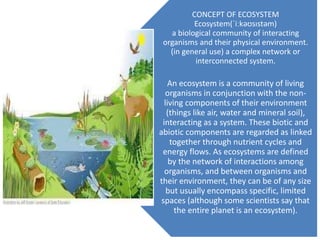
CONCEPT OF ECOSYSTEM
Ecosystem(ˈiːkəʊsɪstəm)
a biological community of interacting
organisms and their physical environment.
(in general use) a complex network or
interconnected system.
An ecosystem is a community of living
organisms in conjunction with the non-
living components of their environment
(things like air, water and mineral soil),
interacting as a system. These biotic and
abiotic components are regarded as linked
together through nutrient cycles and
energy flows. As ecosystems are defined
by the network of interactions among
organisms, and between organisms and
their environment, they can be of any size
but usually encompass specific, limited
spaces (although some scientists say that
the entire planet is an ecosystem).
Thank You

Concept of environment

  • 1.
    CONCEPT OF ENVIRONMENT Environment(ɪnˈvʌɪrənm(ə)nt,/noun The surroundings or conditions in which a person, animal, or plant lives or operates. synonyms: habitat, territory, domain, home, abode; More the natural world, as a whole or in a particular geographical area, especially as affected by human activity.
  • 2.
    The term environmenthas been derived from a French word “Environia” means to surround. It refers to both abiotic (physical or non-living) and biotic (living) environment. The word environment means surroundings, in which organisms live. Environment and the organisms are two dynamic and complex component of nature. Environment regulates the life of the organisms including human beings. Human beings interact with the environment more vigorously than other living beings. Ordinarily environment refers to the materialsand forces that surrounds the living organism. Environment is the sum total of conditions that surrounds us at a given point of time and space. It is comprised of the interacting systems of physical, biological and cultural elements which are interlinked both individually and collectively. Environment is the sum total of conditions in which an organism has to survive or maintain its life process. It influences the growth and development of living forms.
  • 3.
    In other wordsenvironment refers to those surroundings that surrounds living beings from all sides and affect their lives. It consists of atmosphere, hydrosphere, lithosphere and biosphere. It’s chief components are soil, water, air, organisms and solar energy. It has provided us all the resources for leading a comfortable life. According to P. Gisbert “Environment is anything immediately surrounding an object and exerting a direct influence on it.” According to E. J. Ross “Environment is an external force which influences us.” Thus, environment refers to anything that is immediately surrounding an object and exerting a direct influence on it. Our environment refers to those thing or agencies which though distinct from us, affect our life or activity. The environment by which man is surrounded and affected by factors which may be natural, artificial, social, biological and psychological.
  • 4.
    Components of Environment: Environmentmainly consists of atmosphere, hydrosphere, lithosphere and biosphere. But it can be roughly divided into two types such as (a) Micro environment refers to the immediate local surrounding of the organism. (b) Macro environment refers to all the physical and biotic conditions that surround the organism externally. It can also be divided as: (c) Physical environment refers to all abiotic factors or conditions like temperature, light, rainfall, soil, minerals etc. It comprises of atmosphere, lithosphere and hydrosphere. (d) Biotic environment includes all biotic factors or living forms like plants, animals, Micro-organisms.
  • 5.
    CONCEPT OF ECOSYSTEM Ecosystem(ˈiːkəʊsɪstəm) abiological community of interacting organisms and their physical environment. (in general use) a complex network or interconnected system. An ecosystem is a community of living organisms in conjunction with the non- living components of their environment (things like air, water and mineral soil), interacting as a system. These biotic and abiotic components are regarded as linked together through nutrient cycles and energy flows. As ecosystems are defined by the network of interactions among organisms, and between organisms and their environment, they can be of any size but usually encompass specific, limited spaces (although some scientists say that the entire planet is an ecosystem).
  • 6.