

Enterprise Mobility
Suite (EMS)
Lai Yoong Seng | MVP Hyper-V
Senior Consultant |
Yoongseng.lai@infrontconsulting.com
Part 1
Hybrid Identity
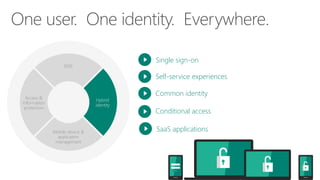
Single sign-on
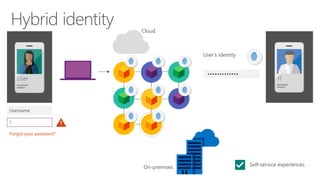
Self-service experiences
Common identity
Conditional access
SaaS applications
EMS
Access &
information
protection
Mobile device &
application
management
Hybrid
identity
User’s identity
•••••••••••••
User’s identity
•••••••••••••
Username
?
ITUser
Cloud
On-premises
User’s identity
•••••••••••••
Username
?
New app
Identity layer
ITUser
On-premises
User’s identity
•••••••••••••
Username
•••••••••••••
ITUser
Cloud
On-premises
User’s identity
•••••••••••••
Username
?
Forgot your password?
ITUser
Cloud
On-premises
User’s identity
•••••••••••••
New device
ITUser
Cloud
On-premises
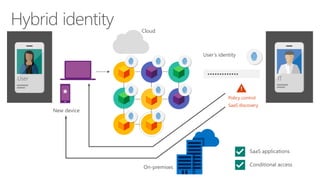
Policy control
SaaS discovery
User’s identity
ITUser
Cloud
On-premises
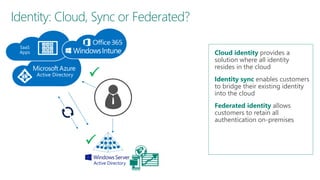
Identity: Cloud, Sync or Federated?


Cloud identity provides a
solution where all identity
resides in the cloud
Federated identity allows
customers to retain all
authentication on-premises
Identity sync enables customers
to bridge their existing identity
into the cloud
Demo
Azure Active Directory
Enriched user experience through a single, verified identity
Unified across cloud and on-premises with single sign-on
Integrated identity solution reduces risk across the business
Reduced IT burden of creating and managing multiple identities

Enterprise Mobility Suite- Azure AD Premium

Editor's Notes

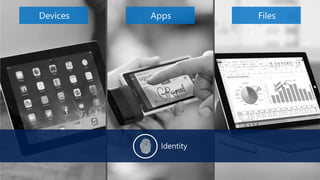
  • #4 On previous slide we saw 3 components Devices Lock down app Lock down of files
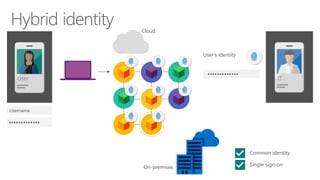
  • #5 Identity is the core components. The best is 1 identity to control access to devices, app & files. In this scenario: AD With federated active directory and sync to Azure AD, we can achieve SSO. Do not require to key in password. In case staff forget password. They can go to portal and perform self service password reset. Which reduce the burden of IT staff. With 1 identify able access to multiple corporate SaaS. When access app, the most common scenario is use user name & app. To enhance security, you can enable additional security called “MFA”.
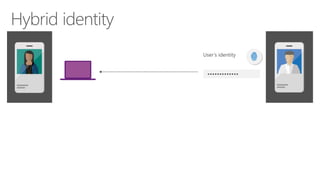
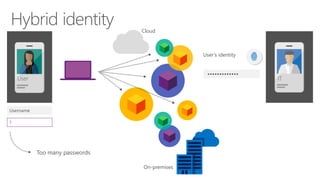
  • #6 Technology suppose to assist people and not create a burden and prevent people from using it. Now let into a scenario: A (Jane)busy woman staff which has multiple app that she need to access. 1 app – 1 identity What happen when 30 app and 30 user name and password that she need to access.
  • #7 Soon or later. She will forget password! If you’re IT, How to solve this issue? Let look into your scenario: Active Directory on-premise. If yes, let start to sync username and password to Azure Active Directory. Password is hash and protected. Read need to rehash Once it is sync to AAD, you can now login with same user name and password exactly on-prem and link to multiple SaaS.
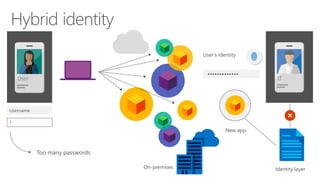
  • #8 When introduce new app, you do not need to create user name & password
  • #9 By sync to AAD, you can have 1 common identity to access all password and achieve single sign on (without need to key in password)
  • #10 That’s not all – if our User forgets a password (and that has happened), she doesn’t need to call the helpdesk – there’s a self-service password reset facility. IT can carry on.
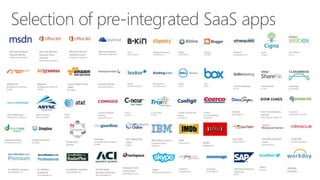
  • #11 Identify SaaS app. You can use Azure AD Discovery to detect SaaS
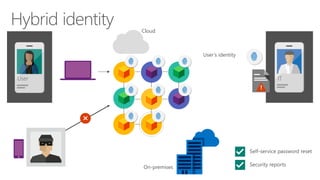
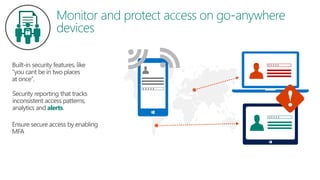
  • #12 Let’s say our User travels a lot and has been known to lose a device or two. Our IT Pro has the peace of mind to know that his Hybrid Identity solution will allow him to spot anomalies in user behavior. Even our User is unlikely to be accessing her expense account from New York at 9am and Bangkok at 10am.
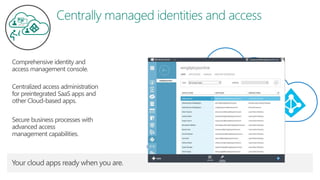
  • #14 Central console to manage user account, group -configuration Set MFA Change page branding SaaS
  • #15 Once activated Azure AD Premium, the system will monitor, learn and detect on abnormal behavior Scenario- cannot from 2 different location. Authentication 1st level using user name & password 2nd level – use MFA Use app code Use phone Use sms
  • #18  So, in summary – Hybrid Identity as part of the Microsoft solution for Enabling Enterprise Mobility puts your user at the center of the solution and gives IT an integrated identity management solution that reduces risk across the business.