
Importance of Nanotechnology in water treatment
 Nanomaterials are fabricated with features, such as high aspect ratio,
reactivity, and tunable pore volume, electro-static, hydrophilic and
hydrophobic interactions, which are useful in adsorption, catalysis,
sensoring etc.
Nanotechnology-enabled processes are highly efficient, modular, and
multifunctional in nature, and they provide high performance,
affordable water and, wastewater treatment solutions
Importance of Nanotechnology in water treatment
 Nanoparticles have a great potential to be used in waste water
treatment. Its unique characteristic of having high surface area can be
used efficiently for removing toxic metal ions, disease causing
microbes, organic and inorganic solutes from water
Nanotechnology has lead to various efficient ways of treating water in
a more precise and accurate way both in small and large scale
Types of Nanomaterials used…
Dendrimers
Zeolites
Metal Nanoparticles
Carbonaceous nanomaterials
Nano sorbents
Nano catalysts
Bioactive Nanoparticles
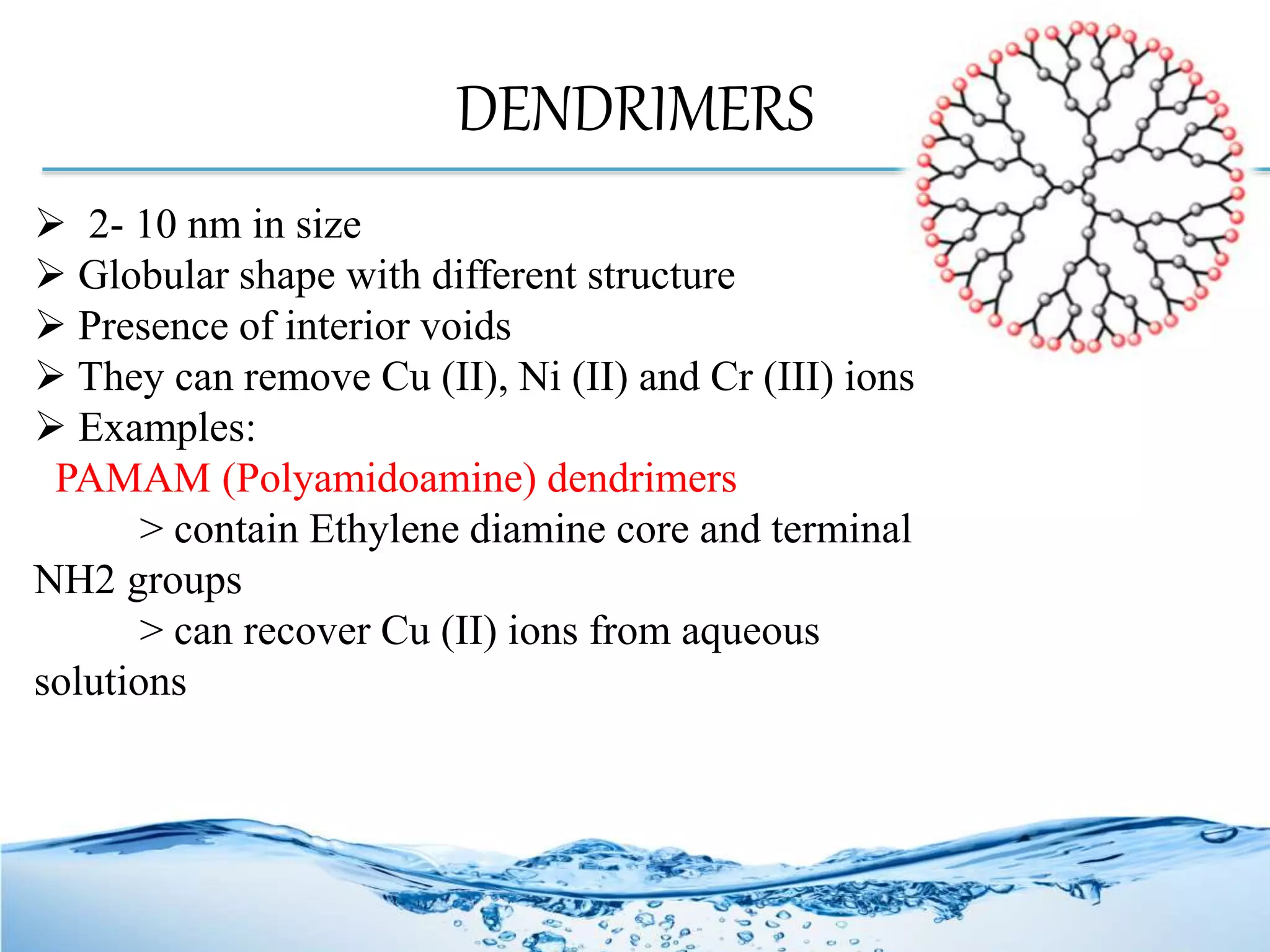
DENDRIMERS
 2- 10 nm in size
 Globular shape with different structure
 Presence of interior voids
 They can remove Cu (II), Ni (II) and Cr (III) ions
 Examples:
PAMAM (Polyamidoamine) dendrimers
> contain Ethylene diamine core and terminal
NH2 groups
> can recover Cu (II) ions from aqueous
solutions
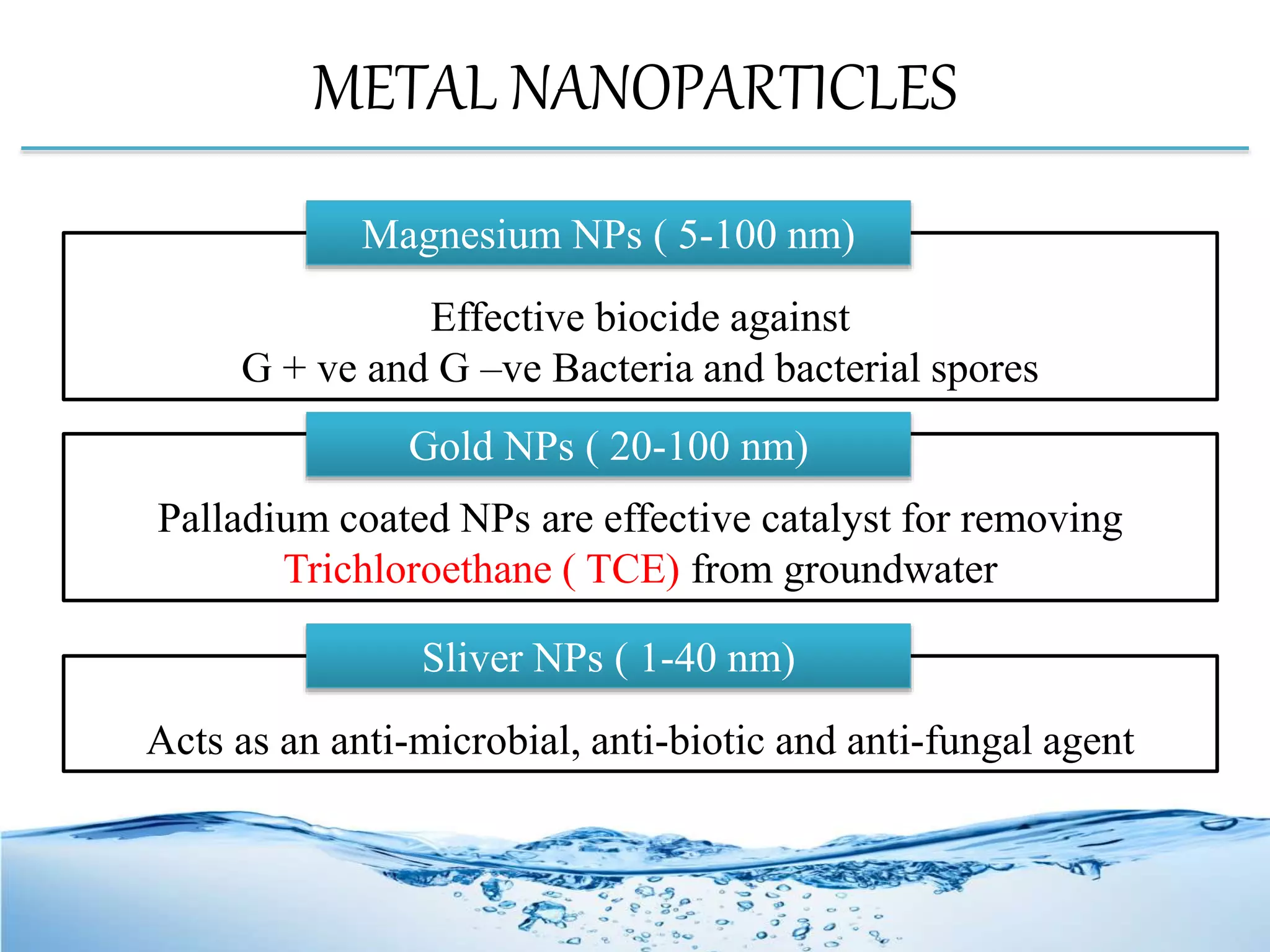
METAL NANOPARTICLES
Effective biocide against
G + ve and G –ve Bacteria and bacterial spores
Palladium coated NPs are effective catalyst for removing
Trichloroethane ( TCE) from groundwater
Acts as an anti-microbial, anti-biotic and anti-fungal agent
Magnesium NPs ( 5-100 nm)
Gold NPs ( 20-100 nm)
Sliver NPs ( 1-40 nm)
ZEOLITES
 Zeolite Nanoparticles are prepared by laser induced
fragmentation
Act as an effective sorbent and ion exchange media for metal
ions
They have porous structure and can accommodate variety of
cations (Na+, K+,Ca2+, Mg2+….)
Successful use of NaPl Zeolites removed Cr(III), Zn(II), Ni(II),
Cu(II), and Cd(II)
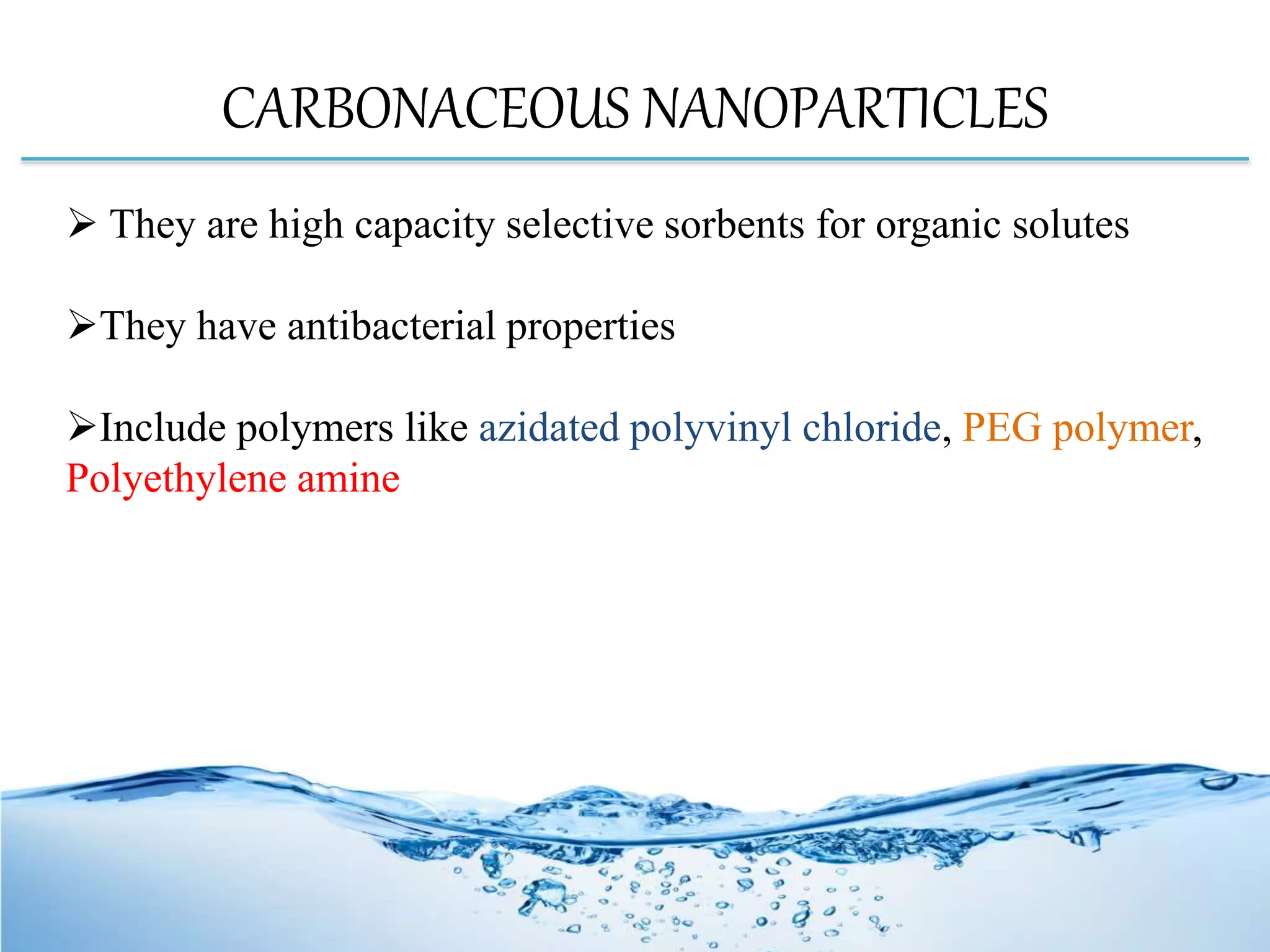
CARBONACEOUS NANOPARTICLES
 They are high capacity selective sorbents for organic solutes
They have antibacterial properties
Include polymers like azidated polyvinyl chloride, PEG polymer,
Polyethylene amine
MECHANISMS FOR REMOVING POLLUTANTS
Nanosorption
Nanofiltration
Photocatalysis
NANOSORPTION
 Adsorption is a surface process wherein pollutants are adsorbed on a
solid surface
Usually nanoadsorbents are used to remove inorganic and organic
pollutants from water and wastewater
The unique properties of nanoadsorbents, such as small size, catalytic
potential, high reactivity, large surface area, ease of separation, and
large number of active sites for interaction with different contaminants
make them ideal adsorbent materials for the treatment of wastewater
Carbon based Nano adsorbents, Metal based Nanoadsorbents,
Polymeric Nanoadsorbents, Magnetic or non-magnetic oxide composite
and Zeolites are currently used for water treatment
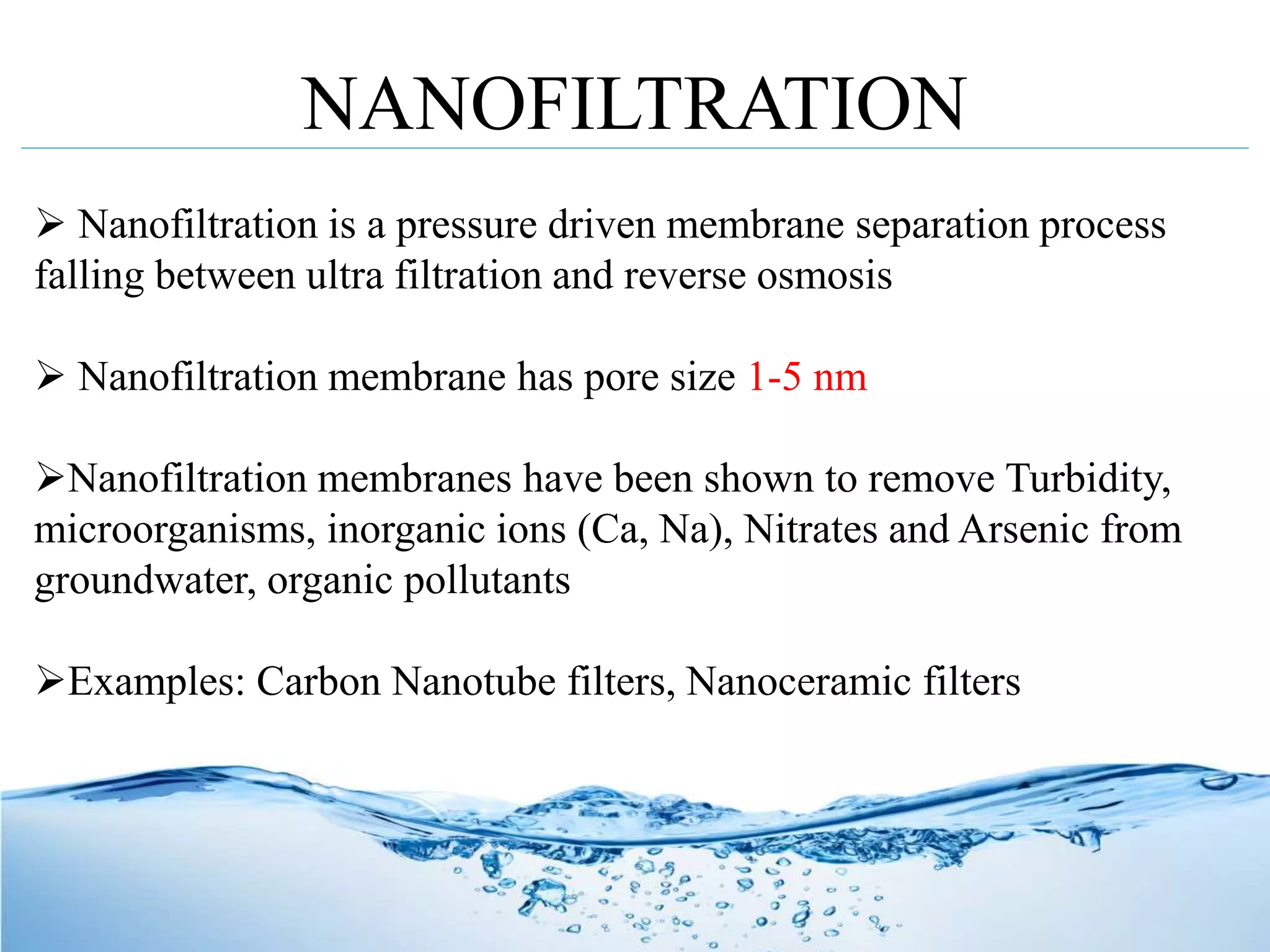
NANOFILTRATION
 Nanofiltration is a pressure driven membrane separation process
falling between ultra filtration and reverse osmosis
 Nanofiltration membrane has pore size 1-5 nm
Nanofiltration membranes have been shown to remove Turbidity,
microorganisms, inorganic ions (Ca, Na), Nitrates and Arsenic from
groundwater, organic pollutants
Examples: Carbon Nanotube filters, Nanoceramic filters
PHOTOCATALYSIS
 Photocatalysis is an advanced oxidation process which is based on
the oxidative elimination of micro pollutants and microbial pathogens
Most organic pollutants can be degraded by heterogeneous
Photocatalysis
HOW IT
WORKS??
PHOTOCATALYSIS
 TiO2 is the most popular and widely used Photocatalyst
It exists naturally in 3 forms: Rutile, Anatase and Brookite out of
which Anatase is the most often used
When TiO2 is irradiated by UV light in the range of 200–390 nm,
electron-hole pair (e− -h+)s is photoexcited
They move into the conduction (CB) and valent (VB) bands, which
results in charge separation for an effective photocatalytic function
depending on redox potential of a substrate
Therefore, the biodegradability of heavily decomposable substances
can be increased in a pretreatment step
Nanotechnology for Water Treatment

Nanotechnology for Water Treatment

  • 2.
    Importance of Nanotechnologyin water treatment  Nanomaterials are fabricated with features, such as high aspect ratio, reactivity, and tunable pore volume, electro-static, hydrophilic and hydrophobic interactions, which are useful in adsorption, catalysis, sensoring etc. Nanotechnology-enabled processes are highly efficient, modular, and multifunctional in nature, and they provide high performance, affordable water and, wastewater treatment solutions
  • 3.
    Importance of Nanotechnologyin water treatment  Nanoparticles have a great potential to be used in waste water treatment. Its unique characteristic of having high surface area can be used efficiently for removing toxic metal ions, disease causing microbes, organic and inorganic solutes from water Nanotechnology has lead to various efficient ways of treating water in a more precise and accurate way both in small and large scale
  • 4.
    Types of Nanomaterialsused… Dendrimers Zeolites Metal Nanoparticles Carbonaceous nanomaterials Nano sorbents Nano catalysts Bioactive Nanoparticles
  • 5.
    DENDRIMERS  2- 10nm in size  Globular shape with different structure  Presence of interior voids  They can remove Cu (II), Ni (II) and Cr (III) ions  Examples: PAMAM (Polyamidoamine) dendrimers > contain Ethylene diamine core and terminal NH2 groups > can recover Cu (II) ions from aqueous solutions
  • 6.
    METAL NANOPARTICLES Effective biocideagainst G + ve and G –ve Bacteria and bacterial spores Palladium coated NPs are effective catalyst for removing Trichloroethane ( TCE) from groundwater Acts as an anti-microbial, anti-biotic and anti-fungal agent Magnesium NPs ( 5-100 nm) Gold NPs ( 20-100 nm) Sliver NPs ( 1-40 nm)
  • 7.
    ZEOLITES  Zeolite Nanoparticlesare prepared by laser induced fragmentation Act as an effective sorbent and ion exchange media for metal ions They have porous structure and can accommodate variety of cations (Na+, K+,Ca2+, Mg2+….) Successful use of NaPl Zeolites removed Cr(III), Zn(II), Ni(II), Cu(II), and Cd(II)
  • 8.
    CARBONACEOUS NANOPARTICLES  Theyare high capacity selective sorbents for organic solutes They have antibacterial properties Include polymers like azidated polyvinyl chloride, PEG polymer, Polyethylene amine
  • 9.
    MECHANISMS FOR REMOVINGPOLLUTANTS Nanosorption Nanofiltration Photocatalysis
  • 10.
    NANOSORPTION  Adsorption isa surface process wherein pollutants are adsorbed on a solid surface Usually nanoadsorbents are used to remove inorganic and organic pollutants from water and wastewater The unique properties of nanoadsorbents, such as small size, catalytic potential, high reactivity, large surface area, ease of separation, and large number of active sites for interaction with different contaminants make them ideal adsorbent materials for the treatment of wastewater Carbon based Nano adsorbents, Metal based Nanoadsorbents, Polymeric Nanoadsorbents, Magnetic or non-magnetic oxide composite and Zeolites are currently used for water treatment
  • 11.
    NANOFILTRATION  Nanofiltration isa pressure driven membrane separation process falling between ultra filtration and reverse osmosis  Nanofiltration membrane has pore size 1-5 nm Nanofiltration membranes have been shown to remove Turbidity, microorganisms, inorganic ions (Ca, Na), Nitrates and Arsenic from groundwater, organic pollutants Examples: Carbon Nanotube filters, Nanoceramic filters
  • 12.
    PHOTOCATALYSIS  Photocatalysis isan advanced oxidation process which is based on the oxidative elimination of micro pollutants and microbial pathogens Most organic pollutants can be degraded by heterogeneous Photocatalysis HOW IT WORKS??
  • 13.
    PHOTOCATALYSIS  TiO2 isthe most popular and widely used Photocatalyst It exists naturally in 3 forms: Rutile, Anatase and Brookite out of which Anatase is the most often used When TiO2 is irradiated by UV light in the range of 200–390 nm, electron-hole pair (e− -h+)s is photoexcited They move into the conduction (CB) and valent (VB) bands, which results in charge separation for an effective photocatalytic function depending on redox potential of a substrate Therefore, the biodegradability of heavily decomposable substances can be increased in a pretreatment step