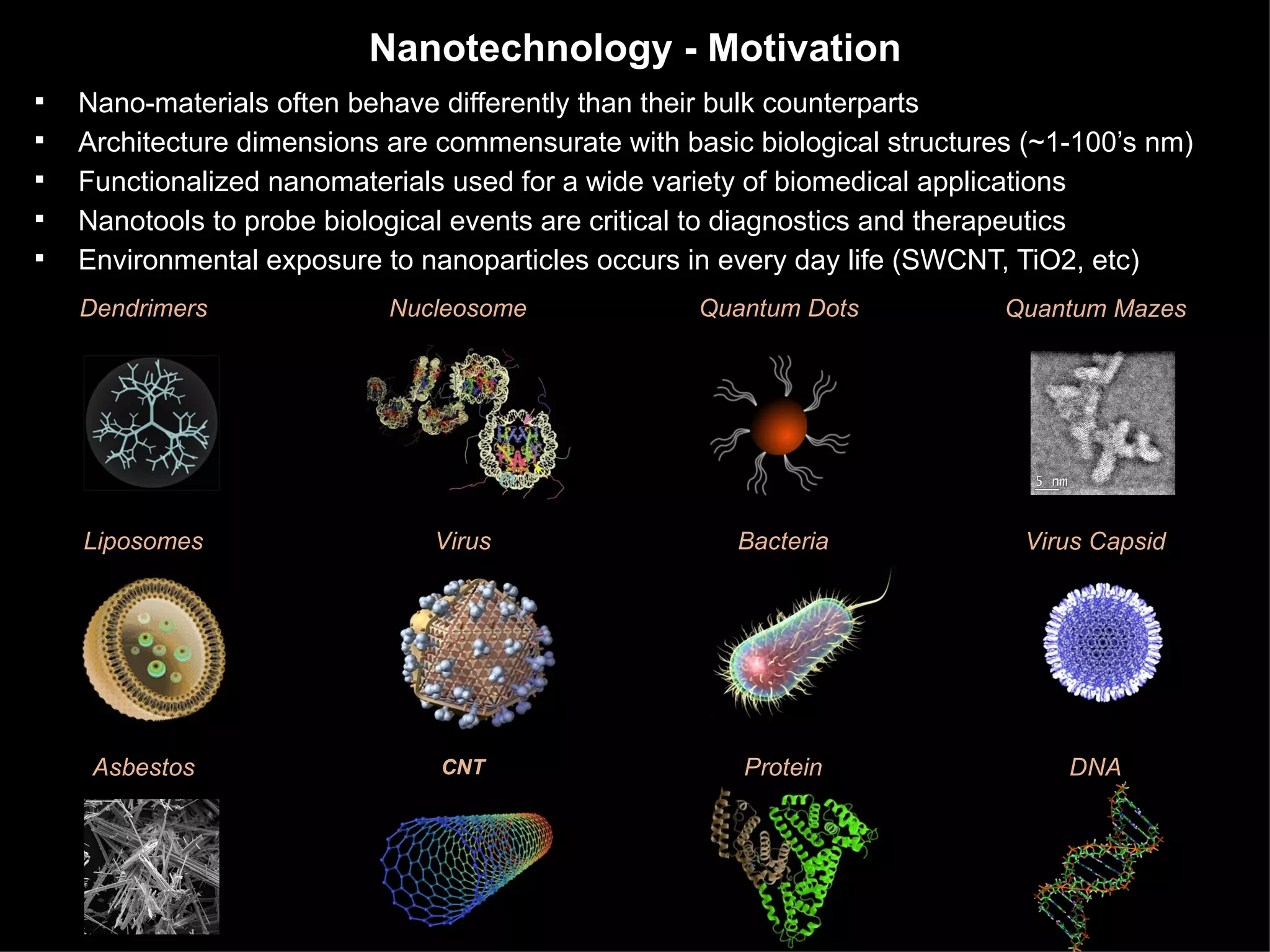
Nanotechnology - Motivation Nano-materials often behave differently than their bulk counterparts Architecture dimensions are commensurate with basic biological structures (~1-100’s nm)  Functionalized nanomaterials used for a wide variety of biomedical applications Nanotools to probe biological events are critical to diagnostics and therapeutics Environmental exposure to nanoparticles occurs in every day life (SWCNT, TiO2, etc)  Quantum Mazes Dendrimers Liposomes Virus Capsid Bacteria Protein DNA Asbestos CNT Virus Quantum Dots Nucleosome
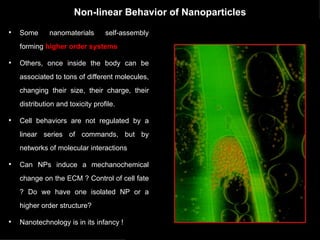
Non-linear Behavior of Nanoparticles Some nanomaterials self-assembly forming  higher order systems  Others, once inside the body can be associated to tons of different molecules, changing their size, their charge, their distribution and toxicity profile.  Cell behaviors are not regulated by a linear series of commands, but by networks of molecular interactions Can NPs induce a mechanochemical change on the ECM ? Control of cell fate ? Do we have one isolated NP or a higher order structure? Nanotechnology is in its infancy !
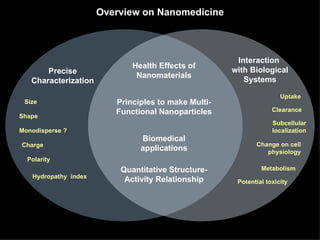
Overview on Nanomedicine Uptake Biomedical applications Size Quantitative Structure-Activity Relationship Health Effects of Nanomaterials Principles to make Multi-Functional Nanoparticles Precise Characterization Shape  Monodisperse ?  Hydropathy  index Charge Polarity Interaction  with Biological Systems Change on cell physiology Subcellular localization Clearance  Metabolism Potential toxicity
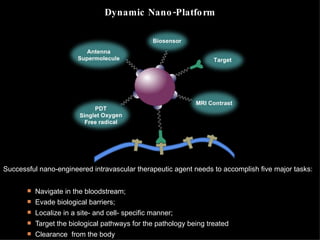
Dynamic Nano-Platform Successful nano-engineered intravascular therapeutic agent needs to accomplish five major tasks: Navigate in the bloodstream;  Evade biological barriers;  Localize in a site- and cell- specific manner;  Target the biological pathways for the pathology being treated Clearance  from the body

Fate of Nanoparticles

  • 1.
    Nanotechnology - MotivationNano-materials often behave differently than their bulk counterparts Architecture dimensions are commensurate with basic biological structures (~1-100’s nm) Functionalized nanomaterials used for a wide variety of biomedical applications Nanotools to probe biological events are critical to diagnostics and therapeutics Environmental exposure to nanoparticles occurs in every day life (SWCNT, TiO2, etc) Quantum Mazes Dendrimers Liposomes Virus Capsid Bacteria Protein DNA Asbestos CNT Virus Quantum Dots Nucleosome
  • 2.
    Non-linear Behavior ofNanoparticles Some nanomaterials self-assembly forming higher order systems Others, once inside the body can be associated to tons of different molecules, changing their size, their charge, their distribution and toxicity profile. Cell behaviors are not regulated by a linear series of commands, but by networks of molecular interactions Can NPs induce a mechanochemical change on the ECM ? Control of cell fate ? Do we have one isolated NP or a higher order structure? Nanotechnology is in its infancy !
  • 3.
    Overview on NanomedicineUptake Biomedical applications Size Quantitative Structure-Activity Relationship Health Effects of Nanomaterials Principles to make Multi-Functional Nanoparticles Precise Characterization Shape Monodisperse ? Hydropathy index Charge Polarity Interaction with Biological Systems Change on cell physiology Subcellular localization Clearance Metabolism Potential toxicity
  • 4.
    Dynamic Nano-Platform Successfulnano-engineered intravascular therapeutic agent needs to accomplish five major tasks: Navigate in the bloodstream; Evade biological barriers; Localize in a site- and cell- specific manner; Target the biological pathways for the pathology being treated Clearance from the body