Welcome Parents & Friends! 
This presentation has been designed to give you a brief overview on the Game 
Sense Approach to teaching which is the style of teaching I will be conducting 
through the year in my Physical Education classes. 
This overview includes some basic information about the Game Sense approach 
and how it works and why it’s beneficial for teaching as well as how it links 
with the Personal Development, Health & Physical Education NSW Syllabus.
Game Sense: What is it? 
According to Mandingo, Butler and Hopper (2007) the Teaching 
Games for Understanding (TGfU) or Game Sense approach to 
teaching was introduced as an alternative mode for teachers to 
teach games to their students. 
The main reason why it was introduced is that it focuses around 
the “learner centred approach” (p. 14) and is designed to enhance 
the overall skills of children in a positive and motivating way. 
Game Sense is important as it allows children to explore different 
ways of playing games and uses games in a way that enables 
students to try different things that allows them to enjoy their 
overall Physical Education experiences.
Game Sense: Focus & Aim 
The Game Sense approach is one method which develops the broader 
meanings of sport and physical activity as it focuses on developing 
thinking through problem solving skills whilst using physical activity. 
The focus of the Game Sense approach is to place the student in 
situations where decision making and problem solving are central to 
successful performance. The central strategy for teaching using the 
Game Sense approach is the use of questioning to stimulate thinking 
about the game instead of using more direct teaching approaches. 
Games are stopped at regular intervals and participants challenged to 
reflect on their participation in order to mature the play.
Game Sense: Benefits 
The main aim of the Game Sense approach is to ensure that the child 
can develop the ability to be “game literate” (Mandingo, Butler & 
Hopper, 2007, p.15) within all aspects of Physical Education. They can 
achieve this through understanding different concepts and developing 
a more tactical approach which is important for the children’s skills 
overall. 
Light (2006) highlights that the Game Sense approach encourages each 
child to develop their own skills at their own pace and it allows the 
child to become more “tactically aware” (p. 13) which will result in 
the ability for them to make better decisions and in general to have 
more fun.
With the Game Sense approach, different games are put into four 
categories: Invasion, Striking, Net/Wall & Target Games. (Light, 
2006; Mandingo, Butler & Hooper, 2006) The main reason behind the 
different categories is that they each contain a similar structure 
which enables the child to work on particular skills and use those 
skills across a range of different games. 
Overall, Game Sense is more beneficial for young children because it 
gives them the ability to develop a range of different skills including 
decision making, understanding and playing games. (Light, 2006)
WHY THE GAME SENSE APPROACH IS IMPORTANT 
Children can often be seen to be their own barriers when it 
comes to certain classes in the school environment, in 
particular Physical Education (PE). 
Some students thoroughly enjoy PE, while others feel they are 
not that good at sport so would rather not participate at all. As 
a teacher, it is vital that each child is treated as an individual 
and that their own skills are recognised. I aim to teach my 
students that PE is not just about being ‘good’ at sport or 
knowing how to play certain games. It is about allowing them to 
work at their own pace and encouraging them to develop their 
individual skills.
WHY THE GAME SENSE APPROACH IS IMPORTANT 
By introducing the Games Sense approach to teaching PE classes, it 
allows those children who may not like PE to get involved and actually 
enjoy themselves and have fun whilst learning some key concepts. The 
strengths of this as a teaching method are that children come to 
understand that there is no right or wrong way of doing something. 
They will also be encouraged to understand that they will not always 
win or lose but by getting involved they can have a lot of fun. 
It is extremely important that children understand their value and self 
worth so by ensuring that there is multiple options they can take and 
they are encouraged to participate then they will be able to 
understand and feel better about the idea of PE and feel more 
inclined to participate.
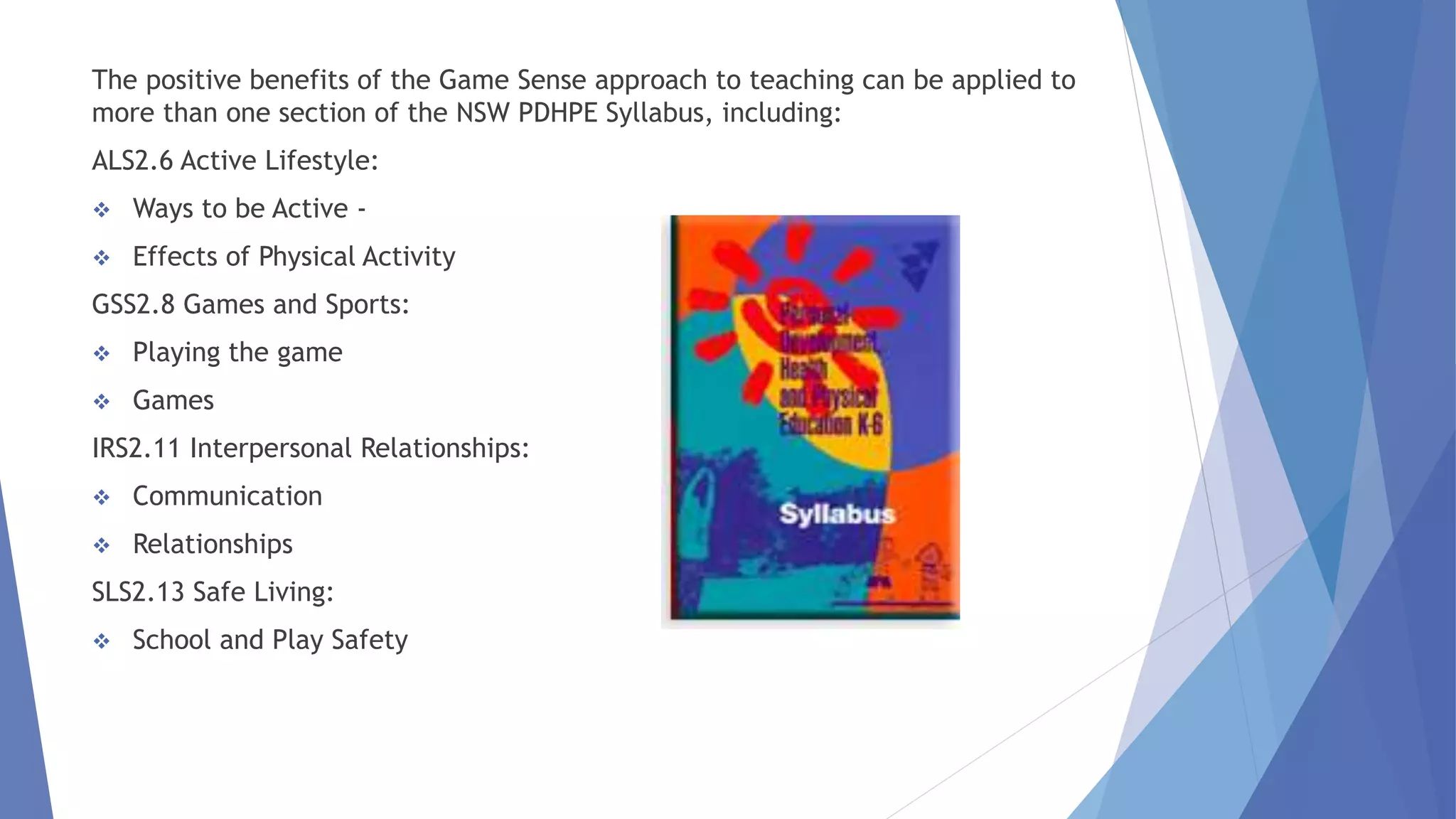
The positive benefits of the Game Sense approach to teaching can be applied to 
more than one section of the NSW PDHPE Syllabus, including: 
ALS2.6 Active Lifestyle: 
 Ways to be Active - 
 Effects of Physical Activity 
GSS2.8 Games and Sports: 
 Playing the game 
 Games 
IRS2.11 Interpersonal Relationships: 
 Communication 
 Relationships 
SLS2.13 Safe Living: 
 School and Play Safety
References 
Board of Studies, NSW. (2007). Personal development, health and physical education K-6: 
Syllabus. Sydney, Australia: Author 
Light, R. (2006). Game sense: Innovation or just good coaching? Journal of Physical 
Education New Zealand, 39(1), 8-19,3. 
Mandigo, J., Butler, J., & Hopper, T. (2007). What is teaching games for understanding? A 
Canadian perspective. Physical & Health Education Journal, 73(2), 14-20.

Miss Lisa’s 3B PDHPE Class - Game Sense Approach

  • 1.
    Welcome Parents &Friends! This presentation has been designed to give you a brief overview on the Game Sense Approach to teaching which is the style of teaching I will be conducting through the year in my Physical Education classes. This overview includes some basic information about the Game Sense approach and how it works and why it’s beneficial for teaching as well as how it links with the Personal Development, Health & Physical Education NSW Syllabus.
  • 2.
    Game Sense: Whatis it? According to Mandingo, Butler and Hopper (2007) the Teaching Games for Understanding (TGfU) or Game Sense approach to teaching was introduced as an alternative mode for teachers to teach games to their students. The main reason why it was introduced is that it focuses around the “learner centred approach” (p. 14) and is designed to enhance the overall skills of children in a positive and motivating way. Game Sense is important as it allows children to explore different ways of playing games and uses games in a way that enables students to try different things that allows them to enjoy their overall Physical Education experiences.
  • 3.
    Game Sense: Focus& Aim The Game Sense approach is one method which develops the broader meanings of sport and physical activity as it focuses on developing thinking through problem solving skills whilst using physical activity. The focus of the Game Sense approach is to place the student in situations where decision making and problem solving are central to successful performance. The central strategy for teaching using the Game Sense approach is the use of questioning to stimulate thinking about the game instead of using more direct teaching approaches. Games are stopped at regular intervals and participants challenged to reflect on their participation in order to mature the play.
  • 4.
    Game Sense: Benefits The main aim of the Game Sense approach is to ensure that the child can develop the ability to be “game literate” (Mandingo, Butler & Hopper, 2007, p.15) within all aspects of Physical Education. They can achieve this through understanding different concepts and developing a more tactical approach which is important for the children’s skills overall. Light (2006) highlights that the Game Sense approach encourages each child to develop their own skills at their own pace and it allows the child to become more “tactically aware” (p. 13) which will result in the ability for them to make better decisions and in general to have more fun.
  • 5.
    With the GameSense approach, different games are put into four categories: Invasion, Striking, Net/Wall & Target Games. (Light, 2006; Mandingo, Butler & Hooper, 2006) The main reason behind the different categories is that they each contain a similar structure which enables the child to work on particular skills and use those skills across a range of different games. Overall, Game Sense is more beneficial for young children because it gives them the ability to develop a range of different skills including decision making, understanding and playing games. (Light, 2006)
  • 6.
    WHY THE GAMESENSE APPROACH IS IMPORTANT Children can often be seen to be their own barriers when it comes to certain classes in the school environment, in particular Physical Education (PE). Some students thoroughly enjoy PE, while others feel they are not that good at sport so would rather not participate at all. As a teacher, it is vital that each child is treated as an individual and that their own skills are recognised. I aim to teach my students that PE is not just about being ‘good’ at sport or knowing how to play certain games. It is about allowing them to work at their own pace and encouraging them to develop their individual skills.
  • 7.
    WHY THE GAMESENSE APPROACH IS IMPORTANT By introducing the Games Sense approach to teaching PE classes, it allows those children who may not like PE to get involved and actually enjoy themselves and have fun whilst learning some key concepts. The strengths of this as a teaching method are that children come to understand that there is no right or wrong way of doing something. They will also be encouraged to understand that they will not always win or lose but by getting involved they can have a lot of fun. It is extremely important that children understand their value and self worth so by ensuring that there is multiple options they can take and they are encouraged to participate then they will be able to understand and feel better about the idea of PE and feel more inclined to participate.
  • 8.
    The positive benefitsof the Game Sense approach to teaching can be applied to more than one section of the NSW PDHPE Syllabus, including: ALS2.6 Active Lifestyle:  Ways to be Active -  Effects of Physical Activity GSS2.8 Games and Sports:  Playing the game  Games IRS2.11 Interpersonal Relationships:  Communication  Relationships SLS2.13 Safe Living:  School and Play Safety
  • 9.
    References Board ofStudies, NSW. (2007). Personal development, health and physical education K-6: Syllabus. Sydney, Australia: Author Light, R. (2006). Game sense: Innovation or just good coaching? Journal of Physical Education New Zealand, 39(1), 8-19,3. Mandigo, J., Butler, J., & Hopper, T. (2007). What is teaching games for understanding? A Canadian perspective. Physical & Health Education Journal, 73(2), 14-20.