Lecture Two
Phonological Development
Phonological development …
• This lecture deals with how
children develop the ability to use
and understand the sounds of
language.
The first year …
• The phonological
development that occurs
during the first year of a
child’s life was outlined
last week:
 Crying
 Cooing
 Babbling
 Phonemic expansion and
contraction
Be careful …
• Be careful not to make sweeping
generalisations when talking about later
phonological development.
• Order in which vowels and consonants are
acquired varies from child to child.
• Sometimes children appear to have
mastered a sound in one word, but then not
in another.
General trends …
• Age 2 ½ : all vowels and 2/3 of consonants
mastered.
• Age 4: difficulty with only a few
consonants.
• Age 6-7: confident use.
General trends …
• Consonants are first used correctly at the
beginnings of words.
• Consonants at the end of words present
more difficulty.
• Example: ‘push’ versus ‘rip’
General trends …
• Frequency: generally, sounds which occur
frequently in a large number of words will
be acquired before sounds that occur less
frequently.
Making words easier (phonemic
simplification) …
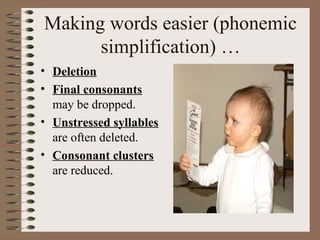
• Deletion
• Final consonants
may be dropped.
• Unstressed syllables
are often deleted.
• Consonant clusters
are reduced.
Making words easier (phonemic
simplification) …
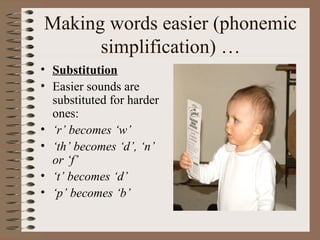
• Substitution
• Easier sounds are
substituted for harder
ones:
• ‘r’ becomes ‘w’
• ‘th’ becomes ‘d’, ‘n’
or ‘f’
• ‘t’ becomes ‘d’
• ‘p’ becomes ‘b’
Understanding …
• Remember: last week we learned that
comprehension is often ahead of speech
(e.g. first words).
• The same can be true in phonological
development.
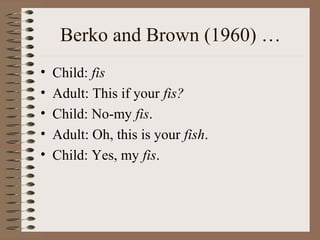
Berko and Brown (1960) …
• Child: fis
• Adult: This if your fis?
• Child: No-my fis.
• Adult: Oh, this is your fish.
• Child: Yes, my fis.
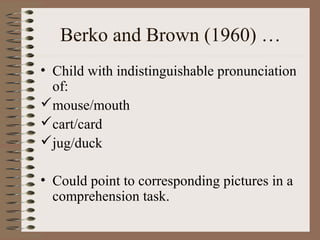
Berko and Brown (1960) …
• Child with indistinguishable pronunciation
of:
mouse/mouth
cart/card
jug/duck
• Could point to corresponding pictures in a
comprehension task.
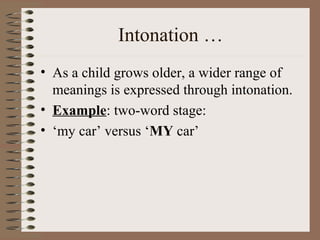
Intonation …
• As a child grows older, a wider range of
meanings is expressed through intonation.
• Example: two-word stage:
• ‘my car’ versus ‘MY car’
Intonation …
• Although intonation patterns can be
reproduced from an early stage,
understanding of their meaning is still
developing into the teenage years.
Cruttenden (1974) …
• Football results.
• Intonation used in first team’s score
enabled adults to accurately predict home
win, away win or draw.
• Children (aged 7-11): youngest were
largely unsuccessful and oldest were
significantly less successful than adults.
New vocabulary …
• Phonemic simplification
• Deletion
• Substitution

Language Acquisition: Lecture 2 Phonological Development

  • 1.
  • 2.
    Phonological development … •This lecture deals with how children develop the ability to use and understand the sounds of language.
  • 3.
    The first year… • The phonological development that occurs during the first year of a child’s life was outlined last week:  Crying  Cooing  Babbling  Phonemic expansion and contraction
  • 4.
    Be careful … •Be careful not to make sweeping generalisations when talking about later phonological development. • Order in which vowels and consonants are acquired varies from child to child. • Sometimes children appear to have mastered a sound in one word, but then not in another.
  • 5.
    General trends … •Age 2 ½ : all vowels and 2/3 of consonants mastered. • Age 4: difficulty with only a few consonants. • Age 6-7: confident use.
  • 6.
    General trends … •Consonants are first used correctly at the beginnings of words. • Consonants at the end of words present more difficulty. • Example: ‘push’ versus ‘rip’
  • 7.
    General trends … •Frequency: generally, sounds which occur frequently in a large number of words will be acquired before sounds that occur less frequently.
  • 8.
    Making words easier(phonemic simplification) … • Deletion • Final consonants may be dropped. • Unstressed syllables are often deleted. • Consonant clusters are reduced.
  • 9.
    Making words easier(phonemic simplification) … • Substitution • Easier sounds are substituted for harder ones: • ‘r’ becomes ‘w’ • ‘th’ becomes ‘d’, ‘n’ or ‘f’ • ‘t’ becomes ‘d’ • ‘p’ becomes ‘b’
  • 10.
    Understanding … • Remember:last week we learned that comprehension is often ahead of speech (e.g. first words). • The same can be true in phonological development.
  • 11.
    Berko and Brown(1960) … • Child: fis • Adult: This if your fis? • Child: No-my fis. • Adult: Oh, this is your fish. • Child: Yes, my fis.
  • 12.
    Berko and Brown(1960) … • Child with indistinguishable pronunciation of: mouse/mouth cart/card jug/duck • Could point to corresponding pictures in a comprehension task.
  • 13.
    Intonation … • Asa child grows older, a wider range of meanings is expressed through intonation. • Example: two-word stage: • ‘my car’ versus ‘MY car’
  • 14.
    Intonation … • Althoughintonation patterns can be reproduced from an early stage, understanding of their meaning is still developing into the teenage years.
  • 15.
    Cruttenden (1974) … •Football results. • Intonation used in first team’s score enabled adults to accurately predict home win, away win or draw. • Children (aged 7-11): youngest were largely unsuccessful and oldest were significantly less successful than adults.
  • 16.
    New vocabulary … •Phonemic simplification • Deletion • Substitution