The document discusses the importance of language development in early childhood, highlighting critical areas such as phonology, morphology, syntax, semantics, and pragmatics. It identifies common language problems and offers strategies for parents and early years workers to support language development, including modeling proper language use, reading, and engaging in interactive play. Additionally, it covers phonics education, emphasizing the significance of listening skills and sound recognition in early literacy.
INTRODUCTION
• Speech, language,and communication are
critical areas of development for children.
• They also support many other aspects of
development, including cognitive, social, and
literacy development.
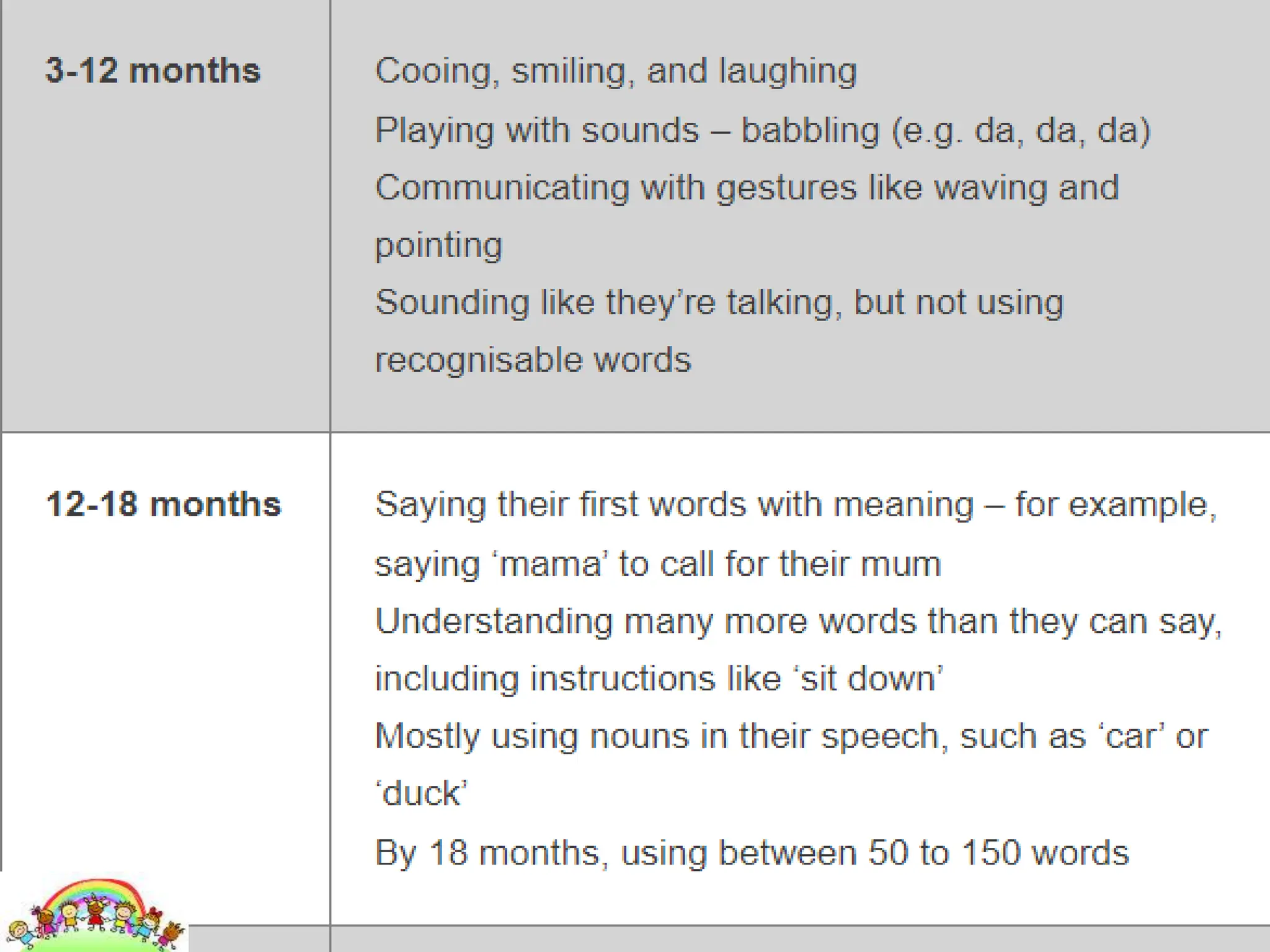
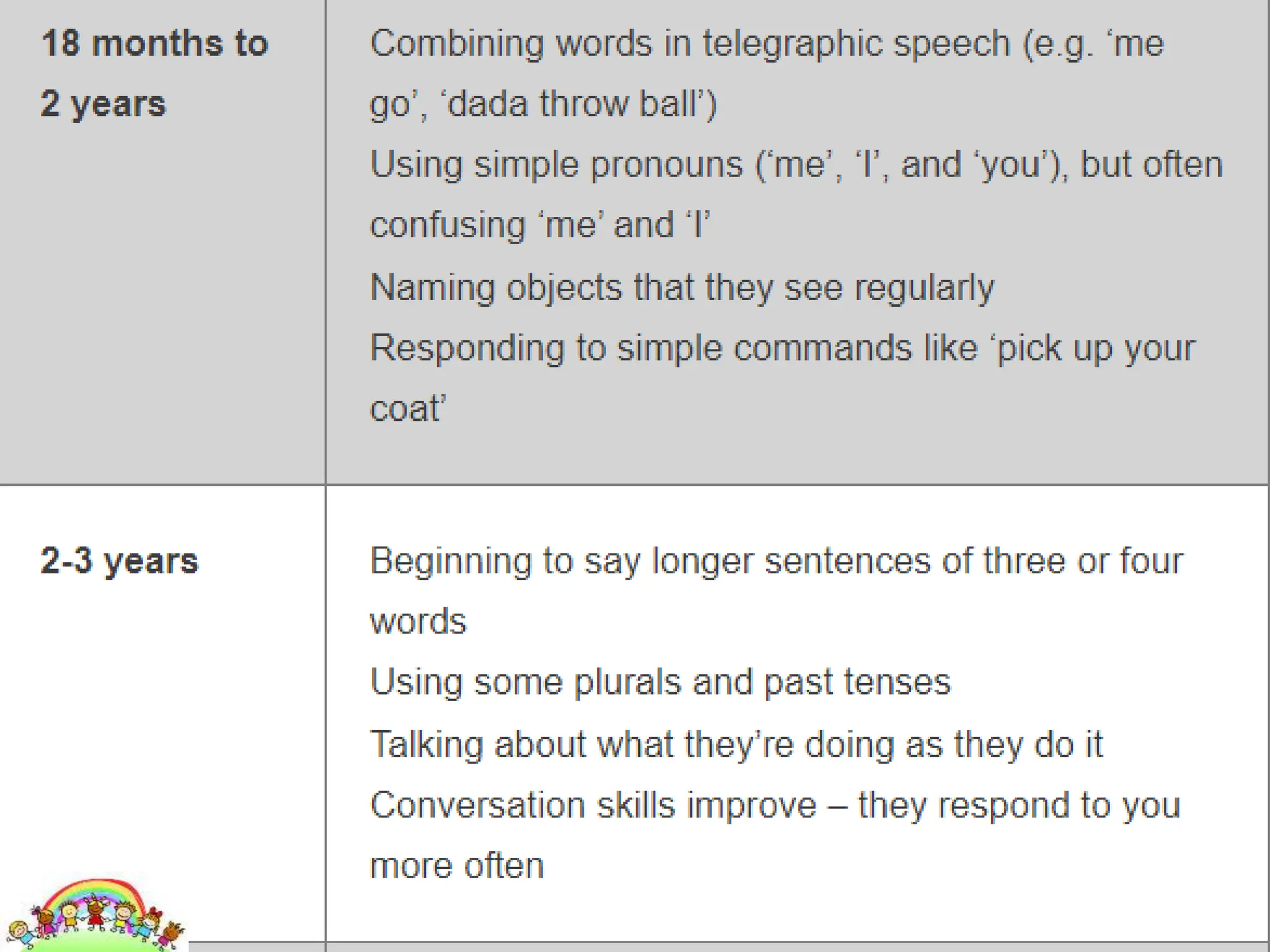
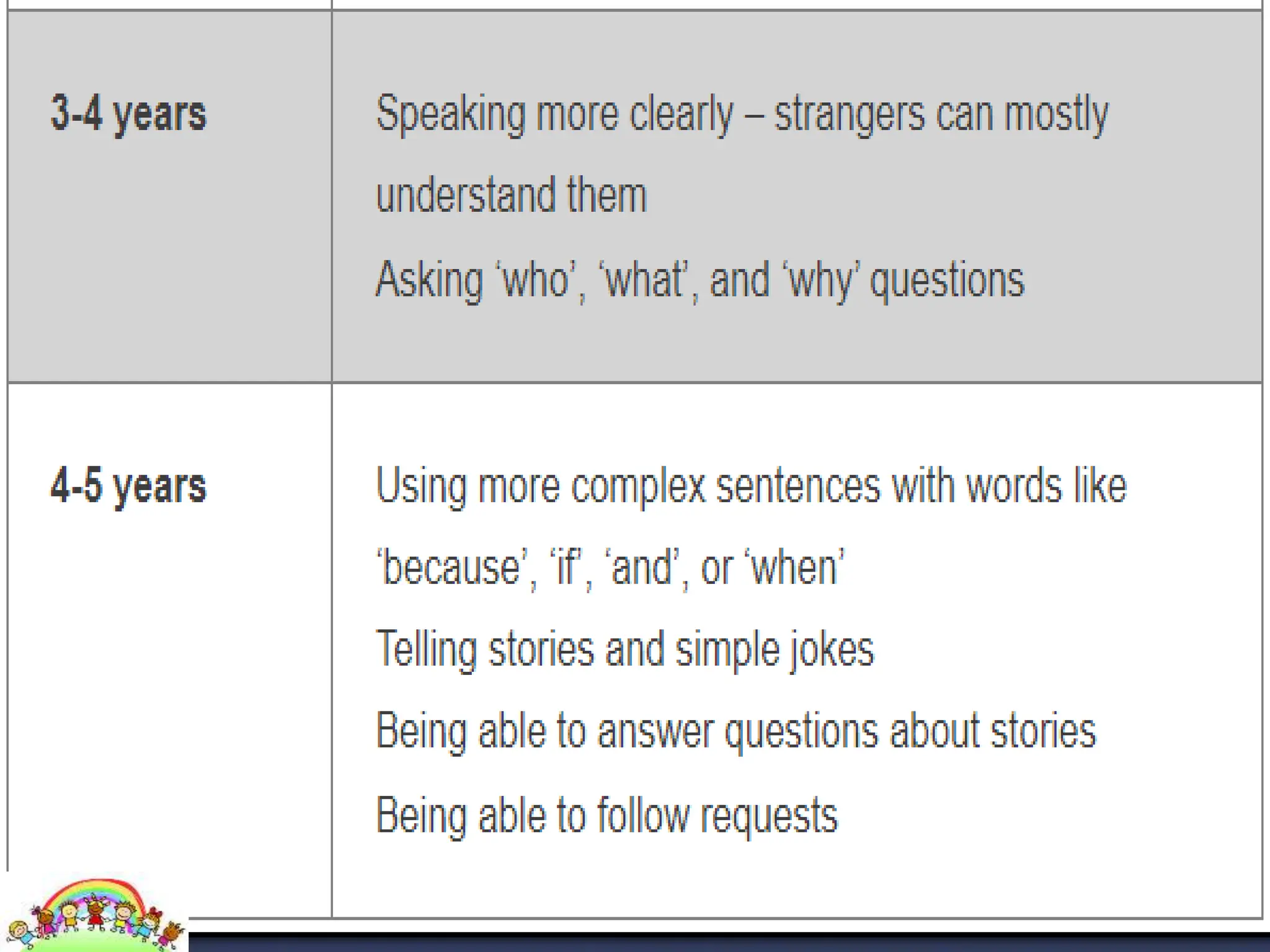
• Preschoolers learn new language skills over
time and at different ages. But here’s what’s
happening for most preschoolers between 3 and
5 years.
3.
INTRODUCTION
• Research hasfound, however, that in
some areas, more than 50% of children
entering reception have language levels
below what is expected for their age.
• Both parents and early years workers
could play a significant role in helping to
improve children’s language development
and outcomes.
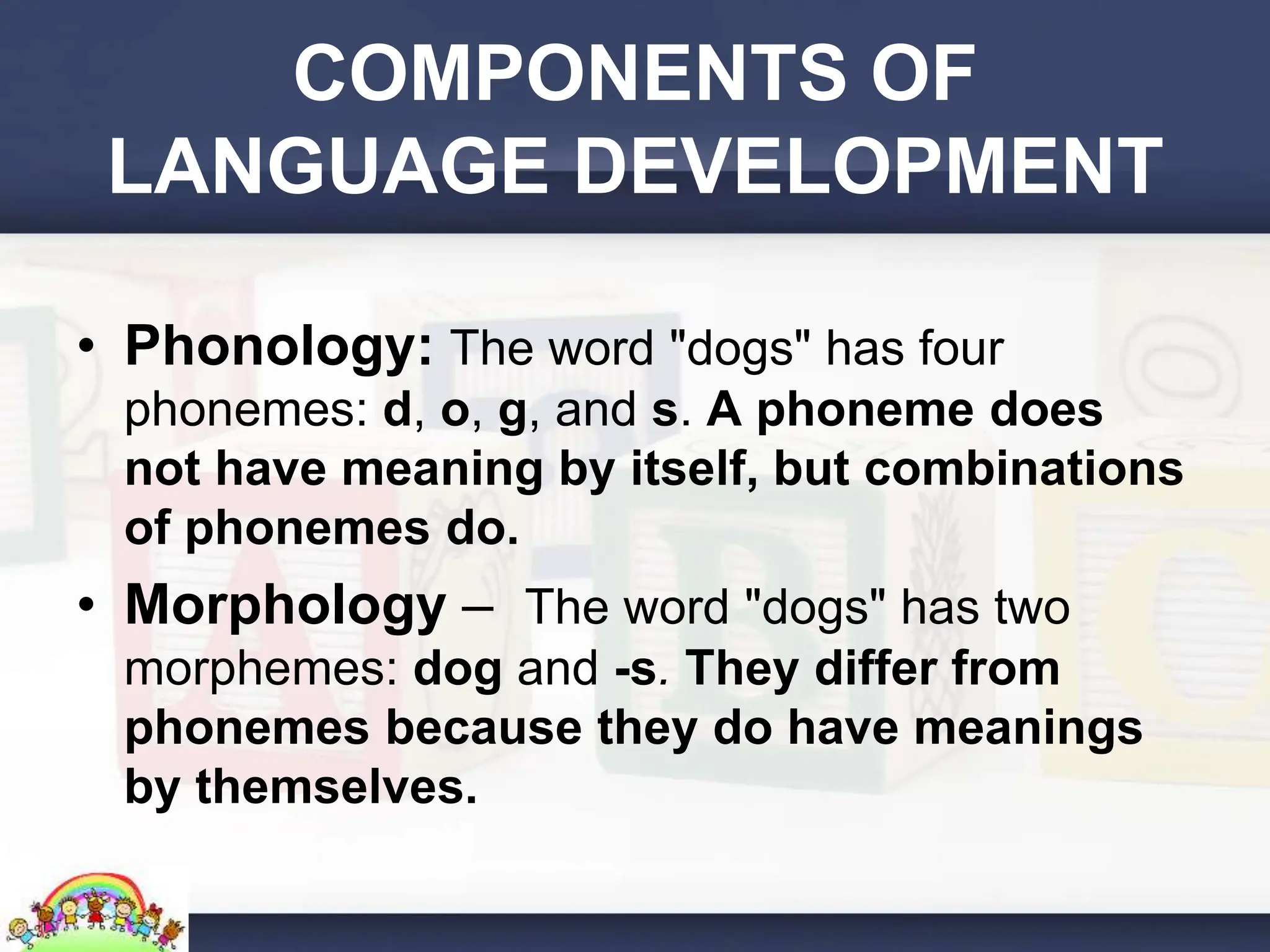
COMPONENTS OF
LANGUAGE DEVELOPMENT
•Phonology: The word "dogs" has four
phonemes: d, o, g, and s. A phoneme does
not have meaning by itself, but combinations
of phonemes do.
• Morphology – The word "dogs" has two
morphemes: dog and -s. They differ from
phonemes because they do have meanings
by themselves.
6.
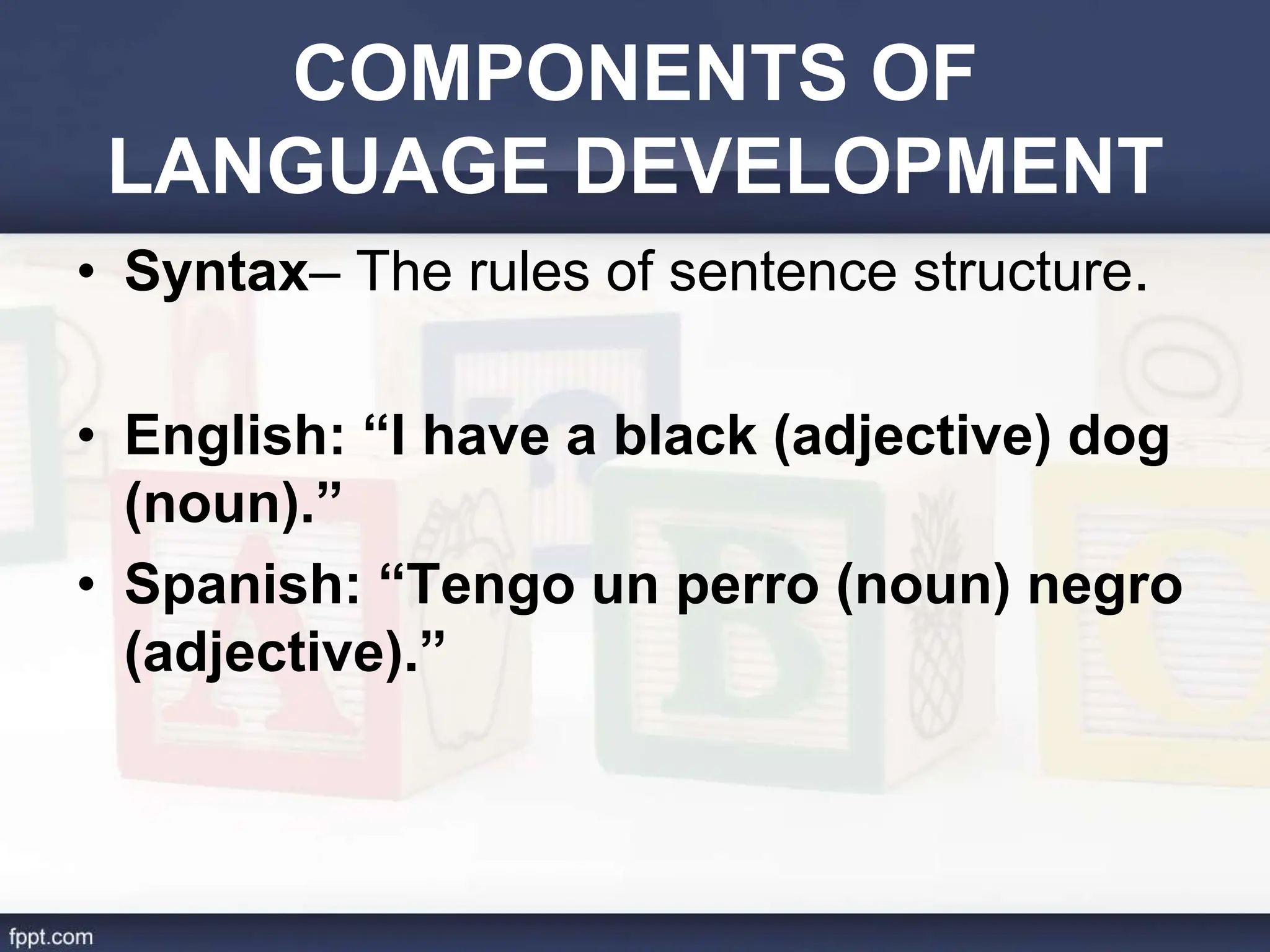
COMPONENTS OF
LANGUAGE DEVELOPMENT
•Syntax– The rules of sentence structure.
• English: “I have a black (adjective) dog
(noun).”
• Spanish: “Tengo un perro (noun) negro
(adjective).”
7.
COMPONENTS OF
LANGUAGE DEVELOPMENT
•Semantics – The rules relating to the
meaning of language; the actual meaning
behind each word within a sentence within
a message.
• Pragmatic – The rules of language that
occur within social situations. For
example, some common language
functions include protesting (e.g., “I don’t
want that!”), commenting (e.g., “Cool shirt
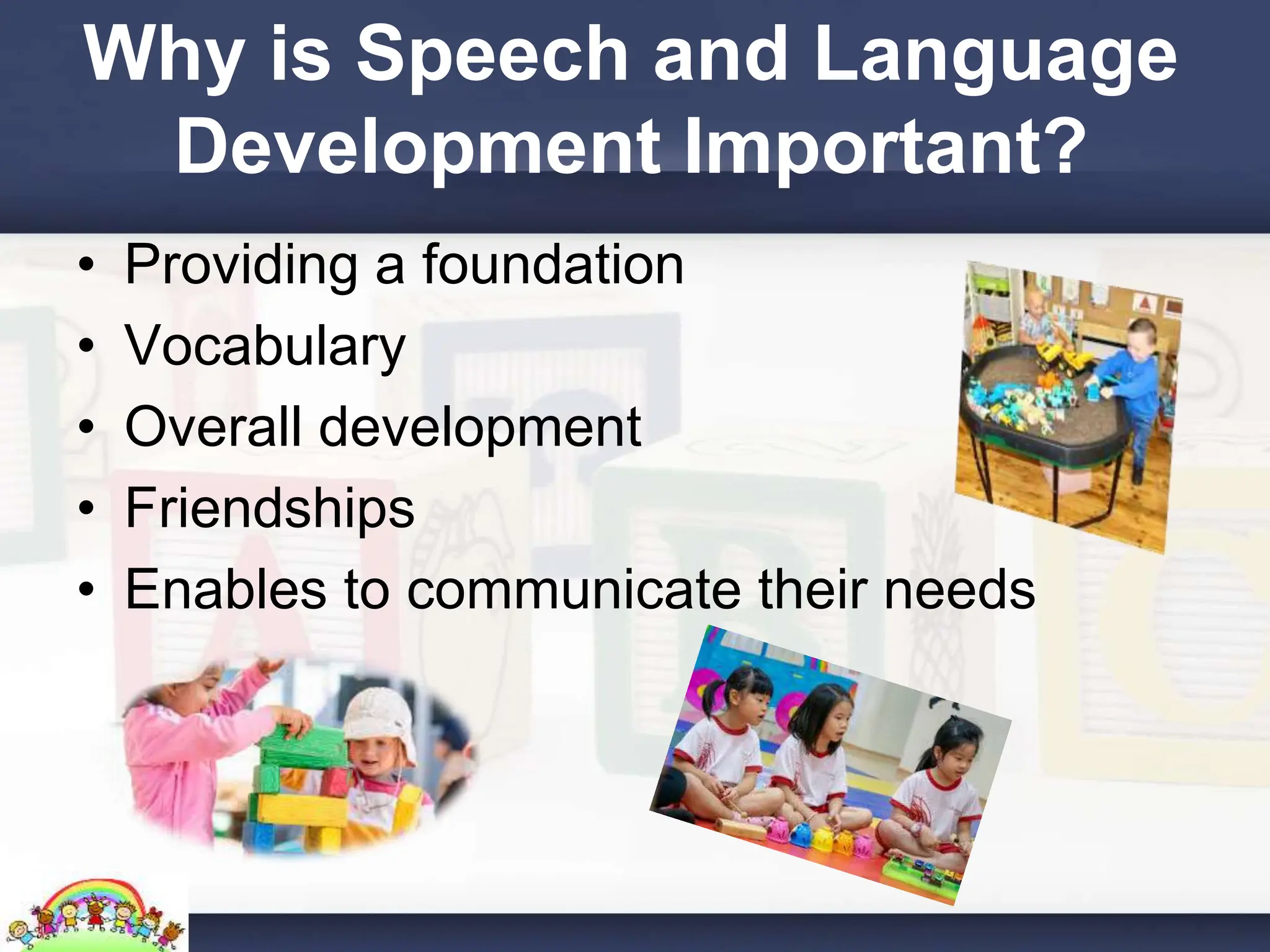
Why is Speechand Language
Development Important?
• Providing a foundation
• Vocabulary
• Overall development
• Friendships
• Enables to communicate their needs
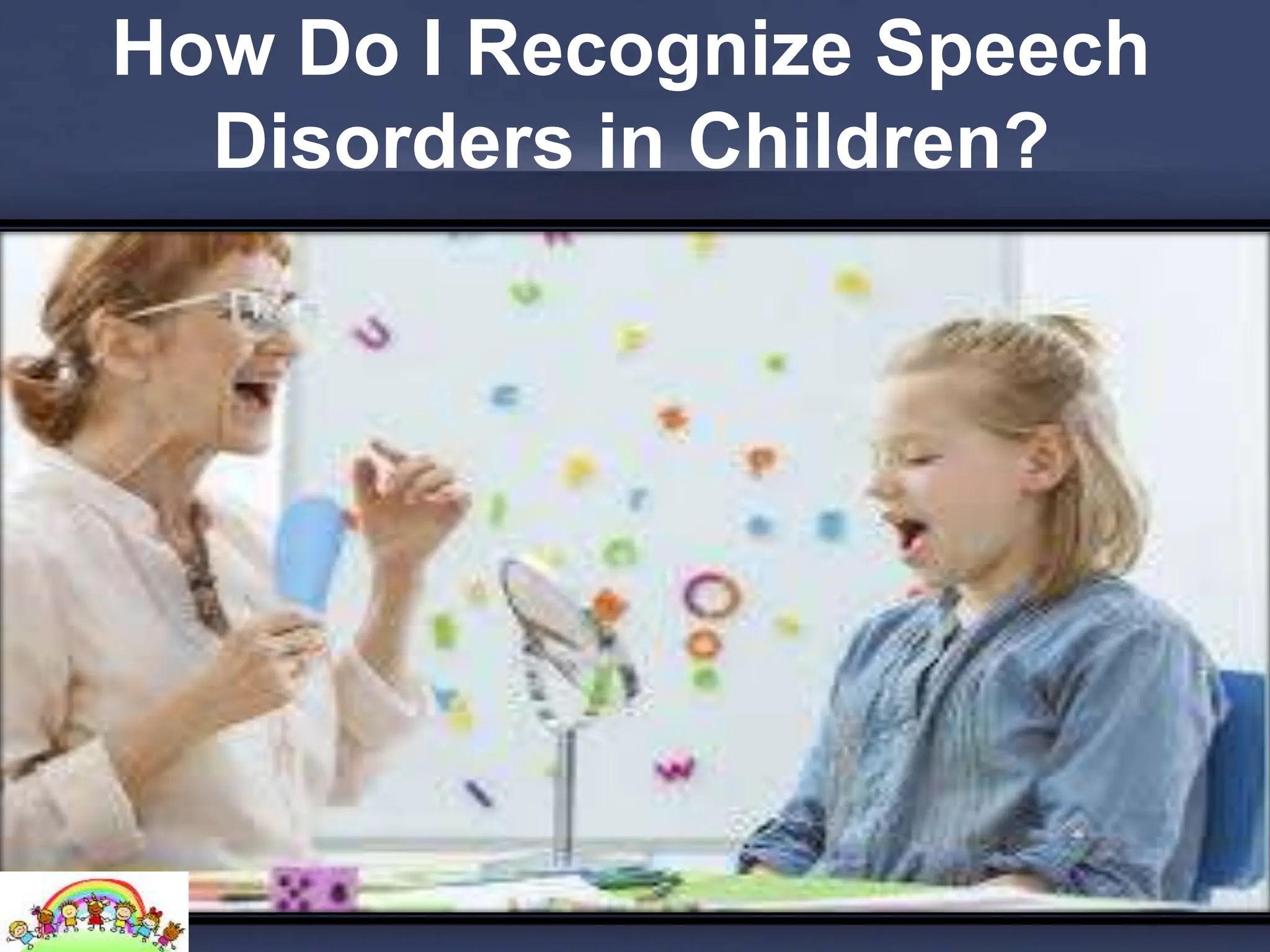
How Do IRecognize Speech
Disorders in Children?
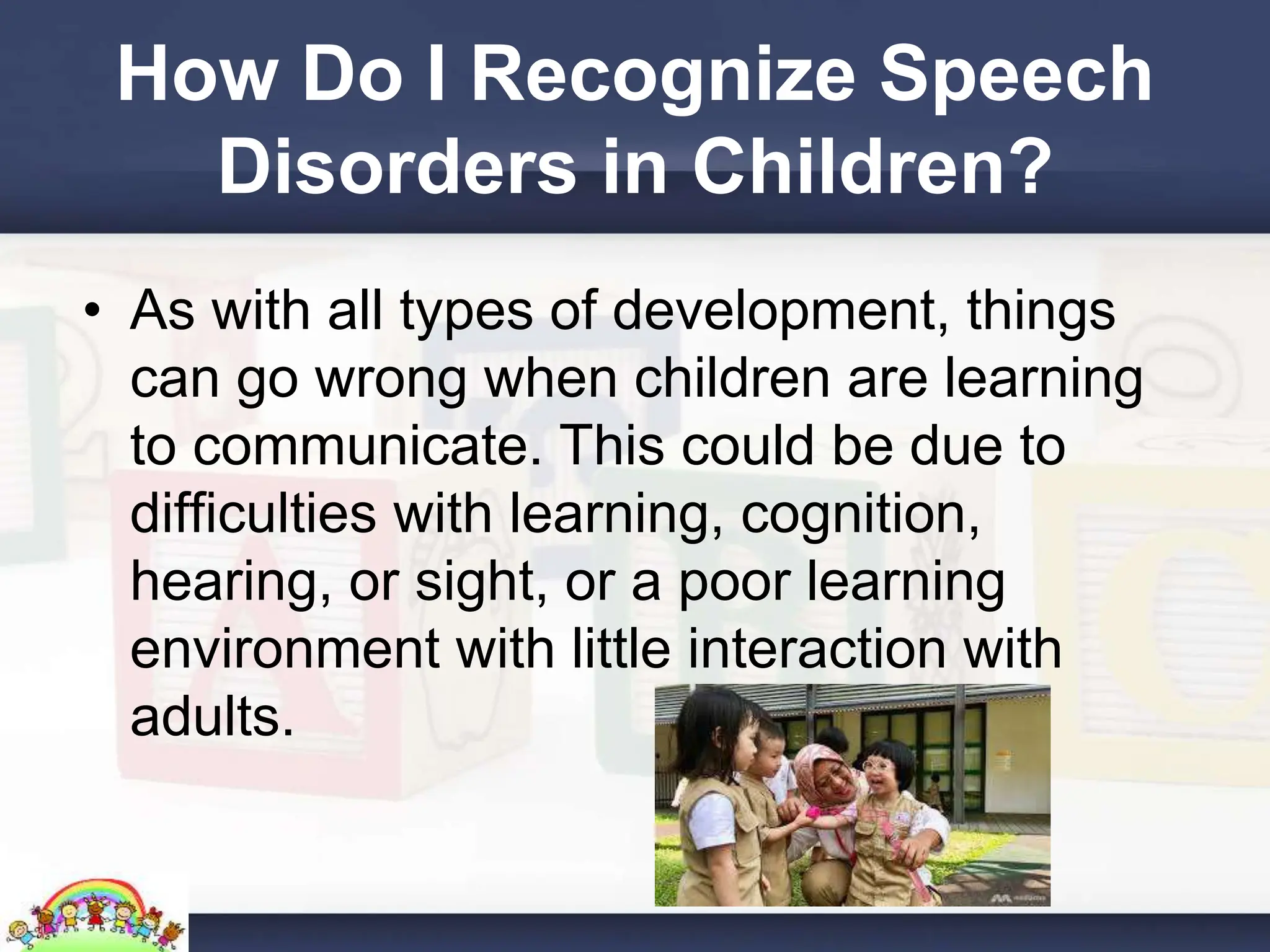
• As with all types of development, things
can go wrong when children are learning
to communicate. This could be due to
difficulties with learning, cognition,
hearing, or sight, or a poor learning
environment with little interaction with
adults.
15.
Types of LanguageProblems
• Language delay
• Developmental Language Disorder
• Speech sound problems
• Fluency
• Attention and listening problems
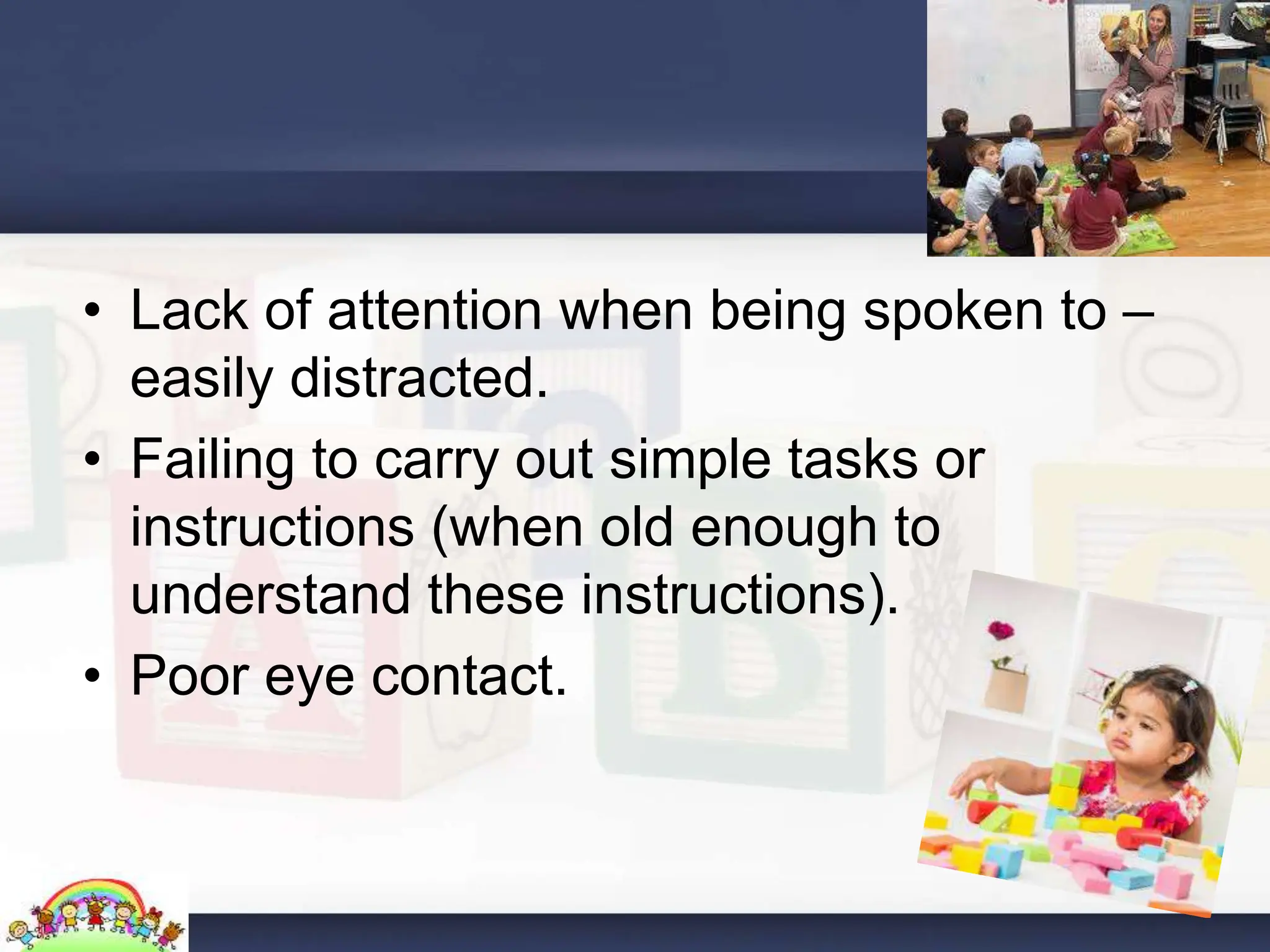
• Lack ofattention when being spoken to –
easily distracted.
• Failing to carry out simple tasks or
instructions (when old enough to
understand these instructions).
• Poor eye contact.
18.
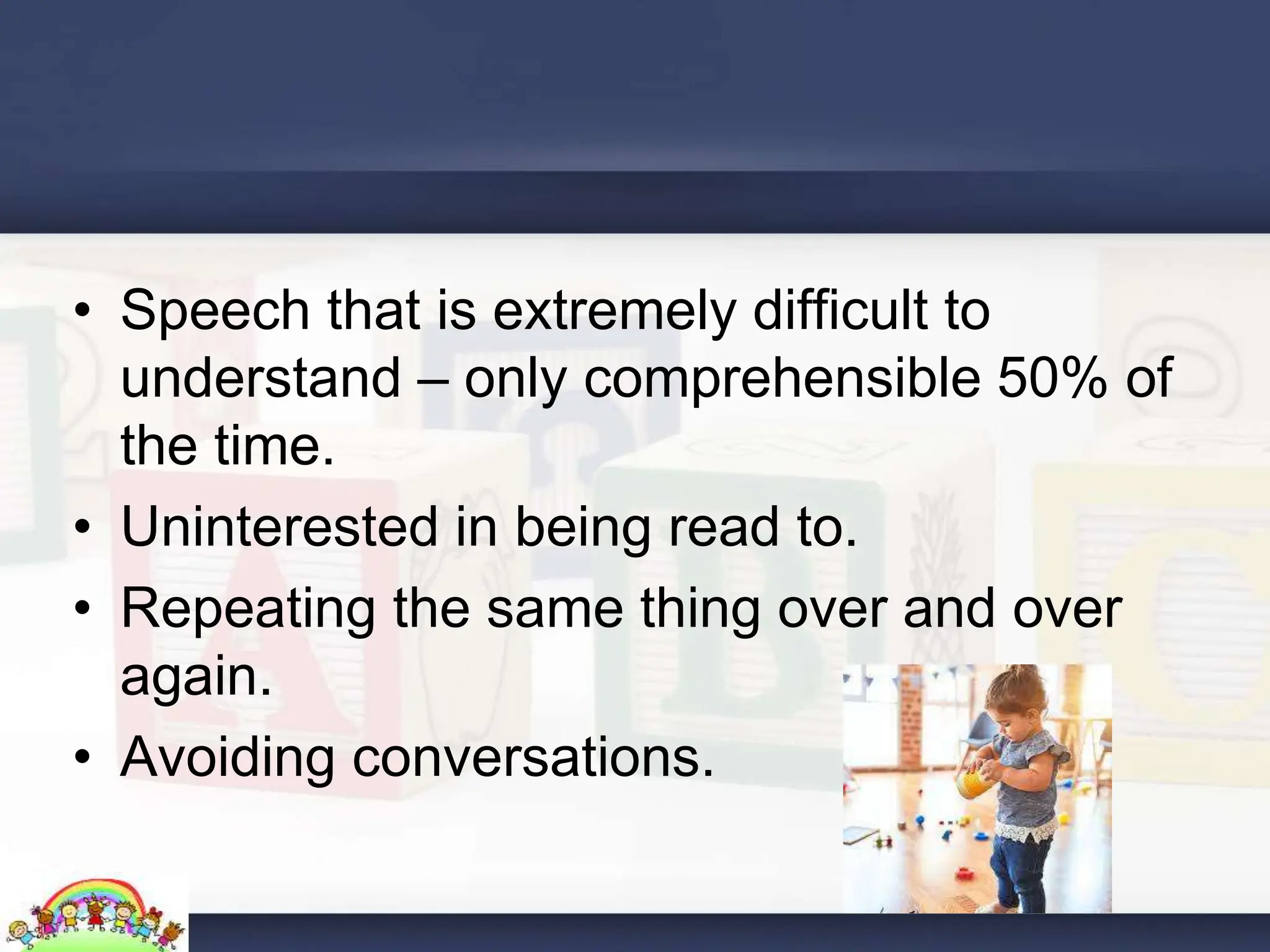
• Speech thatis extremely difficult to
understand – only comprehensible 50% of
the time.
• Uninterested in being read to.
• Repeating the same thing over and over
again.
• Avoiding conversations.
19.
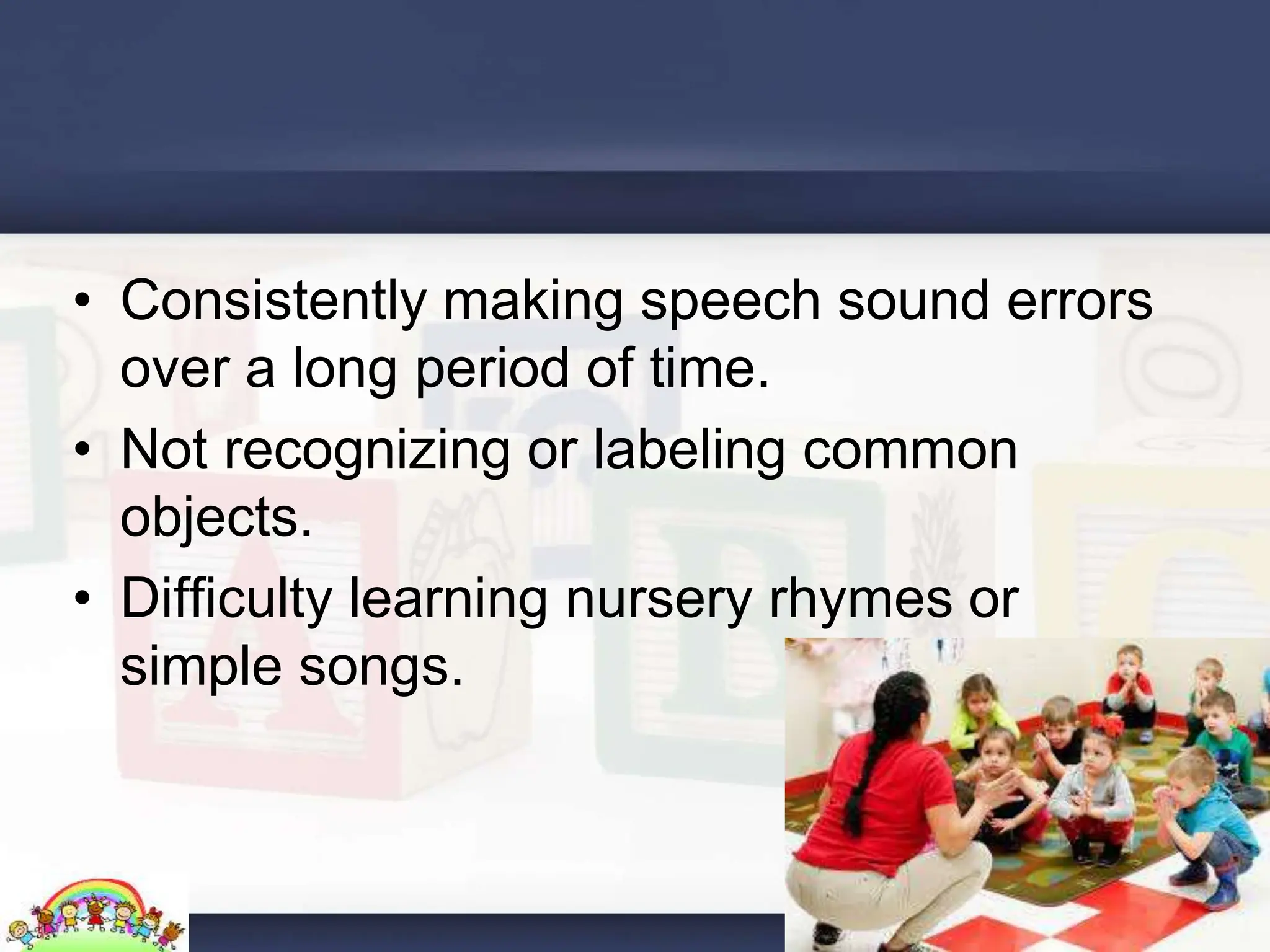
• Consistently makingspeech sound errors
over a long period of time.
• Not recognizing or labeling common
objects.
• Difficulty learning nursery rhymes or
simple songs.
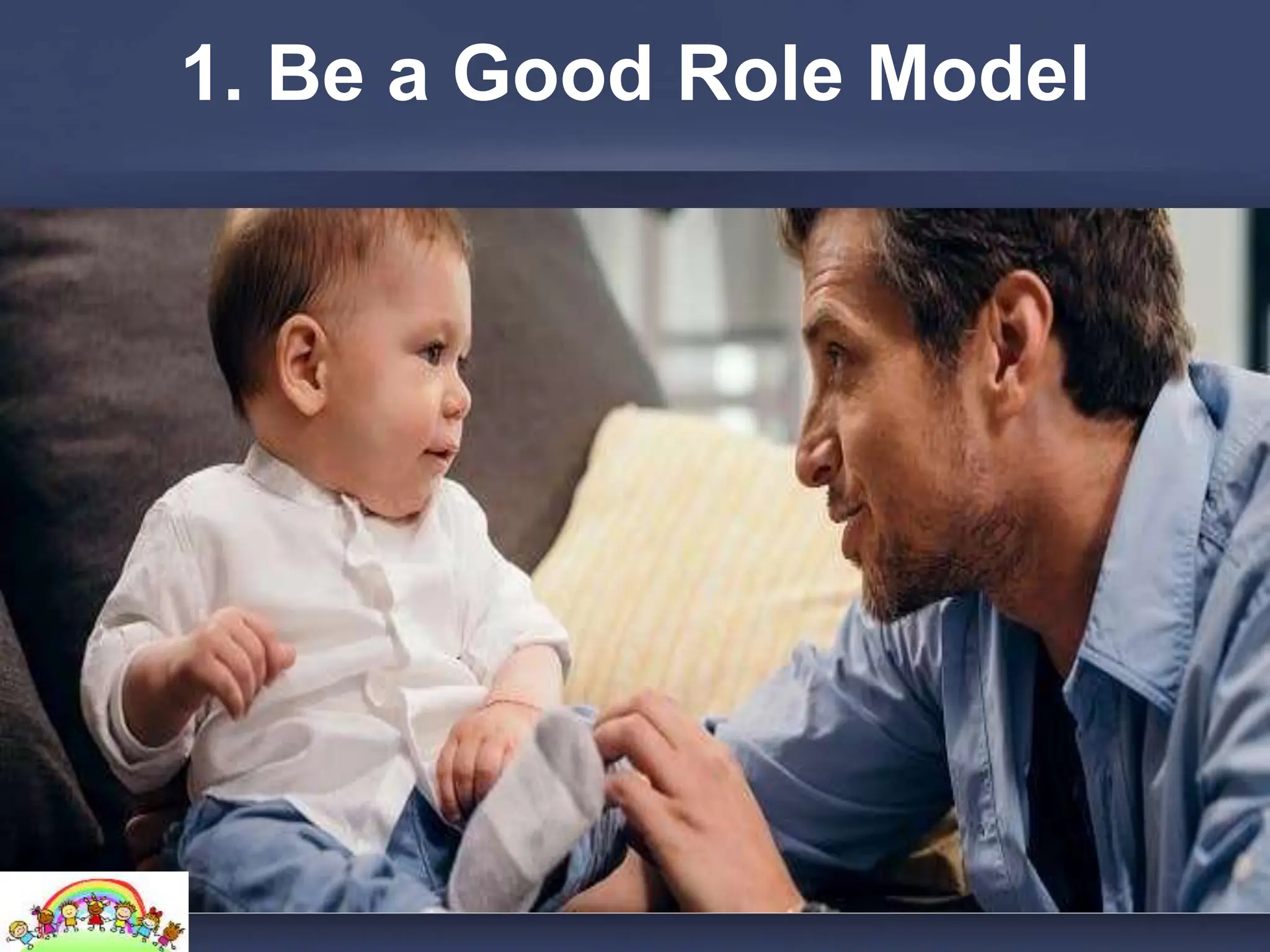
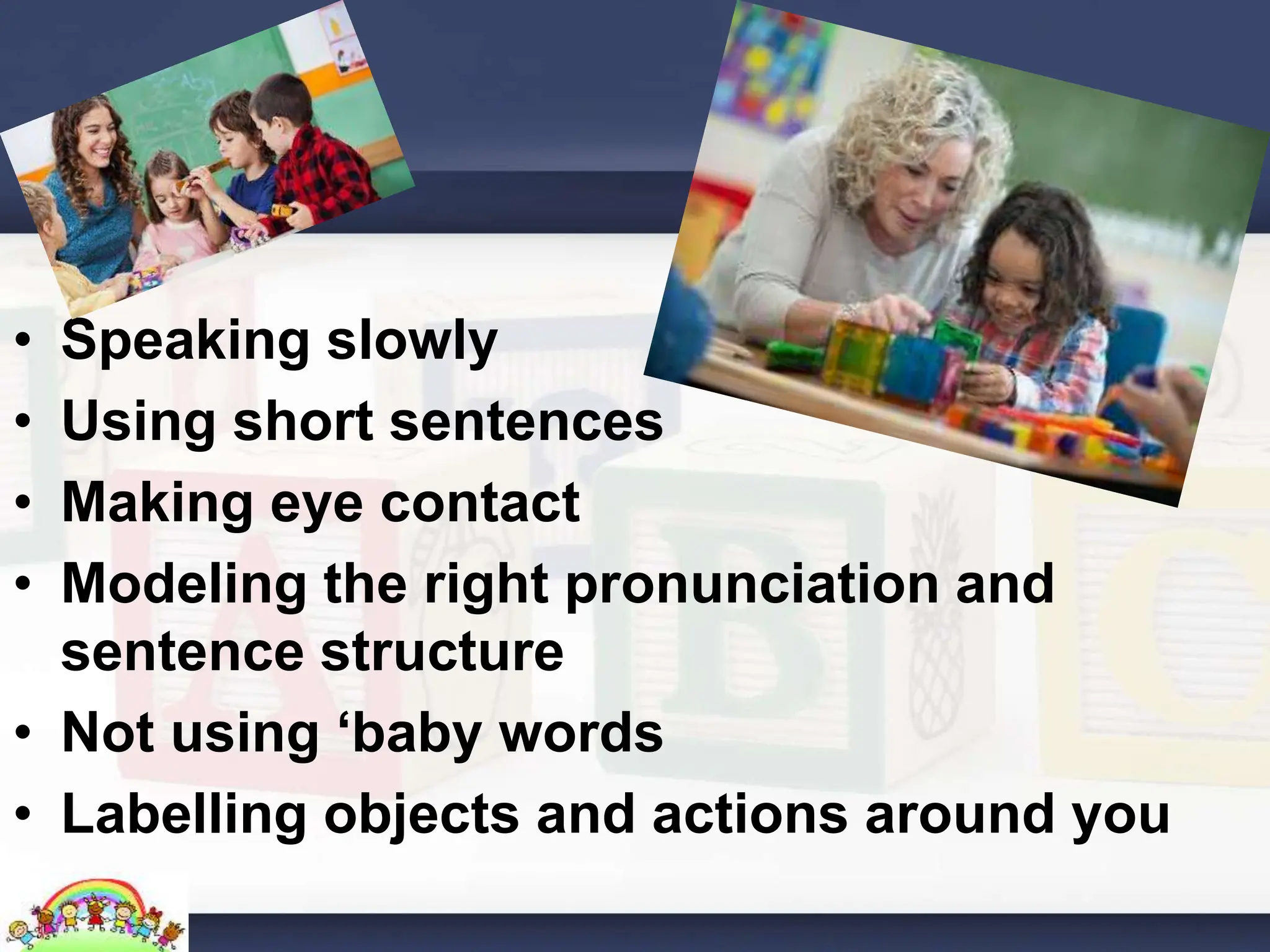
• Speaking slowly
•Using short sentences
• Making eye contact
• Modeling the right pronunciation and
sentence structure
• Not using ‘baby words
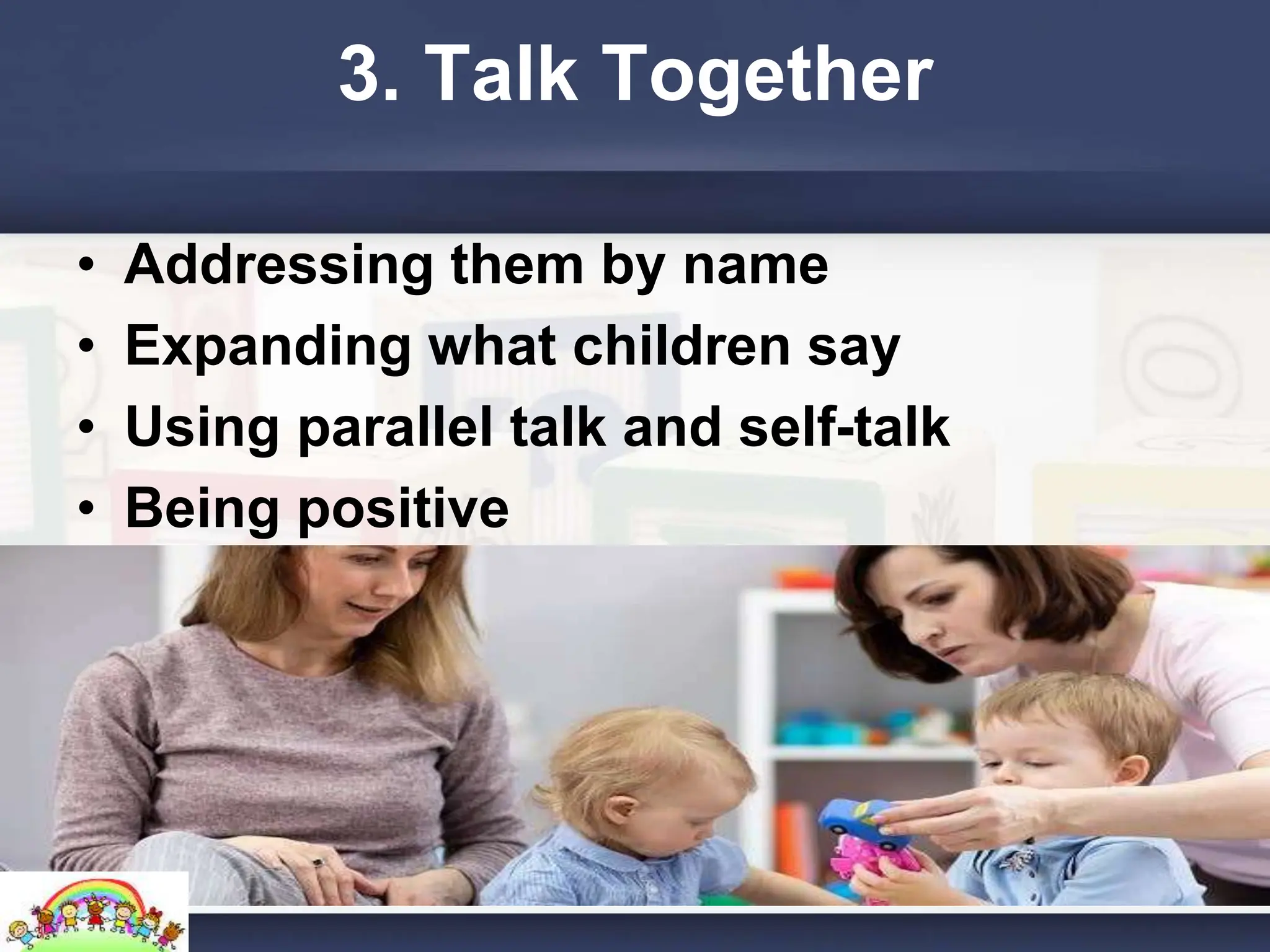
• Labelling objects and actions around you
23.
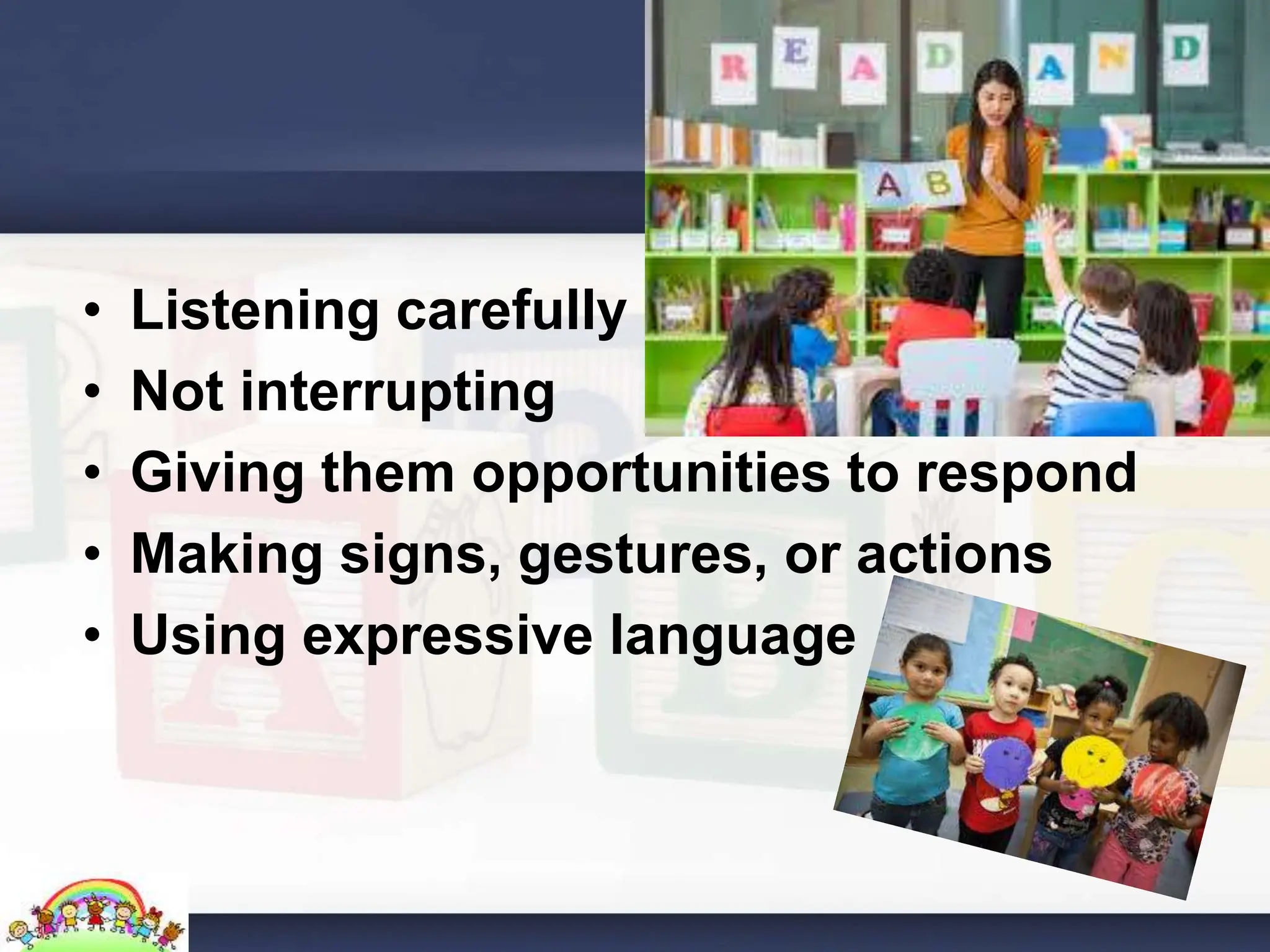
• Listening carefully
•Not interrupting
• Giving them opportunities to respond
• Making signs, gestures, or actions
• Using expressive language
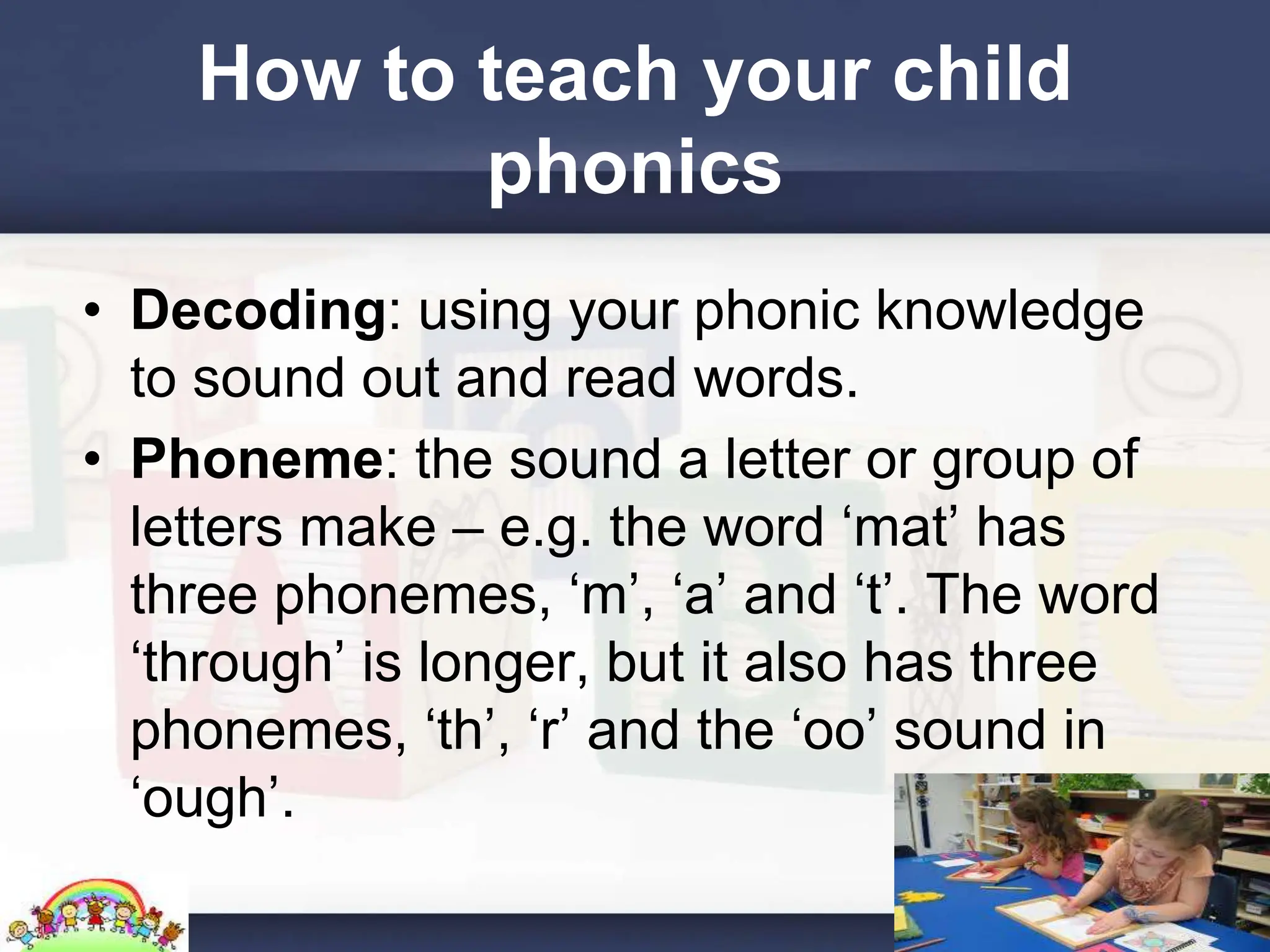
How to teachyour child
phonics
• Decoding: using your phonic knowledge
to sound out and read words.
• Phoneme: the sound a letter or group of
letters make – e.g. the word ‘mat’ has
three phonemes, ‘m’, ‘a’ and ‘t’. The word
‘through’ is longer, but it also has three
phonemes, ‘th’, ‘r’ and the ‘oo’ sound in
‘ough’.
34.
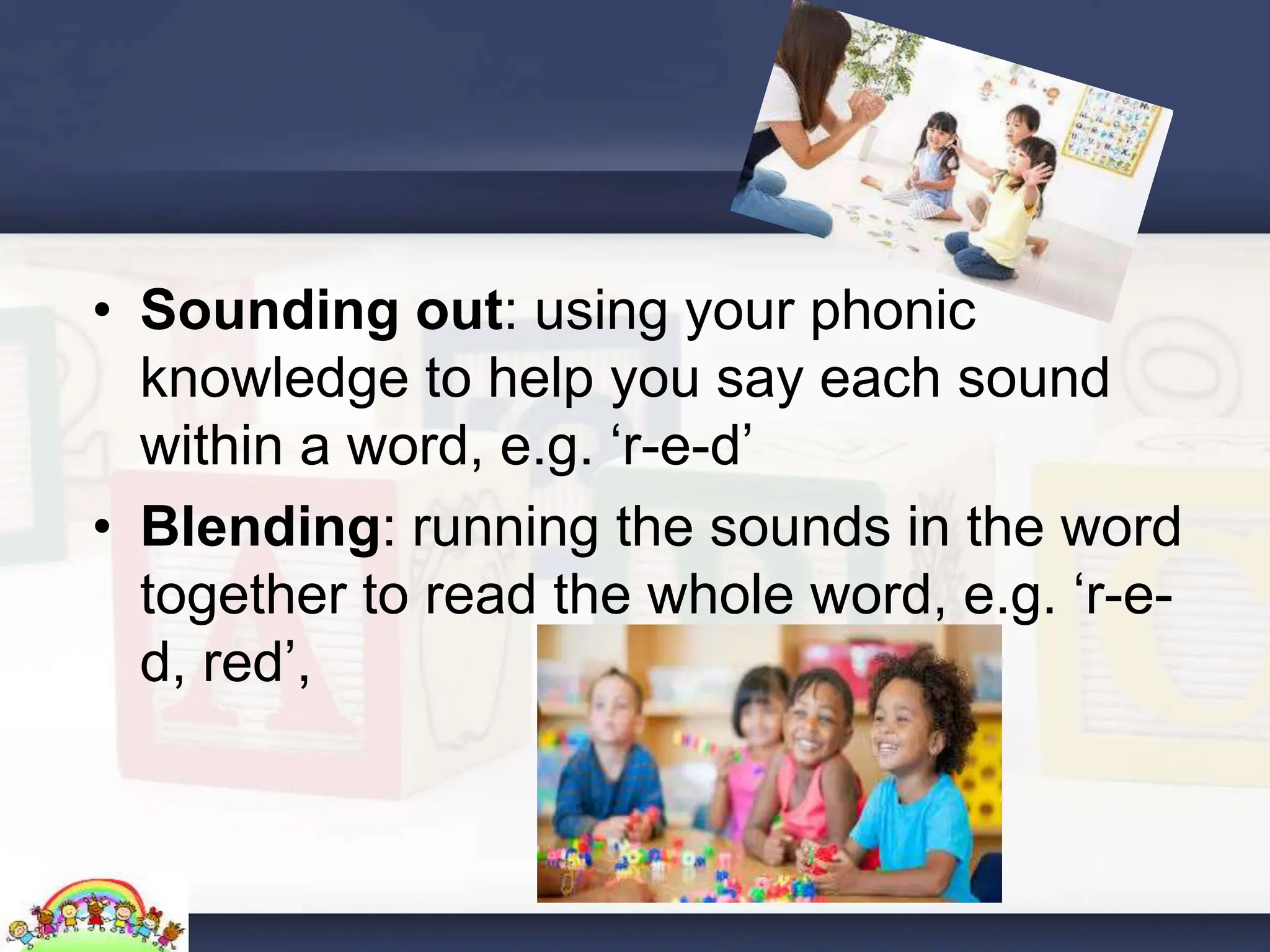
• Sounding out:using your phonic
knowledge to help you say each sound
within a word, e.g. ‘r-e-d’
• Blending: running the sounds in the word
together to read the whole word, e.g. ‘r-e-
d, red’,
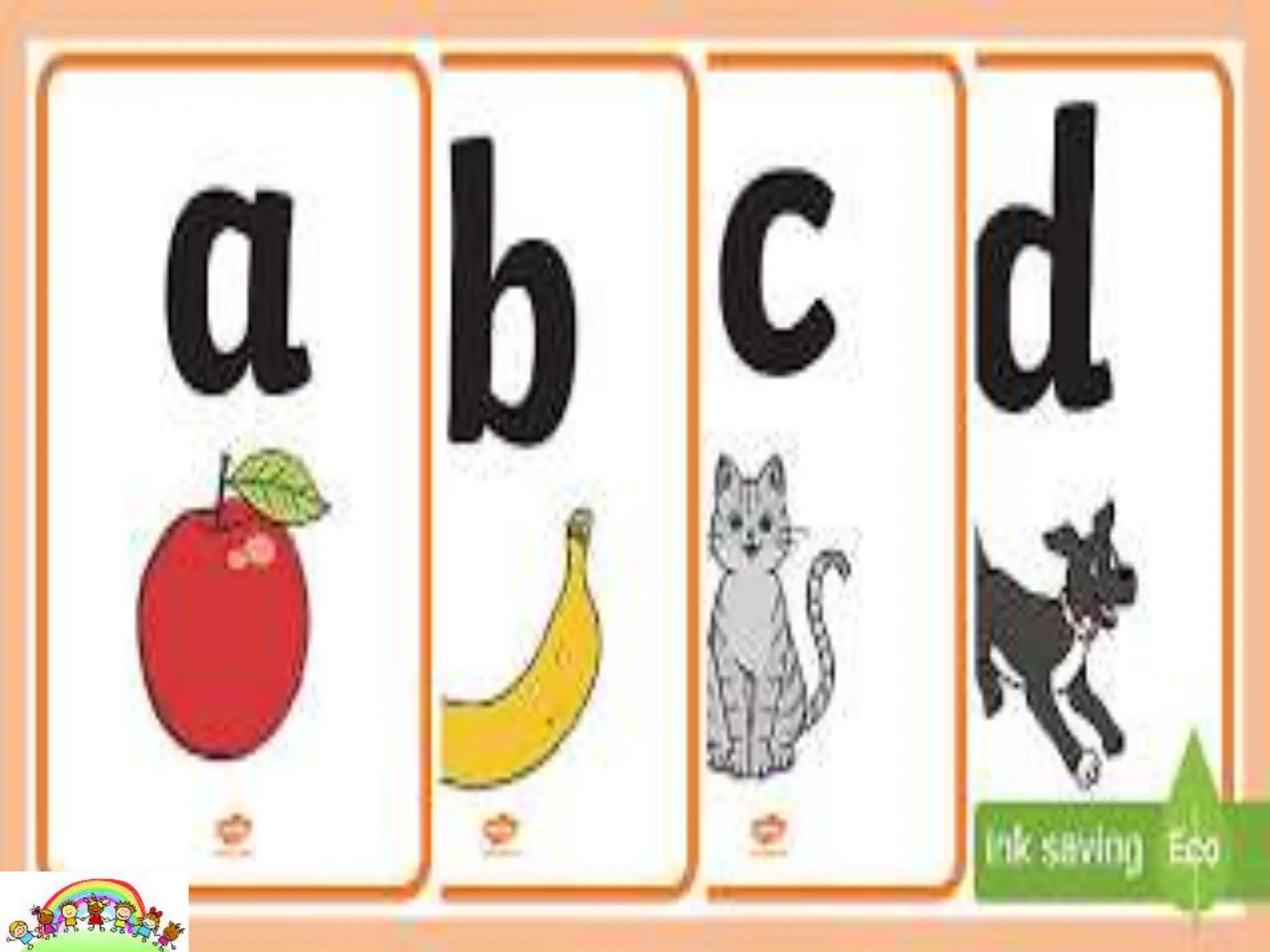
• Phonics meansusing letter sounds to help
you read words.
• In pre-school or nursery, before they even
start learning letter names and sounds,
children begin developing their listening
skills so that they are tuned into the
different sounds in words.
37.
• Then, usuallyin reception or year/primary
one, the letters of the alphabet are
introduced in a set order, and children
learn one sound for each letter. At that
point, they can sound out and read simple,
short words like ‘c-a-t, cat’ and ‘s-u-n, sun’.
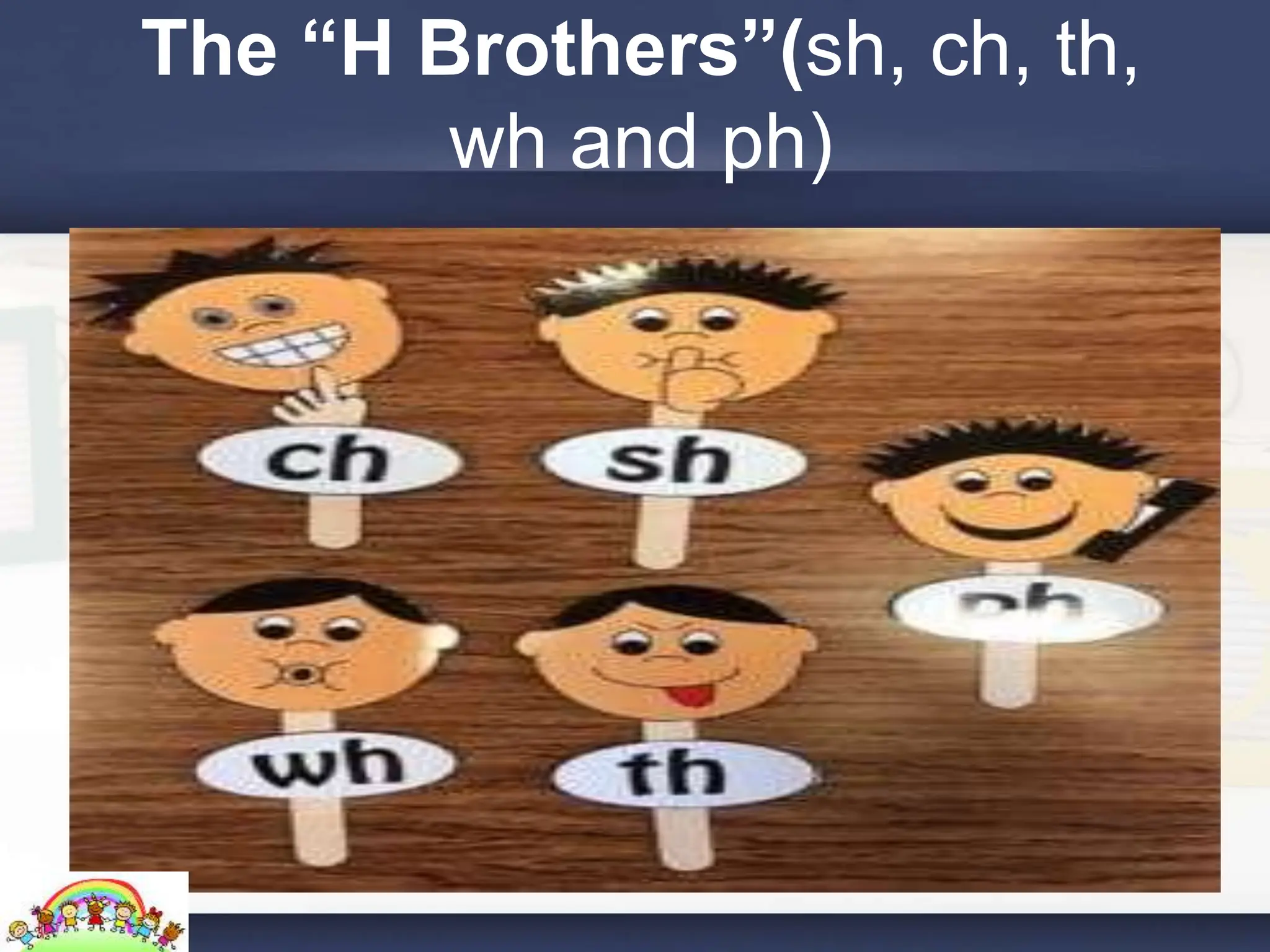
Next, children learn that some letters
make different sounds when you put them
together, like ‘sh’,
38.
Keep it easyand fun
• Keep phonics sessions short and focused. Aim
to stop before your child gets bored! Ten
minutes is often long enough.
• Make it as fun as possible – see below for some
ideas for phonics games you could play
together.
• Pick a time when your child’s not too tired, and
find a quiet place where they won’t be distracted
by screens (or by noisy brothers or sisters!).
39.
• Use theirhobbies and interests! If they’re
into animals, see how many different
animal noises they can make.
• When you’re out and about, listen out for
sounds – birdsong, traffic noises, etc. Can
your child tell you what made the sound?
Can they copy it?
40.
Phonics and Decoding
Activities
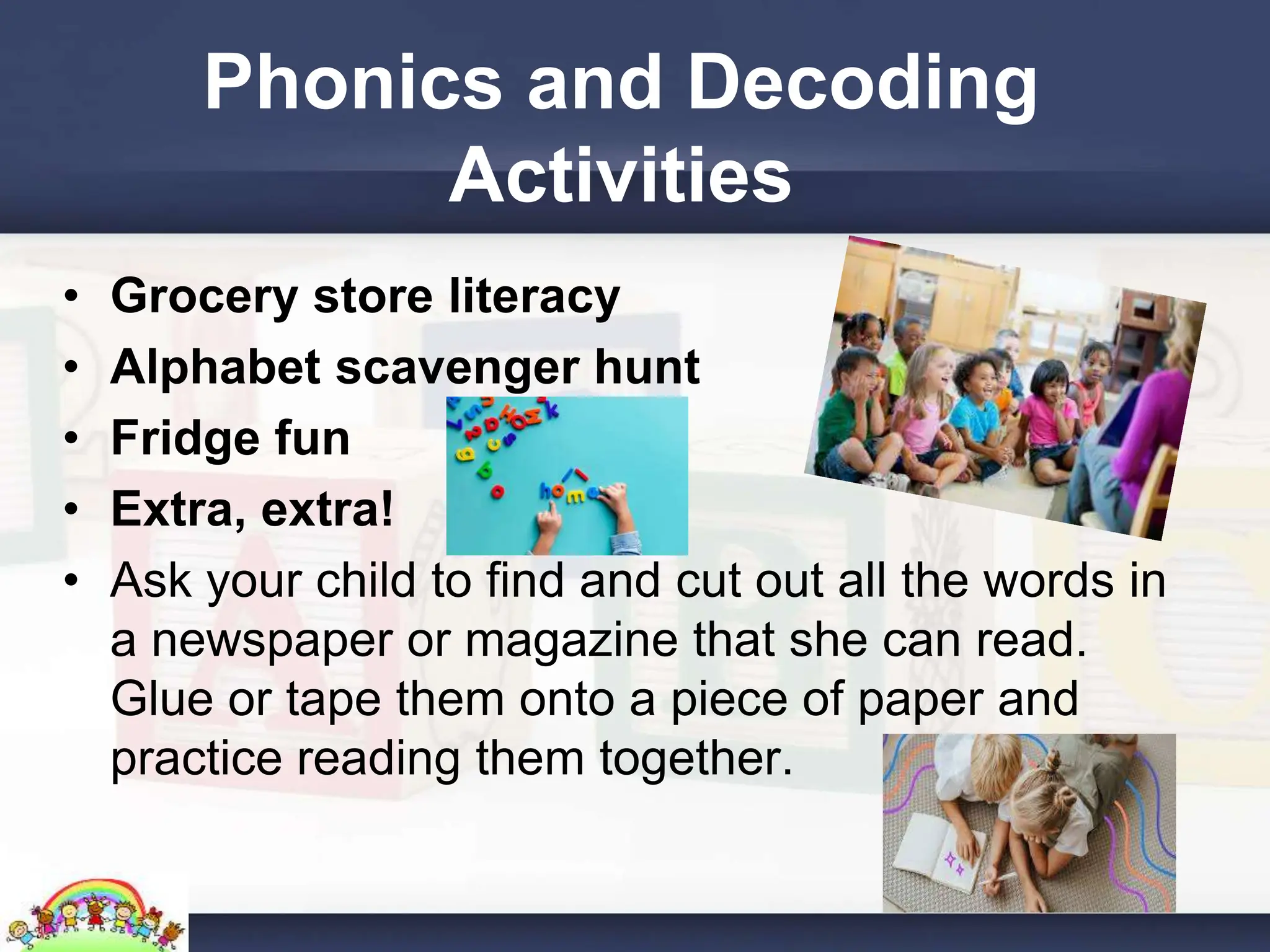
•Grocery store literacy
• Alphabet scavenger hunt
• Fridge fun
• Extra, extra!
• Ask your child to find and cut out all the words in
a newspaper or magazine that she can read.
Glue or tape them onto a piece of paper and
practice reading them together.