Language Therapy Ltd
www.language-therapy.co.uk
Speech Sound
Development
and Intervention
Mary Hampton
specialist speech and language therapist
Director Language Therapy Ltd
13 May 2015
• Putting speech sounds in perspective
• The anatomy of speech
• Classification of speech sounds by production
• Cued articulation
• Typical speech development
• Developmental errors / simplifications
• Intervention programmes
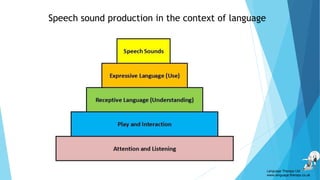
Speech sound production in the context of language
Language Therapy Ltd
www.language-therapy.co.uk
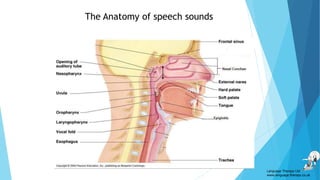
The Anatomy of speech sounds
Language Therapy Ltd
www.language-therapy.co.uk
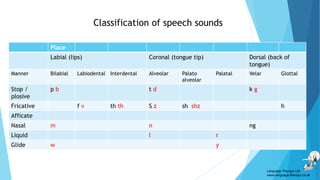
Place
Labial (lips) Coronal (tongue tip) Dorsal (back of
tongue)
Manner Bilabial Labiodental Interdental Alveolar Palato
alveolar
Palatal Velar Glottal
Stop /
plosive
p b t d k g
Fricative f v th th S z sh shz h
Afficate
Nasal m n ng
Liquid l r
Glide w y
Classification of speech sounds
Language Therapy Ltd
www.language-therapy.co.uk
Cued ArticulationTELL ME - I FORGET
SHOW ME - I REMEMBER
INVOLVE ME - I UNDERSTAND.
~ANCIENT CHINESE PROVERB
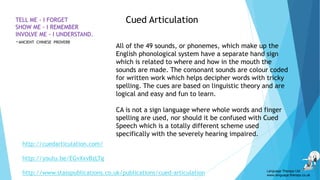
All of the 49 sounds, or phonemes, which make up the
English phonological system have a separate hand sign
which is related to where and how in the mouth the
sounds are made. The consonant sounds are colour coded
for written work which helps decipher words with tricky
spelling. The cues are based on linguistic theory and are
logical and easy and fun to learn.
CA is not a sign language where whole words and finger
spelling are used, nor should it be confused with Cued
Speech which is a totally different scheme used
specifically with the severely hearing impaired.
http://cuedarticulation.com/
http://youtu.be/EGvXxvBzLTg
http://www.stasspublications.co.uk/publications/cued-articulation Language Therapy Ltd
www.language-therapy.co.uk
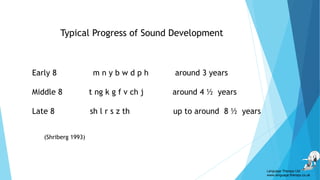
Early 8 m n y b w d p h around 3 years
Middle 8 t ng k g f v ch j around 4 ½ years
Late 8 sh l r s z th up to around 8 ½ years
(Shriberg 1993)
Typical Progress of Sound Development
Language Therapy Ltd
www.language-therapy.co.uk
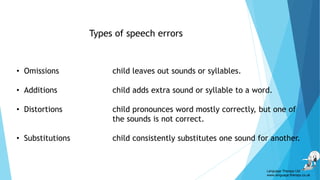
Types of speech errors
• Omissions child leaves out sounds or syllables.
• Additions child adds extra sound or syllable to a word.
• Distortions child pronounces word mostly correctly, but one of
the sounds is not correct.
• Substitutions child consistently substitutes one sound for another.
Language Therapy Ltd
www.language-therapy.co.uk
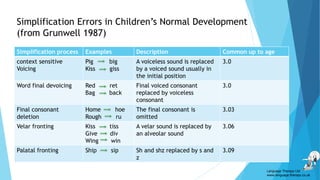
Simplification Errors in Children’s Normal Development
(from Grunwell 1987)
Simplification process Examples Description Common up to age
context sensitive
Voicing
Pig big
Kiss giss
A voiceless sound is replaced
by a voiced sound usually in
the initial position
3.0
Word final devoicing Red ret
Bag back
Final voiced consonant
replaced by voiceless
consonant
3.0
Final consonant
deletion
Home hoe
Rough ru
The final consonant is
omitted
3.03
Velar fronting Kiss tiss
Give div
Wing win
A velar sound is replaced by
an alveolar sound
3.06
Palatal fronting Ship sip Sh and shz replaced by s and
z
3.09
Language Therapy Ltd
www.language-therapy.co.uk
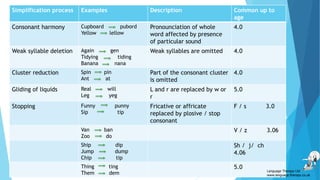
Simplification process Examples Description Common up to
age
Consonant harmony Cupboard pubord
Yellow lellow
Pronounciation of whole
word affected by presence
of particular sound
4.0
Weak syllable deletion Again gen
Tidying tiding
Banana nana
Weak syllables are omitted 4.0
Cluster reduction Spin pin
Ant at
Part of the consonant cluster
is omitted
4.0
Gliding of liquids Real will
Leg yeg
L and r are replaced by w or
r
5.0
Stopping Funny punny
Sip tip
Fricative or affricate
replaced by plosive / stop
consonant
F / s 3.0
Van ban
Zoo do
V / z 3.06
Ship dip
Jump dump
Chip tip
Sh / j/ ch
4.06
Thing ting
Them dem
5.0
Language Therapy Ltd
www.language-therapy.co.uk
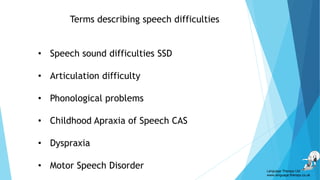
Terms describing speech difficulties
• Speech sound difficulties SSD
• Articulation difficulty
• Phonological problems
• Childhood Apraxia of Speech CAS
• Dyspraxia
• Motor Speech Disorder Language Therapy Ltd
www.language-therapy.co.uk
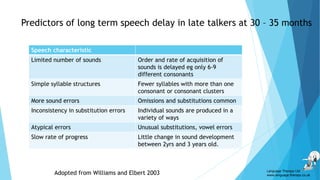
Predictors of long term speech delay in late talkers at 30 – 35 months
Speech characteristic
Limited number of sounds Order and rate of acquisition of
sounds is delayed eg only 6-9
different consonants
Simple syllable structures Fewer syllables with more than one
consonant or consonant clusters
More sound errors Omissions and substitutions common
Inconsistency in substitution errors Individual sounds are produced in a
variety of ways
Atypical errors Unusual substitutions, vowel errors
Slow rate of progress Little change in sound development
between 2yrs and 3 years old.
Adopted from Williams and Elbert 2003 Language Therapy Ltd
www.language-therapy.co.uk
Speech sound production for children with Down Syndrome
• Slower transition from babbling to words
• Greater range of substitutions
• More non developmental errors
• greater variability or inconsistency
• Better in imitation
• Longer period of sound substitutions
• Particular difficulty with structuring sounds in words
• eg missing off sounds at ends of words for longer than expected
• Difficulty sequencing sounds
• More dysfluency in connected speech eg repetition of syllables
• Greater variability between individuals.
Language Therapy Ltd
www.language-therapy.co.uk
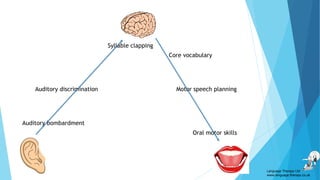
Working on speech production
• Core vocabulary
• Auditory bombardment
• Motor speech planning
• Oral motor skills
• Syllable clapping
• Auditory discrimination
Language Therapy Ltd
www.language-therapy.co.uk
Core vocabulary
Auditory bombardment
Motor speech planning
Oral motor skills
Syllable clapping
Auditory discrimination
Language Therapy Ltd
www.language-therapy.co.uk
Auditory Bombardment
• Exercises in which children hear a target sound accurately produced and several times
in short period of time.
• For example, reading a story that has numerous occurrences of the target sound is
"bombarding" the child with that particular sound.
• Gives the adult the opportunity to model, emphasize and repeat the sound correctly for
the child to hear.
Language Therapy Ltd
www.language-therapy.co.uk
Auditory discrimination
Language Therapy Ltd
www.language-therapy.co.uk
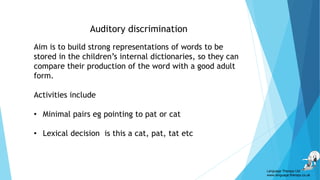
Aim is to build strong representations of words to be
stored in the children’s internal dictionaries, so they can
compare their production of the word with a good adult
form.
Activities include
• Minimal pairs eg pointing to pat or cat
• Lexical decision is this a cat, pat, tat etc
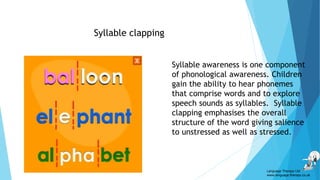
Syllable clapping
Syllable awareness is one component
of phonological awareness. Children
gain the ability to hear phonemes
that comprise words and to explore
speech sounds as syllables. Syllable
clapping emphasises the overall
structure of the word giving salience
to unstressed as well as stressed.
Language Therapy Ltd
www.language-therapy.co.uk
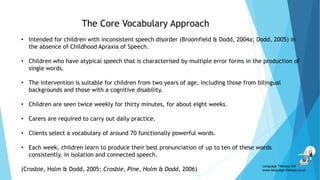
• Intended for children with inconsistent speech disorder (Broomfield & Dodd, 2004a; Dodd, 2005) in
the absence of Childhood Apraxia of Speech.
• Children who have atypical speech that is characterised by multiple error forms in the production of
single words.
• The intervention is suitable for children from two years of age, including those from bilingual
backgrounds and those with a cognitive disability.
• Children are seen twice weekly for thirty minutes, for about eight weeks.
• Carers are required to carry out daily practice.
• Clients select a vocabulary of around 70 functionally powerful words.
• Each week, children learn to produce their best pronunciation of up to ten of these words
consistently, in isolation and connected speech.
(Crosbie, Holm & Dodd, 2005; Crosbie, Pine, Holm & Dodd, 2006)
The Core Vocabulary Approach
Language Therapy Ltd
www.language-therapy.co.uk
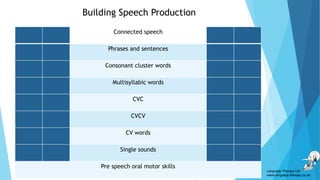
Connected speech
Phrases and sentences
Consonant cluster words
Multisyllabic words
CVC
CVCV
CV words
Single sounds
Pre speech oral motor skills
Building Speech Production
Language Therapy Ltd
www.language-therapy.co.uk
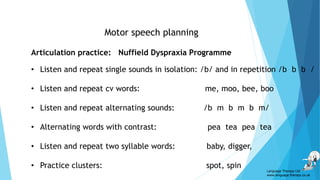
Motor speech planning
Articulation practice: Nuffield Dyspraxia Programme
• Listen and repeat single sounds in isolation: /b/ and in repetition /b b b /
• Listen and repeat cv words: me, moo, bee, boo
• Listen and repeat alternating sounds: /b m b m b m/
• Alternating words with contrast: pea tea pea tea
• Listen and repeat two syllable words: baby, digger,
• Practice clusters: spot, spin
Language Therapy Ltd
www.language-therapy.co.uk
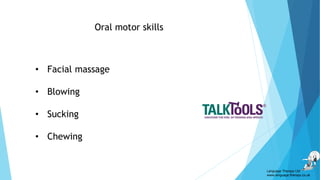
Oral motor skills
• Facial massage
• Blowing
• Sucking
• Chewing
Language Therapy Ltd
www.language-therapy.co.uk
Language Therapy Ltd
www.language-therapy.co.uk

Sounds talk 13 may

  • 1.
    Language Therapy Ltd www.language-therapy.co.uk SpeechSound Development and Intervention Mary Hampton specialist speech and language therapist Director Language Therapy Ltd 13 May 2015
  • 2.
    • Putting speechsounds in perspective • The anatomy of speech • Classification of speech sounds by production • Cued articulation • Typical speech development • Developmental errors / simplifications • Intervention programmes
  • 3.
    Speech sound productionin the context of language Language Therapy Ltd www.language-therapy.co.uk
  • 4.
    The Anatomy ofspeech sounds Language Therapy Ltd www.language-therapy.co.uk
  • 5.
    Place Labial (lips) Coronal(tongue tip) Dorsal (back of tongue) Manner Bilabial Labiodental Interdental Alveolar Palato alveolar Palatal Velar Glottal Stop / plosive p b t d k g Fricative f v th th S z sh shz h Afficate Nasal m n ng Liquid l r Glide w y Classification of speech sounds Language Therapy Ltd www.language-therapy.co.uk
  • 6.
    Cued ArticulationTELL ME- I FORGET SHOW ME - I REMEMBER INVOLVE ME - I UNDERSTAND. ~ANCIENT CHINESE PROVERB All of the 49 sounds, or phonemes, which make up the English phonological system have a separate hand sign which is related to where and how in the mouth the sounds are made. The consonant sounds are colour coded for written work which helps decipher words with tricky spelling. The cues are based on linguistic theory and are logical and easy and fun to learn. CA is not a sign language where whole words and finger spelling are used, nor should it be confused with Cued Speech which is a totally different scheme used specifically with the severely hearing impaired. http://cuedarticulation.com/ http://youtu.be/EGvXxvBzLTg http://www.stasspublications.co.uk/publications/cued-articulation Language Therapy Ltd www.language-therapy.co.uk
  • 7.
    Early 8 mn y b w d p h around 3 years Middle 8 t ng k g f v ch j around 4 ½ years Late 8 sh l r s z th up to around 8 ½ years (Shriberg 1993) Typical Progress of Sound Development Language Therapy Ltd www.language-therapy.co.uk
  • 8.
    Types of speecherrors • Omissions child leaves out sounds or syllables. • Additions child adds extra sound or syllable to a word. • Distortions child pronounces word mostly correctly, but one of the sounds is not correct. • Substitutions child consistently substitutes one sound for another. Language Therapy Ltd www.language-therapy.co.uk
  • 9.
    Simplification Errors inChildren’s Normal Development (from Grunwell 1987) Simplification process Examples Description Common up to age context sensitive Voicing Pig big Kiss giss A voiceless sound is replaced by a voiced sound usually in the initial position 3.0 Word final devoicing Red ret Bag back Final voiced consonant replaced by voiceless consonant 3.0 Final consonant deletion Home hoe Rough ru The final consonant is omitted 3.03 Velar fronting Kiss tiss Give div Wing win A velar sound is replaced by an alveolar sound 3.06 Palatal fronting Ship sip Sh and shz replaced by s and z 3.09 Language Therapy Ltd www.language-therapy.co.uk
  • 10.
    Simplification process ExamplesDescription Common up to age Consonant harmony Cupboard pubord Yellow lellow Pronounciation of whole word affected by presence of particular sound 4.0 Weak syllable deletion Again gen Tidying tiding Banana nana Weak syllables are omitted 4.0 Cluster reduction Spin pin Ant at Part of the consonant cluster is omitted 4.0 Gliding of liquids Real will Leg yeg L and r are replaced by w or r 5.0 Stopping Funny punny Sip tip Fricative or affricate replaced by plosive / stop consonant F / s 3.0 Van ban Zoo do V / z 3.06 Ship dip Jump dump Chip tip Sh / j/ ch 4.06 Thing ting Them dem 5.0 Language Therapy Ltd www.language-therapy.co.uk
  • 11.
    Terms describing speechdifficulties • Speech sound difficulties SSD • Articulation difficulty • Phonological problems • Childhood Apraxia of Speech CAS • Dyspraxia • Motor Speech Disorder Language Therapy Ltd www.language-therapy.co.uk
  • 12.
    Predictors of longterm speech delay in late talkers at 30 – 35 months Speech characteristic Limited number of sounds Order and rate of acquisition of sounds is delayed eg only 6-9 different consonants Simple syllable structures Fewer syllables with more than one consonant or consonant clusters More sound errors Omissions and substitutions common Inconsistency in substitution errors Individual sounds are produced in a variety of ways Atypical errors Unusual substitutions, vowel errors Slow rate of progress Little change in sound development between 2yrs and 3 years old. Adopted from Williams and Elbert 2003 Language Therapy Ltd www.language-therapy.co.uk
  • 13.
    Speech sound productionfor children with Down Syndrome • Slower transition from babbling to words • Greater range of substitutions • More non developmental errors • greater variability or inconsistency • Better in imitation • Longer period of sound substitutions • Particular difficulty with structuring sounds in words • eg missing off sounds at ends of words for longer than expected • Difficulty sequencing sounds • More dysfluency in connected speech eg repetition of syllables • Greater variability between individuals. Language Therapy Ltd www.language-therapy.co.uk
  • 14.
    Working on speechproduction • Core vocabulary • Auditory bombardment • Motor speech planning • Oral motor skills • Syllable clapping • Auditory discrimination Language Therapy Ltd www.language-therapy.co.uk
  • 15.
    Core vocabulary Auditory bombardment Motorspeech planning Oral motor skills Syllable clapping Auditory discrimination Language Therapy Ltd www.language-therapy.co.uk
  • 16.
    Auditory Bombardment • Exercisesin which children hear a target sound accurately produced and several times in short period of time. • For example, reading a story that has numerous occurrences of the target sound is "bombarding" the child with that particular sound. • Gives the adult the opportunity to model, emphasize and repeat the sound correctly for the child to hear. Language Therapy Ltd www.language-therapy.co.uk
  • 17.
    Auditory discrimination Language TherapyLtd www.language-therapy.co.uk Aim is to build strong representations of words to be stored in the children’s internal dictionaries, so they can compare their production of the word with a good adult form. Activities include • Minimal pairs eg pointing to pat or cat • Lexical decision is this a cat, pat, tat etc
  • 18.
    Syllable clapping Syllable awarenessis one component of phonological awareness. Children gain the ability to hear phonemes that comprise words and to explore speech sounds as syllables. Syllable clapping emphasises the overall structure of the word giving salience to unstressed as well as stressed. Language Therapy Ltd www.language-therapy.co.uk
  • 19.
    • Intended forchildren with inconsistent speech disorder (Broomfield & Dodd, 2004a; Dodd, 2005) in the absence of Childhood Apraxia of Speech. • Children who have atypical speech that is characterised by multiple error forms in the production of single words. • The intervention is suitable for children from two years of age, including those from bilingual backgrounds and those with a cognitive disability. • Children are seen twice weekly for thirty minutes, for about eight weeks. • Carers are required to carry out daily practice. • Clients select a vocabulary of around 70 functionally powerful words. • Each week, children learn to produce their best pronunciation of up to ten of these words consistently, in isolation and connected speech. (Crosbie, Holm & Dodd, 2005; Crosbie, Pine, Holm & Dodd, 2006) The Core Vocabulary Approach Language Therapy Ltd www.language-therapy.co.uk
  • 20.
    Connected speech Phrases andsentences Consonant cluster words Multisyllabic words CVC CVCV CV words Single sounds Pre speech oral motor skills Building Speech Production Language Therapy Ltd www.language-therapy.co.uk
  • 21.
    Motor speech planning Articulationpractice: Nuffield Dyspraxia Programme • Listen and repeat single sounds in isolation: /b/ and in repetition /b b b / • Listen and repeat cv words: me, moo, bee, boo • Listen and repeat alternating sounds: /b m b m b m/ • Alternating words with contrast: pea tea pea tea • Listen and repeat two syllable words: baby, digger, • Practice clusters: spot, spin Language Therapy Ltd www.language-therapy.co.uk
  • 22.
    Oral motor skills •Facial massage • Blowing • Sucking • Chewing Language Therapy Ltd www.language-therapy.co.uk
  • 23.