PHONOLOGICAL DEVELOPMENT
Melissa Buco
Irish De Ocampo
Mariz Encarnacion
Ruth Espiritu
PRELINGUISTIC
SPEECH PERCEPTION
• Babies are equipped with the ability to
hear and discriminate speech sounds
upon birth.
• The perceptual ability of infants is at
first language-general, but gradually
they become attuned to the phonemic
characteristics of their native language.
• Researchers use two methods to assess
the perceptual ability of infants: the
high-amplitude sucking technique and
the head turn technique, which
measure the infants’ interest in new
sounds presented to them.
• Infants are capable of perceiving sounds
categorically the way adults do.
– Categorical perception is the
phenomenon in which a range of
stimuli that differ continuously are
perceived as belonging only to a few
categories with no degrees of
difference. Differences in speech
sounds are measured in terms of voice
onset time (VOT).
– The phoneme boundary effect is a
phenomenon of categorical perception
wherein a range of phonemes which
differ along an acoustic continuum are
perceived as belonging to one end of
that continuum; in short, they are not
an in-between phoneme.
• The ability to perceive sounds
categorically is a property of the
mammalian aural system; it is not
a specifically linguistic property
unique to humans.
• Motherese or infant-directed
speech has the following
characteristics which can help
infants process the speech
stream:
1. a higher-pitched voice;
2. longer pauses and shorter
phrases;
3. a slower tempo resulting in
prolonged vowel sounds.
• The intonation contour of
motherese is widely
exaggerated to highlight some
linguistic features to help
language-learning infants.
• Infants have shown preference
to motherese even cross-
linguistically.
PRELINGUISTIC SPEECH
SOUND DEVELOPMENT
STAGES OF PRESPEECH VOCAL
DEVELOPMENT
0-2 months
(0-6 weeks)
Reflexive crying, vegetative sounds (coughs, sneezes), Sounds
reflecting their physical state.
2-5 months
(6-16 weeks)
Cooing and laughter. Early consonants develop, sounds from the
back of throat, laughs and giggles form (to the enjoyment of
parents).
4-6 months
(16-30 weeks)
Vocal play, babbling gets more adult-like, range and pitch play,,
bilabial trills are common (raspberries).
6-12 months Reduplicated babbling ex: mamama, pitch control develops, ability
to sound out some consonants and vowels.
9-18 months Non-reduplicative babbling, varying of consonants and vowels.
• Reflexive crying and Vegetative
sounds
– In crying and in making these
vegetative sounds, an infant’s
vocal cords vibrate, and the
airflow through the vocal
apparatus is stopped and started.
Thus, even these unpromising
sounds include features that will
later be used to produce speech
sounds
• Cooing and laughter
– Coos- sounds that babies make
when they appear to be happy
and contented
– Social interaction- elicit cooing
– 1st laughter- around the age of
16 weeks
• Vocal play
– Also known as the Expansion Stage
(Oller, 1980)
– During this stage, the variety of
different consonant-like and
vowel-like sounds that infants
produce increases.
– Marginal babbling- long series of
sounds that infants produce by the
end of this expansion stage
– Other noises include: squeals,
growls, friction noises
– 1st recognizable consonant-like
sounds- heard at around 2 to 3
months, and are usually the velars
– Around 6 months- infants start to
produce consonant-like sounds
articulated in the front of the
mouth (bilabials and alveolars)
• Reduplicated babbling
– Also known as Canonical Babbling, is
distinguished from the vocalizations
that precede it by the presence of true
syllables, and these syllables are
typically produced in reduplicated
series of the same consonant and vowel
combination.
– The appearance of canonical babbling is
a major landmark in the infant’s
prespeech development. It is the first
development that distinguishes the
vocal development of hearing children
from that of deaf children.
• Nonreduplicated babbling
– Also known as Variegated Babbling
– The range of consonants and vowels
infants produce expands further.
– Infants combine different consonant +
vowel and consonant + vowel +
consonant syllables into series.
– Prosody- the intonation contour of
speech
– Jargon- wordless sentences
– Intonation babies- children who
produce a great deal of jargon and
who do so for a long time (Dore,
1975)
– Word babies- children who
produce relatively little jargon and
who move quickly on to learning
the words to the tune (Dore,
1975)
INFLUENCE OF THE TARGET LANGUAGE
ON BABBLING
– Universal- even the particular sounds
that babies produce are similar
across environments
– Babbling drift- as early as 6 months,
the sounds that babies produce are
somewhat influenced by the
language that they hear (R. Brown,
1958)
– 2 techniques:
1) To use the judgments of
competent speakers to determine
whether they can tell the differences
among the babblings of babies who
are acquiring different languages.
2) To record babblings of children
who are acquiring different
languages and analyze them for the
presence and frequency of features
in the respective adult languages
• De Boysson-Bardies, Sagart,
and Durand (1984)- 1st
technique
• De Boysson-Bardies, Sagart,
and Durand (1984)- 2nd
technique
– By the end of the babbling stage,
children have made great progress
from their first vowels to an
increasingly large repertoire of
consonants and then to knowing
something about the prosody and
sound patterns of their target
language.
– Children’s vocalizations at this point
are most frequently single syllables,
with some two-syllable
productions.
THE TRANSITION FROM BABBLING TO
WORDS
BABBLING FIRST WORD
TRANSITIONAL PERIOD
Children produce their own invented words.
These invented words are soaund sequences
children use with consistent meanings but
that bear no discernible resemblance to the
sound of any word in the target language.
• Transitional forms
– Protowords
– Sensorimotor morphemes
– Quasiwords
– Phonetically consistent forms
– Often express broad meanings, and
their use tends either to be tightly
bound to particular contexts or to
serve particular functions.
– Stage of vocal development overlaps
with the use of communicative
gestures
PROCESSES UNDERLYING INFANTS’
DEVELOPMENT OF SPEECH SOUNDS
• Nervous system maturation
• Experience
1) Hearing the speech adults
produce
2) Infants’ experience hearing their
own vocal output
TRIVIA
• A baby’s first form of communication
is:
CRYING SMILING
TRIVIA
• To be “bulol” in early years is normal.
– True
– False
TRIVIA
• Children stop babbling when they
learn to speak words.
– True
– False
PHONOLOGICAL DEVELOPMENT
ONCE SPEECH BEGINS
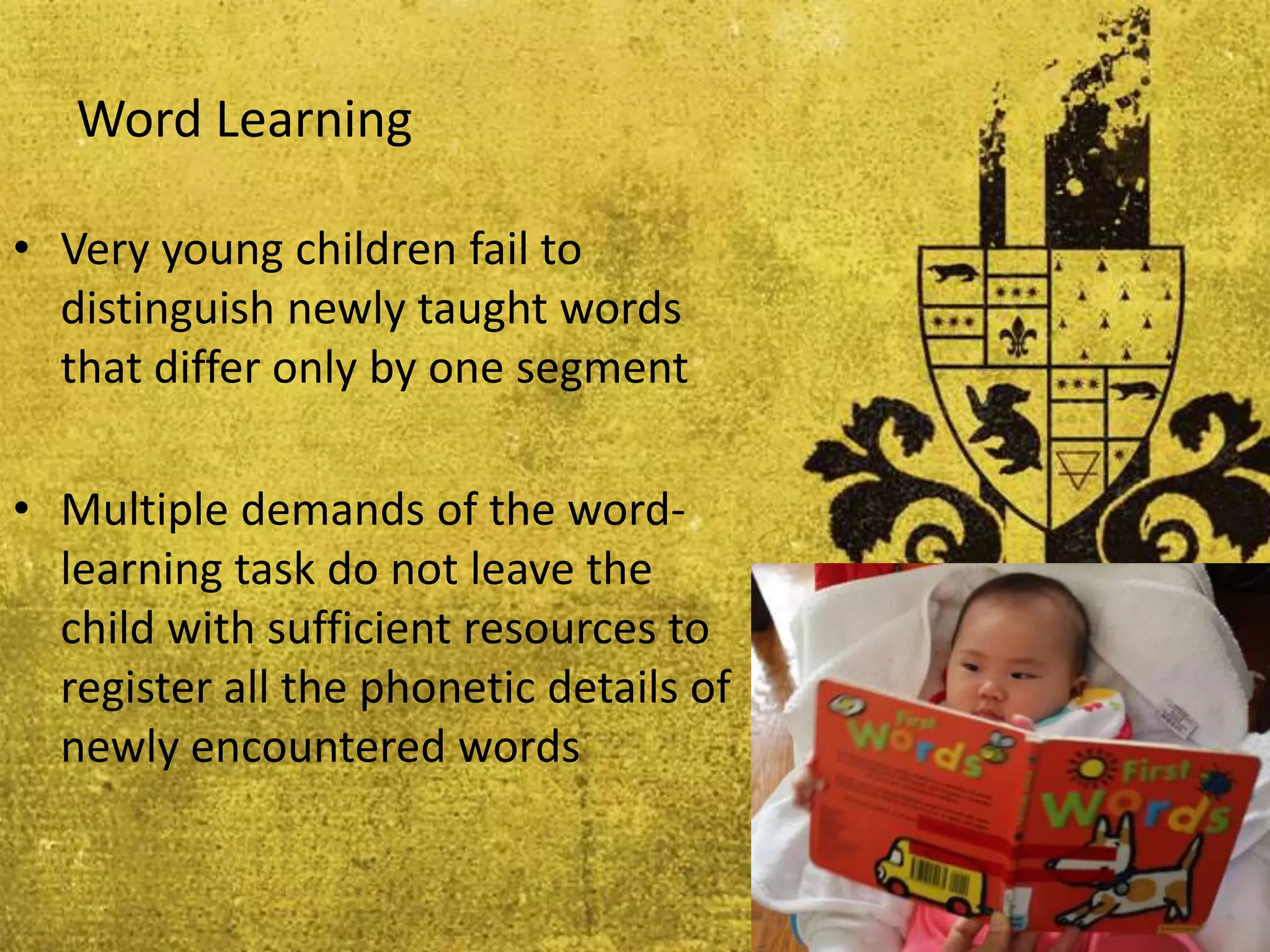
Word Learning
• Very young children fail to
distinguish newly taught words
that differ only by one segment
• Multiple demands of the word-
learning task do not leave the
child with sufficient resources to
register all the phonetic details of
newly encountered words
Word Recognition
• It is usually believed that children
only have rough representations;
they are less sensitive to differences
between words at the level phonetic
segments and base their judgments
on syllables or whole words.
• However, more recent evidence
suggests that children do represent
words they know in some phonetic
detail, such as when they show
sensitivity to small
mispronunciations.
Word Production
First Words
• simple syllable structure: either
single syllables or reduplicated
syllables
ex. mama, dada
• small inventory of vowels and
consonants
• sounds most common in children’s
babble were also most common in
early vocabularies
• some sounds in the adult
language were noticeably absent
in children’s productions
/m/, /b/,/d/- present
/ð/,/Ѳ/,/r/,/l/- absent
• It has been proposed that early word
representations are of the whole,
rather than as separate phonemic
segments
-lack of consistency in the ways
children produce sounds during
this stage
-phonemic idioms- words the
child produces in a very adultlike
way, while still incorrectly
producing other words that use
the very same sounds
The Development of Phonological
Processes
• at around 18 months of age,
children’s productions become more
consistent, though not adultlike
• phonological processes- develop
systematic ways in which they alter
the sounds of the target language so
that they fit within the range of
sounds they can produce
• whole word
Reduplication
• individual segments
Assimilation
ex. “doggy” /dɑgij/ “goggy” /gɑgij/
“self” /sɛlf/  “felf” /fɛlf/
Denasalization
ex. “jam” /dʒæm/  “jab” /dʒæb/
“sing” /sɪŋ/  “sig” /sɪg/
Gliding
ex. “look” /lʊk/  “wook” /wʊk/
Reduction (consonant clusters)
ex. “school” /skul/  “kool” /kul/
“bring” /brɪŋ/  “bing” /bɪŋ/
Deletion
ex. “boot” /but/  “boo” /bu/
“away” /əwej/  “way” /wej/
“butterfly” /bʌtərflaj/  “bufly” /bʌflaj/
Multiple processes
ex. “giraffe” /dʒəræf/  “faffe” /fæf/
/dʒəræf/  /ræf/
/ræf/  /fæf/
• strategies:
-avoid acquiring new words that
use sounds that they can’t
produce
-assimilate a new word either to
another similar-sounding word
or to a pre-existing sound-
pattern (ex. VC,CV, CVC, CVCV)
• the need for these processes decline
gradually declines as children
become able to produce more and
more of the sounds of the target
language
The Relation Between Perception and
Production
• children demonstrate awareness
of the difference between their
own pronunciation of a word and
the adult pronunciation
• ‘fis’ phenomenon
Child: “Gimme my guk!”
Father: “You mean your
duck?”
Child: “Yes, my guk!”
Father (hands child the duck):
“Okay, here’s your guk.”
Child (annoyed): “No, Daddy -
I say it that way, not you.”
• children’s mispronunciations do
not necessarily imply that children
have incomplete mental
representations of how the word is
supposed to sound
Cross-Linguistic Differences in
Phonological Development
• the order in which sounds appear in
children’s speech is influenced by
properties of the target language
-ex. /v/ is a relatively late-
appearing sound for children
acquiring English, but not for
those acquiring Swedish,
Bulgarian, and Estonian
• the function different speech sounds
serve in the language is another
important factor
• it is not the frequency with which
children hear the sound but rather
the frequency with which the sound
is used in different words
-ex. the and this (/ð/)
Individual Differences in Phonological
Development
• difference in rate of development
• difference in the particular sounds
produced
• difference in the approaches children
take to constructing a phonological
system
The Development of Phonological
Awareness
• phonological awareness- being able
to rhyme, count syllables, and think of
different words that being with a
particular sound
• children show some signs of
phonological awareness beginning
around 2 years old
• central importance in considering the
relation between oral language and
literacy
-children’s levels of phonological
awareness predict their success
in learning to read
THE RELATION BETWEEN
PHONOLOGICAL AND LEXICAL
DEVELOPMENT
Issue: Does children’s knowledge of the sounds of
their language influence their acquisition of
words and does their knowledge of words
influence their knowledge of sounds?
Evidences
1. Lexical selection
• items in the child's vocabulary are
fit to the repertoire of the sounds
they can produce
-i.e. mama, papa (mother/
father)
- child's phonetic inventory
directly proportional to size of
vocabulary
2. Lexical development causes drives
phonological development
• From vague and global
representations, word
representations achieve full
phonological detail once vocabularies
acquire it
• the denser the neighborhood, the
more distinct the sounds become
to the child
• Definition of “neighborhood”
Explanations of Phonological
Development
A. Behaviorist
Problems
1. not consider maturation process
2. non-selection of sound reinforcement
from parents
3. acquisition of mental representations
that are not unconscious
B. Rule and constraint based approach
- driving force of phonological
development is not rules but constraints
- Phonological development consists of
learning the ranking of
-constraints that applies in the language
one is acquiring
C. Biologically based theories
- the initial sounds made are
dependent on what the human vocal
apparatus is inclined to make
- explains the similarities of the first
sounds babies make at a certain age
Universality of Sounds
D. Usage based Phonology
- language input and use of the
language
E. Cognitive Problem Solving Approach
- word representation is seen as a
whole, and only after sufficient mental
representations, word analysis
becomes segmental with contrasting
features
F. Connectionist Approach
- children try to approximate the target
word and commits errors because of
immature connections in the brain
/ Ѳɛnk ju/!!!

Phonological development report

  • 1.
    PHONOLOGICAL DEVELOPMENT Melissa Buco IrishDe Ocampo Mariz Encarnacion Ruth Espiritu
  • 2.
  • 3.
    • Babies areequipped with the ability to hear and discriminate speech sounds upon birth. • The perceptual ability of infants is at first language-general, but gradually they become attuned to the phonemic characteristics of their native language. • Researchers use two methods to assess the perceptual ability of infants: the high-amplitude sucking technique and the head turn technique, which measure the infants’ interest in new sounds presented to them.
  • 4.
    • Infants arecapable of perceiving sounds categorically the way adults do. – Categorical perception is the phenomenon in which a range of stimuli that differ continuously are perceived as belonging only to a few categories with no degrees of difference. Differences in speech sounds are measured in terms of voice onset time (VOT). – The phoneme boundary effect is a phenomenon of categorical perception wherein a range of phonemes which differ along an acoustic continuum are perceived as belonging to one end of that continuum; in short, they are not an in-between phoneme.
  • 5.
    • The abilityto perceive sounds categorically is a property of the mammalian aural system; it is not a specifically linguistic property unique to humans.
  • 6.
    • Motherese orinfant-directed speech has the following characteristics which can help infants process the speech stream: 1. a higher-pitched voice; 2. longer pauses and shorter phrases; 3. a slower tempo resulting in prolonged vowel sounds.
  • 7.
    • The intonationcontour of motherese is widely exaggerated to highlight some linguistic features to help language-learning infants. • Infants have shown preference to motherese even cross- linguistically.
  • 8.
  • 9.
    STAGES OF PRESPEECHVOCAL DEVELOPMENT 0-2 months (0-6 weeks) Reflexive crying, vegetative sounds (coughs, sneezes), Sounds reflecting their physical state. 2-5 months (6-16 weeks) Cooing and laughter. Early consonants develop, sounds from the back of throat, laughs and giggles form (to the enjoyment of parents). 4-6 months (16-30 weeks) Vocal play, babbling gets more adult-like, range and pitch play,, bilabial trills are common (raspberries). 6-12 months Reduplicated babbling ex: mamama, pitch control develops, ability to sound out some consonants and vowels. 9-18 months Non-reduplicative babbling, varying of consonants and vowels.
  • 10.
    • Reflexive cryingand Vegetative sounds – In crying and in making these vegetative sounds, an infant’s vocal cords vibrate, and the airflow through the vocal apparatus is stopped and started. Thus, even these unpromising sounds include features that will later be used to produce speech sounds
  • 11.
    • Cooing andlaughter – Coos- sounds that babies make when they appear to be happy and contented – Social interaction- elicit cooing – 1st laughter- around the age of 16 weeks
  • 12.
    • Vocal play –Also known as the Expansion Stage (Oller, 1980) – During this stage, the variety of different consonant-like and vowel-like sounds that infants produce increases. – Marginal babbling- long series of sounds that infants produce by the end of this expansion stage
  • 13.
    – Other noisesinclude: squeals, growls, friction noises – 1st recognizable consonant-like sounds- heard at around 2 to 3 months, and are usually the velars – Around 6 months- infants start to produce consonant-like sounds articulated in the front of the mouth (bilabials and alveolars)
  • 14.
    • Reduplicated babbling –Also known as Canonical Babbling, is distinguished from the vocalizations that precede it by the presence of true syllables, and these syllables are typically produced in reduplicated series of the same consonant and vowel combination. – The appearance of canonical babbling is a major landmark in the infant’s prespeech development. It is the first development that distinguishes the vocal development of hearing children from that of deaf children.
  • 15.
    • Nonreduplicated babbling –Also known as Variegated Babbling – The range of consonants and vowels infants produce expands further. – Infants combine different consonant + vowel and consonant + vowel + consonant syllables into series. – Prosody- the intonation contour of speech – Jargon- wordless sentences
  • 16.
    – Intonation babies-children who produce a great deal of jargon and who do so for a long time (Dore, 1975) – Word babies- children who produce relatively little jargon and who move quickly on to learning the words to the tune (Dore, 1975)
  • 17.
    INFLUENCE OF THETARGET LANGUAGE ON BABBLING – Universal- even the particular sounds that babies produce are similar across environments – Babbling drift- as early as 6 months, the sounds that babies produce are somewhat influenced by the language that they hear (R. Brown, 1958)
  • 18.
    – 2 techniques: 1)To use the judgments of competent speakers to determine whether they can tell the differences among the babblings of babies who are acquiring different languages. 2) To record babblings of children who are acquiring different languages and analyze them for the presence and frequency of features in the respective adult languages
  • 19.
    • De Boysson-Bardies,Sagart, and Durand (1984)- 1st technique
  • 20.
    • De Boysson-Bardies,Sagart, and Durand (1984)- 2nd technique
  • 21.
    – By theend of the babbling stage, children have made great progress from their first vowels to an increasingly large repertoire of consonants and then to knowing something about the prosody and sound patterns of their target language. – Children’s vocalizations at this point are most frequently single syllables, with some two-syllable productions.
  • 22.
    THE TRANSITION FROMBABBLING TO WORDS BABBLING FIRST WORD TRANSITIONAL PERIOD Children produce their own invented words. These invented words are soaund sequences children use with consistent meanings but that bear no discernible resemblance to the sound of any word in the target language.
  • 23.
    • Transitional forms –Protowords – Sensorimotor morphemes – Quasiwords – Phonetically consistent forms – Often express broad meanings, and their use tends either to be tightly bound to particular contexts or to serve particular functions. – Stage of vocal development overlaps with the use of communicative gestures
  • 24.
    PROCESSES UNDERLYING INFANTS’ DEVELOPMENTOF SPEECH SOUNDS • Nervous system maturation
  • 25.
    • Experience 1) Hearingthe speech adults produce 2) Infants’ experience hearing their own vocal output
  • 26.
    TRIVIA • A baby’sfirst form of communication is: CRYING SMILING
  • 27.
    TRIVIA • To be“bulol” in early years is normal. – True – False
  • 28.
    TRIVIA • Children stopbabbling when they learn to speak words. – True – False
  • 29.
  • 30.
    Word Learning • Veryyoung children fail to distinguish newly taught words that differ only by one segment • Multiple demands of the word- learning task do not leave the child with sufficient resources to register all the phonetic details of newly encountered words
  • 31.
    Word Recognition • Itis usually believed that children only have rough representations; they are less sensitive to differences between words at the level phonetic segments and base their judgments on syllables or whole words. • However, more recent evidence suggests that children do represent words they know in some phonetic detail, such as when they show sensitivity to small mispronunciations.
  • 32.
    Word Production First Words •simple syllable structure: either single syllables or reduplicated syllables ex. mama, dada • small inventory of vowels and consonants
  • 33.
    • sounds mostcommon in children’s babble were also most common in early vocabularies • some sounds in the adult language were noticeably absent in children’s productions /m/, /b/,/d/- present /ð/,/Ѳ/,/r/,/l/- absent
  • 34.
    • It hasbeen proposed that early word representations are of the whole, rather than as separate phonemic segments -lack of consistency in the ways children produce sounds during this stage -phonemic idioms- words the child produces in a very adultlike way, while still incorrectly producing other words that use the very same sounds
  • 35.
    The Development ofPhonological Processes • at around 18 months of age, children’s productions become more consistent, though not adultlike • phonological processes- develop systematic ways in which they alter the sounds of the target language so that they fit within the range of sounds they can produce
  • 36.
    • whole word Reduplication •individual segments Assimilation ex. “doggy” /dɑgij/ “goggy” /gɑgij/ “self” /sɛlf/  “felf” /fɛlf/ Denasalization ex. “jam” /dʒæm/  “jab” /dʒæb/ “sing” /sɪŋ/  “sig” /sɪg/ Gliding ex. “look” /lʊk/  “wook” /wʊk/
  • 37.
    Reduction (consonant clusters) ex.“school” /skul/  “kool” /kul/ “bring” /brɪŋ/  “bing” /bɪŋ/ Deletion ex. “boot” /but/  “boo” /bu/ “away” /əwej/  “way” /wej/ “butterfly” /bʌtərflaj/  “bufly” /bʌflaj/ Multiple processes ex. “giraffe” /dʒəræf/  “faffe” /fæf/ /dʒəræf/  /ræf/ /ræf/  /fæf/
  • 38.
    • strategies: -avoid acquiringnew words that use sounds that they can’t produce -assimilate a new word either to another similar-sounding word or to a pre-existing sound- pattern (ex. VC,CV, CVC, CVCV)
  • 39.
    • the needfor these processes decline gradually declines as children become able to produce more and more of the sounds of the target language
  • 40.
    The Relation BetweenPerception and Production • children demonstrate awareness of the difference between their own pronunciation of a word and the adult pronunciation • ‘fis’ phenomenon
  • 41.
    Child: “Gimme myguk!” Father: “You mean your duck?” Child: “Yes, my guk!” Father (hands child the duck): “Okay, here’s your guk.” Child (annoyed): “No, Daddy - I say it that way, not you.”
  • 42.
    • children’s mispronunciationsdo not necessarily imply that children have incomplete mental representations of how the word is supposed to sound
  • 43.
    Cross-Linguistic Differences in PhonologicalDevelopment • the order in which sounds appear in children’s speech is influenced by properties of the target language -ex. /v/ is a relatively late- appearing sound for children acquiring English, but not for those acquiring Swedish, Bulgarian, and Estonian
  • 44.
    • the functiondifferent speech sounds serve in the language is another important factor • it is not the frequency with which children hear the sound but rather the frequency with which the sound is used in different words -ex. the and this (/ð/)
  • 46.
    Individual Differences inPhonological Development • difference in rate of development • difference in the particular sounds produced • difference in the approaches children take to constructing a phonological system
  • 47.
    The Development ofPhonological Awareness • phonological awareness- being able to rhyme, count syllables, and think of different words that being with a particular sound • children show some signs of phonological awareness beginning around 2 years old • central importance in considering the relation between oral language and literacy -children’s levels of phonological awareness predict their success in learning to read
  • 48.
    THE RELATION BETWEEN PHONOLOGICALAND LEXICAL DEVELOPMENT
  • 49.
    Issue: Does children’sknowledge of the sounds of their language influence their acquisition of words and does their knowledge of words influence their knowledge of sounds?
  • 50.
  • 51.
  • 52.
    • items inthe child's vocabulary are fit to the repertoire of the sounds they can produce -i.e. mama, papa (mother/ father) - child's phonetic inventory directly proportional to size of vocabulary
  • 53.
    2. Lexical developmentcauses drives phonological development
  • 54.
    • From vagueand global representations, word representations achieve full phonological detail once vocabularies acquire it
  • 55.
    • the denserthe neighborhood, the more distinct the sounds become to the child
  • 56.
    • Definition of“neighborhood”
  • 57.
  • 58.
  • 60.
  • 61.
    1. not considermaturation process 2. non-selection of sound reinforcement from parents 3. acquisition of mental representations that are not unconscious
  • 62.
    B. Rule andconstraint based approach
  • 63.
    - driving forceof phonological development is not rules but constraints - Phonological development consists of learning the ranking of -constraints that applies in the language one is acquiring
  • 64.
  • 65.
    - the initialsounds made are dependent on what the human vocal apparatus is inclined to make - explains the similarities of the first sounds babies make at a certain age
  • 66.
  • 67.
    D. Usage basedPhonology
  • 68.
    - language inputand use of the language
  • 69.
    E. Cognitive ProblemSolving Approach
  • 70.
    - word representationis seen as a whole, and only after sufficient mental representations, word analysis becomes segmental with contrasting features
  • 71.
  • 72.
    - children tryto approximate the target word and commits errors because of immature connections in the brain
  • 73.

Editor's Notes

  • #23 The five-stage division of the period of prespeech vocal development according to Stark (1986)Source: http://languagedevelopment.tripod.com/id16.html
  • #38 Sources: teens.drugabuse.govwww.answers.com