Ratcliffe College Information
Evening
Letters and Sounds
Introduction
• Children learn a great deal from other
people.
• As parents and carers, you are your child’s
first teachers. You have a powerful
influence on your child’s early learning.
The spoken language
• From a very early age, children develop an
awareness of the different sounds in our spoken
language(s)
• They learn how to use their voices:
– to make contact with you
– to let you know what they need
– to show how they are feeling

• As parents and carers, you best understand your
child’s communications; you are key in helping
them to develop their speaking and listening
skills
How can you help?
• Provide your child with lots of different
opportunities to speak and listen with others:
–
–
–
–

•
•
•
•

Preparing meals
Tidying up
Putting shopping away
Getting ready to go out

Switch off the TV, radio and mobile phones
Show you are interested in their conversation
Read stories
Use puppets and toys
The importance of speech sounds
• As children grow older, they will begin to
understand the different sounds in languages,
and join in with stories, songs, rhymes by
clapping, stamping and skipping.
• This is an important stage, as the ears are
beginning to tune into the important sounds they
can hear, and discriminate.
• Over time, your child will begin to distinguish
between different speech sounds (phonemes),
and they will match sounds to letters
(graphemes). This is called phonic knowledge.
Phase 1
• Your child will be learning to:
–
–
–
–
–
–
–
–

Have fun with sounds
Listen carefully
Develop their vocabulary
Speak confidently to you, other adults and children
Tune into sounds
Listen and remember sounds
Talk about sounds
Understand that spoken words are made up of
different sounds
Phase 1
• Phase 1 is made up of 7 different areas:
– Environmental sounds
– Instrumental sounds
– Body percussion
– Rhythm and rhyme
– Alliteration (words that begin with the same
sound)
– Voice sounds
– Oral blending and segmenting
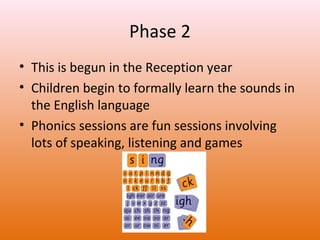
Phase 2
• This is begun in the Reception year
• Children begin to formally learn the sounds in
the English language
• Phonics sessions are fun sessions involving
lots of speaking, listening and games
Not all children will learn at the same rate!
• Your child should be supported whatever their
rate of learning
• There is a very close link between difficulty
with phonics and hearing, so if your child is
making progress more slowly than expected, it
is worth having their hearing checked.
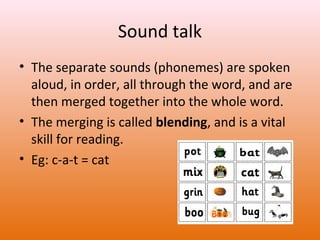
Sound talk
• The separate sounds (phonemes) are spoken
aloud, in order, all through the word, and are
then merged together into the whole word.
• The merging is called blending, and is a vital
skill for reading.
• Eg: c-a-t = cat
Sound talk
• Children will also learn to do this the other
way round. Eg: cat = c-a-t
• The whole word is spoken aloud and then
broken up into its sounds (phonemes) in
order, through the word.
• This is called segmenting, and is a vital skill for
spelling.
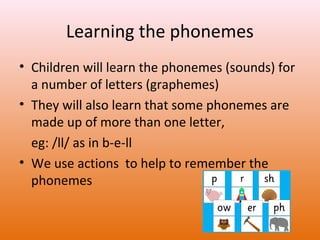
Learning the phonemes
• Children will learn the phonemes (sounds) for
a number of letters (graphemes)
• They will also learn that some phonemes are
made up of more than one letter,
eg: /ll/ as in b-e-ll
• We use actions to help to remember the
phonemes
Saying the sounds
• Your child will be taught how to pronounce
the sounds (phonemes) correctly to make
blending easier
• Sounds should be sustained where possible
(eg, sss, mmm, fff)
• If not, ‘uh’ sounds after consonants should be
reduced where possible (eg, try to avoid
saying ‘b-uh’, ‘c-uh’)
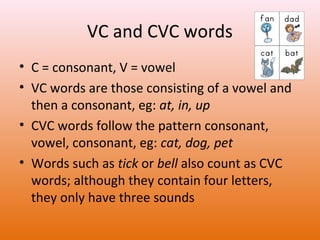
VC and CVC words
• C = consonant, V = vowel
• VC words are those consisting of a vowel and
then a consonant, eg: at, in, up
• CVC words follow the pattern consonant,
vowel, consonant, eg: cat, dog, pet
• Words such as tick or bell also count as CVC
words; although they contain four letters,
they only have three sounds
Making words
• Now the children will be seeing letters and
words, as well as hearing them
• They will be shown how to make whole words
by:
– pushing magnetic letters together to form little
words
– Reading little words on the board
– Breaking up words into individual sounds
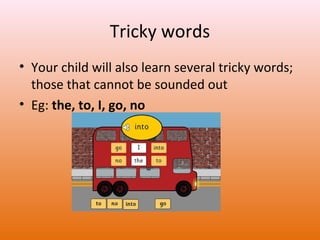
Tricky words
• Your child will also learn several tricky words;
those that cannot be sounded out
• Eg: the, to, I, go, no
Phase 3
• The main individual letter phonemes have
now been learnt, and children are reading CVC
words independently
• Phase 3 teaches children to learn the
graphemes (written sounds), made up of
more than one letter, eg: ‘oa’ as in boat
• Your child will also learn all the letter names in
the alphabet and how to form them correctly
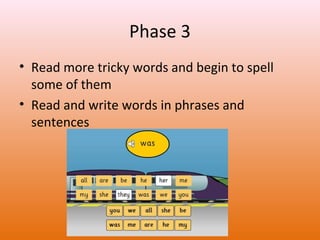
Phase 3
• Read more tricky words and begin to spell
some of them
• Read and write words in phrases and
sentences
How can I help?
• Sing an alphabet song together
• Play ‘I spy’
• Continue to play with magnetic letters, using
some two-grapheme (letter) combinations, eg: rai-n = rain blending for reading
rain = r-ai-n segmenting for spelling
• Praise your child for trying out words
• Ask for a list of tricky words
• Create phonic games with a timer
• Play pairs
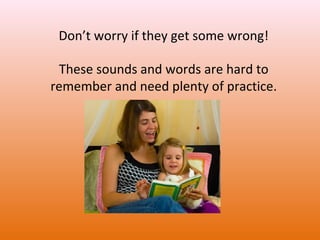
Don’t worry if they get some wrong!
These sounds and words are hard to
remember and need plenty of practice.

Parent session 4_phonics_letters_&_sounds

  • 1.
  • 2.
    Introduction • Children learna great deal from other people. • As parents and carers, you are your child’s first teachers. You have a powerful influence on your child’s early learning.
  • 3.
    The spoken language •From a very early age, children develop an awareness of the different sounds in our spoken language(s) • They learn how to use their voices: – to make contact with you – to let you know what they need – to show how they are feeling • As parents and carers, you best understand your child’s communications; you are key in helping them to develop their speaking and listening skills
  • 4.
    How can youhelp? • Provide your child with lots of different opportunities to speak and listen with others: – – – – • • • • Preparing meals Tidying up Putting shopping away Getting ready to go out Switch off the TV, radio and mobile phones Show you are interested in their conversation Read stories Use puppets and toys
  • 5.
    The importance ofspeech sounds • As children grow older, they will begin to understand the different sounds in languages, and join in with stories, songs, rhymes by clapping, stamping and skipping. • This is an important stage, as the ears are beginning to tune into the important sounds they can hear, and discriminate. • Over time, your child will begin to distinguish between different speech sounds (phonemes), and they will match sounds to letters (graphemes). This is called phonic knowledge.
  • 6.
    Phase 1 • Yourchild will be learning to: – – – – – – – – Have fun with sounds Listen carefully Develop their vocabulary Speak confidently to you, other adults and children Tune into sounds Listen and remember sounds Talk about sounds Understand that spoken words are made up of different sounds
  • 7.
    Phase 1 • Phase1 is made up of 7 different areas: – Environmental sounds – Instrumental sounds – Body percussion – Rhythm and rhyme – Alliteration (words that begin with the same sound) – Voice sounds – Oral blending and segmenting
  • 8.
    Phase 2 • Thisis begun in the Reception year • Children begin to formally learn the sounds in the English language • Phonics sessions are fun sessions involving lots of speaking, listening and games
  • 9.
    Not all childrenwill learn at the same rate! • Your child should be supported whatever their rate of learning • There is a very close link between difficulty with phonics and hearing, so if your child is making progress more slowly than expected, it is worth having their hearing checked.
  • 10.
    Sound talk • Theseparate sounds (phonemes) are spoken aloud, in order, all through the word, and are then merged together into the whole word. • The merging is called blending, and is a vital skill for reading. • Eg: c-a-t = cat
  • 11.
    Sound talk • Childrenwill also learn to do this the other way round. Eg: cat = c-a-t • The whole word is spoken aloud and then broken up into its sounds (phonemes) in order, through the word. • This is called segmenting, and is a vital skill for spelling.
  • 12.
    Learning the phonemes •Children will learn the phonemes (sounds) for a number of letters (graphemes) • They will also learn that some phonemes are made up of more than one letter, eg: /ll/ as in b-e-ll • We use actions to help to remember the phonemes
  • 13.
    Saying the sounds •Your child will be taught how to pronounce the sounds (phonemes) correctly to make blending easier • Sounds should be sustained where possible (eg, sss, mmm, fff) • If not, ‘uh’ sounds after consonants should be reduced where possible (eg, try to avoid saying ‘b-uh’, ‘c-uh’)
  • 14.
    VC and CVCwords • C = consonant, V = vowel • VC words are those consisting of a vowel and then a consonant, eg: at, in, up • CVC words follow the pattern consonant, vowel, consonant, eg: cat, dog, pet • Words such as tick or bell also count as CVC words; although they contain four letters, they only have three sounds
  • 15.
    Making words • Nowthe children will be seeing letters and words, as well as hearing them • They will be shown how to make whole words by: – pushing magnetic letters together to form little words – Reading little words on the board – Breaking up words into individual sounds
  • 16.
    Tricky words • Yourchild will also learn several tricky words; those that cannot be sounded out • Eg: the, to, I, go, no
  • 17.
    Phase 3 • Themain individual letter phonemes have now been learnt, and children are reading CVC words independently • Phase 3 teaches children to learn the graphemes (written sounds), made up of more than one letter, eg: ‘oa’ as in boat • Your child will also learn all the letter names in the alphabet and how to form them correctly
  • 18.
    Phase 3 • Readmore tricky words and begin to spell some of them • Read and write words in phrases and sentences
  • 19.
    How can Ihelp? • Sing an alphabet song together • Play ‘I spy’ • Continue to play with magnetic letters, using some two-grapheme (letter) combinations, eg: rai-n = rain blending for reading rain = r-ai-n segmenting for spelling • Praise your child for trying out words • Ask for a list of tricky words • Create phonic games with a timer • Play pairs
  • 20.
    Don’t worry ifthey get some wrong! These sounds and words are hard to remember and need plenty of practice.