• Language acquisitioninvolves development in various components
• Lexicon
• Phonology
• Morphology
• Syntax
• Semantics
• These different components interact in complex ways to chart an
overall course of language development.
3.
• Language acquisitionresearch has shown that children in all speech
communities learn language similarly:
• babbling: about 6 months
• First words: about 1 year
• First grammatical morphemes: about 2 years
• Basic mastery: about 4 years
• Continues learning, especially vocabulary
4.
• Before FirstWords -
• The earliest vocalizations
• Involuntary crying (when they feel hungry or uncomfortable)
• Cooing and gurgling – showing satisfaction or happiness
• ‘Babbling’ especially ‘reduplicative babbling’ e.g. ma ma, ba ba, da da
• babbling sequences sound very similar to the sentences spoken by the
caregivers
• Babies use sounds to reflect the characteristics of the different
language they are learning.
5.
Acquisition of phonology
•The child is first exposed to the sounds of its immediate environment.
• From this input, the child learns and realises that certain sounds in that
language have distinctive functions, while others do not.
• The child does not memorise the utterances he or she hears, rather he or
she uses these sounds to construct a grammar which he can use to produce
and understand an infinite number of utterances.
• Most of the utterances he or she produces may be new or not identical to
what he has heard before.
6.
• These grammarsinclude how to mark plural, tense and suchlike.
• A child and a linguist do the same thing; a linguist analyses language
data to see how a particular grammar is produced.
• A child observes patterns of organisation of linguistic features of a
language to construct its grammar.
• Child’s language is not merely a gabbled version of adult speech.
• There is consistency in child’s language such that we can predict the
differences between child’s language and adults in regular ways.
7.
• Just likein adult language, child’s language depicts issues of
competence versus performance.
• The child’s basic competence far exceeds that which is represented by
his or her speech.
• Regarding acquisition of phonology, one of the main researchers is a
Russian linguist, Roman Jakobson.
• In his 1941 and then 1976 publication Child Language, Aphasia and
Phonological Universals, he introduced the concept of ‘Laws of
irreversible solidarity'.
8.
Laws of irreversiblesolidarity
• These are laws of implication that hold in the description of
phonological structure in languages in general.
• The laws contain that if a language contains a phonological feature Y,
it will contain X; however, the presence of X does not presuppose the
presence of Y.
• Similarly, if a child acquires Y, it means he has already acquired X,
whereas the presence of X does not presuppose the acquisition of Y.
• For instance, back consonants /k/ and /g/ presuppose presence of /p/
and /b/, but the reverse of this is not true i.e. this kind of solidarity is
irreversible.
9.
• According toRoman Jakobson, acquisition of phonology proceeds
through eight major stages:
• Stage 1: contrast between consonants and vowels. Acquisition of
vowels begins with the central vowel /a/, and acquisition of
consonants is launched with /p/.
• The two combined produce syllable ‘pa’.
• Stage 2: first consonant opposition of oral and nasal stops
distinguishing ‘ma’ and ‘pa’ in ‘mama’ and ‘papa’.
10.
• Stage 3:consonant opposition i.e. distinguishes between labials and
dentals.
• Stage 4: Vocalic opposition – distinguishes between vowels i.e. high
and low. Here, the mid vowel ‘ε’ emerges.
• Stage 5: emergence of the rounded high vowel ‘u’.
• Here, the fundamental vowel triangle is developed.
• These five stages constitute the child’s minimum phonemic system.
• Beyond this, all stages deal with Laws of Irreversible Solidarity, and
not merely the phonemic inventory development.
11.
• Stage 6:Acquisition of fricatives. This presupposes acquisition of
stops.
• In earliest stages, child replaces fricatives with corresponding stops.
• Stage 7: Acquisition of back consonants, and this presupposes
acquisition of front consonants.
• Stage 8: deals with vocalic system. Child differentiates between
rounded and unrounded vowels.
12.
Theories of phonologicaldevelopment in
children
• Research on phonological development has mostly focused on how
sounds occur as a child acquires language.
• This also includes how children mispronounce certain sounds.
• Put precisely, studies look at children’s perception and production of
speech sounds.
• Four theories have been developed to account for perception of speech
sounds, namely; Perceptual Learning Theory, Attunement Theory;
Universal Theory; and, Maturational Theory.
13.
Perceptual Learning Theory
•It is a behaviourist theory.
• It states that the child’s perceptual capacity is blank.
• In the first years of life, the begin to pick up sounds from their
environments.
• Speech sounds that do not exist in their environment will be regarded
as noise.
14.
Attunement Theory
• Itclaims that every child is born with the ability to learn and perceive
sounds.
• It also states that some sounds are universal i.e. they are found in all
natural languages e.g. stops.
• The theory states that children are born with these universal sounds or
basic sounds.
• Thus, as a child develops, he will maintain universal sounds and
acquire more to add on top of these.
• This is a nativist theory.
15.
Universal Theory
• Itis somehow similar to Attunement Theory in the sense that both
speculate that children are born with the capacity to perceive sounds.
• However, there is a difference between these theories.
• This theory explains that children are born with the capacity to
perceive all sounds in all languages.
• What the child does, according to this theory, is to lose sounds that are
not found in his language.
16.
Maturational Theory
• Thetheory states that sounds develop as the child develops.
• This means that a child will only acquire specific sounds when he or
she reaches specific stages of development.
• Sounds are acquired in stages according to states of biological
development.
17.
Methods used totest sound perception
• Three methods can be distinguished:
i. High Amplitude Sucking technique (HAS)
ii. Heartrate technique (HRT)
iii. Head Turning technique
18.
High Amplitude SuckingTechnique
• It is used on children about a month old.
• The child is given an object which he is supposed to suck. The object
will have wires attached to it and in turn the wires are attached to a
computer to measure the rate of sucking.
• At given intervals, different sounds are produced in a systematic pattern
while the rate of the child’s sucking is measured.
• A sound is produced for some time, and the rate of sucking declines, and
then another sound is introduced. If a child retakes the sucking, it is
concluded that he has perceived the sound, if not then he hasn’t.
• The aim is to see if the child is able to differentiate the sounds.
19.
Heartrate technique
• Thistechnique is used for children aged about three or four months
and above.
• The child is connected to wires which are in turn connected to a
computer, and a sound is introduced.
• If the child perceives the new sound, the heartbeat will increase, and if
the new sound is not perceived, the heartbeat will remain the same.
20.
Head turning technique
•This is used on children aged 6 months and above.
• They introduce different sounds at given intervals. If the child
perceives the difference that a new sound has been introduced, they
turn their head towards the direction of the sound to see the object.
• If they don’t perceive the new sound, they don’t turn their head.
21.
Production of speechsounds
• Research on speech sound production in language acquisition has
predominantly been done on:
i. The order of acquisition of sounds;
ii. Why children mispronounce adult speech sounds.
22.
Order of acquisition
•Scholars have argued that the order of acquisition is correlated to the
universal characteristics of the sound system.
• This has been discussed in detail in the foregoing slides.
23.
Why children mispronouncecertain sounds
• Between the ages of 1 and 4 years, the child’s phonology goes through
predictable developmental stages.
• Children’s pronunciation is different from that of adults.
• Acquisition of phonology is rule governed. Children deviate from
adult pronunciation in a regular and systematic manner.
• The differences in children and adult pronunciations are a result of
phonological processes which changes a sound segment into another.
24.
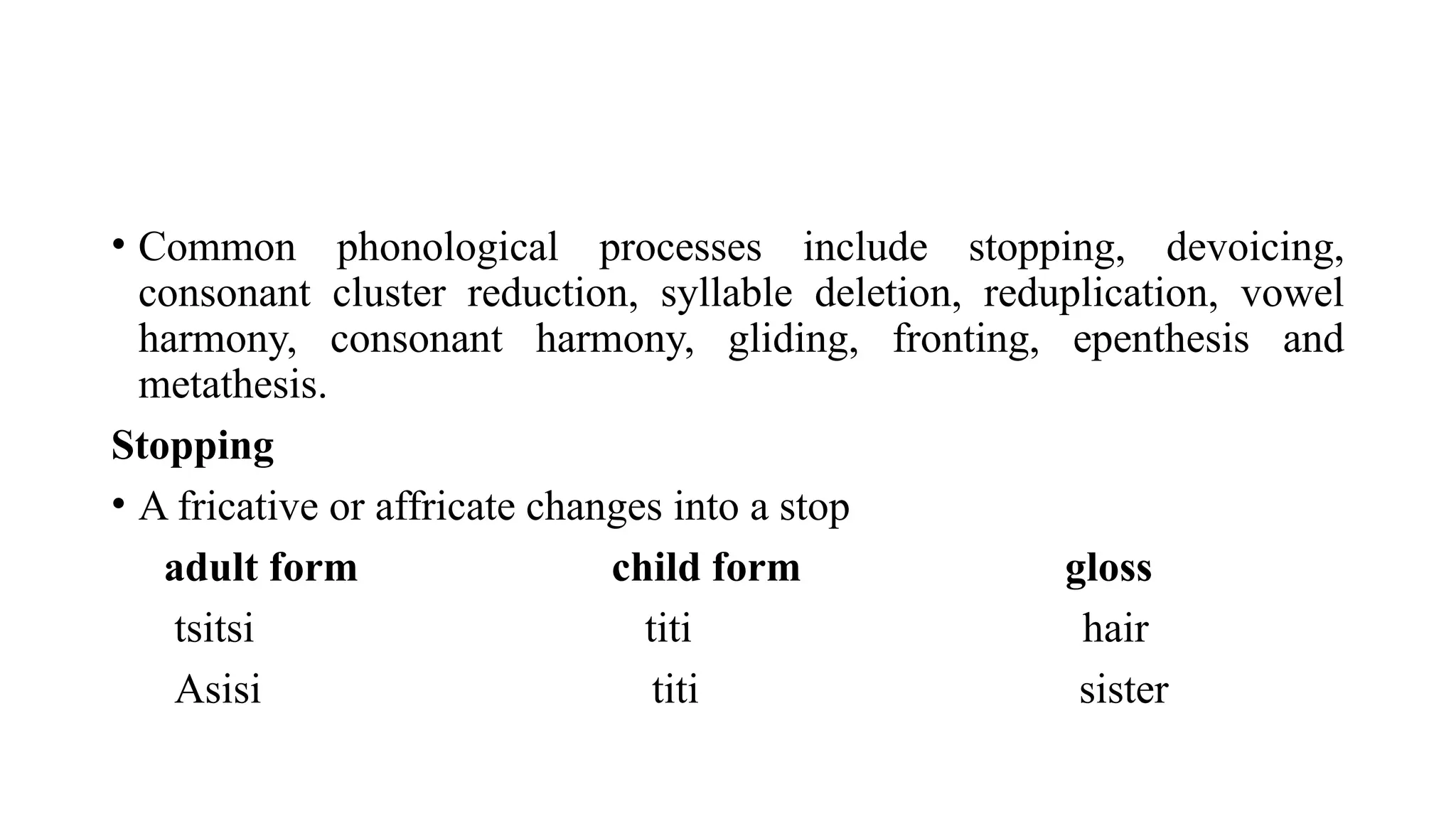
• Common phonologicalprocesses include stopping, devoicing,
consonant cluster reduction, syllable deletion, reduplication, vowel
harmony, consonant harmony, gliding, fronting, epenthesis and
metathesis.
Stopping
• A fricative or affricate changes into a stop
adult form child form gloss
tsitsi titi hair
Asisi titi sister
25.
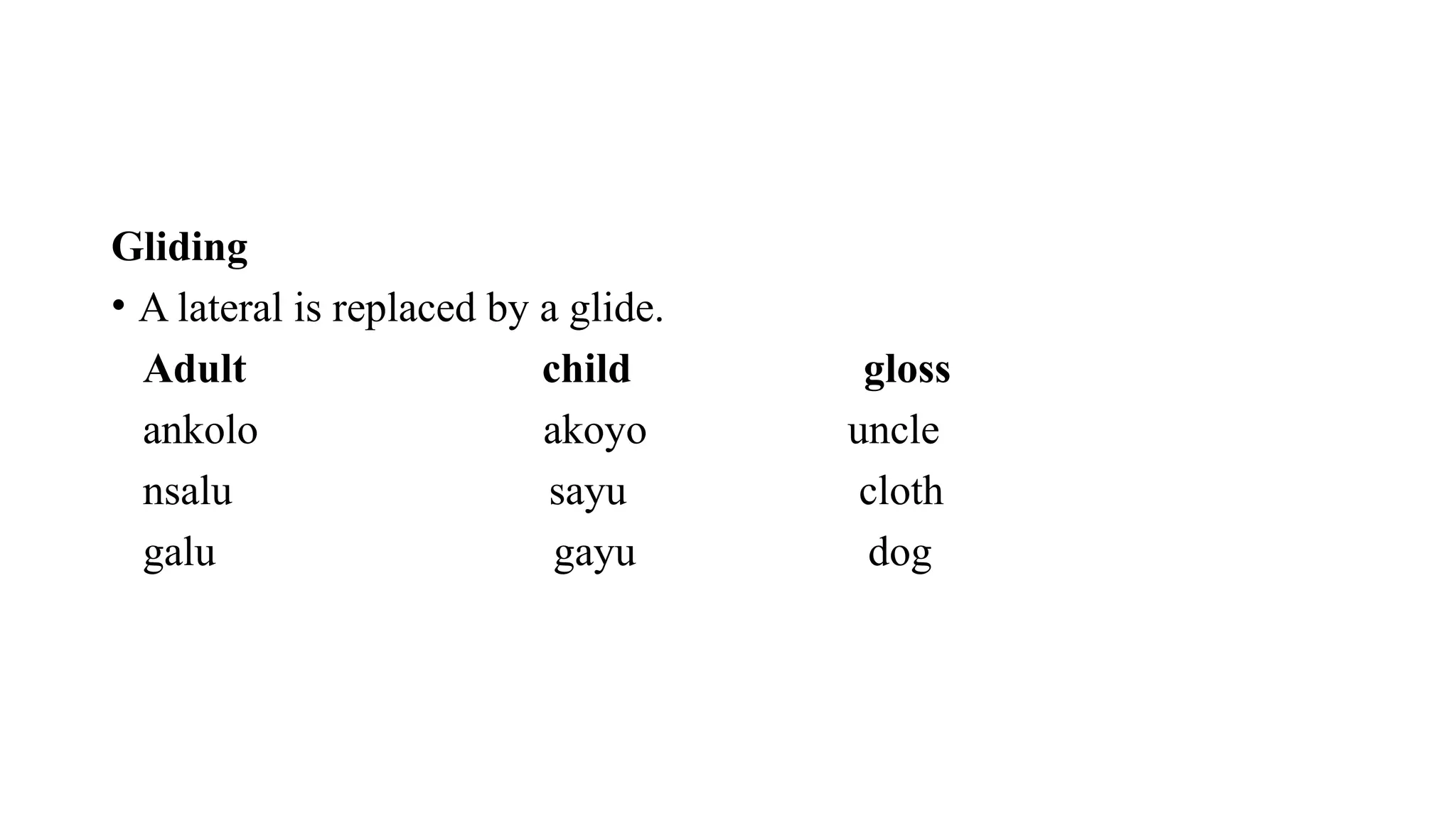
Gliding
• A lateralis replaced by a glide.
Adult child gloss
ankolo akoyo uncle
nsalu sayu cloth
galu gayu dog
26.
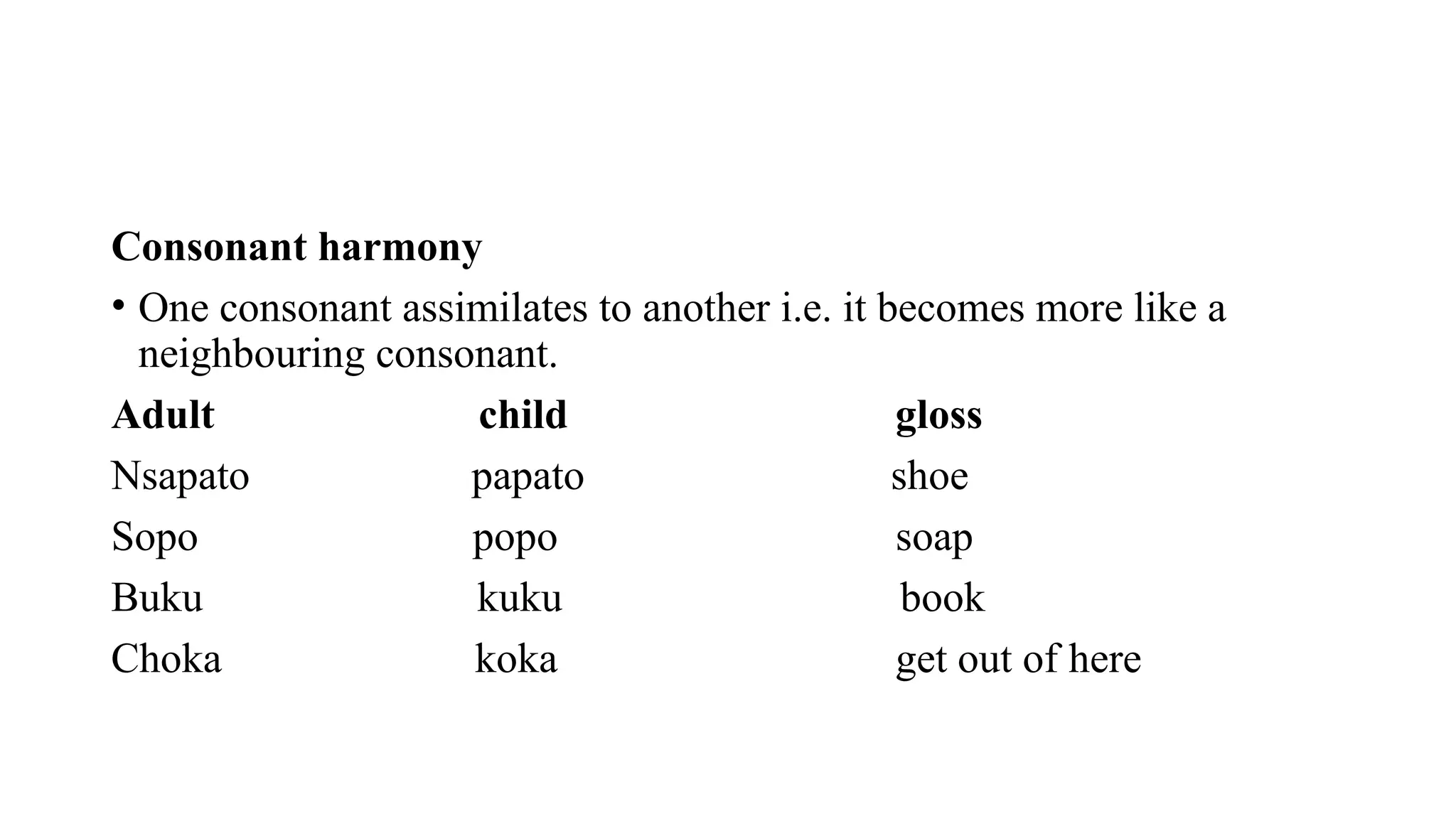
Consonant harmony
• Oneconsonant assimilates to another i.e. it becomes more like a
neighbouring consonant.
Adult child gloss
Nsapato papato shoe
Sopo popo soap
Buku kuku book
Choka koka get out of here
27.
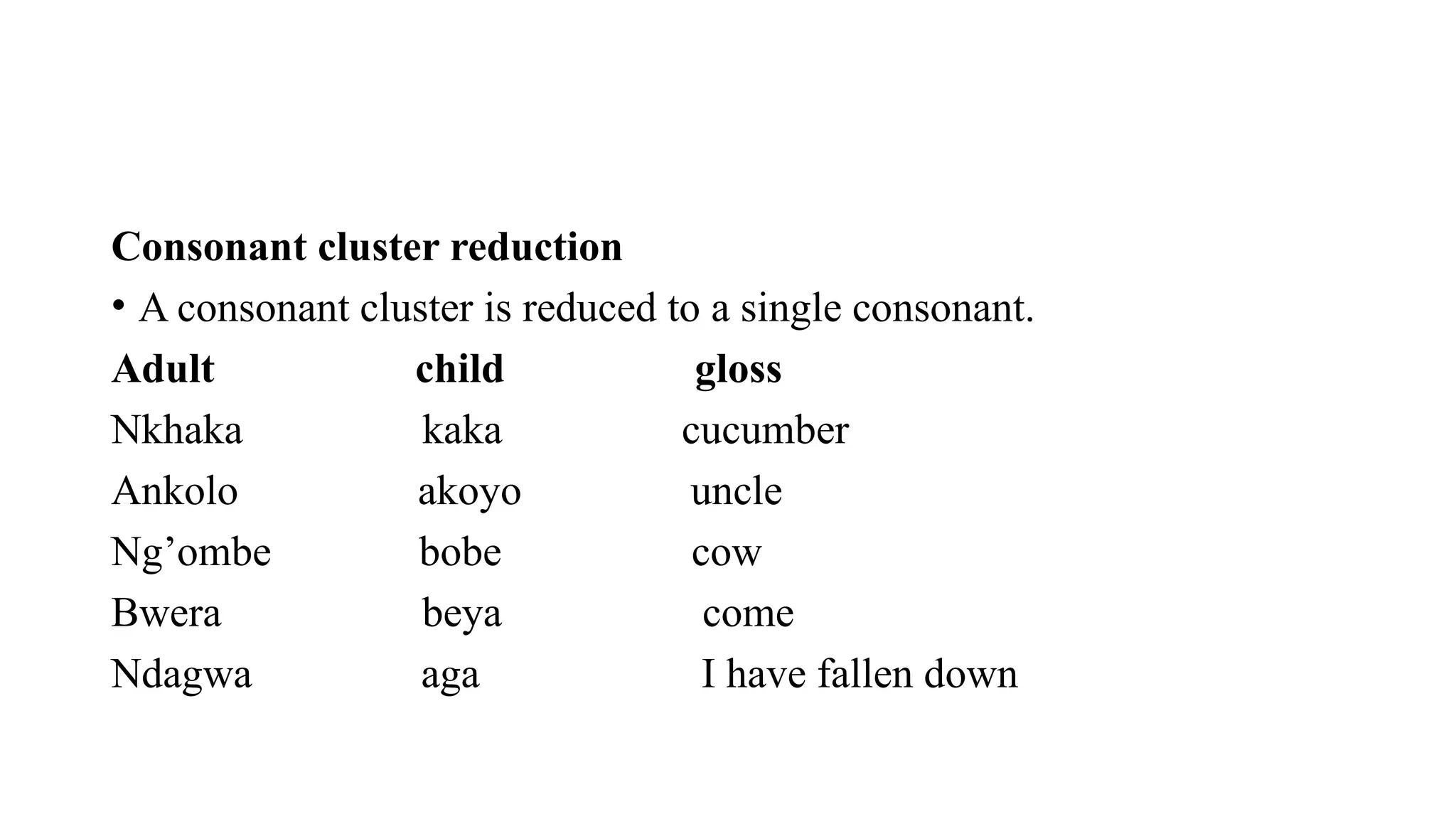
Consonant cluster reduction
•A consonant cluster is reduced to a single consonant.
Adult child gloss
Nkhaka kaka cucumber
Ankolo akoyo uncle
Ng’ombe bobe cow
Bwera beya come
Ndagwa aga I have fallen down
28.
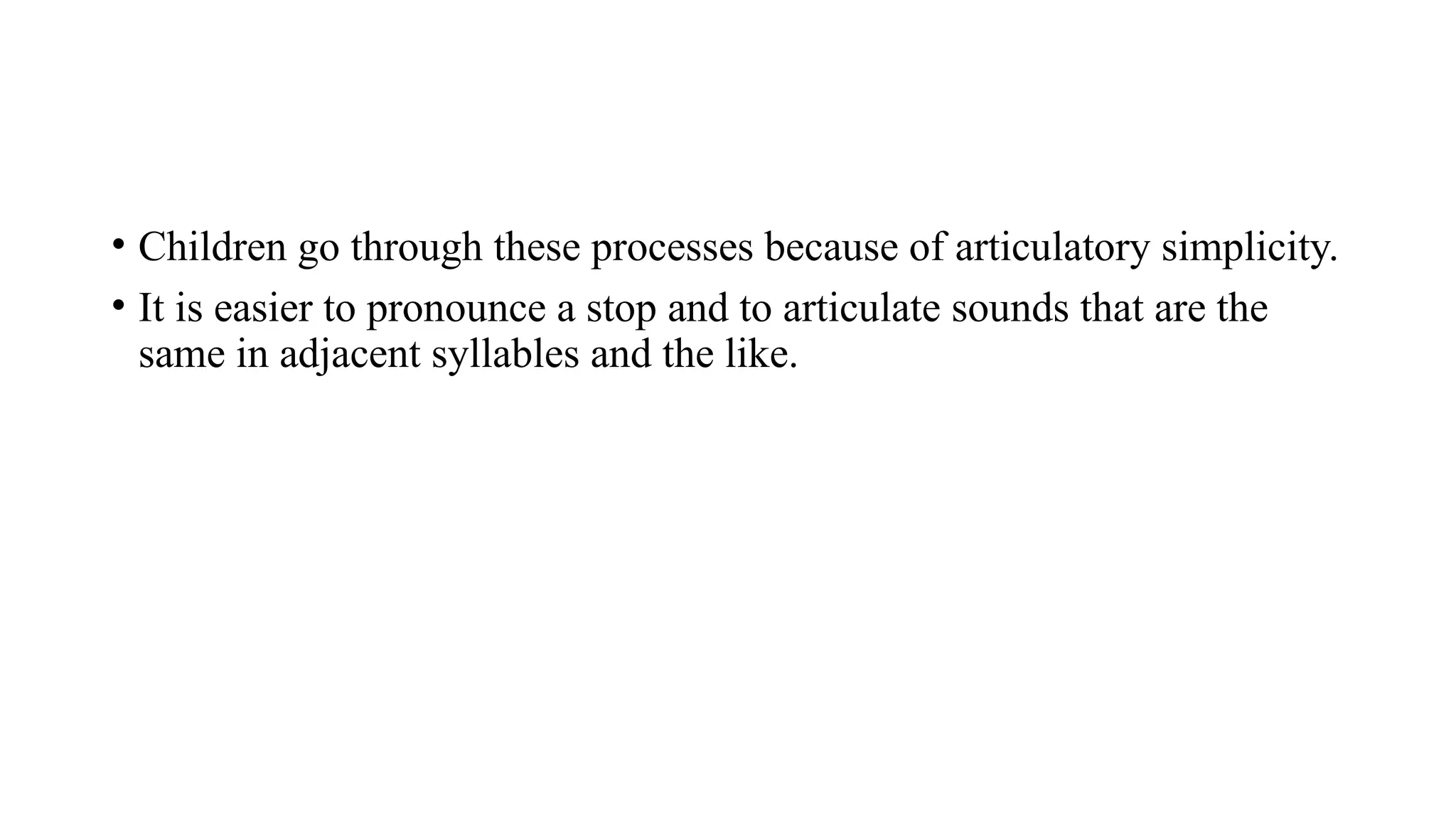
• Children gothrough these processes because of articulatory simplicity.
• It is easier to pronounce a stop and to articulate sounds that are the
same in adjacent syllables and the like.