

ENERGY RATING
Submitted to :
Mam Ayesha
Sir Sajjid
Submitted by:
Neyalish Aman-12
Asad Qasim-32
Mehak Khan-16
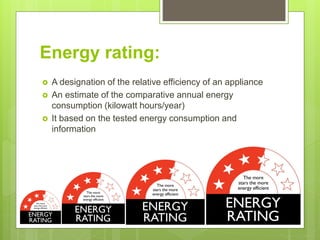
Energy rating:
 A designation of the relative efficiency of an appliance
 An estimate of the comparative annual energy
consumption (kilowatt hours/year)
 It based on the tested energy consumption and
information
Energy rating Program:
The Energy Rating Program is implemented by a number
of initiatives i.e. federal, state and government agencies
under the Equipment Energy Efficiency (E3) Program. It
includes different programs:
 Minimum Energy Performance Standards (MEPS)
 Residential Energy Monitoring Program
 Energy rating label
 Climate-based energy efficiency
labeling system
WHY ENERGY RATING?
 Electricity consumption and greenhouse gas
emissions.
 To improve the energy efficiency of the products
 So that they uses least energy and meets the
consumers energy service needs.
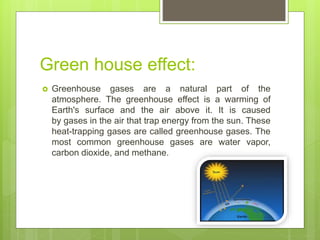
Green house effect:
 Greenhouse gases are a natural part of the
atmosphere. The greenhouse effect is a warming of
Earth's surface and the air above it. It is caused
by gases in the air that trap energy from the sun. These
heat-trapping gases are called greenhouse gases. The
most common greenhouse gases are water vapor,
carbon dioxide, and methane.
Main policy tools:
The main policy tools that are used to improve the energy
efficiency of appliances and equipment, in the residential,
commercial and industrial sector, and save money are :
 Mandatory Minimum Energy Performance Standards
(MEPS)
 Mandatory Energy Rating Labels
 Energy star
Minimum Energy Performance
Standard:
 MEPS specify the minimum level of energy
performance that product must meet or
exceed before they can be offered for sale
 MEPS specify the energy performance
 The products must be registered online
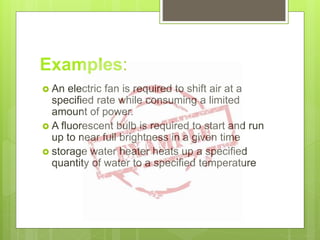
Examples:
 An electric fan is required to shift air at a
specified rate while consuming a limited
amount of power.
 A fluorescent bulb is required to start and run
up to near full brightness in a given time
 storage water heater heats up a specified
quantity of water to a specified temperature
Advantages of MEPS:
 Effective way to increase the energy efficiency
of products
 Increase average product efficiency over time
 Prevent inefficient products in market
 Reduces greenhouse gas emissions
Disadvantages of MEPS:
 Requires consensus/cooperation among
multiple stakeholders
 Can incur some up-front costs to consumers
 Requires good enforcement policy
Energy star:
 Energy Star is a government-backed
labeling program
 It helps people and organizations save money and reduce
greenhouse gas emissions
 In recent years, Energy Star ratings have been extended
to some new homes, commercial and industrial facilities.
 It sets energy performance standards for:
Electronic equipment
Appliances
Buildings & HOME
Origin of energy star:
 Energy Star is an international standard for energy
efficient consumers products originated in the United
States. It was created in 1992 by the environmental
protection agency and the department of energy
 Since then, Australia, Canada, Japan, New Zealand,
Taiwan and the European union have adopted the
program
what makes a product energy
star?
 ENERGY STAR products are better than standard
products
 To earn the ENERGY STAR they must meet strict
energy efficiency criteria set by the EPA or the DOE.
 Since they use less energy, these products save
money and help protect the environment by causing
less harmful emissions from power plants.
Energy star logo:
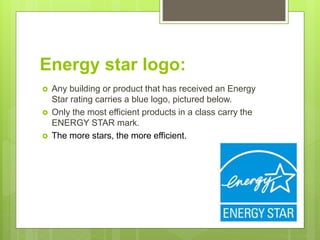
 Any building or product that has received an Energy
Star rating carries a blue logo, pictured below.
 Only the most efficient products in a class carry the
ENERGY STAR mark.
 The more stars, the more efficient.
Benefits of energy star:
 Saves money
 reduce air pollution
 Environment friendly
 Adds value
 Durability
Qualified product:
Home electronics
 Washing machines
 Televisions
Office equipment
 Imaging equipment
 computers
Air conditioners
 Heat pumps
 Efficient water heating
Efficient lighting
 LED lighting
 Fluorescent bulbs
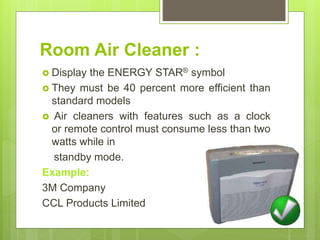
Room Air Cleaner :
 Display the ENERGY STAR® symbol
 They must be 40 percent more efficient than
standard models
 Air cleaners with features such as a clock
or remote control must consume less than two
watts while in
standby mode.
Example:
3M Company
CCL Products Limited
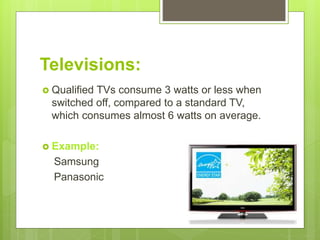
Televisions:
 Qualified TVs consume 3 watts or less when
switched off, compared to a standard TV,
which consumes almost 6 watts on average.
 Example:
Samsung
Panasonic
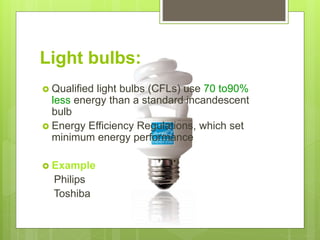
Light bulbs:
 Qualified light bulbs (CFLs) use 70 to90%
less energy than a standard incandescent
bulb
 Energy Efficiency Regulations, which set
minimum energy performance
 Example
Philips
Toshiba
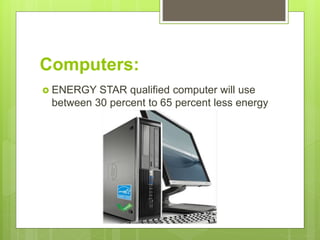
Computers:
 ENERGY STAR qualified computer will use
between 30 percent to 65 percent less energy
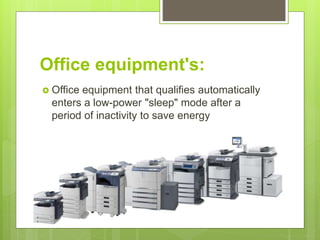
Office equipment's:
 Office equipment that qualifies automatically
enters a low-power "sleep" mode after a
period of inactivity to save energy
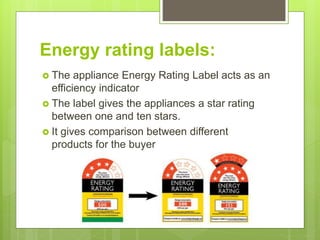
Energy rating labels:
 The appliance Energy Rating Label acts as an
efficiency indicator
 The label gives the appliances a star rating
between one and ten stars.
 It gives comparison between different
products for the buyer
Features:
 Efficient products use less electricity to achieve the
same level of performance of similar models
 Appliances that are labeled up to 6 stars are
considered ‘efficient’ while those above 6 are defined
as ‘super efficient.’
 It tells how much energy the appliance uses in kilowatt-
hours
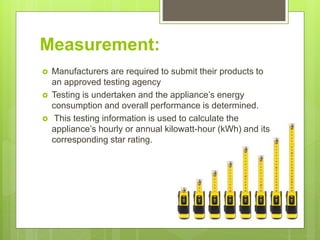
Measurement:
 Manufacturers are required to submit their products to
an approved testing agency
 Testing is undertaken and the appliance’s energy
consumption and overall performance is determined.
 This testing information is used to calculate the
appliance’s hourly or annual kilowatt-hour (kWh) and its
corresponding star rating.
Types of energy labeling:
Energy labels are of two types:
 Energy Rating Label:
It is concerned with the star rating
 The EU(European union) energy label:
It rates products from A, (the most efficient) to G (the least
efficient).
Categories of labeling:
The energy labels are separated into four
categories:
 Appliance's details
 Energy class
 Appliance type
 Appliance noise
Qualified products:
 Fridge or Freezers
 Dish Washers
 Tumble dryer
 Air condition
 Television
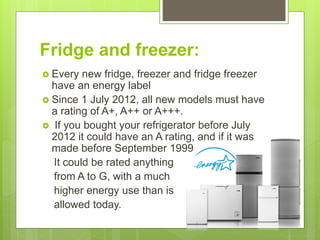
Fridge and freezer:
 Every new fridge, freezer and fridge freezer
have an energy label
 Since 1 July 2012, all new models must have
a rating of A+, A++ or A+++.
 If you bought your refrigerator before July
2012 it could have an A rating, and if it was
made before September 1999
It could be rated anything
from A to G, with a much
higher energy use than is
allowed today.
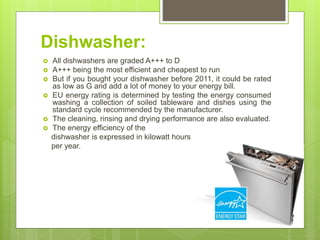
Dishwasher:
 All dishwashers are graded A+++ to D
 A+++ being the most efficient and cheapest to run
 But if you bought your dishwasher before 2011, it could be rated
as low as G and add a lot of money to your energy bill.
 EU energy rating is determined by testing the energy consumed
washing a collection of soiled tableware and dishes using the
standard cycle recommended by the manufacturer.
 The cleaning, rinsing and drying performance are also evaluated.
 The energy efficiency of the
dishwasher is expressed in kilowatt hours
per year.
Advantages:
 Gives information of products at point of sale
 Increase consumer awareness and demand
for energy efficient appliances
 encourage manufacturers to respond to that
market demand.
 works hand-in-hand with a mechanism called
(MEPS).
EnerGuide:
 EnerGuide is energy rating and labeling system that
certifies the energy efficiency of new and existing
products and homes
 EnerGuide rating allows you to easily compare the
energy efficiency of major household appliances
 EnerGuide also provides a standard measure of your
home’s energy performance
EnerGuide system:
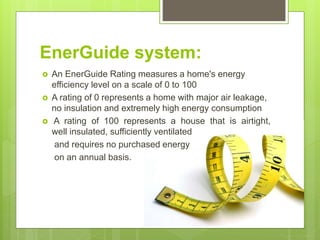
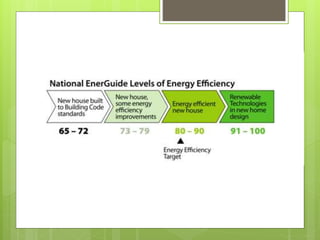
 An EnerGuide Rating measures a home's energy
efficiency level on a scale of 0 to 100
 A rating of 0 represents a home with major air leakage,
no insulation and extremely high energy consumption
 A rating of 100 represents a house that is airtight,
well insulated, sufficiently ventilated
and requires no purchased energy
on an annual basis.
Products :
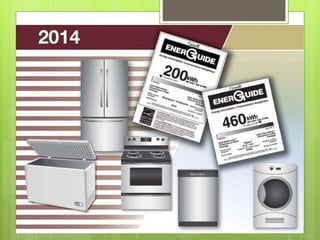
The products that are tested by energuide testing method
to be rated are:
 clothes dryers
 clothes washers
 dishwashers
 electric ranges, cook tops and ovens
 freezers
 refrigerators
Energy Rating Calculator:
 To find out the energy efficiency of a product, energy
rating calculator is the easiest way of doing that.
 Step1: Select an appliance.
 Step2: Select your usage details
 Step3:Adjust the energy rating slider. By adjusting this ,
the max energy consumption, the running cost per year
and the green house gas emission will automatically
valued down.
Energy rating-final-2

Energy rating-final-2

  • 2.
    ENERGY RATING Submitted to: Mam Ayesha Sir Sajjid Submitted by: Neyalish Aman-12 Asad Qasim-32 Mehak Khan-16
  • 3.
    Energy rating:  Adesignation of the relative efficiency of an appliance  An estimate of the comparative annual energy consumption (kilowatt hours/year)  It based on the tested energy consumption and information
  • 4.
    Energy rating Program: TheEnergy Rating Program is implemented by a number of initiatives i.e. federal, state and government agencies under the Equipment Energy Efficiency (E3) Program. It includes different programs:  Minimum Energy Performance Standards (MEPS)  Residential Energy Monitoring Program  Energy rating label  Climate-based energy efficiency labeling system
  • 5.
    WHY ENERGY RATING? Electricity consumption and greenhouse gas emissions.  To improve the energy efficiency of the products  So that they uses least energy and meets the consumers energy service needs.
  • 6.
    Green house effect: Greenhouse gases are a natural part of the atmosphere. The greenhouse effect is a warming of Earth's surface and the air above it. It is caused by gases in the air that trap energy from the sun. These heat-trapping gases are called greenhouse gases. The most common greenhouse gases are water vapor, carbon dioxide, and methane.
  • 7.
    Main policy tools: Themain policy tools that are used to improve the energy efficiency of appliances and equipment, in the residential, commercial and industrial sector, and save money are :  Mandatory Minimum Energy Performance Standards (MEPS)  Mandatory Energy Rating Labels  Energy star
  • 8.
    Minimum Energy Performance Standard: MEPS specify the minimum level of energy performance that product must meet or exceed before they can be offered for sale  MEPS specify the energy performance  The products must be registered online
  • 9.
    Examples:  An electricfan is required to shift air at a specified rate while consuming a limited amount of power.  A fluorescent bulb is required to start and run up to near full brightness in a given time  storage water heater heats up a specified quantity of water to a specified temperature
  • 10.
    Advantages of MEPS: Effective way to increase the energy efficiency of products  Increase average product efficiency over time  Prevent inefficient products in market  Reduces greenhouse gas emissions
  • 11.
    Disadvantages of MEPS: Requires consensus/cooperation among multiple stakeholders  Can incur some up-front costs to consumers  Requires good enforcement policy
  • 12.
    Energy star:  EnergyStar is a government-backed labeling program  It helps people and organizations save money and reduce greenhouse gas emissions  In recent years, Energy Star ratings have been extended to some new homes, commercial and industrial facilities.  It sets energy performance standards for: Electronic equipment Appliances Buildings & HOME
  • 13.
    Origin of energystar:  Energy Star is an international standard for energy efficient consumers products originated in the United States. It was created in 1992 by the environmental protection agency and the department of energy  Since then, Australia, Canada, Japan, New Zealand, Taiwan and the European union have adopted the program
  • 14.
    what makes aproduct energy star?  ENERGY STAR products are better than standard products  To earn the ENERGY STAR they must meet strict energy efficiency criteria set by the EPA or the DOE.  Since they use less energy, these products save money and help protect the environment by causing less harmful emissions from power plants.
  • 15.
    Energy star logo: Any building or product that has received an Energy Star rating carries a blue logo, pictured below.  Only the most efficient products in a class carry the ENERGY STAR mark.  The more stars, the more efficient.
  • 16.
    Benefits of energystar:  Saves money  reduce air pollution  Environment friendly  Adds value  Durability
  • 17.
    Qualified product: Home electronics Washing machines  Televisions Office equipment  Imaging equipment  computers Air conditioners  Heat pumps  Efficient water heating Efficient lighting  LED lighting  Fluorescent bulbs
  • 18.
    Room Air Cleaner:  Display the ENERGY STAR® symbol  They must be 40 percent more efficient than standard models  Air cleaners with features such as a clock or remote control must consume less than two watts while in standby mode. Example: 3M Company CCL Products Limited
  • 19.
    Televisions:  Qualified TVsconsume 3 watts or less when switched off, compared to a standard TV, which consumes almost 6 watts on average.  Example: Samsung Panasonic
  • 20.
    Light bulbs:  Qualifiedlight bulbs (CFLs) use 70 to90% less energy than a standard incandescent bulb  Energy Efficiency Regulations, which set minimum energy performance  Example Philips Toshiba
  • 21.
    Computers:  ENERGY STARqualified computer will use between 30 percent to 65 percent less energy
  • 22.
    Office equipment's:  Officeequipment that qualifies automatically enters a low-power "sleep" mode after a period of inactivity to save energy
  • 23.
    Energy rating labels: The appliance Energy Rating Label acts as an efficiency indicator  The label gives the appliances a star rating between one and ten stars.  It gives comparison between different products for the buyer
  • 24.
    Features:  Efficient productsuse less electricity to achieve the same level of performance of similar models  Appliances that are labeled up to 6 stars are considered ‘efficient’ while those above 6 are defined as ‘super efficient.’  It tells how much energy the appliance uses in kilowatt- hours
  • 25.
    Measurement:  Manufacturers arerequired to submit their products to an approved testing agency  Testing is undertaken and the appliance’s energy consumption and overall performance is determined.  This testing information is used to calculate the appliance’s hourly or annual kilowatt-hour (kWh) and its corresponding star rating.
  • 26.
    Types of energylabeling: Energy labels are of two types:  Energy Rating Label: It is concerned with the star rating  The EU(European union) energy label: It rates products from A, (the most efficient) to G (the least efficient).
  • 27.
    Categories of labeling: Theenergy labels are separated into four categories:  Appliance's details  Energy class  Appliance type  Appliance noise
  • 28.
    Qualified products:  Fridgeor Freezers  Dish Washers  Tumble dryer  Air condition  Television
  • 29.
    Fridge and freezer: Every new fridge, freezer and fridge freezer have an energy label  Since 1 July 2012, all new models must have a rating of A+, A++ or A+++.  If you bought your refrigerator before July 2012 it could have an A rating, and if it was made before September 1999 It could be rated anything from A to G, with a much higher energy use than is allowed today.
  • 30.
    Dishwasher:  All dishwashersare graded A+++ to D  A+++ being the most efficient and cheapest to run  But if you bought your dishwasher before 2011, it could be rated as low as G and add a lot of money to your energy bill.  EU energy rating is determined by testing the energy consumed washing a collection of soiled tableware and dishes using the standard cycle recommended by the manufacturer.  The cleaning, rinsing and drying performance are also evaluated.  The energy efficiency of the dishwasher is expressed in kilowatt hours per year.
  • 31.
    Advantages:  Gives informationof products at point of sale  Increase consumer awareness and demand for energy efficient appliances  encourage manufacturers to respond to that market demand.  works hand-in-hand with a mechanism called (MEPS).
  • 32.
    EnerGuide:  EnerGuide isenergy rating and labeling system that certifies the energy efficiency of new and existing products and homes  EnerGuide rating allows you to easily compare the energy efficiency of major household appliances  EnerGuide also provides a standard measure of your home’s energy performance
  • 33.
    EnerGuide system:  AnEnerGuide Rating measures a home's energy efficiency level on a scale of 0 to 100  A rating of 0 represents a home with major air leakage, no insulation and extremely high energy consumption  A rating of 100 represents a house that is airtight, well insulated, sufficiently ventilated and requires no purchased energy on an annual basis.
  • 35.
    Products : The productsthat are tested by energuide testing method to be rated are:  clothes dryers  clothes washers  dishwashers  electric ranges, cook tops and ovens  freezers  refrigerators
  • 37.
    Energy Rating Calculator: To find out the energy efficiency of a product, energy rating calculator is the easiest way of doing that.  Step1: Select an appliance.  Step2: Select your usage details  Step3:Adjust the energy rating slider. By adjusting this , the max energy consumption, the running cost per year and the green house gas emission will automatically valued down.