
Energy Star 101What you always wanted to know about Energy Star...
Introduction2Energy Star is an international standard for energy efficient consumer products.
It was first created as a United States government program by the Clinton Administration in 1992, but Australia, Canada, Japan, New Zealand, Taiwan and the European Union have also adopted the program.
Devices carrying the Energy Star logo, generally use 20%–30% less energy than required by federal standards.
Many European-targeted products are labeled using a different standard, TCO Certification, a combined energy usage and ergonomics rating from the Swedish Confederation of Professional Employees (TCO) instead of Energy Star.History1991EPA introduces the Green Lights Program1992EPA introduces the first ENERGY STAR qualified product line. Initiated as a voluntary labeling program designed to identify and promote energy efficient products, Energy Star began with labels for computer products.1995the program was significantly expanded, ENERGY STAR for buildings launched2006more than 40,000 Energy Star products are available in a wide range of items2008USEPA announced Green Power Partnership program3
4Specifications
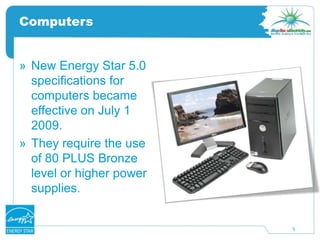
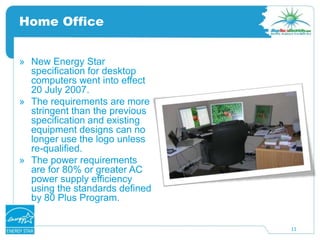
ComputersNew Energy Star 5.0 specifications for computers became effective on July 1 2009. They require the use of 80 PLUS Bronze level or higher power supplies.5
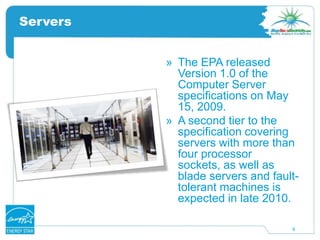
ServersThe EPA released Version 1.0 of the Computer Server specifications on May 15, 2009.
A second tier to the specification covering servers with more than four processor sockets, as well as blade servers and fault-tolerant machines is expected in late 2010.6
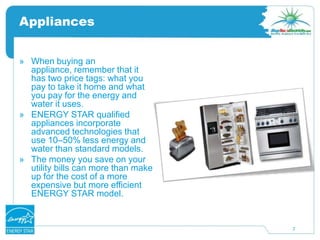
AppliancesWhen buying an appliance, remember that it has two price tags: what you pay to take it home and what you pay for the energy and water it uses.
ENERGY STAR qualified appliances incorporate advanced technologies that use 10–50% less energy and water than standard models.
The money you save on your utility bills can more than make up for the cost of a more expensive but more efficient ENERGY STAR model.7
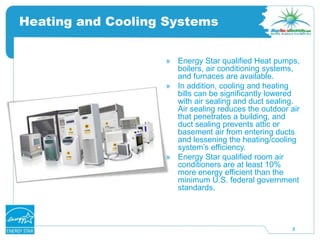
Heating and Cooling SystemsEnergy Star qualified Heat pumps, boilers, air conditioning systems, and furnaces are available.
In addition, cooling and heating bills can be significantly lowered with air sealing and duct sealing. Air sealing reduces the outdoor air that penetrates a building, and duct sealing prevents attic or basement air from entering ducts and lessening the heating/cooling system’s efficiency.
Energy Star qualified room air conditioners are at least 10% more energy efficient than the minimum U.S. federal government standards.8
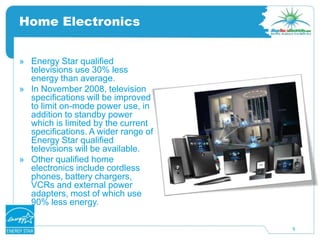
Home ElectronicsEnergy Star qualified televisions use 30% less energy than average.
In November 2008, television specifications will be improved to limit on-mode power use, in addition to standby power which is limited by the current specifications. A wider range of Energy Star qualified televisions will be available.

Energy Star 101

  • 1.
    Energy Star 101Whatyou always wanted to know about Energy Star...
  • 2.
    Introduction2Energy Star isan international standard for energy efficient consumer products.
  • 3.
    It was firstcreated as a United States government program by the Clinton Administration in 1992, but Australia, Canada, Japan, New Zealand, Taiwan and the European Union have also adopted the program.
  • 4.
    Devices carrying theEnergy Star logo, generally use 20%–30% less energy than required by federal standards.
  • 5.
    Many European-targeted productsare labeled using a different standard, TCO Certification, a combined energy usage and ergonomics rating from the Swedish Confederation of Professional Employees (TCO) instead of Energy Star.History1991EPA introduces the Green Lights Program1992EPA introduces the first ENERGY STAR qualified product line. Initiated as a voluntary labeling program designed to identify and promote energy efficient products, Energy Star began with labels for computer products.1995the program was significantly expanded, ENERGY STAR for buildings launched2006more than 40,000 Energy Star products are available in a wide range of items2008USEPA announced Green Power Partnership program3
  • 6.
  • 7.
    ComputersNew Energy Star5.0 specifications for computers became effective on July 1 2009. They require the use of 80 PLUS Bronze level or higher power supplies.5
  • 8.
    ServersThe EPA releasedVersion 1.0 of the Computer Server specifications on May 15, 2009.
  • 9.
    A second tierto the specification covering servers with more than four processor sockets, as well as blade servers and fault-tolerant machines is expected in late 2010.6
  • 10.
    AppliancesWhen buying anappliance, remember that it has two price tags: what you pay to take it home and what you pay for the energy and water it uses.
  • 11.
    ENERGY STAR qualifiedappliances incorporate advanced technologies that use 10–50% less energy and water than standard models.
  • 12.
    The money yousave on your utility bills can more than make up for the cost of a more expensive but more efficient ENERGY STAR model.7
  • 13.
    Heating and CoolingSystemsEnergy Star qualified Heat pumps, boilers, air conditioning systems, and furnaces are available.
  • 14.
    In addition, coolingand heating bills can be significantly lowered with air sealing and duct sealing. Air sealing reduces the outdoor air that penetrates a building, and duct sealing prevents attic or basement air from entering ducts and lessening the heating/cooling system’s efficiency.
  • 15.
    Energy Star qualifiedroom air conditioners are at least 10% more energy efficient than the minimum U.S. federal government standards.8
  • 16.
    Home ElectronicsEnergy Starqualified televisions use 30% less energy than average.
  • 17.
    In November 2008,television specifications will be improved to limit on-mode power use, in addition to standby power which is limited by the current specifications. A wider range of Energy Star qualified televisions will be available.

Editor's Notes

  • #5 Energy Star specifications differ with each item, and are set by either the Environmental Protection Agency or the Department of Energy. The following highlights product and specification information available on the Energy Star website.
  • #7 The EPA released Version 1.0 of the Computer Server specifications on May 15, 2009. It covers standalone servers with one to four processor sockets. A second tier to the specification covering servers with more than four processor sockets, as well as blade servers and fault-tolerant machines is expected in late 2010
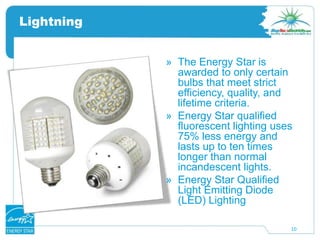
  • #11 The Energy Star is awarded to only certain bulbs that meet strict efficiency, quality, and lifetime criteria.Energy Star qualified fluorescent lighting uses 75% less energy and lasts up to ten times longer than normal incandescent lights.Energy Star Qualified Light Emitting Diode (LED) Lighting:Reduces energy costs — uses at least 75% less energy than incandescent lighting, saving on operating expenses.Reduces maintenance costs — lasts 35 to 50 times longer than incandescent lighting and about 2 to 5 times longer than fluorescent lighting. No bulb-replacements, no ladders, no ongoing disposal program.Reduces cooling costs — LEDs produce very little heat.Is guaranteed — comes with a minimum three-year warranty — far beyond the industry standard.Offers convenient features — available with dimming on some indoor models and automatic daylight shut-off and motion sensors on some outdoor models.Is durable — won’t break like a bulb.To qualify for Energy Star certification, LED lighting products must pass a variety of tests to prove that the products will display the following characteristics:Brightness is equal to or greater than existing lighting technologies (incandescent or fluorescent) and light is well distributed over the area lighted by the fixture.Light output remains constant over time, only decreasing towards the end of the rated lifetime (at least 35,000 hours or 12 years based on use of 8 hours per day).Excellent color quality. The shade of white light appears clear and consistent over time.Efficiency is as good as or better than fluorescent lighting.Light comes on instantly when turned on.No flicker when dimmed.No off-state power draw. The fixture does not use power when it is turned off, with the exception of external controls, whose power should not exceed 0.5 watts in the off state.