1
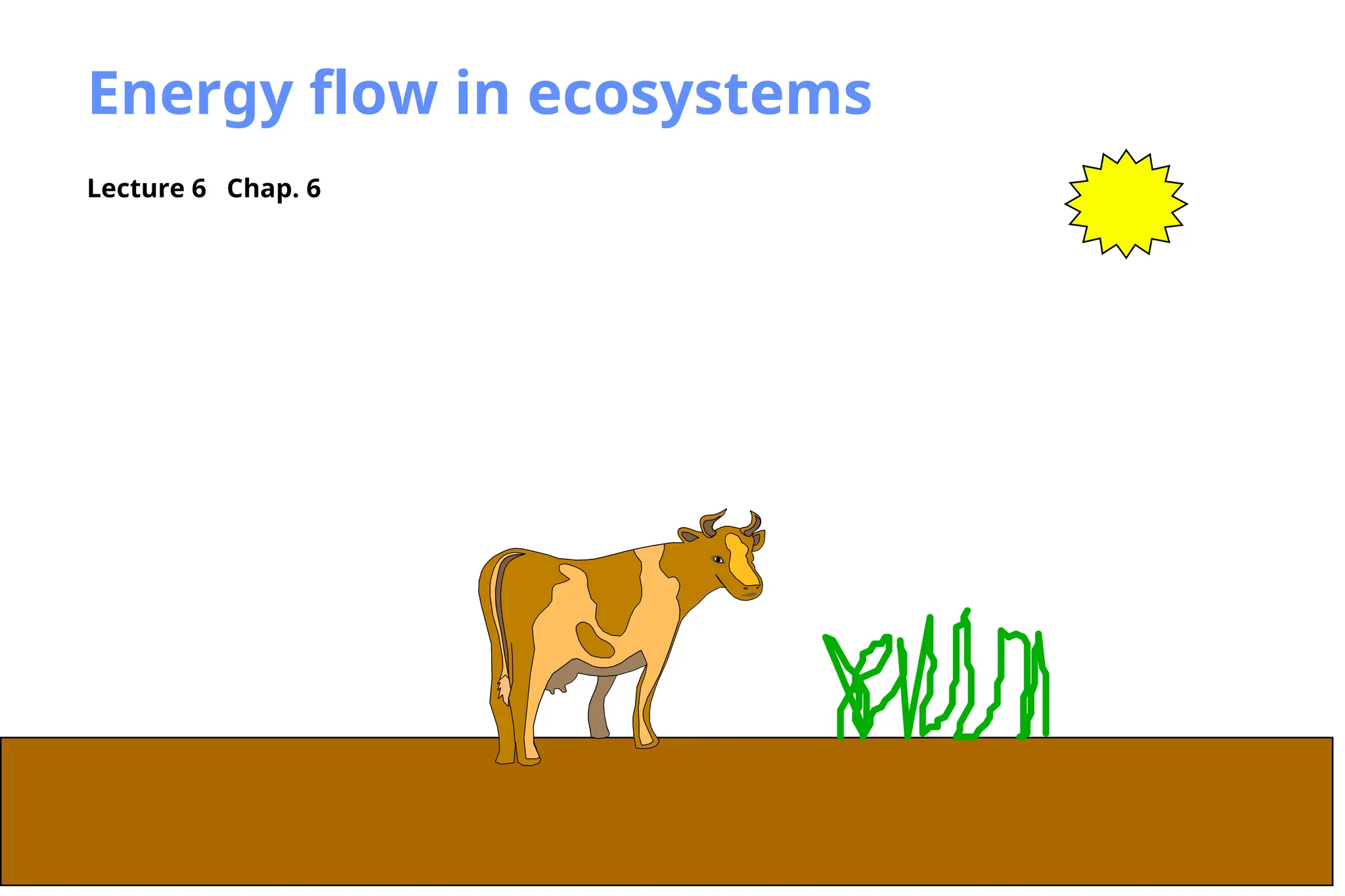
Energy flow in ecosystems
Lecture 6 Chap. 6
2
What is an ecosystem?
System = regularly interacting and
interdependent components forming a
unified whole
Ecosystem = an ecological system;
= a community and its physical
environment treated together as a
functional system
3
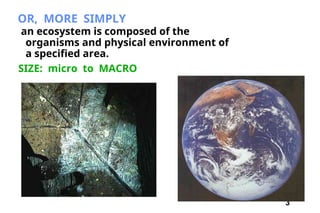
OR, MORE SIMPLY
an ecosystem is composed of the
organisms and physical environment of
a specified area.
SIZE: micro to MACRO
4
THE RULES OF ECOLOGY
F. A. BAZZAZ:
1. Everything is connected to everything else.
2. Everything must go somewhere.
3. There is no such thing as a free lunch.
5
H. T. Odum:
To understand any system you must
understand the next larger system.
6
Attributes of Ecosystems
Order
Development
Metabolism (energy flow)
Material cycles
Response to the environment
Porous boundaries
Emphasis on function, not species
7
ENERGY FLOW IN ECOSYSTEMS
All organisms require energy,
for growth, maintenance, reproduction,
locomotion, etc.
Hence, for all organisms there must be:
A source of energy
A loss of usable energy
8
Types of energy
heat energy
mechanical energy (+gravitational energy,
etc.)
chemical energy = energy stored in
molecular bonds
9
Transformations of energy
How is solar energy converted to chemical
energy?
How does this process influence life as we see it
on earth?
The transformations of energy from solar
radiation to chemical energy and mechanical
energy and finally back to heat are a traditional
topic of Ecosystem Ecology.
10
An ecosystem has abiotic and
biotic components:
ABIOTIC components:
Solar energy provides practically all the energy
for ecosystems.
Inorganic substances, e.g., sulfur, boron, tend
to cycle through ecosystems.
Organic compounds, such as proteins,
carbohydrates, lipids, and other complex
molecules, form a link between biotic and
abiotic components of the system.
11
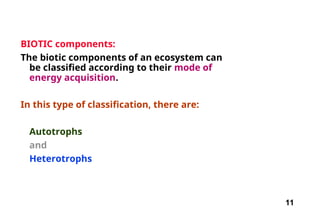
BIOTIC components:
The biotic components of an ecosystem can
be classified according to their mode of
energy acquisition.
In this type of classification, there are:
Autotrophs
and
Heterotrophs
12
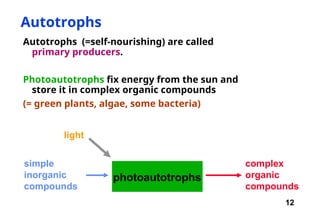
Autotrophs
Autotrophs (=self-nourishing) are called
primary producers.
Photoautotrophs fix energy from the sun and
store it in complex organic compounds
(= green plants, algae, some bacteria)
photoautotrophs
simple
inorganic
compounds
complex
organic
compounds
light
13
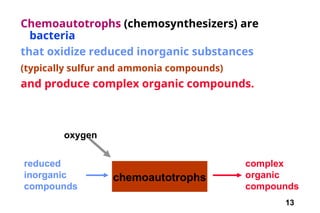
Chemoautotrophs (chemosynthesizers) are
bacteria
that oxidize reduced inorganic substances
(typically sulfur and ammonia compounds)
and produce complex organic compounds.
chemoautotrophs
reduced
inorganic
compounds
complex
organic
compounds
oxygen
14
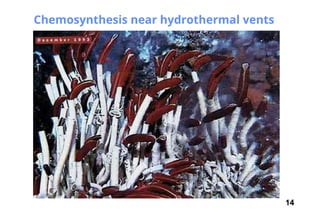
Chemosynthesis near hydrothermal vents
15
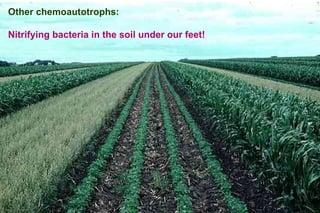
Other chemoautotrophs:
Nitrifying bacteria in the soil under our feet!
16
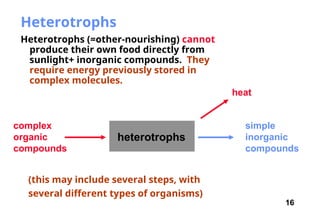
Heterotrophs
Heterotrophs (=other-nourishing) cannot
produce their own food directly from
sunlight+ inorganic compounds. They
require energy previously stored in
complex molecules.
heterotrophs
simple
inorganic
compounds
complex
organic
compounds
(this may include several steps, with
several different types of organisms)
heat
17
Heterotrophs can be grouped as:
consumers
decomposers
18
Consumers feed on organisms or particulate organic
matter.
Decomposers utilize complex compounds in dead
protoplasm.
Bacteria and fungi are the main groups of decomposers.
Bacteria are the main feeders on animal material.
Fungi feed primarily on plants, although bacteria also
are important in some plant decomposition processes.
19
20
The Laws of Thermodynamics
Energy flow is a one-directional process.
sun---> heat (longer wavelengths)
FIRST LAW of THERMODYNAMICS:
Energy can be converted from one form to another, but cannot be created or destroyed.
21
SECOND LAW of THERMODYNAMICS
Transformations of energy always result in some loss or dissipation of energy
or
In energy exchanges in a closed system, the potential energy of the final state will
be less than that of the initial state
or
Entropy tends to increase (entropy = amount of unavailable energy in a system)
or
Systems will tend to go from ordered states to disordered states (to maintain order,
energy must be added to the system, to compensate for the loss of energy)
22
Examples
Internal combustion engines in cars are 25% efficient
in converting chemical energy to kinetic energy; the
rest is not used or is lost as heat.
My house, particularly my girls' rooms, goes from a
complex, ordered state to a simpler, disordered
state.
23
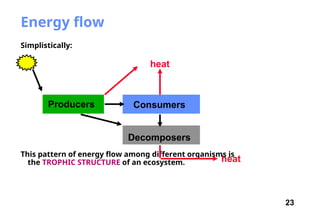
Energy flow
Simplistically:
This pattern of energy flow among different organisms is
the TROPHIC STRUCTURE of an ecosystem. heat
Producers Consumers
Decomposers
heat
24
It is useful to distinguish different types of
organisms within these major groups,
particularly within the consumer group.
Consumers
25
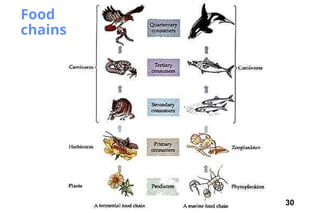
Terminology of trophic levels
We can further separate the TROPHIC LEVELS, particularly the
Consumers:
Producers (Plants, algae, cyanobacteria; some chemotrophs)--
capture energy, produce complex organic compounds
Primary consumers--feed on producers
Secondary consumers--feed on primary consumers
Tertiary consumers--feed on secondary consumers
26
More trophic levels:
Detritivores--invertebrates that feed on
organic wastes and dead organisms
(detritus) from all trophic levels
Decomposers--bacteria and fungi that break
down dead material into inorganic
materials
27
Alternate Terminology
Producers = plants etc. that capture energy from the
sun
Herbivores = plant-eaters
Carnivores = animal-eaters
Omnivores--eat both animals and plants
Specialized herbivores:
Granivores--seed-eaters
Frugivores--fruit-eaters
28
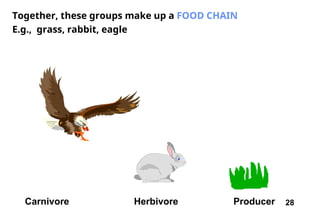
Together, these groups make up a FOOD CHAIN
E.g., grass, rabbit, eagle
Carnivore Herbivore Producer
29
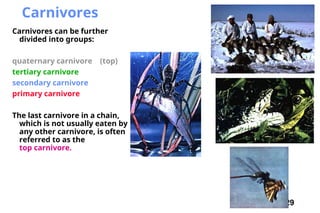
Carnivores
Carnivores can be further
divided into groups:
quaternary carnivore (top)
tertiary carnivore
secondary carnivore
primary carnivore
The last carnivore in a chain,
which is not usually eaten by
any other carnivore, is often
referred to as the
top carnivore.
30
Food
chains
31
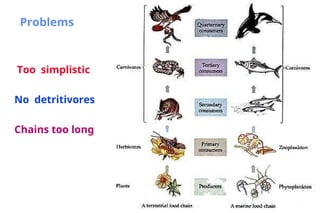
Problems
Too simplistic
No detritivores
Chains too long
32
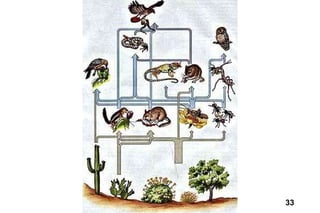
Rarely are things as simple as grass, rabbit,
hawk, or indeed any simple linear sequence
of organisms.
More typically, there are multiple
interactions, so that we end up with a
FOOD WEB.
33
34
Energy transfers among trophic
levels
How much energy is passed from one trophic
level to the next?
How efficient are such transfers?
35
Biomass--the dry mass of organic material
in the organism(s).
(the mass of water is not usually included,
since water content is variable and
contains no usable energy)
Standing crop--the amount of biomass
present at any point in time.
36
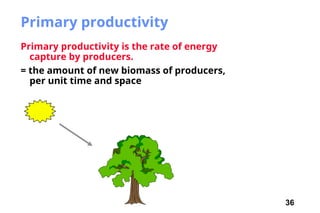
Primary productivity
Primary productivity is the rate of energy
capture by producers.
= the amount of new biomass of producers,
per unit time and space
37
Gross primary production (GPP)
= total amount of energy captured
Net primary production (NPP)
= GPP - respiration
Net primary production is thus the amount of
energy stored by the producers and potentially
available to consumers and decomposers.
38
Secondary productivity is the rate of production of new
biomass by consumers, i.e., the rate at which
consumers convert organic material into new biomass
of consumers.
Note that secondary production simply involves the
repackaging of energy previously captured by
producers--no additional energy is introduced into the
food chain.
And, since there are multiple levels of consumers and no
new energy is being captured and introduced into the
system, the modifiers gross and net are not very
appropriate and are not usually used.
39
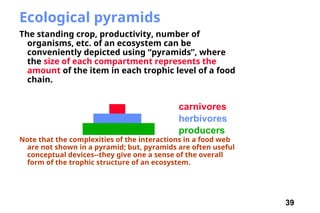
Ecological pyramids
The standing crop, productivity, number of
organisms, etc. of an ecosystem can be
conveniently depicted using “pyramids”, where
the size of each compartment represents the
amount of the item in each trophic level of a food
chain.
Note that the complexities of the interactions in a food web
are not shown in a pyramid; but, pyramids are often useful
conceptual devices--they give one a sense of the overall
form of the trophic structure of an ecosystem.
producers
herbivores
carnivores
40
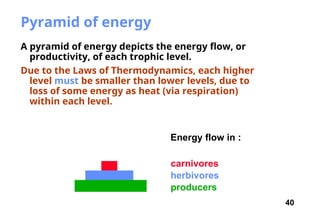
Pyramid of energy
A pyramid of energy depicts the energy flow, or
productivity, of each trophic level.
Due to the Laws of Thermodynamics, each higher
level must be smaller than lower levels, due to
loss of some energy as heat (via respiration)
within each level.
producers
herbivores
carnivores
Energy flow in :
41
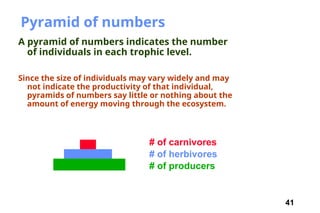
Pyramid of numbers
A pyramid of numbers indicates the number
of individuals in each trophic level.
Since the size of individuals may vary widely and may
not indicate the productivity of that individual,
pyramids of numbers say little or nothing about the
amount of energy moving through the ecosystem.
# of producers
# of herbivores
# of carnivores
42
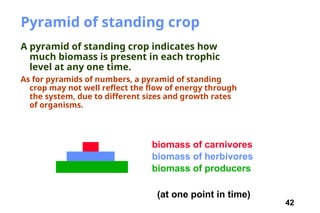
Pyramid of standing crop
A pyramid of standing crop indicates how
much biomass is present in each trophic
level at any one time.
As for pyramids of numbers, a pyramid of standing
crop may not well reflect the flow of energy through
the system, due to different sizes and growth rates
of organisms.
biomass of producers
biomass of herbivores
biomass of carnivores
(at one point in time)
43
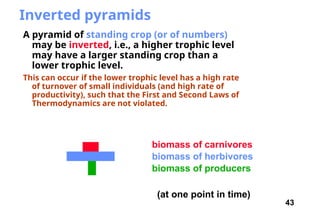
Inverted pyramids
A pyramid of standing crop (or of numbers)
may be inverted, i.e., a higher trophic level
may have a larger standing crop than a
lower trophic level.
This can occur if the lower trophic level has a high rate
of turnover of small individuals (and high rate of
productivity), such that the First and Second Laws of
Thermodynamics are not violated.
biomass of producers
biomass of herbivores
biomass of carnivores
(at one point in time)
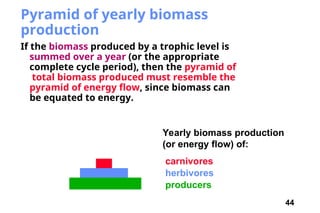
44
Pyramid of yearly biomass
production
If the biomass produced by a trophic level is
summed over a year (or the appropriate
complete cycle period), then the pyramid of
total biomass produced must resemble the
pyramid of energy flow, since biomass can
be equated to energy.
producers
herbivores
carnivores
Yearly biomass production
(or energy flow) of:
45
Note that pyramids of energy and yearly biomass
production can never be inverted, since this
would violate the laws of thermodynamics.
Pyramids of standing crop and numbers can be
inverted, since the amount of organisms at any
one time does not indicate the amount of energy
flowing through the system.
E.g., consider the amount of food you eat in a year
compared to the amount on hand in your pantry.
46
Examples of food webs
the North Sea
a hypothetical web--effects on species
diversity
47
7-12 mm 13-40 mm 40-130 mm Adult
Herring
in the
North Sea
48
a hypothetical web--effects on species diversity
49
Examples of pyramids
Terrestrial and fresh-water communities
Ocean communities--English Channel
50
51

energy_ecosystem AND ITS MEANING AND THE PROCESS

  • 1.
    1 Energy flow inecosystems Lecture 6 Chap. 6
  • 2.
    2 What is anecosystem? System = regularly interacting and interdependent components forming a unified whole Ecosystem = an ecological system; = a community and its physical environment treated together as a functional system
  • 3.
    3 OR, MORE SIMPLY anecosystem is composed of the organisms and physical environment of a specified area. SIZE: micro to MACRO
  • 4.
    4 THE RULES OFECOLOGY F. A. BAZZAZ: 1. Everything is connected to everything else. 2. Everything must go somewhere. 3. There is no such thing as a free lunch.
  • 5.
    5 H. T. Odum: Tounderstand any system you must understand the next larger system.
  • 6.
    6 Attributes of Ecosystems Order Development Metabolism(energy flow) Material cycles Response to the environment Porous boundaries Emphasis on function, not species
  • 7.
    7 ENERGY FLOW INECOSYSTEMS All organisms require energy, for growth, maintenance, reproduction, locomotion, etc. Hence, for all organisms there must be: A source of energy A loss of usable energy
  • 8.
    8 Types of energy heatenergy mechanical energy (+gravitational energy, etc.) chemical energy = energy stored in molecular bonds
  • 9.
    9 Transformations of energy Howis solar energy converted to chemical energy? How does this process influence life as we see it on earth? The transformations of energy from solar radiation to chemical energy and mechanical energy and finally back to heat are a traditional topic of Ecosystem Ecology.
  • 10.
    10 An ecosystem hasabiotic and biotic components: ABIOTIC components: Solar energy provides practically all the energy for ecosystems. Inorganic substances, e.g., sulfur, boron, tend to cycle through ecosystems. Organic compounds, such as proteins, carbohydrates, lipids, and other complex molecules, form a link between biotic and abiotic components of the system.
  • 11.
    11 BIOTIC components: The bioticcomponents of an ecosystem can be classified according to their mode of energy acquisition. In this type of classification, there are: Autotrophs and Heterotrophs
  • 12.
    12 Autotrophs Autotrophs (=self-nourishing) arecalled primary producers. Photoautotrophs fix energy from the sun and store it in complex organic compounds (= green plants, algae, some bacteria) photoautotrophs simple inorganic compounds complex organic compounds light
  • 13.
    13 Chemoautotrophs (chemosynthesizers) are bacteria thatoxidize reduced inorganic substances (typically sulfur and ammonia compounds) and produce complex organic compounds. chemoautotrophs reduced inorganic compounds complex organic compounds oxygen
  • 14.
  • 15.
  • 16.
    16 Heterotrophs Heterotrophs (=other-nourishing) cannot producetheir own food directly from sunlight+ inorganic compounds. They require energy previously stored in complex molecules. heterotrophs simple inorganic compounds complex organic compounds (this may include several steps, with several different types of organisms) heat
  • 17.
    17 Heterotrophs can begrouped as: consumers decomposers
  • 18.
    18 Consumers feed onorganisms or particulate organic matter. Decomposers utilize complex compounds in dead protoplasm. Bacteria and fungi are the main groups of decomposers. Bacteria are the main feeders on animal material. Fungi feed primarily on plants, although bacteria also are important in some plant decomposition processes.
  • 19.
  • 20.
    20 The Laws ofThermodynamics Energy flow is a one-directional process. sun---> heat (longer wavelengths) FIRST LAW of THERMODYNAMICS: Energy can be converted from one form to another, but cannot be created or destroyed.
  • 21.
    21 SECOND LAW ofTHERMODYNAMICS Transformations of energy always result in some loss or dissipation of energy or In energy exchanges in a closed system, the potential energy of the final state will be less than that of the initial state or Entropy tends to increase (entropy = amount of unavailable energy in a system) or Systems will tend to go from ordered states to disordered states (to maintain order, energy must be added to the system, to compensate for the loss of energy)
  • 22.
    22 Examples Internal combustion enginesin cars are 25% efficient in converting chemical energy to kinetic energy; the rest is not used or is lost as heat. My house, particularly my girls' rooms, goes from a complex, ordered state to a simpler, disordered state.
  • 23.
    23 Energy flow Simplistically: This patternof energy flow among different organisms is the TROPHIC STRUCTURE of an ecosystem. heat Producers Consumers Decomposers heat
  • 24.
    24 It is usefulto distinguish different types of organisms within these major groups, particularly within the consumer group. Consumers
  • 25.
    25 Terminology of trophiclevels We can further separate the TROPHIC LEVELS, particularly the Consumers: Producers (Plants, algae, cyanobacteria; some chemotrophs)-- capture energy, produce complex organic compounds Primary consumers--feed on producers Secondary consumers--feed on primary consumers Tertiary consumers--feed on secondary consumers
  • 26.
    26 More trophic levels: Detritivores--invertebratesthat feed on organic wastes and dead organisms (detritus) from all trophic levels Decomposers--bacteria and fungi that break down dead material into inorganic materials
  • 27.
    27 Alternate Terminology Producers =plants etc. that capture energy from the sun Herbivores = plant-eaters Carnivores = animal-eaters Omnivores--eat both animals and plants Specialized herbivores: Granivores--seed-eaters Frugivores--fruit-eaters
  • 28.
    28 Together, these groupsmake up a FOOD CHAIN E.g., grass, rabbit, eagle Carnivore Herbivore Producer
  • 29.
    29 Carnivores Carnivores can befurther divided into groups: quaternary carnivore (top) tertiary carnivore secondary carnivore primary carnivore The last carnivore in a chain, which is not usually eaten by any other carnivore, is often referred to as the top carnivore.
  • 30.
  • 31.
  • 32.
    32 Rarely are thingsas simple as grass, rabbit, hawk, or indeed any simple linear sequence of organisms. More typically, there are multiple interactions, so that we end up with a FOOD WEB.
  • 33.
  • 34.
    34 Energy transfers amongtrophic levels How much energy is passed from one trophic level to the next? How efficient are such transfers?
  • 35.
    35 Biomass--the dry massof organic material in the organism(s). (the mass of water is not usually included, since water content is variable and contains no usable energy) Standing crop--the amount of biomass present at any point in time.
  • 36.
    36 Primary productivity Primary productivityis the rate of energy capture by producers. = the amount of new biomass of producers, per unit time and space
  • 37.
    37 Gross primary production(GPP) = total amount of energy captured Net primary production (NPP) = GPP - respiration Net primary production is thus the amount of energy stored by the producers and potentially available to consumers and decomposers.
  • 38.
    38 Secondary productivity isthe rate of production of new biomass by consumers, i.e., the rate at which consumers convert organic material into new biomass of consumers. Note that secondary production simply involves the repackaging of energy previously captured by producers--no additional energy is introduced into the food chain. And, since there are multiple levels of consumers and no new energy is being captured and introduced into the system, the modifiers gross and net are not very appropriate and are not usually used.
  • 39.
    39 Ecological pyramids The standingcrop, productivity, number of organisms, etc. of an ecosystem can be conveniently depicted using “pyramids”, where the size of each compartment represents the amount of the item in each trophic level of a food chain. Note that the complexities of the interactions in a food web are not shown in a pyramid; but, pyramids are often useful conceptual devices--they give one a sense of the overall form of the trophic structure of an ecosystem. producers herbivores carnivores
  • 40.
    40 Pyramid of energy Apyramid of energy depicts the energy flow, or productivity, of each trophic level. Due to the Laws of Thermodynamics, each higher level must be smaller than lower levels, due to loss of some energy as heat (via respiration) within each level. producers herbivores carnivores Energy flow in :
  • 41.
    41 Pyramid of numbers Apyramid of numbers indicates the number of individuals in each trophic level. Since the size of individuals may vary widely and may not indicate the productivity of that individual, pyramids of numbers say little or nothing about the amount of energy moving through the ecosystem. # of producers # of herbivores # of carnivores
  • 42.
    42 Pyramid of standingcrop A pyramid of standing crop indicates how much biomass is present in each trophic level at any one time. As for pyramids of numbers, a pyramid of standing crop may not well reflect the flow of energy through the system, due to different sizes and growth rates of organisms. biomass of producers biomass of herbivores biomass of carnivores (at one point in time)
  • 43.
    43 Inverted pyramids A pyramidof standing crop (or of numbers) may be inverted, i.e., a higher trophic level may have a larger standing crop than a lower trophic level. This can occur if the lower trophic level has a high rate of turnover of small individuals (and high rate of productivity), such that the First and Second Laws of Thermodynamics are not violated. biomass of producers biomass of herbivores biomass of carnivores (at one point in time)
  • 44.
    44 Pyramid of yearlybiomass production If the biomass produced by a trophic level is summed over a year (or the appropriate complete cycle period), then the pyramid of total biomass produced must resemble the pyramid of energy flow, since biomass can be equated to energy. producers herbivores carnivores Yearly biomass production (or energy flow) of:
  • 45.
    45 Note that pyramidsof energy and yearly biomass production can never be inverted, since this would violate the laws of thermodynamics. Pyramids of standing crop and numbers can be inverted, since the amount of organisms at any one time does not indicate the amount of energy flowing through the system. E.g., consider the amount of food you eat in a year compared to the amount on hand in your pantry.
  • 46.
    46 Examples of foodwebs the North Sea a hypothetical web--effects on species diversity
  • 47.
    47 7-12 mm 13-40mm 40-130 mm Adult Herring in the North Sea
  • 48.
    48 a hypothetical web--effectson species diversity

  • 49.
    49 Examples of pyramids Terrestrialand fresh-water communities Ocean communities--English Channel
  • 50.
  • 51.