ENERGY A BODY HAS
BECAUSE OF ITS
POSITION OR CONDITION
P.E.= EP.E.= Epp = mgh= mgh
G.P.E. = weight x height
KINETIC
ENERGY (E k) =
½ mv2
=
KE
mv2
2
POTENTIAPOTENTIA
L ENERGYL ENERGY
ENERGY A BODY HAS
BECAUSE OF ITS
POSITION OR CONDITION
P.E.= EP.E.= Epp = mgh= mgh
G.P.E. = weight x height
EXAMPLEEXAMPLE
What is the p.e. of a book ofWhat is the p.e. of a book of
massmass 1200 g1200 g, resting on a shelf, resting on a shelf
2 m2 m above the ground?above the ground?
p.e. = mgh
p.e. = 1.2kg x 10m/s/s x 2m
p.e. = 12.0 N x 2 m
p.e. = 24 N-meter or Joulesp.e. = 24 N-meter or Joules
SAMPLE PROBLEM:
A hiker weighing
680 N climbs 40 m
up a hill. Calculate
the gravitational
potential energy
gained at the top of
the climb. Ep= mgh
Ep = 680 N x 40 m
= 27,200 N-m
P.E.= Ep= mgh
1. Calculate the p.e. of a 40 kg iron
bar raised 1 m. (g = 10m/s/s)
2. Calculate the p.e. of a 65 kg
boulder resting at 22 m above the
road.
3. A 200 g jar falls from a height 1.5
m onto the floor. Calculate the p.e.
of the jar before the fall.
1. Calculate the p.e. of a 40 kg iron
bar raised 1 m. 400 N-m or 400J
2. Calculate the p.e. of a 65 kg
boulder resting at 22 m above
the road. 14,300 N-m or 14.3 KJ
3. A 200 g jar falls from a height 1.5
m onto the floor. Calculate the
p.e. of the jar before the fall. 3 J
ANSWERS
POTENTIAL ENERGY
Ep or p.e. is the potential energy an
object has because of its height.
“The higher an object is lifted, the
greater its p.e.”
“The greater the mass of an object the
greater its p.e.”
the gain in p.e. = work done
Ep = W
Remember: W = F x d where
the lifting force is m x g
(F= ma)
(m = mass, g = acceleration
due to gravity)
gain in p.e. = work donegain in p.e. = work done
EpEp = W= W
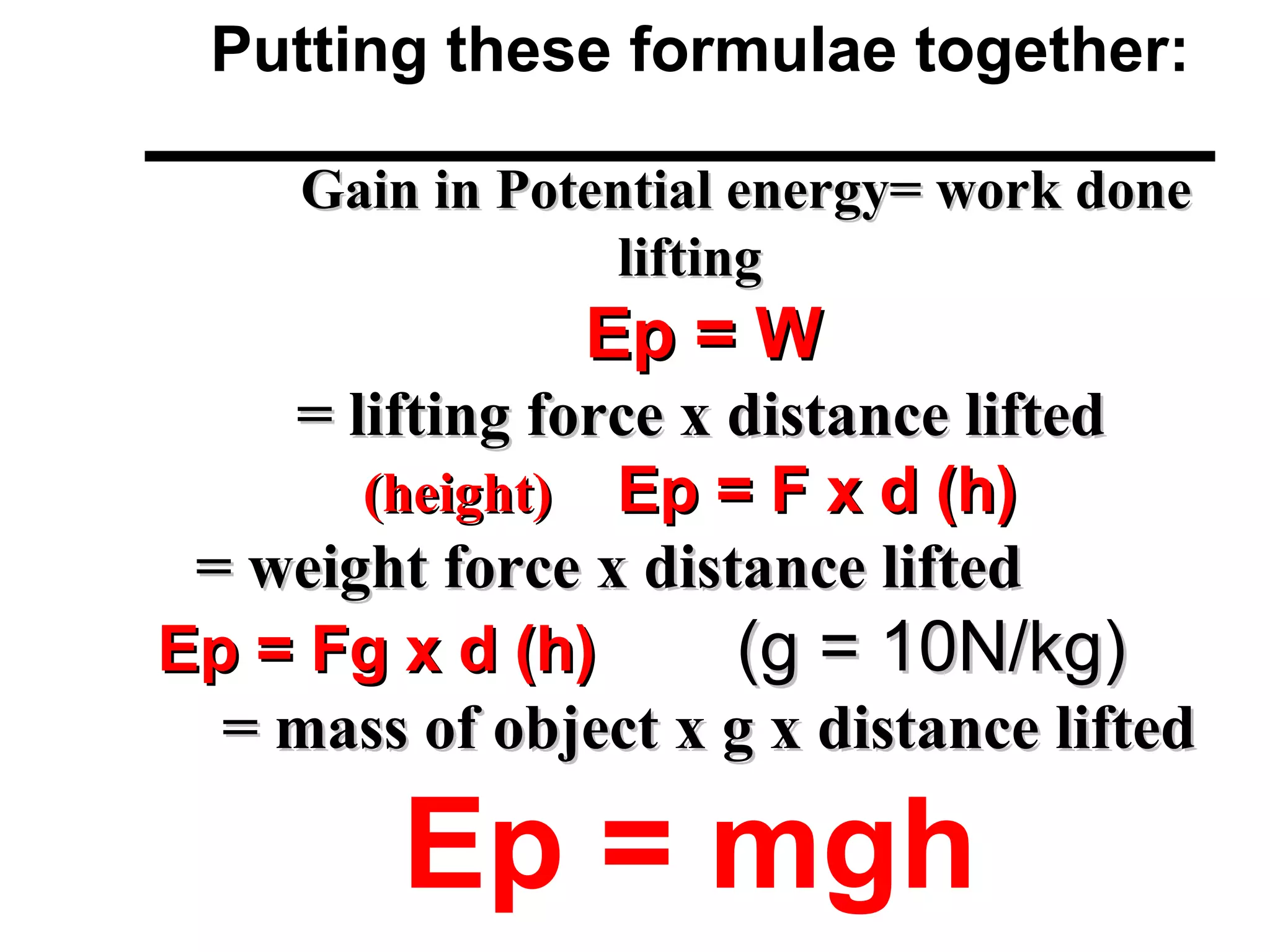
Putting these formulae together:
Gain in Potential energy= work doneGain in Potential energy= work done
liftinglifting
Ep = WEp = W
= lifting force x distance lifted= lifting force x distance lifted
(height)(height) Ep = F x d (h)Ep = F x d (h)
= weight force x distance lifted= weight force x distance lifted
Ep = Fg x d (h)Ep = Fg x d (h) (g = 10N/kg)(g = 10N/kg)
= mass of object x g x distance lifted= mass of object x g x distance lifted
Ep = mgh
KINETIC
ENERGY (E k) =
½ mv2
=
KE
mv2
2
KINETIC ENERGYKINETIC ENERGY
• Kinetic energy EkKinetic energy Ek or k.e. is theor k.e. is the
energy that an object has because itenergy that an object has because it
isis movingmoving
•TheThe unit of measureunit of measure for k.e. isfor k.e. is joulejoule
•TheThe greater the speed the greater thegreater the speed the greater the
k.e. of the objectk.e. of the object
•The greater the mass of a movingThe greater the mass of a moving
object, the greater the k.eobject, the greater the k.e. of the. of the
What is the Ek of an arrow
weighing 25 gm traveling at
25m/s?
What is the Ek of an arrow weighing 25
gm traveling at 25m/s?
Answer:
k.e. = ½ mv2
= ½ x .025kg x 25m/s2
= ½ x 0.025kg x 625m/s
= (0.5) 15.625
= 7.8125 Nm
but 1 Nm = 1J
= 7.8125 J
Potential Energy = Weight x Height (P.E. = w x h)
or Ep= mgh
Kinetic Energy = ½ Mass x Velocity2
(K.E.= 1/2mv2
)
weight = mg
Units:
Energy = joules (J) Weight = newtons (N)
Mass = kilograms (kg) Velocity = m/s
Height = meters (m)
Gravity constant = 9.8m/sec/sec
1km = 1000m1km = 1000m 1kg= 1000g1kg= 1000g 1hr= 3,600sec1hr= 3,600sec
Work = joules
Energy cannot be created
nor destroyed. Energy is
converted from one form to
another.

Potential and kinetic energy

  • 2.
    ENERGY A BODYHAS BECAUSE OF ITS POSITION OR CONDITION P.E.= EP.E.= Epp = mgh= mgh G.P.E. = weight x height
  • 3.
    KINETIC ENERGY (E k)= ½ mv2 = KE mv2 2
  • 5.
  • 6.
    ENERGY A BODYHAS BECAUSE OF ITS POSITION OR CONDITION P.E.= EP.E.= Epp = mgh= mgh G.P.E. = weight x height
  • 7.
    EXAMPLEEXAMPLE What is thep.e. of a book ofWhat is the p.e. of a book of massmass 1200 g1200 g, resting on a shelf, resting on a shelf 2 m2 m above the ground?above the ground? p.e. = mgh p.e. = 1.2kg x 10m/s/s x 2m p.e. = 12.0 N x 2 m p.e. = 24 N-meter or Joulesp.e. = 24 N-meter or Joules
  • 8.
    SAMPLE PROBLEM: A hikerweighing 680 N climbs 40 m up a hill. Calculate the gravitational potential energy gained at the top of the climb. Ep= mgh
  • 9.
    Ep = 680N x 40 m = 27,200 N-m P.E.= Ep= mgh
  • 10.
    1. Calculate thep.e. of a 40 kg iron bar raised 1 m. (g = 10m/s/s) 2. Calculate the p.e. of a 65 kg boulder resting at 22 m above the road. 3. A 200 g jar falls from a height 1.5 m onto the floor. Calculate the p.e. of the jar before the fall.
  • 11.
    1. Calculate thep.e. of a 40 kg iron bar raised 1 m. 400 N-m or 400J 2. Calculate the p.e. of a 65 kg boulder resting at 22 m above the road. 14,300 N-m or 14.3 KJ 3. A 200 g jar falls from a height 1.5 m onto the floor. Calculate the p.e. of the jar before the fall. 3 J ANSWERS
  • 12.
    POTENTIAL ENERGY Ep orp.e. is the potential energy an object has because of its height. “The higher an object is lifted, the greater its p.e.” “The greater the mass of an object the greater its p.e.” the gain in p.e. = work done Ep = W
  • 13.
    Remember: W =F x d where the lifting force is m x g (F= ma) (m = mass, g = acceleration due to gravity) gain in p.e. = work donegain in p.e. = work done EpEp = W= W
  • 14.
    Putting these formulaetogether: Gain in Potential energy= work doneGain in Potential energy= work done liftinglifting Ep = WEp = W = lifting force x distance lifted= lifting force x distance lifted (height)(height) Ep = F x d (h)Ep = F x d (h) = weight force x distance lifted= weight force x distance lifted Ep = Fg x d (h)Ep = Fg x d (h) (g = 10N/kg)(g = 10N/kg) = mass of object x g x distance lifted= mass of object x g x distance lifted Ep = mgh
  • 16.
    KINETIC ENERGY (E k)= ½ mv2 = KE mv2 2
  • 17.
    KINETIC ENERGYKINETIC ENERGY •Kinetic energy EkKinetic energy Ek or k.e. is theor k.e. is the energy that an object has because itenergy that an object has because it isis movingmoving •TheThe unit of measureunit of measure for k.e. isfor k.e. is joulejoule •TheThe greater the speed the greater thegreater the speed the greater the k.e. of the objectk.e. of the object •The greater the mass of a movingThe greater the mass of a moving object, the greater the k.eobject, the greater the k.e. of the. of the
  • 18.
    What is theEk of an arrow weighing 25 gm traveling at 25m/s?
  • 19.
    What is theEk of an arrow weighing 25 gm traveling at 25m/s? Answer: k.e. = ½ mv2 = ½ x .025kg x 25m/s2 = ½ x 0.025kg x 625m/s = (0.5) 15.625 = 7.8125 Nm but 1 Nm = 1J = 7.8125 J
  • 20.
    Potential Energy =Weight x Height (P.E. = w x h) or Ep= mgh Kinetic Energy = ½ Mass x Velocity2 (K.E.= 1/2mv2 ) weight = mg Units: Energy = joules (J) Weight = newtons (N) Mass = kilograms (kg) Velocity = m/s Height = meters (m) Gravity constant = 9.8m/sec/sec 1km = 1000m1km = 1000m 1kg= 1000g1kg= 1000g 1hr= 3,600sec1hr= 3,600sec Work = joules
  • 21.
    Energy cannot becreated nor destroyed. Energy is converted from one form to another.