Nursing (Endoscopy) Lecture:
Endoscopic Hemostasis
Dr Jarrod Lee
Gastroenterologist & Advanced Endoscopist
April 2020
About gutCARE
• Founded 2014
• Singapore's only digestive specialist group practice
• Regional authorities in sub-specialty areas
• Comprehensive & niche services
From 2020:
• 6 clinics in 6 hospitals
• 7 doctors in all main subspecialty disciplines
A full gastroenterology department in private practice
3
Scope
• Upper GI Bleed (UGIB)
• PUD
• Varices
• Endoscopic modalities
• Lower GI Bleed (LGIB)
• Bleeding due to
interventional endoscopy
Upper GI Bleed
4
Upper GI Bleed
• Definition: bleeding source proximal to ligament of
Treitz (corresponds to DJ flexure)
• Symptoms: hematemesis, malena, coffee ground
vomitus, hematochezia
• 80% of all bleeding cases
• Mortality: 3.5-10%
5
6
Initial Management
• Resuscitation: fluids, PCT, FFP
• Restrictive transfusion strategy
• Early intensive resuscitation
• NGT: decide if needed
• IV PPI: reduces risk of high risk stigmata on
endoscopy; reduces need for endoscopic therapy
• IV prokinetic agents e.g. erythromycin: reduces need
for repeat endoscopy due to obscured views
7
Transfusion Strategy
Landmark 2013 RCT
• 921 subjects with severe acute UGIB
• Restrictive vs Liberal transfusion strategy
• Restrictive: transfuse if Hb < 7; target Hb 7-9
• Liberal: transfuse if Hb < 9; target Hb 9-11
• Primary outcome: 45 days all cause mortality rate
• Secondary outcomes: rebleeding rate, overall
complication rate
NEJM 2013;368;11-21
Restrictive Strategy Superior
Restrictive Liberal P value
Mortality rate 5% 9% 0.02
Rate of further
bleeding
10% 16% 0.01
Overall
complication rate
40% 48% 0.02
NEJM 2013;368;11-21
Benefit seen primarily in
Child A/B cirrhotics
Early Intensive Resuscitation
2004 Study
• Consecutive series of patients with hemodynamically
significant UGIB
• 1st 36 subjects: Observation Group (no intervention)
• 2nd 36 subjects: Intensive Resuscitation Group
• Intense guidance provided; decreased time to correct
hemodynamics, Hct and coagulopathy
• Both groups same in demographics
Am J Gastroenterol 2004;99:619
Early Intensive
Resuscitation
Reduces UGIB
Mortality
Am J Gastroenterol 2004;99:619
Causes of Mortality in Patients
with Peptic Ulcer Bleeding
• Patients rarely
bleed to death
• Prospective cohort
study >10,000
cases of PUD bleed
• Mortality rate 6.2%
• 80% of deaths not
related to bleeding
Am J Gastroenterol 2010;105:84
International Consensus Group 2019
Pre Endoscopy Management
• Initiate resuscitation if hemodynamically unstable
• Blood transfusion if Hb < 8 and no underlying
cardiovascular disease
• Consider: Nasogastric tube, PPI treatment
• Perform early endoscopy within 24H
• Variceal bleed: do ASAP, within 12H
13
Bleeding
Peptic
Ulcer
14
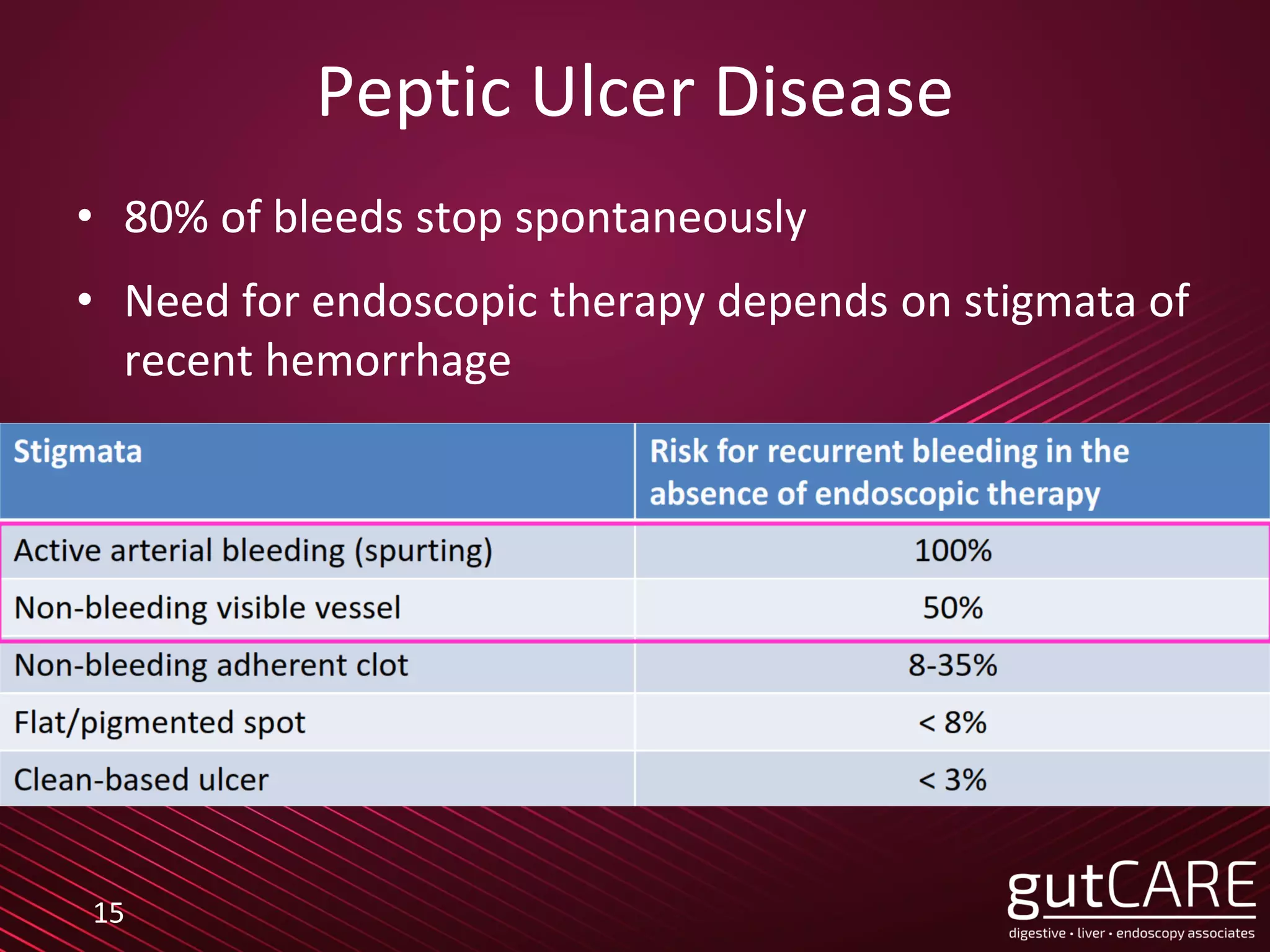
Peptic Ulcer Disease
• 80% of bleeds stop spontaneously
• Need for endoscopic therapy depends on stigmata of
recent hemorrhage
15
High Risk Stigmata
• High rebleeding risk: Needs endoscopic hemostasis
16
Spurting
Vessel
Oozing
Vessel
NBVV
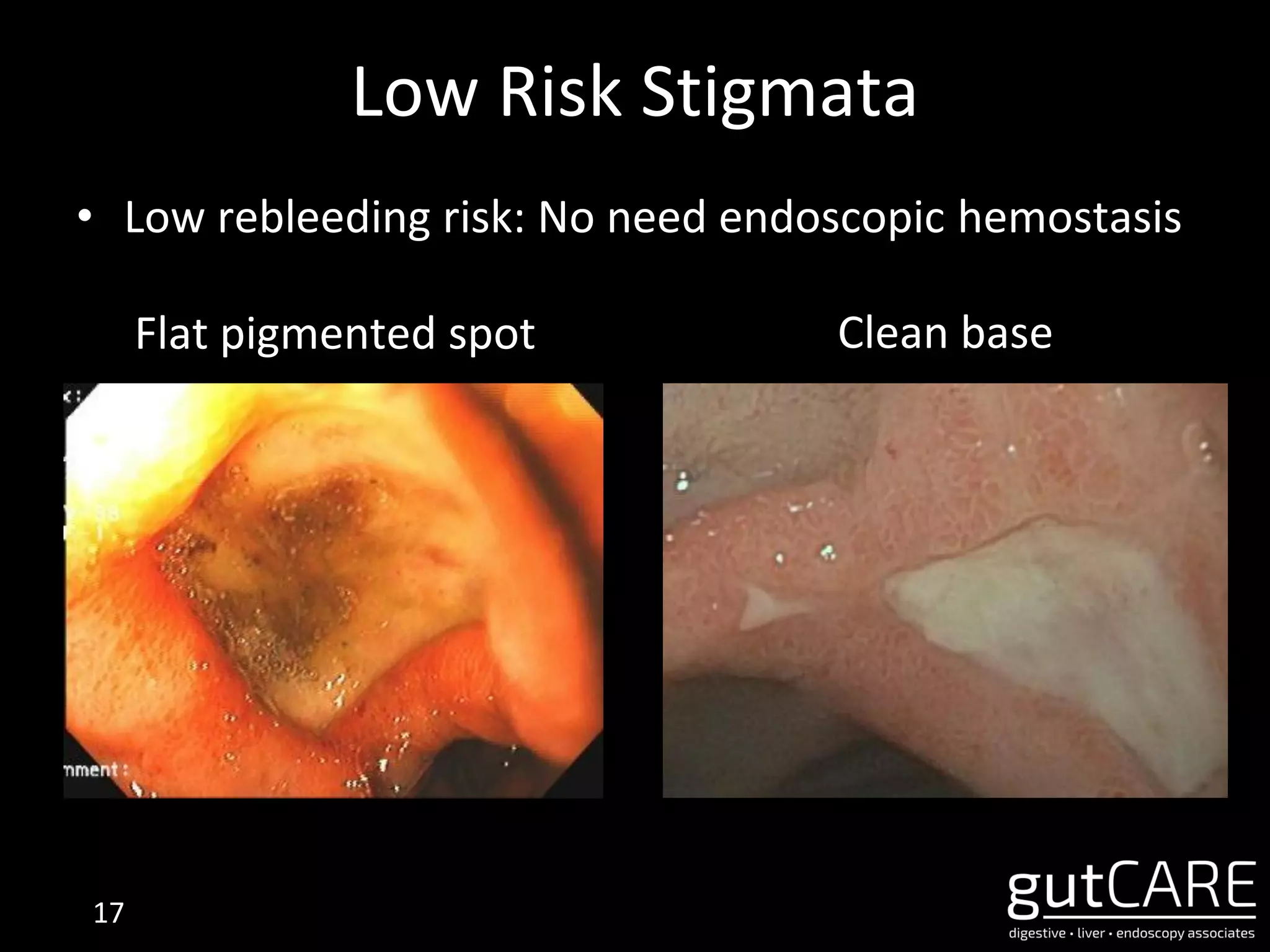
Low Risk Stigmata
• Low rebleeding risk: No need endoscopic hemostasis
17
Flat pigmented spot Clean base
Adherent CLot
18
• Role of endoscopic
therapy of ulcers with
adherent clot is
controversial
• Clot removal usually
attempted
• Underlying lesion can
then be assessed,
treated if necessary
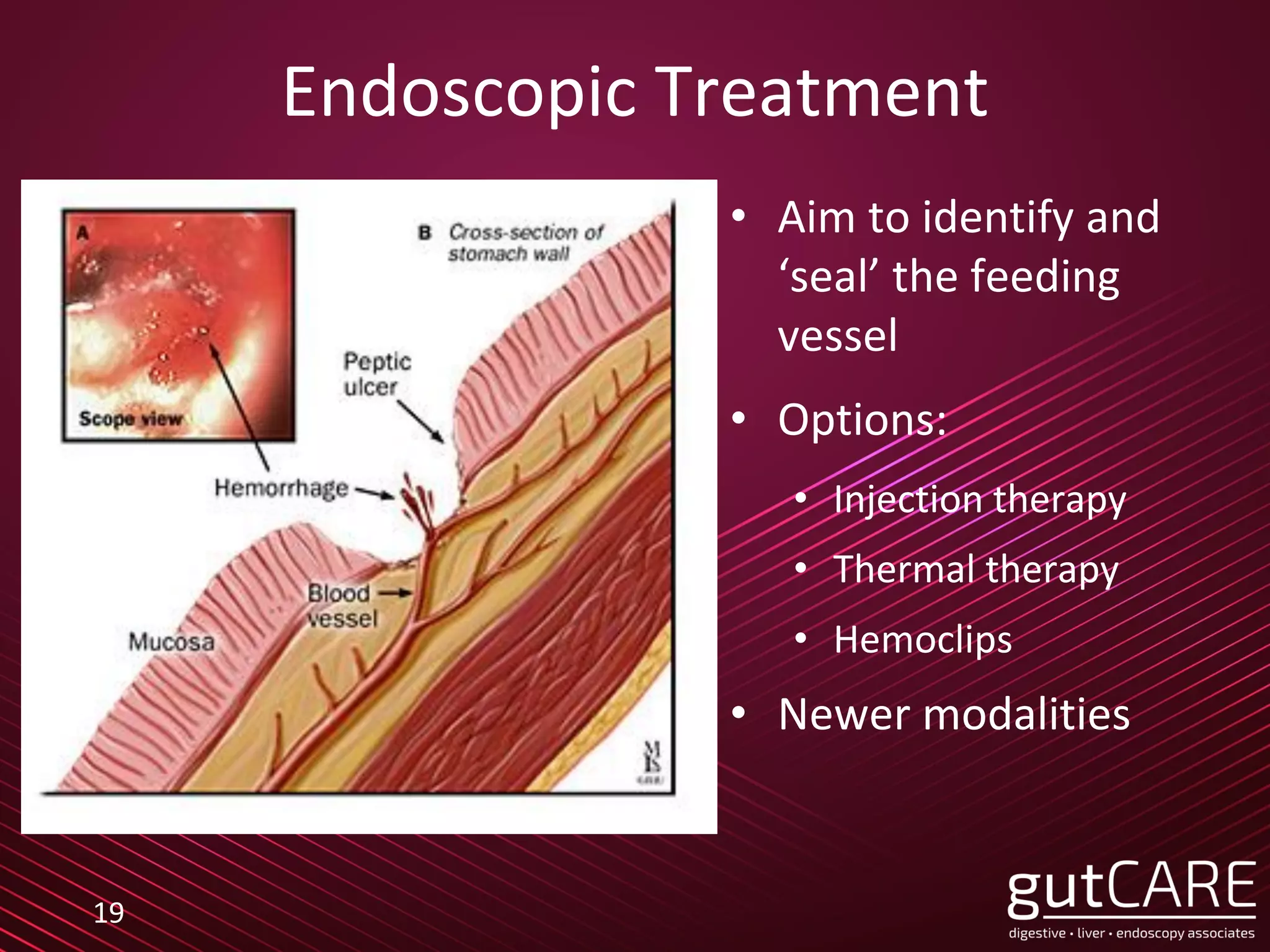
Endoscopic Treatment
• Aim to identify and
‘seal’ the feeding
vessel
• Options:
• Injection therapy
• Thermal therapy
• Hemoclips
• Newer modalities
19
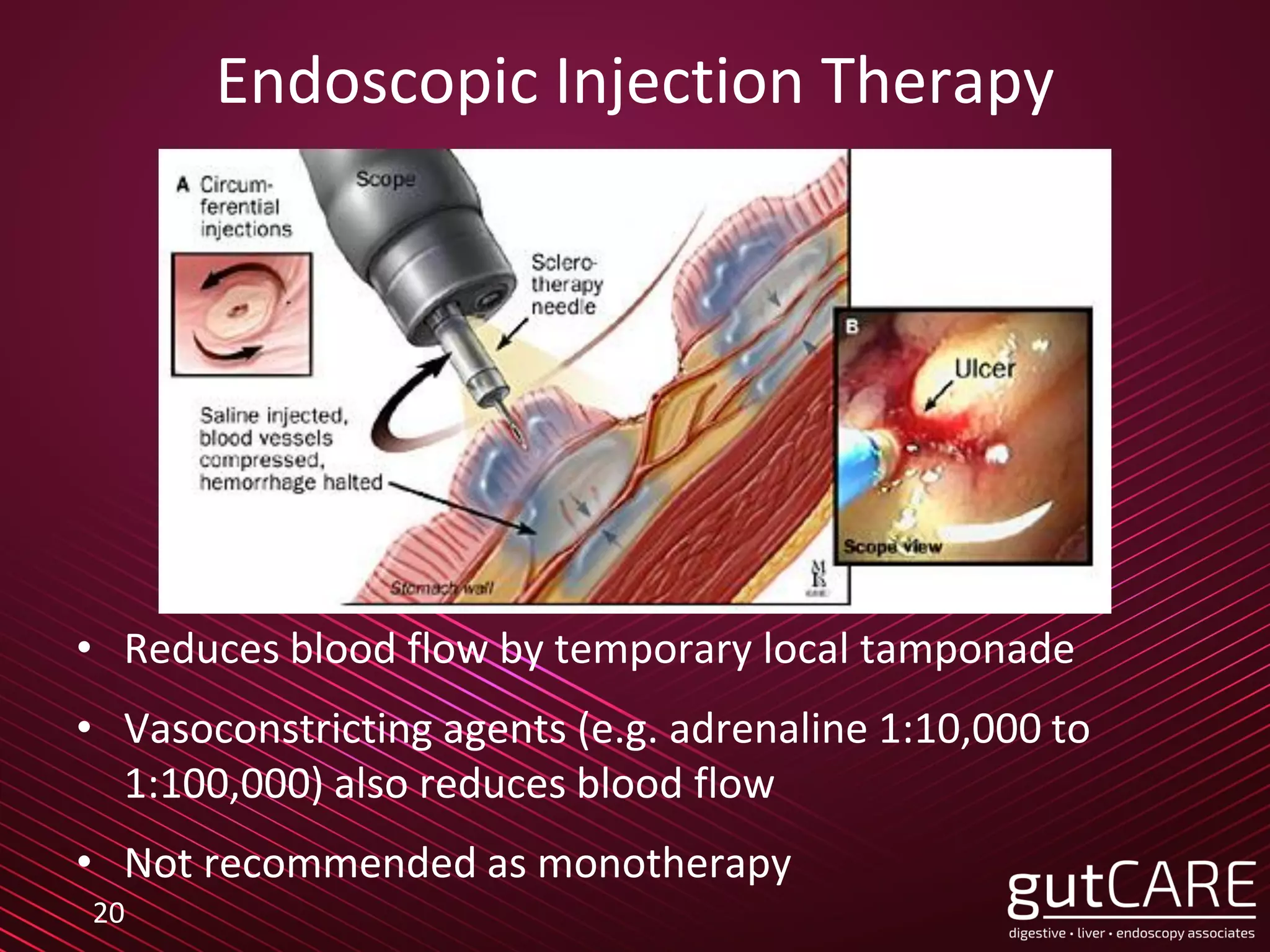
Endoscopic Injection Therapy
• Reduces blood flow by temporary local tamponade
• Vasoconstricting agents (e.g. adrenaline 1:10,000 to
1:100,000) also reduces blood flow
• Not recommended as monotherapy
20
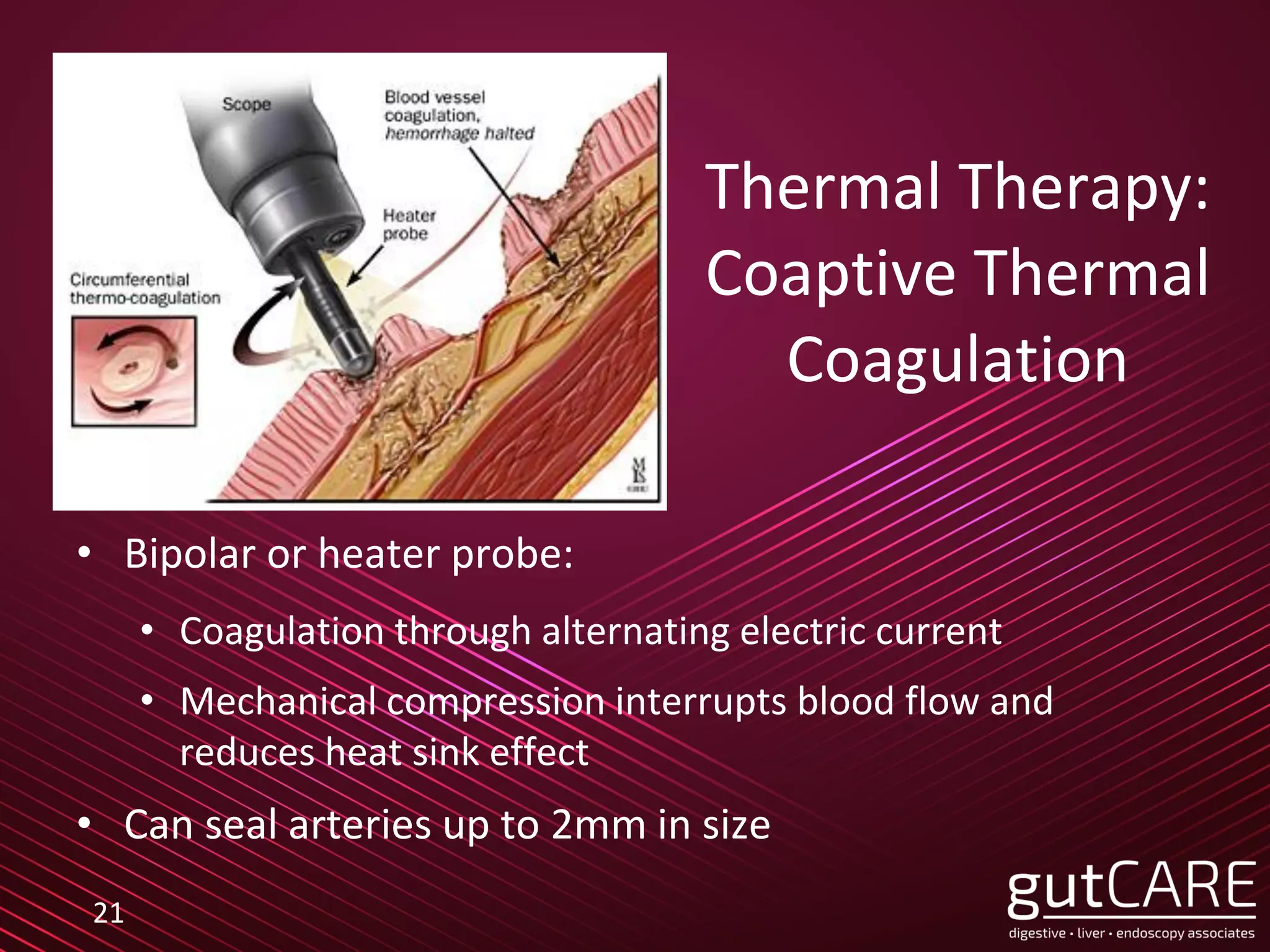
Thermal Therapy:
Coaptive Thermal
Coagulation
• Bipolar or heater probe:
• Coagulation through alternating electric current
• Mechanical compression interrupts blood flow and
reduces heat sink effect
• Can seal arteries up to 2mm in size
21
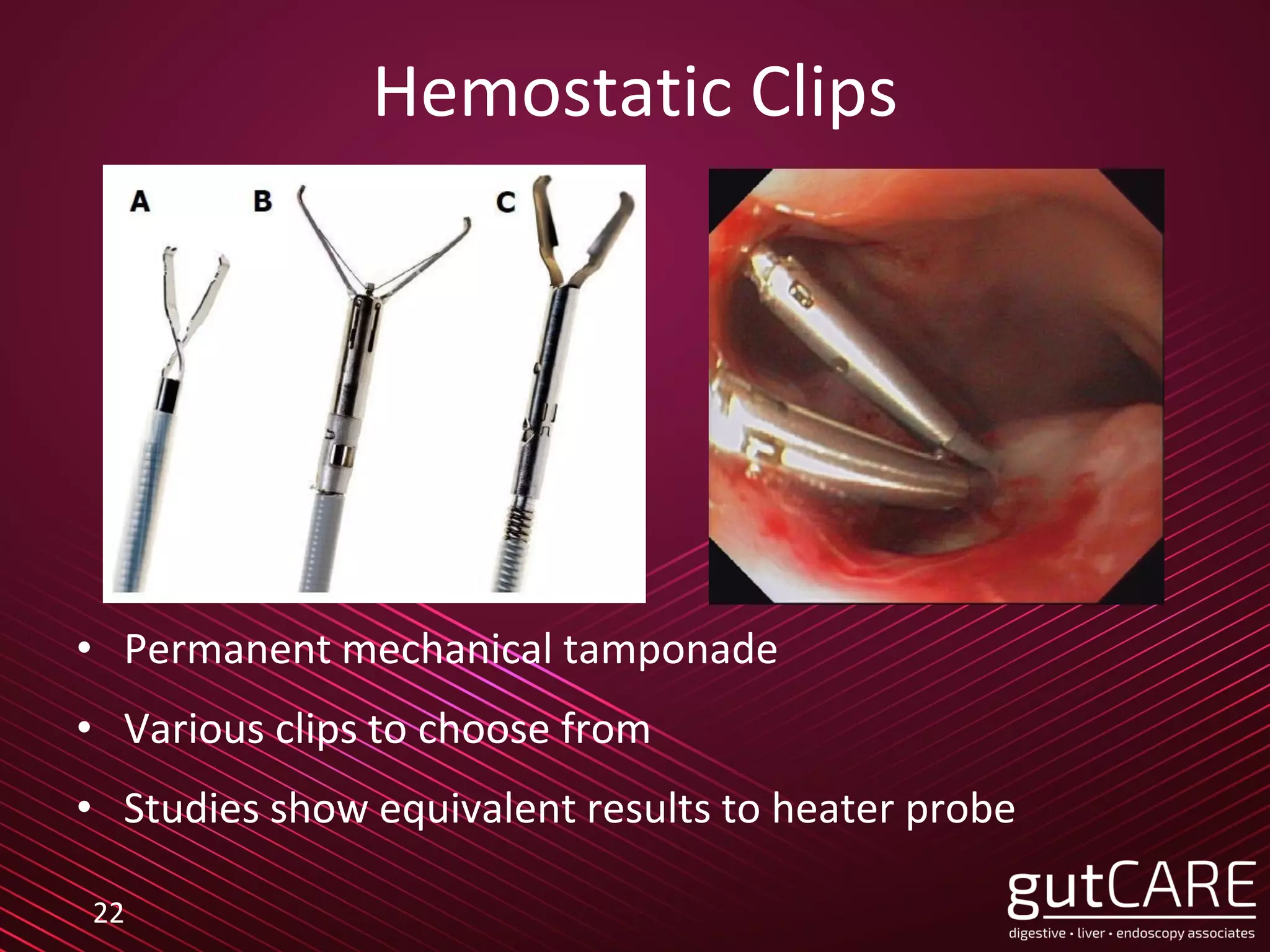
Hemostatic Clips
• Permanent mechanical tamponade
• Various clips to choose from
• Studies show equivalent results to heater probe
22
What to Use? When to Use?
• Studies show that other than adrenaline injection
monotherapy, no single modality was superior
• Choice will depend on type of lesion, anatomical
location and operator preference
• Favours clips: recurrent bleeding, pliable lesion, < 2
mm vessel, < 2 cm ulcer, coagulopathy
• Favours heater probe: initial hemostasis, fibrotic/
indurated base
23
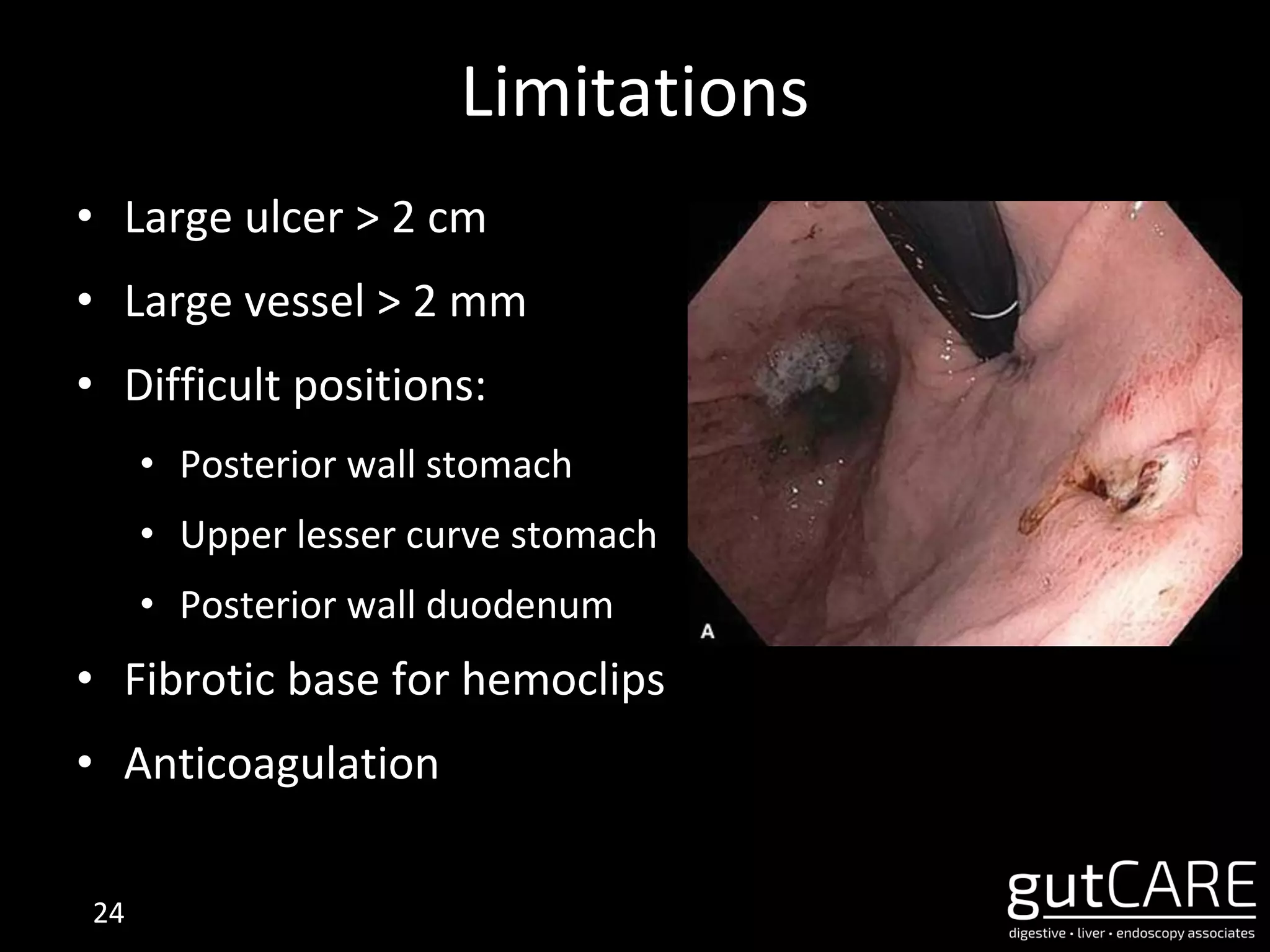
Limitations
• Large ulcer > 2 cm
• Large vessel > 2 mm
• Difficult positions:
• Posterior wall stomach
• Upper lesser curve stomach
• Posterior wall duodenum
• Fibrotic base for hemoclips
• Anticoagulation
24
25
Hemostatic Nanopowder Spray
Hemospray, Endoclot, Ankaferd
Hemostatic Nanopowder Spray
• 95% effective for acute hemostasis
• Advantages:
• Non contact, simple to use
• Can cover large area
• Effective for difficult locations, tumour bleeding
• Disadvantages:
• Only effective in actively bleeding or oozing lesions
• Moisture can plug catheter tip
• Loss of view after application
26
How It Works
27
Ulcer
Bleed
28
Cancer
Related
Bleeding
29
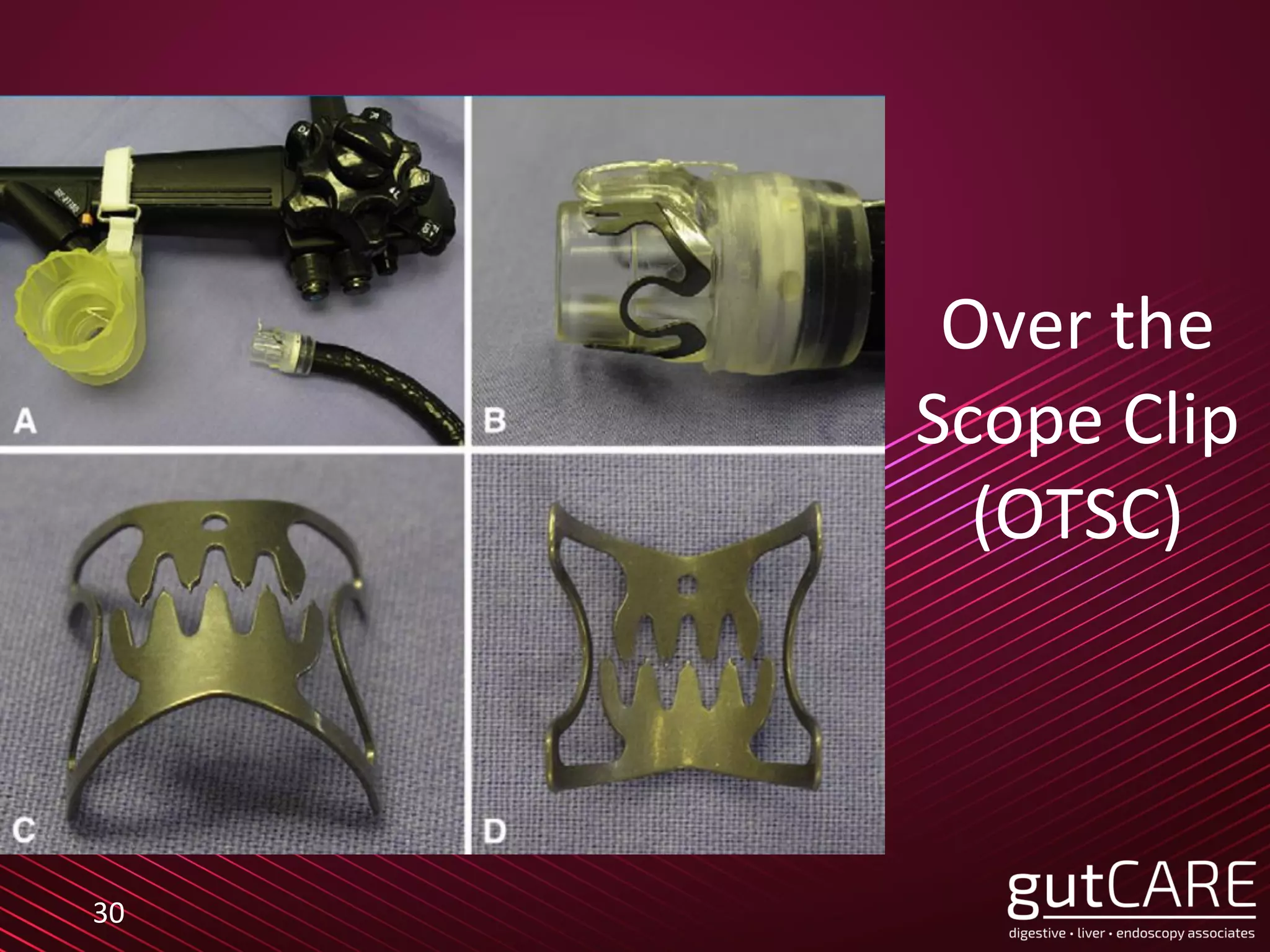
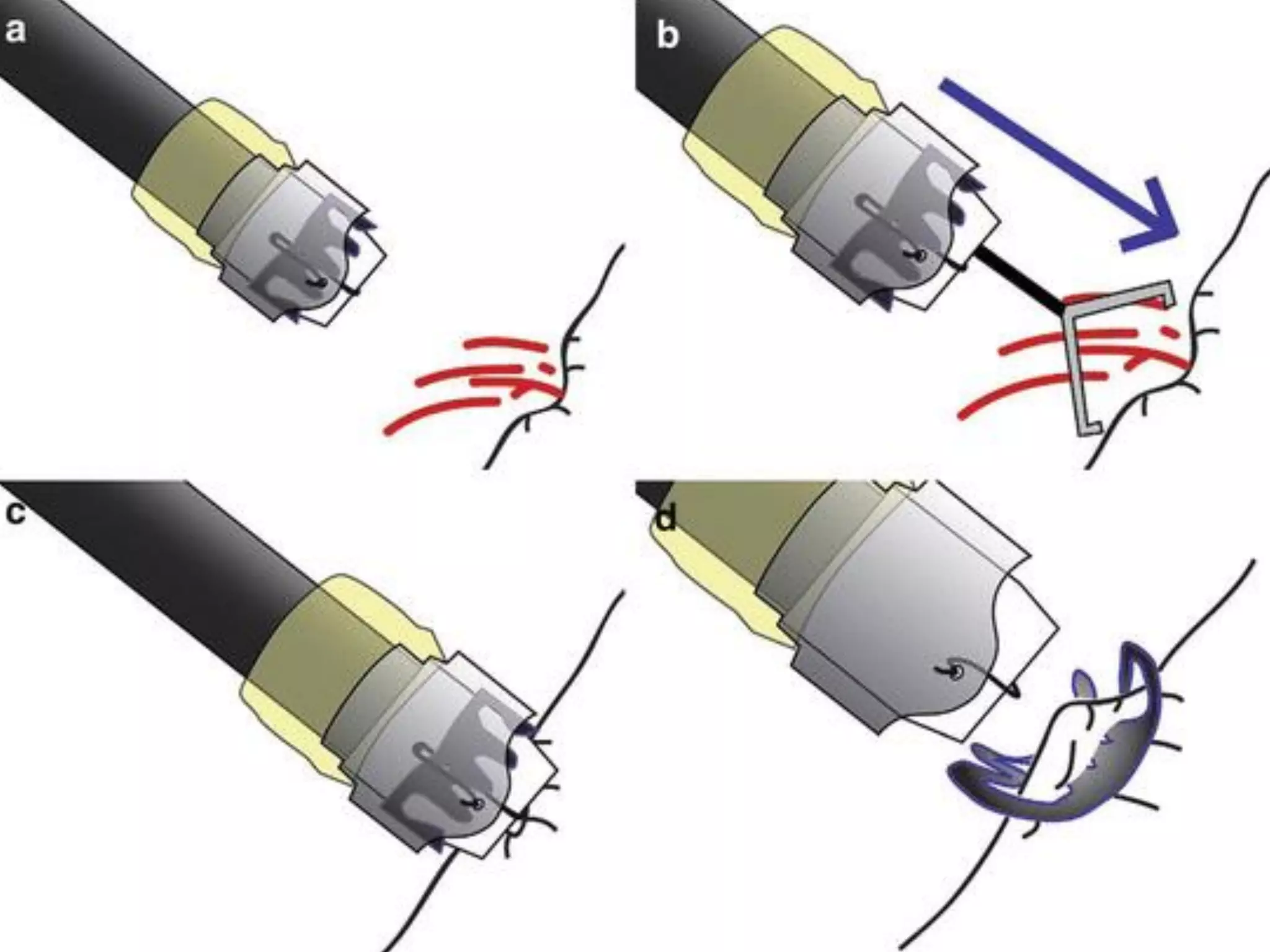
Over the
Scope Clip
(OTSC)
30
Designs
31
32
33
• Effective for refractory bleeding
• Generally safe
• Advantages
• Entraps large amount of tissue
• Band ligation technique
• Generally safe
• Disadvantages
• Withdraw scope to mount
• Endoscopic view impaired
• Suction traps fluid in cap
• Limited scope angulation
34
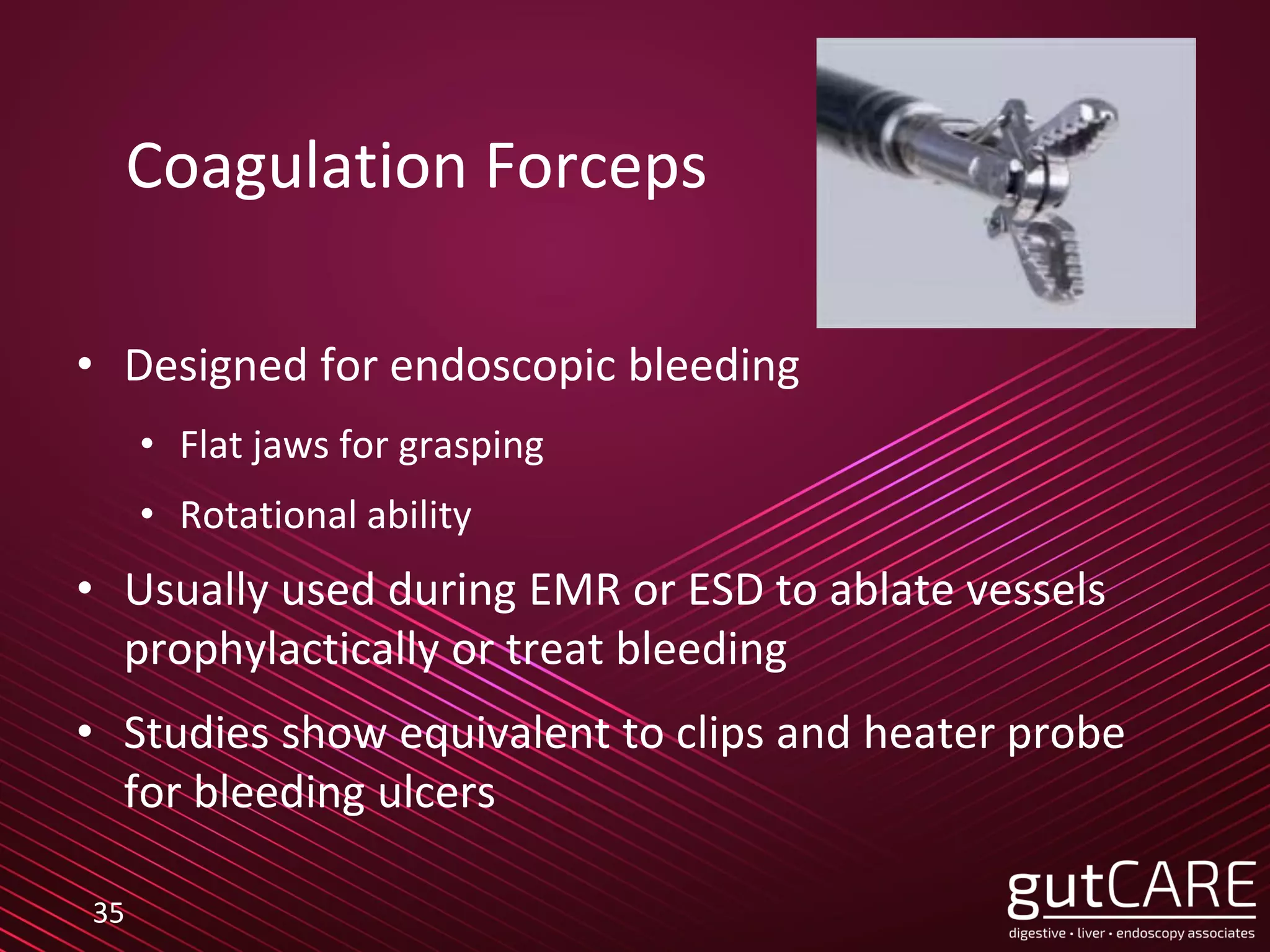
Coagulation Forceps
• Designed for endoscopic bleeding
• Flat jaws for grasping
• Rotational ability
• Usually used during EMR or ESD to ablate vessels
prophylactically or treat bleeding
• Studies show equivalent to clips and heater probe
for bleeding ulcers
35
Gastric Antral Vascular Ectasia
(GAVE)
36
APC
• Most widely used and studied treatment
• 75-85% success
• 20% complications, usually mild
37
Refractory GAVE: RFA
38
Esophageal
Varices
39
Variceal Bleeding
• Suspect if background cirrhosis or portal
hypertension
• Rule of ‘thirds’
• Occurs in 1/3 of cirrhotic patients
• 1/3 of initial bleeding are fatal
• 1/3 will rebleed in 6 weeks
• Only 1/3 will survive > 1 year
40
Resuscitation
• Vasoconstrictor therapy: IV terlipressin or
somatostatin/ octreotide
• Antibiotics: bacterial infections occur in 2/3 of cases
• Restrictive transfusion strategy
• Platelets and FFP usually not needed
• HDU care; avoid volume overexpansion
• Endoscopy as soon as possible (<12H), may need
intubation
41
Varices: Endoscopic Management
• Endoscopy as soon as possible (<12H)
• May need intubation
• Oesophageal varices:
• Look for ‘red’ and ‘white’ signs
• Gastric varices:
• GOV1: Banding or glue injection
• GOV2 or IGV: glue injection or TIPS
• Ectopic varices: case by case basis
42
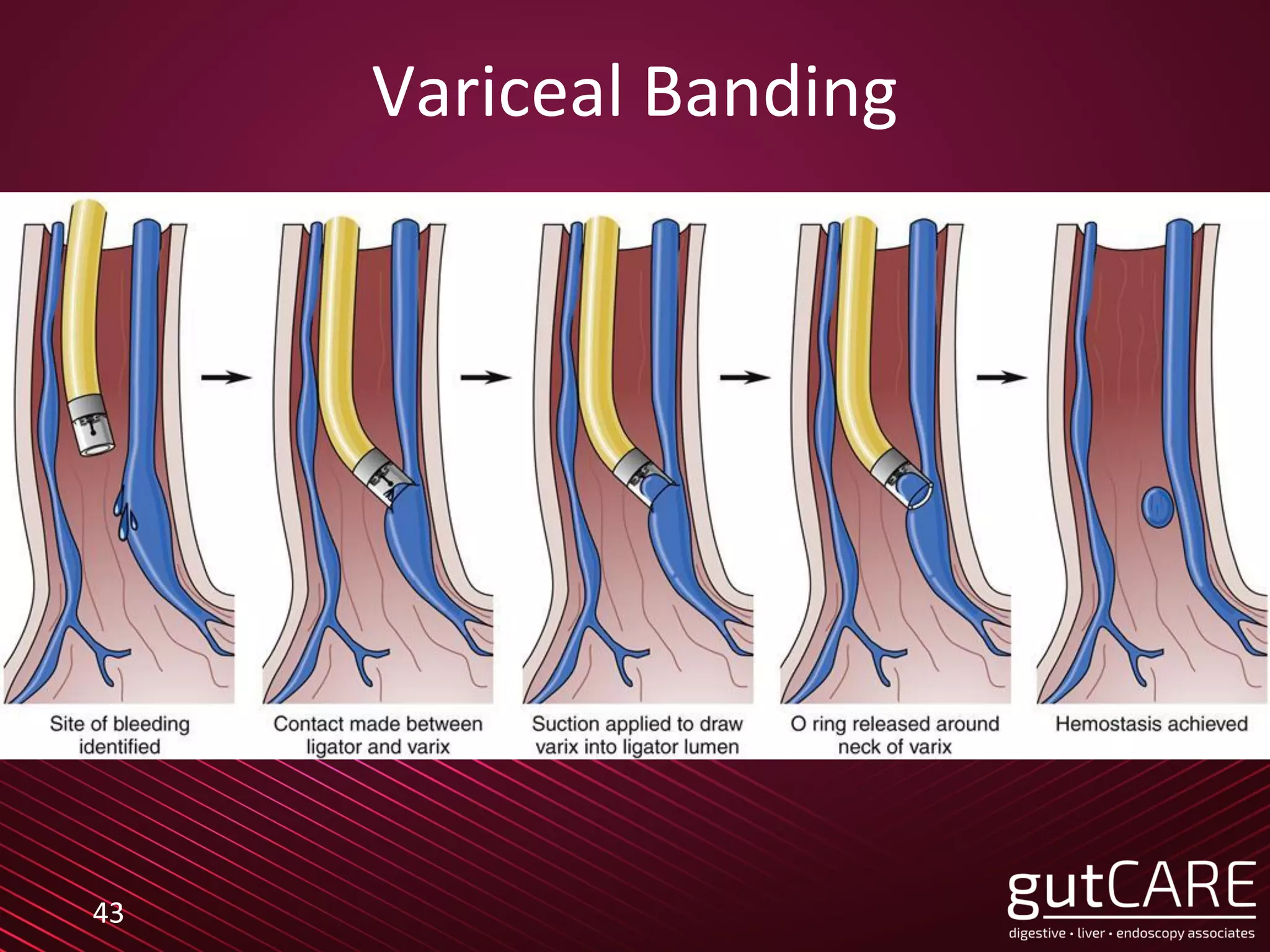
Variceal Banding
43
Variceal Banding
44
Oesophageal
Varices
45
White Nipple Sign
46
Gastric varices
47
Gastric Varices: Glue Injection
48
49
Ectopic Varices
50
51
52
Salvage Therapy
• Definition:
• Failure to control acute variceal bleed in 24H
• Failure to prevent clinically significant rebleeding within 5
days after treatment initiation
• Options
• TIPS
• Sengstaken Blackmore Tube
• Covered metal stent
53
TIPS
54
Covered Metal Stent
55
Lower GI
Bleed
56
Lower GI Bleed
• Definition: bleeding source distal to ileocecal valve
• Symptoms: hematochezia, malena
• 20% of all cases
• 80% stop spontaneously; 25-30% rebleed
• Mortality: 2-4%
• 10-15% of presumed LGIB have UGIB
57
Causes
• Diverticulosis: 20-65%
• Angioectasia: 5-20%
• Hemorrhoids: 5%
• Colitis: Ischemic,
Infectious, IBD
• Neoplasia
• Solitary rectal ulcer
• Radiation proctitis
58
Urgent Colonoscopy
• No standardized approach; few studies to date do
not show any improvement in clinical outcomes
• Rapid bowel prep required: 4-6L PEG over 3-4H
• Colonoscopy performed within 1H of clearing stool,
blood and clots
• Should be performed in 12-24H in stable patient
• Need for bowel prep and sedation may be
prohibitive in unstable patient
59
Endoscopic Therapy
• Diverticular bleeding
• Difficult to identify bleeding site
• If bleeding site identified, clips preferred
• Angiectasia: APC preferred
• Radiation proctitis
• APC preferred
• RFA and thermal therapies also used
60
Diverticular
Bleed
61
Refractory
Bleeding
62
Angioectasia
63
Radiation Proctitis
64
Solitary Rectal Ulcer
65
Risk Factors for Endoscopic Failure
• Hemodynamic instability on presentation:
tachycardia, hypotension, syncope
• Ongoing bleeding
• Comorbid illnesses
• Age > 60
• Initial Hct < 35%, elevated creatinine
• History of diverticulosis or angioectasia
66
When to go straight to Angiogram?
ACG guidelines
“Radiographic interventions should be considered in
patients with high-risk clinical features and ongoing
bleeding who have a negative upper endoscopy and do
not respond adequately to hemodynamic resuscitation
efforts and are therefore unlikely to tolerate bowel
preparation and urgent colonoscopy (strong
recommendation, very low quality evidence)”
67
ACG/ ASGE Guidelines
68
69
Bleeding due to
Interventional
Endoscopy
70
Polypectomy
• Biggest risk factor is polyp
size
• Delayed bleeding can occur
up to 2 weeks later
• If large polyp > 2cm,
consider prophylactic loop
or clip placement
• In immediate or delayed
bleeding, all modalities can
be used except thermal
therapy in right colon
71
72
Delayed Bleeding
73
74
EMR/ ESD
• High risk of bleeding
• Intraprocedural 10-15%
• Delayed 5-10%
• Must differentiate intra-procedural from delayed bleeding
• Use dissection knife, hemostatic forceps or clips
• Prophylactic hemostasis of all visible vessels with
hemostatic forceps prevents delayed bleed
• Closing of scars with clips may prevent delayed bleed
75
Immediate Bleeding
76
77
EMR
78
ESD
79
80
Delayed Bleed in EMR Ulcer
81
Post Sphincterotomy
• Adrenaline injection
• Method of choice
• Easy, effective
• Aim at apex or 20-30mm above site
• Clips and thermal therapy
• Salvage
• Fully covered metal stent
• Hemospray
82
Thermal Therapy
83
84
Fully Covered Metal Stent
85
Hemospray
86
Summary of Endoscopic Modalities
87
Conclusion
• Endoscopy hemostasis is
the mainstay of treatment
for bleeding GIT
• Many studies and
techniques have
emerged. Endoscopy
Centres need to keep
pace to ensure best
outcomes.
88
Thank
You
Questions?
89

Endoscopic Hemostasis - for Endoscopy Nurses

  • 1.
    Nursing (Endoscopy) Lecture: EndoscopicHemostasis Dr Jarrod Lee Gastroenterologist & Advanced Endoscopist April 2020
  • 2.
    About gutCARE • Founded2014 • Singapore's only digestive specialist group practice • Regional authorities in sub-specialty areas • Comprehensive & niche services From 2020: • 6 clinics in 6 hospitals • 7 doctors in all main subspecialty disciplines A full gastroenterology department in private practice
  • 3.
    3 Scope • Upper GIBleed (UGIB) • PUD • Varices • Endoscopic modalities • Lower GI Bleed (LGIB) • Bleeding due to interventional endoscopy
  • 4.
  • 5.
    Upper GI Bleed •Definition: bleeding source proximal to ligament of Treitz (corresponds to DJ flexure) • Symptoms: hematemesis, malena, coffee ground vomitus, hematochezia • 80% of all bleeding cases • Mortality: 3.5-10% 5
  • 6.
  • 7.
    Initial Management • Resuscitation:fluids, PCT, FFP • Restrictive transfusion strategy • Early intensive resuscitation • NGT: decide if needed • IV PPI: reduces risk of high risk stigmata on endoscopy; reduces need for endoscopic therapy • IV prokinetic agents e.g. erythromycin: reduces need for repeat endoscopy due to obscured views 7
  • 8.
    Transfusion Strategy Landmark 2013RCT • 921 subjects with severe acute UGIB • Restrictive vs Liberal transfusion strategy • Restrictive: transfuse if Hb < 7; target Hb 7-9 • Liberal: transfuse if Hb < 9; target Hb 9-11 • Primary outcome: 45 days all cause mortality rate • Secondary outcomes: rebleeding rate, overall complication rate NEJM 2013;368;11-21
  • 9.
    Restrictive Strategy Superior RestrictiveLiberal P value Mortality rate 5% 9% 0.02 Rate of further bleeding 10% 16% 0.01 Overall complication rate 40% 48% 0.02 NEJM 2013;368;11-21 Benefit seen primarily in Child A/B cirrhotics
  • 10.
    Early Intensive Resuscitation 2004Study • Consecutive series of patients with hemodynamically significant UGIB • 1st 36 subjects: Observation Group (no intervention) • 2nd 36 subjects: Intensive Resuscitation Group • Intense guidance provided; decreased time to correct hemodynamics, Hct and coagulopathy • Both groups same in demographics Am J Gastroenterol 2004;99:619
  • 11.
  • 12.
    Causes of Mortalityin Patients with Peptic Ulcer Bleeding • Patients rarely bleed to death • Prospective cohort study >10,000 cases of PUD bleed • Mortality rate 6.2% • 80% of deaths not related to bleeding Am J Gastroenterol 2010;105:84
  • 13.
    International Consensus Group2019 Pre Endoscopy Management • Initiate resuscitation if hemodynamically unstable • Blood transfusion if Hb < 8 and no underlying cardiovascular disease • Consider: Nasogastric tube, PPI treatment • Perform early endoscopy within 24H • Variceal bleed: do ASAP, within 12H 13
  • 14.
  • 15.
    Peptic Ulcer Disease •80% of bleeds stop spontaneously • Need for endoscopic therapy depends on stigmata of recent hemorrhage 15
  • 16.
    High Risk Stigmata •High rebleeding risk: Needs endoscopic hemostasis 16 Spurting Vessel Oozing Vessel NBVV
  • 17.
    Low Risk Stigmata •Low rebleeding risk: No need endoscopic hemostasis 17 Flat pigmented spot Clean base
  • 18.
    Adherent CLot 18 • Roleof endoscopic therapy of ulcers with adherent clot is controversial • Clot removal usually attempted • Underlying lesion can then be assessed, treated if necessary
  • 19.
    Endoscopic Treatment • Aimto identify and ‘seal’ the feeding vessel • Options: • Injection therapy • Thermal therapy • Hemoclips • Newer modalities 19
  • 20.
    Endoscopic Injection Therapy •Reduces blood flow by temporary local tamponade • Vasoconstricting agents (e.g. adrenaline 1:10,000 to 1:100,000) also reduces blood flow • Not recommended as monotherapy 20
  • 21.
    Thermal Therapy: Coaptive Thermal Coagulation •Bipolar or heater probe: • Coagulation through alternating electric current • Mechanical compression interrupts blood flow and reduces heat sink effect • Can seal arteries up to 2mm in size 21
  • 22.
    Hemostatic Clips • Permanentmechanical tamponade • Various clips to choose from • Studies show equivalent results to heater probe 22
  • 23.
    What to Use?When to Use? • Studies show that other than adrenaline injection monotherapy, no single modality was superior • Choice will depend on type of lesion, anatomical location and operator preference • Favours clips: recurrent bleeding, pliable lesion, < 2 mm vessel, < 2 cm ulcer, coagulopathy • Favours heater probe: initial hemostasis, fibrotic/ indurated base 23
  • 24.
    Limitations • Large ulcer> 2 cm • Large vessel > 2 mm • Difficult positions: • Posterior wall stomach • Upper lesser curve stomach • Posterior wall duodenum • Fibrotic base for hemoclips • Anticoagulation 24
  • 25.
  • 26.
    Hemostatic Nanopowder Spray •95% effective for acute hemostasis • Advantages: • Non contact, simple to use • Can cover large area • Effective for difficult locations, tumour bleeding • Disadvantages: • Only effective in actively bleeding or oozing lesions • Moisture can plug catheter tip • Loss of view after application 26
  • 27.
  • 28.
  • 29.
  • 30.
  • 31.
  • 32.
  • 33.
  • 34.
    • Effective forrefractory bleeding • Generally safe • Advantages • Entraps large amount of tissue • Band ligation technique • Generally safe • Disadvantages • Withdraw scope to mount • Endoscopic view impaired • Suction traps fluid in cap • Limited scope angulation 34
  • 35.
    Coagulation Forceps • Designedfor endoscopic bleeding • Flat jaws for grasping • Rotational ability • Usually used during EMR or ESD to ablate vessels prophylactically or treat bleeding • Studies show equivalent to clips and heater probe for bleeding ulcers 35
  • 36.
    Gastric Antral VascularEctasia (GAVE) 36
  • 37.
    APC • Most widelyused and studied treatment • 75-85% success • 20% complications, usually mild 37
  • 38.
  • 39.
  • 40.
    Variceal Bleeding • Suspectif background cirrhosis or portal hypertension • Rule of ‘thirds’ • Occurs in 1/3 of cirrhotic patients • 1/3 of initial bleeding are fatal • 1/3 will rebleed in 6 weeks • Only 1/3 will survive > 1 year 40
  • 41.
    Resuscitation • Vasoconstrictor therapy:IV terlipressin or somatostatin/ octreotide • Antibiotics: bacterial infections occur in 2/3 of cases • Restrictive transfusion strategy • Platelets and FFP usually not needed • HDU care; avoid volume overexpansion • Endoscopy as soon as possible (<12H), may need intubation 41
  • 42.
    Varices: Endoscopic Management •Endoscopy as soon as possible (<12H) • May need intubation • Oesophageal varices: • Look for ‘red’ and ‘white’ signs • Gastric varices: • GOV1: Banding or glue injection • GOV2 or IGV: glue injection or TIPS • Ectopic varices: case by case basis 42
  • 43.
  • 44.
  • 45.
  • 46.
  • 47.
  • 48.
  • 49.
  • 50.
  • 51.
  • 52.
  • 53.
    Salvage Therapy • Definition: •Failure to control acute variceal bleed in 24H • Failure to prevent clinically significant rebleeding within 5 days after treatment initiation • Options • TIPS • Sengstaken Blackmore Tube • Covered metal stent 53
  • 54.
  • 55.
  • 56.
  • 57.
    Lower GI Bleed •Definition: bleeding source distal to ileocecal valve • Symptoms: hematochezia, malena • 20% of all cases • 80% stop spontaneously; 25-30% rebleed • Mortality: 2-4% • 10-15% of presumed LGIB have UGIB 57
  • 58.
    Causes • Diverticulosis: 20-65% •Angioectasia: 5-20% • Hemorrhoids: 5% • Colitis: Ischemic, Infectious, IBD • Neoplasia • Solitary rectal ulcer • Radiation proctitis 58
  • 59.
    Urgent Colonoscopy • Nostandardized approach; few studies to date do not show any improvement in clinical outcomes • Rapid bowel prep required: 4-6L PEG over 3-4H • Colonoscopy performed within 1H of clearing stool, blood and clots • Should be performed in 12-24H in stable patient • Need for bowel prep and sedation may be prohibitive in unstable patient 59
  • 60.
    Endoscopic Therapy • Diverticularbleeding • Difficult to identify bleeding site • If bleeding site identified, clips preferred • Angiectasia: APC preferred • Radiation proctitis • APC preferred • RFA and thermal therapies also used 60
  • 61.
  • 62.
  • 63.
  • 64.
  • 65.
  • 66.
    Risk Factors forEndoscopic Failure • Hemodynamic instability on presentation: tachycardia, hypotension, syncope • Ongoing bleeding • Comorbid illnesses • Age > 60 • Initial Hct < 35%, elevated creatinine • History of diverticulosis or angioectasia 66
  • 67.
    When to gostraight to Angiogram? ACG guidelines “Radiographic interventions should be considered in patients with high-risk clinical features and ongoing bleeding who have a negative upper endoscopy and do not respond adequately to hemodynamic resuscitation efforts and are therefore unlikely to tolerate bowel preparation and urgent colonoscopy (strong recommendation, very low quality evidence)” 67
  • 68.
  • 69.
  • 70.
  • 71.
    Polypectomy • Biggest riskfactor is polyp size • Delayed bleeding can occur up to 2 weeks later • If large polyp > 2cm, consider prophylactic loop or clip placement • In immediate or delayed bleeding, all modalities can be used except thermal therapy in right colon 71
  • 72.
  • 73.
  • 74.
  • 75.
    EMR/ ESD • Highrisk of bleeding • Intraprocedural 10-15% • Delayed 5-10% • Must differentiate intra-procedural from delayed bleeding • Use dissection knife, hemostatic forceps or clips • Prophylactic hemostasis of all visible vessels with hemostatic forceps prevents delayed bleed • Closing of scars with clips may prevent delayed bleed 75
  • 76.
  • 77.
  • 78.
  • 79.
  • 80.
  • 81.
    Delayed Bleed inEMR Ulcer 81
  • 82.
    Post Sphincterotomy • Adrenalineinjection • Method of choice • Easy, effective • Aim at apex or 20-30mm above site • Clips and thermal therapy • Salvage • Fully covered metal stent • Hemospray 82
  • 83.
  • 84.
  • 85.
  • 86.
  • 87.
    Summary of EndoscopicModalities 87
  • 88.
    Conclusion • Endoscopy hemostasisis the mainstay of treatment for bleeding GIT • Many studies and techniques have emerged. Endoscopy Centres need to keep pace to ensure best outcomes. 88
  • 89.