
GERD: Current Paradigms
Dr Jarrod Lee
Gastroenterologist &
Advanced Endoscopist
Peer to Peer Workshop
Rosso Bianco
2 Aug 2018
Scope
• Pathophysiology
• Clinical spectrum
• Natural history
• Diagnosis
• Medical treatment
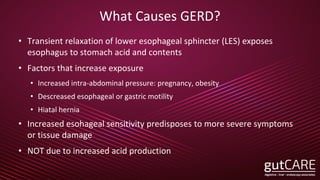
What Causes GERD?
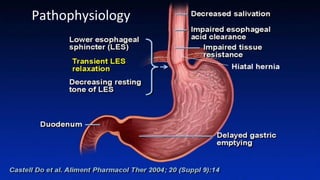
• Transient relaxation of lower esophageal sphincter (LES) exposes
esophagus to stomach acid and contents
• Factors that increase exposure
• Increased intra-abdominal pressure: pregnancy, obesity
• Descreased esophageal or gastric motility
• Hiatal hernia
• Increased esohageal sensitivity predisposes to more severe symptoms
or tissue damage
• NOT due to increased acid production
Pathophysiology
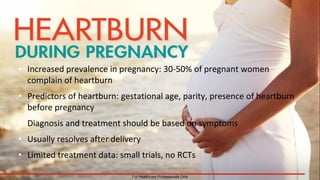
• Increased prevalence in pregnancy: 30-50% of pregnant women
complain of heartburn
• Predictors of heartburn: gestational age, parity, presence of heartburn
before pregnancy
• Diagnosis and treatment should be based on symptoms
• Usually resolves after delivery
• Limited treatment data: small trials, no RCTs
For Healthcare Professionals Only
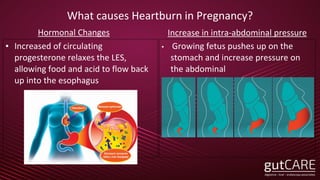
What causes Heartburn in Pregnancy?
Hormonal Changes
• Increased of circulating
progesterone relaxes the LES,
allowing food and acid to flow back
up into the esophagus
Increase in intra-abdominal pressure
• Growing fetus pushes up on the
stomach and increase pressure on
the abdominal
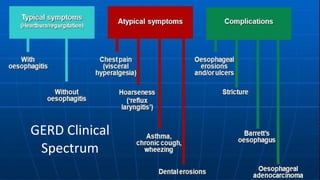
GERD Clinical
Spectrum
7
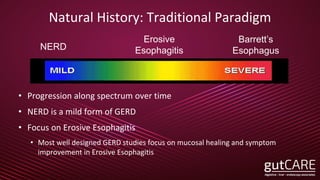
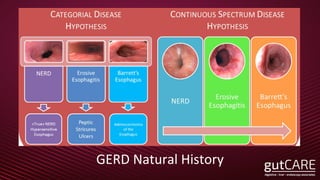
Natural History: Traditional Paradigm
• Progression along spectrum over time
• NERD is a mild form of GERD
• Focus on Erosive Esophagitis
• Most well designed GERD studies focus on mucosal healing and symptom
improvement in Erosive Esophagitis
NERD
Erosive
Esophagitis
Barrett’s
Esophagus
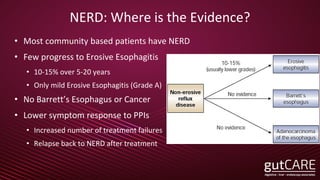
NERD: Where is the Evidence?
• Most community based patients have NERD
• Few progress to Erosive Esophagitis
• 10-15% over 5-20 years
• Only mild Erosive Esophagitis (Grade A)
• No Barrett’s Esophagus or Cancer
• Lower symptom response to PPIs
• Increased number of treatment failures
• Relapse back to NERD after treatment
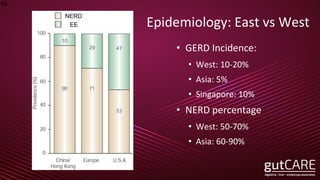
Epidemiology: East vs West
• GERD Incidence:
• West: 10-20%
• Asia: 5%
• Singapore: 10%
• NERD percentage
• West: 50-70%
• Asia: 60-90%
10
NERD
EE
GERD Natural History
How is GERD diagnosed?
• No gold standard!!
• Presumptive diagnosis can be made with typical symptoms:
• Heartburn, acid regurgitation
• Frequency: at least weekly
• If presumptive diagnosis made, can proceed to an empirical trial of PPI
• Good Sensitivity 75-85%: 4-8 weeks of PPI will control symptoms in 75-85%
• Poor Specificity 25-65%: may be positive in other acid disorders; specificity with
placebo 40% !!
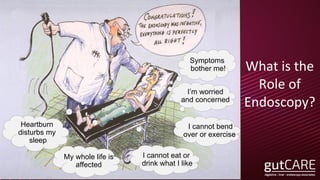
What is the
Role of
Endoscopy?
I’m worried
and concerned
Symptoms
bother me!
My whole life is
affected
Heartburn
disturbs my
sleep
I cannot eat or
drink what I like
I cannot bend
over or exercise
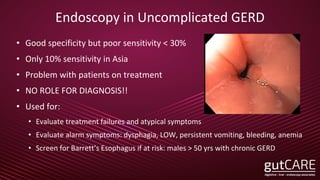
Endoscopy in Uncomplicated GERD
• Good specificity but poor sensitivity < 30%
• Only 10% sensitivity in Asia
• Problem with patients on treatment
• NO ROLE FOR DIAGNOSIS!!
• Used for:
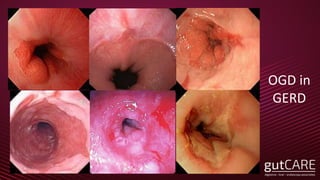
• Evaluate treatment failures and atypical symptoms
• Evaluate alarm symptoms: dysphagia, LOW, persistent vomiting, bleeding, anemia
• Screen for Barrett’s Esophagus if at risk: males > 50 yrs with chronic GERD
OGD in
GERD
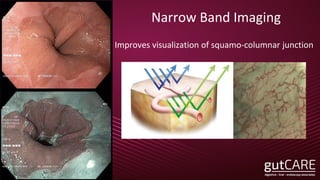
Narrow Band Imaging
Improves visualization of squamo-columnar junction
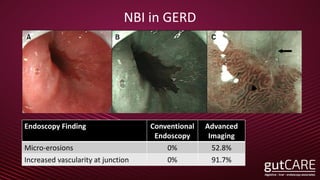
NBI in GERD
Endoscopy Finding Conventional
Endoscopy
Advanced
Imaging
Micro-erosions 0% 52.8%
Increased vascularity at junction 0% 91.7%
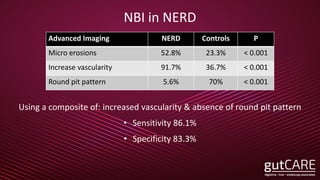
NBI in NERD
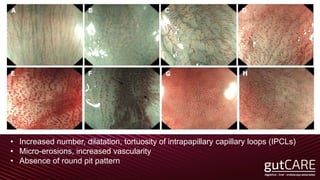
Using a composite of: increased vascularity & absence of round pit pattern
• Sensitivity 86.1%
• Specificity 83.3%
Advanced Imaging NERD Controls P
Micro erosions 52.8% 23.3% < 0.001
Increase vascularity 91.7% 36.7% < 0.001
Round pit pattern 5.6% 70% < 0.001
• Increased number, dilatation, tortuosity of intrapapillary capillary loops (IPCLs)
• Micro-erosions, increased vascularity
• Absence of round pit pattern
Treatment Paradigms
Lifestyle Measures
• Eat smaller meals
• Avoid eating late at night (2-3 hours before sleep)
• Elevation of head of the bed or sleep in left lateral position
• Lose weight, stop smoking
• Dietary modifications may improve symptoms or reduce complications,
but evidence is very weak
• Some foods may lower LES tone (carminatives)
• Other foods may irritate inflamed esophageal mucosa (citrus)
• Patients may report improvement when avoiding particular substances
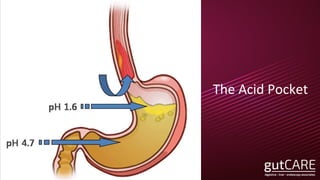
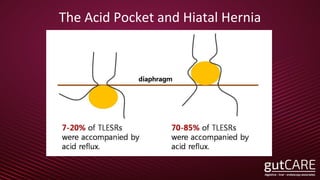
The Acid Pocket
The Acid Pocket and Hiatal Hernia
Alginate (Barrier)
Antacids
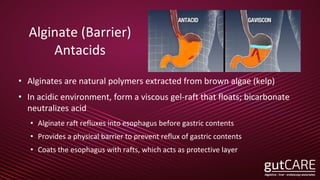
• Alginates are natural polymers extracted from brown algae (kelp)
• In acidic environment, form a viscous gel-raft that floats; bicarbonate
neutralizes acid
• Alginate raft refluxes into esophagus before gastric contents
• Provides a physical barrier to prevent reflux of gastric contents
• Coats the esophagus with rafts, which acts as protective layer
Alginate Antacids in
Pregnancy
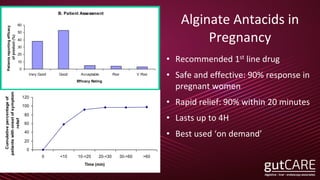
• Recommended 1st line drug
• Safe and effective: 90% response in
pregnant women
• Rapid relief: 90% within 20 minutes
• Lasts up to 4H
• Best used ‘on demand’
0
20
40
60
80
100
120
0 <10 10-<20 20-<30 30-<60 >60
Time (min)
Cumulativepercentageof
patientswithonsetofsymptom
relief
B. Patient Assessment
0
10
20
30
40
50
60
Very Good Good Acceptable Poor V Poor
Efficacy Rating
Patientsreportingefficacy
ofproduct(%)
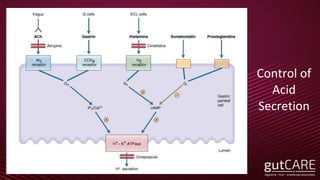
Control of
Acid
Secretion
27
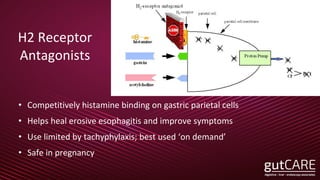
H2 Receptor
Antagonists
• Competitively histamine binding on gastric parietal cells
• Helps heal erosive esophagitis and improve symptoms
• Use limited by tachyphylaxis; best used ‘on demand’
• Safe in pregnancy
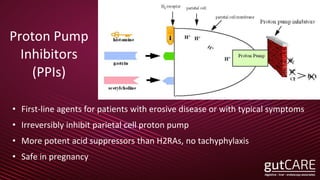
Proton Pump
Inhibitors
(PPIs)
• First-line agents for patients with erosive disease or with typical symptoms
• Irreversibly inhibit parietal cell proton pump
• More potent acid suppressors than H2RAs, no tachyphylaxis
• Safe in pregnancy
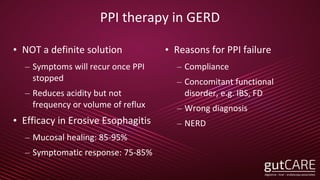
PPI therapy in GERD
• NOT a definite solution
– Symptoms will recur once PPI
stopped
– Reduces acidity but not
frequency or volume of reflux
• Efficacy in Erosive Esophagitis
– Mucosal healing: 85-95%
– Symptomatic response: 75-85%
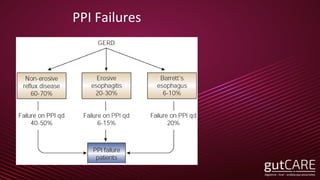
• Reasons for PPI failure
– Compliance
– Concomitant functional
disorder, e.g. IBS, FD
– Wrong diagnosis
– NERD
PPI Failures
31
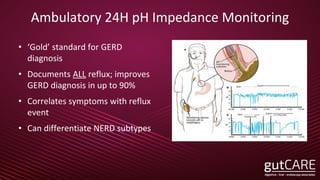
Ambulatory 24H pH Impedance Monitoring
• ‘Gold’ standard for GERD
diagnosis
• Documents ALL reflux; improves
GERD diagnosis in up to 90%
• Correlates symptoms with reflux
event
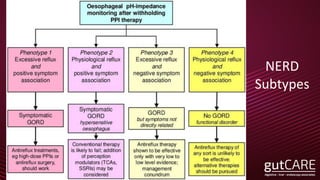
• Can differentiate NERD subtypes
NERD
Subtypes
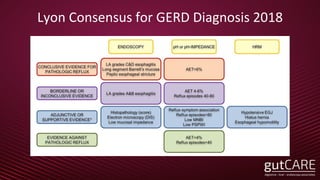
Lyon Consensus for GERD Diagnosis 2018
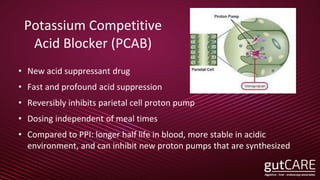
Potassium Competitive
Acid Blocker (PCAB)
• New acid suppressant drug
• Fast and profound acid suppression
• Reversibly inhibits parietal cell proton pump
• Dosing independent of meal times
• Compared to PPI: longer half life in blood, more stable in acidic
environment, and can inhibit new proton pumps that are synthesized
24 hours gastric pH4 HTR (Study V-E: Vonoprazan 20mg and Esomeprazole 20mg administered)
Vonoprazan 20 mg group (n=10)
Esomeprazole 20 mg group (n=10)
100
0
day 1 of administration day 7 of administration
80
60
40
20 23.9
61.2
71.4
85.8
pH4HTR
Average value ±standard deviation
pH4 HTR: pH≧4 Holding Time Ratio (Holding time ratio is greater than pH 4)
Difference between both
drugs (%) [95% CI]
47.5 [35.5, 59.4] Difference between both
drugs (%) [95% CI]
24.6 [16.2, 33.1]
Sakurai Y, et al: Aliment Pharmacol Ther. 2015; 42 (6): 719-730
(%)
Target and method: In a randomized, open-label 2-period crossover study of 20 adult Japanese males with CYP2C19 genotype EM
(including hetero EM, homo EM), once daily dose of Vonoprazan 20mg and Esomeprazole 20mg (Study V-E, n=10), Vonoprazan
20mg and Rabeprazole 10mg (Study V-R, n=10) was administered for 7 days.
Difference between both
drugs (%) [95% CI]
58.2 [43.6, 72.9]
Difference between both
drugs (%) [95% CI]
28.8 [17.2, 40.4]
24 hours gastric pH4 HTR (Study V-R: Vonoprazan 20mg and Rabeprazole 10mg administered)
Vonoprazan 20 mg group (n=7)
Rabeprazole 10 mg group (n=7)
Average value ±standard deviation
pH4 HTR: pH≧4 Holding Time Ratio (Holding time ratio is greater than pH 4)
100
(%)
0
day 1 of administration day 7 of administration
80
60
40
20
pH4HTR
26.3
65.1
93.8
84.2
Target and method: In a randomized, open-label 2-period crossover study of 20 adult Japanese males with CYP2C19 genotype EM
(including hetero EM, homo EM), once daily dose of Vonoprazan 20mg and Esomeprazole 20mg (Study V-E, n=10), Vonoprazan
20mg and Rabeprazole 10mg (Study V-R, n=10) was administered for 7 days.
Sakurai Y, et al: Aliment Pharmacol Ther. 2015; 42 (6): 719-730. More figures
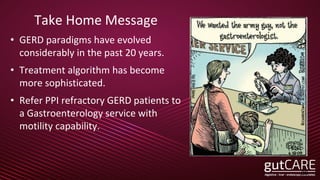
Take Home Message
• GERD paradigms have evolved
considerably in the past 20 years.
• Treatment algorithm has become
more sophisticated.
• Refer PPI refractory GERD patients to
a Gastroenterology service with
motility capability.
39

GERD: Current Paradigms

  • 1.
    GERD: Current Paradigms DrJarrod Lee Gastroenterologist & Advanced Endoscopist Peer to Peer Workshop Rosso Bianco 2 Aug 2018
  • 2.
    Scope • Pathophysiology • Clinicalspectrum • Natural history • Diagnosis • Medical treatment
  • 3.
    What Causes GERD? •Transient relaxation of lower esophageal sphincter (LES) exposes esophagus to stomach acid and contents • Factors that increase exposure • Increased intra-abdominal pressure: pregnancy, obesity • Descreased esophageal or gastric motility • Hiatal hernia • Increased esohageal sensitivity predisposes to more severe symptoms or tissue damage • NOT due to increased acid production
  • 4.
  • 5.
    • Increased prevalencein pregnancy: 30-50% of pregnant women complain of heartburn • Predictors of heartburn: gestational age, parity, presence of heartburn before pregnancy • Diagnosis and treatment should be based on symptoms • Usually resolves after delivery • Limited treatment data: small trials, no RCTs For Healthcare Professionals Only
  • 6.
    What causes Heartburnin Pregnancy? Hormonal Changes • Increased of circulating progesterone relaxes the LES, allowing food and acid to flow back up into the esophagus Increase in intra-abdominal pressure • Growing fetus pushes up on the stomach and increase pressure on the abdominal
  • 7.
  • 8.
    Natural History: TraditionalParadigm • Progression along spectrum over time • NERD is a mild form of GERD • Focus on Erosive Esophagitis • Most well designed GERD studies focus on mucosal healing and symptom improvement in Erosive Esophagitis NERD Erosive Esophagitis Barrett’s Esophagus
  • 9.
    NERD: Where isthe Evidence? • Most community based patients have NERD • Few progress to Erosive Esophagitis • 10-15% over 5-20 years • Only mild Erosive Esophagitis (Grade A) • No Barrett’s Esophagus or Cancer • Lower symptom response to PPIs • Increased number of treatment failures • Relapse back to NERD after treatment
  • 10.
    Epidemiology: East vsWest • GERD Incidence: • West: 10-20% • Asia: 5% • Singapore: 10% • NERD percentage • West: 50-70% • Asia: 60-90% 10 NERD EE
  • 12.
  • 13.
    How is GERDdiagnosed? • No gold standard!! • Presumptive diagnosis can be made with typical symptoms: • Heartburn, acid regurgitation • Frequency: at least weekly • If presumptive diagnosis made, can proceed to an empirical trial of PPI • Good Sensitivity 75-85%: 4-8 weeks of PPI will control symptoms in 75-85% • Poor Specificity 25-65%: may be positive in other acid disorders; specificity with placebo 40% !!
  • 14.
    What is the Roleof Endoscopy? I’m worried and concerned Symptoms bother me! My whole life is affected Heartburn disturbs my sleep I cannot eat or drink what I like I cannot bend over or exercise
  • 15.
    Endoscopy in UncomplicatedGERD • Good specificity but poor sensitivity < 30% • Only 10% sensitivity in Asia • Problem with patients on treatment • NO ROLE FOR DIAGNOSIS!! • Used for: • Evaluate treatment failures and atypical symptoms • Evaluate alarm symptoms: dysphagia, LOW, persistent vomiting, bleeding, anemia • Screen for Barrett’s Esophagus if at risk: males > 50 yrs with chronic GERD
  • 16.
  • 17.
    Narrow Band Imaging Improvesvisualization of squamo-columnar junction
  • 18.
    NBI in GERD EndoscopyFinding Conventional Endoscopy Advanced Imaging Micro-erosions 0% 52.8% Increased vascularity at junction 0% 91.7%
  • 19.
    NBI in NERD Usinga composite of: increased vascularity & absence of round pit pattern • Sensitivity 86.1% • Specificity 83.3% Advanced Imaging NERD Controls P Micro erosions 52.8% 23.3% < 0.001 Increase vascularity 91.7% 36.7% < 0.001 Round pit pattern 5.6% 70% < 0.001
  • 20.
    • Increased number,dilatation, tortuosity of intrapapillary capillary loops (IPCLs) • Micro-erosions, increased vascularity • Absence of round pit pattern
  • 21.
  • 22.
    Lifestyle Measures • Eatsmaller meals • Avoid eating late at night (2-3 hours before sleep) • Elevation of head of the bed or sleep in left lateral position • Lose weight, stop smoking • Dietary modifications may improve symptoms or reduce complications, but evidence is very weak • Some foods may lower LES tone (carminatives) • Other foods may irritate inflamed esophageal mucosa (citrus) • Patients may report improvement when avoiding particular substances
  • 23.
  • 24.
    The Acid Pocketand Hiatal Hernia
  • 25.
    Alginate (Barrier) Antacids • Alginatesare natural polymers extracted from brown algae (kelp) • In acidic environment, form a viscous gel-raft that floats; bicarbonate neutralizes acid • Alginate raft refluxes into esophagus before gastric contents • Provides a physical barrier to prevent reflux of gastric contents • Coats the esophagus with rafts, which acts as protective layer
  • 26.
    Alginate Antacids in Pregnancy •Recommended 1st line drug • Safe and effective: 90% response in pregnant women • Rapid relief: 90% within 20 minutes • Lasts up to 4H • Best used ‘on demand’ 0 20 40 60 80 100 120 0 <10 10-<20 20-<30 30-<60 >60 Time (min) Cumulativepercentageof patientswithonsetofsymptom relief B. Patient Assessment 0 10 20 30 40 50 60 Very Good Good Acceptable Poor V Poor Efficacy Rating Patientsreportingefficacy ofproduct(%)
  • 27.
  • 28.
    H2 Receptor Antagonists • Competitivelyhistamine binding on gastric parietal cells • Helps heal erosive esophagitis and improve symptoms • Use limited by tachyphylaxis; best used ‘on demand’ • Safe in pregnancy
  • 29.
    Proton Pump Inhibitors (PPIs) • First-lineagents for patients with erosive disease or with typical symptoms • Irreversibly inhibit parietal cell proton pump • More potent acid suppressors than H2RAs, no tachyphylaxis • Safe in pregnancy
  • 30.
    PPI therapy inGERD • NOT a definite solution – Symptoms will recur once PPI stopped – Reduces acidity but not frequency or volume of reflux • Efficacy in Erosive Esophagitis – Mucosal healing: 85-95% – Symptomatic response: 75-85% • Reasons for PPI failure – Compliance – Concomitant functional disorder, e.g. IBS, FD – Wrong diagnosis – NERD
  • 31.
  • 32.
    Ambulatory 24H pHImpedance Monitoring • ‘Gold’ standard for GERD diagnosis • Documents ALL reflux; improves GERD diagnosis in up to 90% • Correlates symptoms with reflux event • Can differentiate NERD subtypes
  • 33.
  • 34.
    Lyon Consensus forGERD Diagnosis 2018
  • 35.
    Potassium Competitive Acid Blocker(PCAB) • New acid suppressant drug • Fast and profound acid suppression • Reversibly inhibits parietal cell proton pump • Dosing independent of meal times • Compared to PPI: longer half life in blood, more stable in acidic environment, and can inhibit new proton pumps that are synthesized
  • 36.
    24 hours gastricpH4 HTR (Study V-E: Vonoprazan 20mg and Esomeprazole 20mg administered) Vonoprazan 20 mg group (n=10) Esomeprazole 20 mg group (n=10) 100 0 day 1 of administration day 7 of administration 80 60 40 20 23.9 61.2 71.4 85.8 pH4HTR Average value ±standard deviation pH4 HTR: pH≧4 Holding Time Ratio (Holding time ratio is greater than pH 4) Difference between both drugs (%) [95% CI] 47.5 [35.5, 59.4] Difference between both drugs (%) [95% CI] 24.6 [16.2, 33.1] Sakurai Y, et al: Aliment Pharmacol Ther. 2015; 42 (6): 719-730 (%) Target and method: In a randomized, open-label 2-period crossover study of 20 adult Japanese males with CYP2C19 genotype EM (including hetero EM, homo EM), once daily dose of Vonoprazan 20mg and Esomeprazole 20mg (Study V-E, n=10), Vonoprazan 20mg and Rabeprazole 10mg (Study V-R, n=10) was administered for 7 days.
  • 37.
    Difference between both drugs(%) [95% CI] 58.2 [43.6, 72.9] Difference between both drugs (%) [95% CI] 28.8 [17.2, 40.4] 24 hours gastric pH4 HTR (Study V-R: Vonoprazan 20mg and Rabeprazole 10mg administered) Vonoprazan 20 mg group (n=7) Rabeprazole 10 mg group (n=7) Average value ±standard deviation pH4 HTR: pH≧4 Holding Time Ratio (Holding time ratio is greater than pH 4) 100 (%) 0 day 1 of administration day 7 of administration 80 60 40 20 pH4HTR 26.3 65.1 93.8 84.2 Target and method: In a randomized, open-label 2-period crossover study of 20 adult Japanese males with CYP2C19 genotype EM (including hetero EM, homo EM), once daily dose of Vonoprazan 20mg and Esomeprazole 20mg (Study V-E, n=10), Vonoprazan 20mg and Rabeprazole 10mg (Study V-R, n=10) was administered for 7 days. Sakurai Y, et al: Aliment Pharmacol Ther. 2015; 42 (6): 719-730. More figures
  • 39.
    Take Home Message •GERD paradigms have evolved considerably in the past 20 years. • Treatment algorithm has become more sophisticated. • Refer PPI refractory GERD patients to a Gastroenterology service with motility capability. 39