UGI BLEEDING
D R . N AV YA T E J A
•BLEEDING THAT ARISES FROM GI TRACT
PROXIMAL TO LIGAMENT OF TREITZ.
•ACCOUNTS FOR 80% OF SIGNIFICANT GI
HEMORRAGE
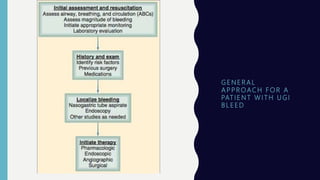
G E N E R A L
A P P R OAC H F O R A
PAT I E N T W I T H U G I
B L E E D
• -INITIAL ASSESSMENT
-ABC ,HEMODYNAMIC STATUS
-HEMATOCRIT IS NOT A USEFUL PARAMETER IN ACUTE SETTING
BCZ PROPORTION OF RBCS & PLASMA LOST INITIALLY IS CONSTANT.HEMATOCRIT
DOESN’T FALL UNTIL PLASMA IS REDISTRIBUTED INTO INTRAVASCULAR SPACE &
RESUSCITATION WITH CRYSTALLOID IS NBEGUN
-ABSENCE OF TACHYCARDIA MAY BE MISLEADING-PTS WITH SEVERE BLOOD LOSS
MAY ACTUALLY HAVE BRADYCARDIA SEC TO VAGAL SLOWING OF HEART
• HEMODYNAMIC SIGNS LESS RELIABLE IN ELDERLY & PTS TAKING BETABLOCKERS
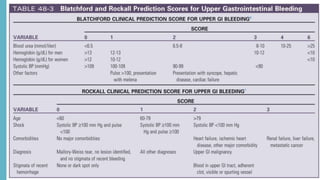
S E V E R A L R I S K
S T R AT I F I C AT I O N
S C O R E S H AV E B E E N
D E V E LO P E D TO
A S S I S T I N
I D E N T I F I C AT I O N O F
PAT I E N T S W H O
R E Q U I R E C LO S E
M O N I TO R I N G A N D
A R E AT R I S K O F
R E B L E E D I N G .
T H E T W O M O S T
C O M M O N LY U S E D
TO O L S A R E T H E
R O C K A L L S C O R E A N D
T H E L E S S E R U S E D
B L ATC H F O R D S C O R E
RESUSCITATION
• More severe the bleeding, the more aggressive the resuscitation.
• Intubation and ventilation should be initiated early if there is any question of
respiratory compromise.
• Unstable patients should receive a 2-liter bolus of crystalloid solution, usually
lactated Ringer
• The response to the fluid resuscitation should be noted. Routine blood
investigations, grouping and cross matching
• A Foley catheter should also be inserted for assessment of end- organ
perfusion.
• In older patients and patients with significant cardiac, pulmonary, or renal
disease - central venous or pulmonary artery catheter
• The oxygen-carrying capacity of the blood can be maximized by administering
supplemental oxygen.
BLOOD TRANSFUSION
The decision to transfuse blood depends on
• the response to the fluid challenge,
• age of the patient,
• whether concomitant cardiopulmonary disease is present &
• whether the bleeding continues.
• The initial effects of crystalloid infusion and the patient’s ongoing hemodynamic
parameters should be the primary criteria.
• In general, the hematocrit should be maintained
above 30% in older adults and
above 20% in young, otherwise healthy patients.
• Packed red blood cells are the preferred form of transfusion
• Whole blood, preferably warmed, may be used in scenarios
of massive blood loss.
• Defects in coagulation and platelets should be replaced as
they are detected.
• Patients who require high volume blood transfusion should
receive fresh-frozen plasma, platelets, and calcium
empirically.
HISTORY AND PHYSICAL
EXAMINATION• Once the severity of the bleeding is assessed and resuscitation initiated,
attention is directed to the history and physical examination.
• The time of onset, volume, and frequency are important in estimating blood
loss.
• The medical history may provide clues to the diagnosis.
• Antecedent vomiting - Mallory-Weiss tear
• Weight loss in malignancy.
• Past history of GI disease, bleeding, or operation.
• Antecedent epigastric distress in peptic ulcer
• Previous aortic surgery - aortoenteric fistula.
• history of liver disease prompts a consideration of variceal bleeding.
• Medication use – NSAIDS and SSRIs
PHYSICAL EXAMINATION
• The oropharynx and nose can occasionally simulate
symptoms from a more distal source and should always be examined.
• Epigastric tenderness - gastritis or peptic ulceration.
• The stigmata of liver disease, including jaundice, ascites, palmar
erythema, and caput medusae, may suggest bleeding related to varices,
LOCALIZATION
• Subsequent management of the patient with acute GI
hemorrhage depends on localization of the site of the
bleeding.
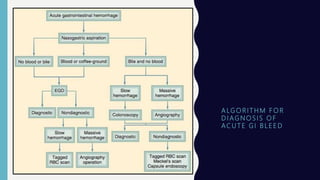
A LG O R I T H M F O R
D I AG N O S I S O F
AC U T E G I B L E E D
NON VARICEAL
BLEED- 80%
PEPTIC ULCER
DISEASE -MC
PEPTIC ULCER DISEASE
• Most frequent cause of upper GI hemorrhage, accounting for
approximately 40% of all cases.
• Approximately 10% to 15% of patients with PUD develop bleeding at
some point in the course of their disease.
• Bleeding is the most frequent indication for operation and the principal
cause for death in PUD.
• Bleeding develops as a consequence of peptic acid erosion of the
mucosal surface
• The most significant hemorrhage occurs when duodenal or gastric
ulcers penetrate into branches of the gastroduodenal artery or left
gastric arteries, respectively.
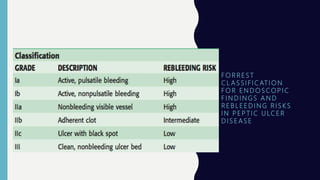
F O R R E S T
C L A S S I F I C AT I O N
F O R E N D O S CO P I C
F I N D I N G S A N D
R E B L E E D I N G R I S K S
I N P E P T I C U LC E R
D I S E A S E
A LG O R I T H M F O R
T H E D I AG N O S I S
A N D M A N AG E M E N T
O F N O N -
VA R I C E A L U P P E R G I
B L E E D I N G .
• STOP All ulcerogenic medications ; nonulcerogenic alternatives
prescribed.
ERADICATION OF H. PYLORI AND LONG-TERM ACID SUPPRESSION. –
• H. pylori infection reported in only 60–70% of bleeding ulcers.
• Recent data show that treating patients positive for H. pylori with
eradication therapy reduces the risk of rebleeding and obviates the
need for long-term acid sup- pression;
• hence H. pylori eradication is recommended in all bleeders infected
with H. pylori.
Proton Pump Inhibitors (PPIs)
• reduce the risk of rebleeding and
• the need for surgical intervention.
• Therefore, patients with a suspected or confirmed
• ulcer should be started on a PPI.
ENDOSCOPIC MANAGEMENT
• Timing - patients with clinical evidence of a GI bleed should receive an
endoscopy within 24 hours and, while awaiting this procedure, they
should be treated with a PPI.
• Techniques :
Injection techniques
Thermal techniques
Mechanical therapy
• A combination of injection with thermal therapy achieves hemostasis in
90% of bleeding PUDs.
INJECTION TECHNIQUES
• Primary mechanism – tamponade, resulting from a volume
effect
• Commonest injection fluid - Epinephrine (1 : 10,000) injected
in all four quadrants of the lesion, optimum injection volume
– >13ml
• Epinephrine alone is associated with a high rebleeding rate;
therefore used in combination with thermal therapy
THERMAL TECHNIQUES
Include
• Heater probes
• Argon Plasma coagulation –primarily used for superficial
lesions such as vascular abnormalities
• Electrocautery (monopolar or bipolar) – for bleeding ulcers
M E C H A N I C A L
T H E R A P Y
Use of device that causes
physical tamponade of the
bleeding site e.g.
Haemoclips and
bands
May be particularly effective
when dealing with a
spurting vessel because
they provide immediate
control of hemorrhage.
SECOND LOOK ENDOSCOPY
• Defined as preplanned systematic second endoscopy
performed 16-24 hours after the initial endoscopy.
• In those who rebleed, the role of a second attempt at
endoscopic control has been controversial but has been
validated.
• Most clinicians now encourage a second attempt at
endoscopic control before subjecting the patient to surgery.
POST ENDOSCOPY PPIS
• Post endoscopy high dose IV PPI infusion is effective in
reducing rebleeding and the need for surgery.
• Regimen – Omeprazole or Pantoprazole 80mg bolus,
followed by an 8mg/hr infusion for 72 hours
REBLEEDING FOLLOWING
ENDOSCOPIC THERAPY
• Percutaneous angio-embolization or
• transarterial embolization
can be considered as an alternative to surgery
in case of persistent or recurrent bleeding refractory to
endoscopic therapy
SURGICAL MANAGEMENT
Indications for Surgery in Peptic Ulcer Bleeding
Absolute indications
• Persistent blood loss refractory to endoscopic therapy
• Shock with recurrent hemorrhage
• Slow blood loss requiring >3/day units blood on admission
• Transfusion in excess of 6 units
Relative indications
• Elderly patient
• Severe comorbidity
• Rare blood type/refusal of transfusion
• Suspicion of malignancy in a gastric ulcer
DUODENAL ULCER- SURGICAL
MANAGEMENT
• A longitudinal duodenotomy or duodenopyloromyotomy provides
good exposure of bleeding sites in the duodenal bulb, the most
common site of duodenal ulcers.
• Direct pressure provides temporary arrest of the bleeding, and it should
be followed by suture ligation with a nonabsorbable suture such as
Prolene.
• Four-quadrant suture ligation will achieve hemostasis in anterior
ulcers.
• Posterior ulcers, particularly if involving the pancreaticoduodenal or
gastroduodenal artery – will require suture ligation of the artery both
proximal and distal to the ulcer for adequate control of hemorrhage, as
well as placement of a 3 point U-stitch underneath the ulcer to
S U T U R E CO N T R O L
O F B L E E D I N G
D U O D E N A L U LC E R S .
A LO N G I T U D I N A L
P Y LO R I C I N C I S I O N
I S M A D E A N D
F I G U R E - O F - E I G H T
S U T U R E S A R E
P L AC E D AT T H E
C E P H A L A D A N D
C AU DA D A S P E C T S
O F T H E U LC E R TO
O CC LU D E T H E
G A S T R O D U O D E N A L
A R T E R Y.
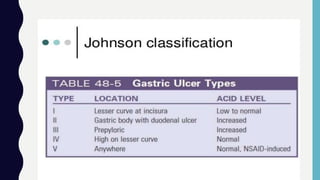
SURGICAL MANAGEMENT OF GASTRIC
ULCERS
• Although it may initially require gastrotomy and suture ligation, this alone is
associated with a high risk of rebleeding of almost 30%.
• In addition, because of a 10% incidence of malignancy, gastric ulcer resection is
generally indicated.
• Simple excision alone is associated with rebleeding in as many as 20% of patients so
distal gastrectomy is generally preferred, although excision combined with vagotomy
and pyloroplasty may be considered for the high-risk patient.
• Bleeding ulcers of the proximal stomach near the gastroesophageal junction are more
difficult to manage.
• Proximal or near-total gastrectomy is associated with a particularly high mortality in
the setting of acute
• hemorrhage.
• Options include distal gastrectomy combined with resection of a tongue of proximal
stomach to include the ulcer, and vagotomy and pyloroplasty combined with wedge
resection or simple oversewing of the ulcer.
UPPER GI RADIOGRAPHY
• DEMONSTARTION OF BARIUM WITHIN ULCER CRATER,WHICH IS USUALLY ROUND
OR OVAL & MAY OR MAY NOT BE SURROUNDED BY EDEMA
• USED TO DETERMINE THE -LOCATION & DEPTH OF PENETRATION.
-EXTENT OF DEFORMATION FROM CHRONIC FIBROSIS
• DOUBLE CONTRAST STUDIES –PREFERRED
• REPLACED BY FLEXIBLE UPPER ENDOSCOPY
MALLORY-WEISS TEAR
• FORCEFUL VOMITTING,RETCHING,COUGHING OR STRAINING THAT RESULTS IN
DISRUPTION OF GASTRIC MUCOSA HIGH ON LESSER CURVE IN GE JUNCTION.
• FORCEFUL CONTRACTION OF ABDOMINAL WALL AGAINST UNRELAXED CARDIA
INCREASED INTRAGASTRIC PRESSURE MUCOSAL LACERATION OF THE CARDIA
• 15 % OF ACUTE UGI,RARELY ASSOCIATED WITH MASSIVE BLEED
• MORTALITY – 3-4 %
• CAN OCCUR IN ANY PATIENT WITH HISTORY OF REPEATED EMESIS.GREATER RISK IN
ALCOHOLIC PATIENTS WITH PRE EXISTING PORTAL HYPERTENSION
• MOST PTS CAN BE MANAGED BY ENDOSCOPIC METHODS SUCH AS MULTIPOLAR
ELECTROCOAGULATION,EPINEPHRINE INJECTION,ENDOSCOPIC BAND LIGATION OR
CLIPPING
• IN SELECT HIGH RISK CASES- ANGIOGRAPHIC INTRA ARTERIAL INFUSION OF
VASOPRESSIN OR TRANSCATHETER EMBOLIZATION
• IF SURGERY IS NEEDED, LESION AT GE JUNCTION IS APPROACHED THROUGH
ANTERIOR GASTROTOMY..BLEEDING OVERSEWN WITH SEVERAL DEEP 2-0 SILK
LIGATURE
STRESS GASTRITIS
• APPEARANCE OF MULTIPLE, SUPERFICIAL ( NON ULCERATING ) EROSIONS THAT
BEGIN IN PROXIMAL/ ACID SECRETING PORTION OF STOMACH & PROGRESS
DISTALLY
• OCCURS AFTER PHYSICAL TRAUMA,SHOCK,SEPSIS,HEMORRHAGE OR RESPIRATORY
FAILURE.
• PATHOPHYSIOLOGY –
STRESS REDUCTION IN BF,MUCUS,HCO3- SECRETION BY MUCOSAL CELLS(IMPAIRED
MUCOSAL DEFENSE MECHANISMS)MUCOSAL ISCHEMIADAMAGE DUE TO
LUMINAL ACID
PRESENTATION
• DEVLOPS WITHIN 1-2 DAYS AFTER TRAUMATIC EVENT IN MORE THAN 50% OF PTS.
• PAINLESS UPPER GI BLEEDING THAT MAY BE DELAYED IN ONSET
• BLEEDING IS USUALLY SLOW,DETECTED BY ONLY A FEW FLECKS OF BLOOD IN NG
TUBE OR UNEXPLAINED DECREASE IN HB LEVEL
• IF PROFOUND UGI HEMORRAGE –HEMATEMESIS & HYPOTENSION PRESENT
• HEMATOCHEZIA OR MALENA –RARE BUT FECAL OCCULT BLOOD TEST POSITIVE
• ENDOSOPY – REQUIRED TO DIFFERENTIATE STRESS GASTRITIS FROM OTHER
SOURCES OF GI HEMORRAGE
• 2 STRONG RISK FACTORS FOR DEVELOPING CLINICALLY SIGNIFICANT BLEEDING
FROM GASTRIC STRESS ULCERS ARE
- COAGULOPATHY &
-RESPIRATORY FAILURE REQUIRING PROLONGED MECH VENTILATION >48HRS
PROPHYLACTICALLY INCREASING GASTRIC PH- INCREASED RATES OF VENTILATOR ASS
PNEUMONIA & CLOSTRIDIUM DIFFICILE INFECTION
• ENTERAL NUTRITION DECREASES THE RISK OF STRESS ULCER FORMATION &
SHOULD BE INITIATED AS SOON AS POSSIBLE
DEFINITIVE TREATMENT
• FLUID RESUSCITATION
• CORRECTION OF COAGULATION / PLATELET ABNORMALITIES
• TREATMENT OF UNDERLYING SEPSIS
• SELECTIVE INFUSION OF VASOPRESSIN INTO SPLANCHNIC CIRCULATION THROUGH
LEFT GASTRIC ARTERY. VASOPRESSIN ADMINISTERED BY CONTINIOUS INFUSION
THROUGH THE CATHETER @ 0.2-0.4 IU/MIN FOR A MAX OF 48-72 HRS
( VASOPRESSIN CONTRAINDICATED IN CASE OF UNDERLYING LIVER OR CARDIAC
DISEASE)
• EMBOLIZATION OF LEFT GASTRIC ARTERY IF BLEEDING IS IDENTIFIED ON
ANGIOGRAPHY
• BLEEDING THAT RECURS OR PERSISTS ,REQUIRING > 6 UNITS OF BLOOD IS AN
INDICATION FOR SURGERY.
• ANTERIOR GASTROTOMY GASTRIC LUMEN CLEARED OF BLOOD & MUCOSAL
SURFACE INSPECTED FOR BLEEDING POINTS BLEEDING POINTS OVERSEWN WITH
FIGURE OF 8 STITCHES TAKEN DEEP WITHIN THE GASTRIC WALL.SUPERFICIAL
EROSIONS WHICH ARE NOT ACTIVELY BLEEDING DON’T NEEDLIGATION UNLESS A
BLOOD VESSEL IS SEEN AT THE BASE CLOSURE OF ANT. GASTOTOMY + TRUNCAL
VAGOTOMY + PYLOROPLASTY ( TO REDUCE ACID SECRETION)
• PARTIAL GASTRECTOMY + VAGOTOMY – LESS COMMON
• TOTAL GASTRECTOMY – IN LIFE THREATENING HEMORRAGE REFRACTORY TO OTHER
FORMS OF THERAPY
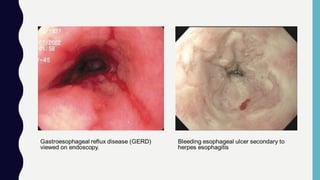
ESOPHAGITIS
• Esophagus - infrequent source for significant hemorrhage.
• Most commonly the result of esophagitis. Seen in -
• Gastroesophageal reflux disease (GERD). Ulceration may accompany this but the
superficial mucosal ulcerations generally do not bleed acutely
• Infectious agents may also cause esophagitis, particularly in the immunocompromised
host. With infection, hemorrhage can occasionally be massive.
• Other causes of esophageal bleeding include medications, Crohn’s disease, and
radiation.
Treatment:
• Acid suppressive therapy
• Endoscopic control of the hemorrhage, usually with electrocoagulation or a heater
probe, is often successful.
• In patients with an infectious cause, targeted therapy is appropriate.
• Surgery is seldom necessary.
DIEULAFOY LESION
• They are vascular malformations found primarily along the lesser curve of the
stomach within 6 cm of the gastroesophageal junction, although they can
occur elsewhere in the GI tract.
• They represent rupture of unusually large vessels (1 to 3 mm) found in the
gastric submucosa.
• Erosion of the gastric mucosa overlying these vessels leads to hemorrhage.
• The mucosal defect is usually small (2 to 5 mm) and may be difficult to
identify. Bleeding can be massive
TREATMENT-
• Initially – endoscopic thermal or sclerosant therapy
• In cases that fail endoscopic therapy, angiographic coil embolization can be
successful.
• If these approaches are unsuccessful, surgical intervention may be necessary.
A gastrostomy is performed and attempts are made at identifying the
bleeding source. The lesion can then be oversewn.
• In patients in whom the bleeding point is not identified, a partial gastrectomy
may be necessary.
BLEEDING DIEULAFOY’S LESION OF THE STOMACH.
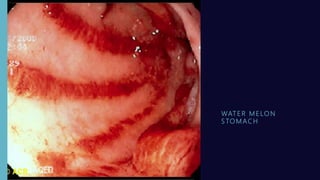
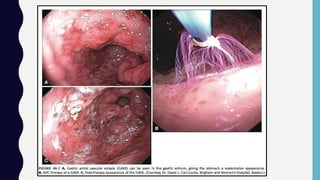
GASTRIC ANTRAL VASCULAR ECTASIA
• Also known as watermelon stomach.
• Characterized by a collection of dilated venules appearing as
linear red streaks converging on the antrum in a longitudinal
fashion, giving it the appearance of a watermelon.
• Acute severe hemorrhage is rare in GAVE.
• Most patients present with persistent iron deficiency anemia
from continued occult blood loss.
TREATMENT
• Endoscopic therapy is indicated for persistent, transfusion- dependent
bleeding and has been reportedly successful in up 90% of patients.
• The preferred endoscopic therapy is APC (Argon Plasma coagulation)
• Patients failing endoscopic therapy should be considered for
antrectomy.
WAT E R M E LO N
S TO M AC H
MALIGNANCY
• Malignancies of the upper GI tract are usually associated with
chronic anemia or hemoccult-positive stool rather than
episodes of significant hemorrhage.
• Occasionally they may present as ulcerative lesions that bleed
persistently.
• Most characteristic of the GI stromal tumor (GIST), although it
may occur with other lesions, including leiomyomas and
lymphomas.
Treatment:
• Although endoscopic therapy is often successful in
controlling these bleeds, the rebleeding rate is high;
• Therefore, when a malignancy is diagnosed, surgical
is indicated.
AORTO ENTERIC FISTULA
• Primary aortoduodenal fistulas are rare lesions.
• They typically develop in the setting of a previous abdominal aortic
aneurysm repair.
• Although, they may occur as a result of an inflammatory or infectious
aortitis, and they may develop in up to 1% of aortic graft cases.
• The median interval between surgery and hemorrhage is approximately
3 years.
• Development of pseudo aneurysm at proximal anastomotic
sutureline due to infection  subsequent fistulization into
overlying duodenum
• This diagnosis should be considered in all bleedi g patients with
known abdominal aortic aneurysm or previous prosthetic aneurysm
repair
• Typically, patients will present first with a sentinel bleed. Self-
limited episode - heralds the subsequent massive and often fatal
hemorrhage.
• Diagnosis :
• EGD- any evidence of bleeding in distal (3rd or 4th ) duodenum
• CT scan- air around the graft suggestive of infection.
• possible pseudo aneurysm
Therapy includes
• ligation of the aorta proximal to graft,
• removal of the infected prosthesis, and
• an extra-anatomic bypass.
• defect in the duodenum is often small and can be repaired
primarily.
HEMOBILIA
• Difficult diagnosis to make.
• Typically associated with trauma, recent instrumentation of the biliary tree, or hepatic
neoplasms.
• Should be suspected in anyone who presents with hemorrhage, right upper quadrant
pain, and jaundice.
• This triad is seen in less than 50% of patientsAngiography is the diagnostic procedure
of choice.
• If diagnosis is confirmed, angiographic embolization is the preferred treatment.
HEMOSUCCUS PANCREATICUS
• Another rare cause of upper GI bleeding is bleeding from the pancreatic duct.
• This is often caused by erosion of a pancreatic pseudocyst into the splenic
artery.
• Presents with abdominal pain and hematochezia.
• High index of suspicion in patients with abdominal pain, blood loss, and a past
history of pancreatitis.
• Angiography is diagnostic and permits embolization, which is often
therapeutic.
• In patients amenable to a distal pancreatectomy, the procedure often
results in cure.
IATROGENIC BLEEDING
• Percutaneous transhepatic procedures
• Endoscopic sphincterotomy
• Percutaneous endoscopic gastrostomy (PEG)
BLEEDING
RELATED TO
PORTAL
HYPERTENSION
• Hemorrhage related to portal hypertension is usually the result of
bleeding from varices.
• These dilated submucosal veins develop in response to the portal
hypertension, providing a collateral pathway for decompression of the
portal system into the systemic venous circulation.
• They are most common in the distal esophagus and can reach sizes of 1
to 2 cm.
• As they enlarge, the overlying mucosa becomes increasingly tenuous,
excoriating with minimal trauma.
• Varices can also be seen in hemorroidal plexus of rectum &
stomach (portal hypertensive gastropathy)
• Gastroesophaeal varices devlop in 30% of pts with cirrhosis &
portal hypertension
• 30 % in this devlop variceal bleeding
• Variceal bleeding – ass with increased risk of rebleeding,need
of more transfusins,increased mortality
• Hemorrage is frequently massive with hematemesis &
hemodynamic instability
• Hepatic functional reserve calculated by child criteria closely
corelates with outcome in pts
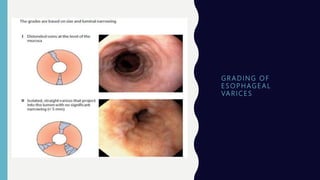
G R A D I N G O F
E S O P H AG E A L
VA R I C E S
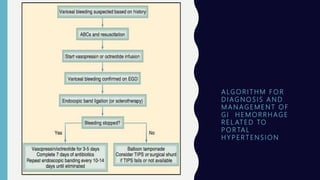
A LG O R I T H M F O R
D I AG N O S I S A N D
M A N AG E M E N T O F
G I H E M O R R H AG E
R E L AT E D TO
P O R TA L
H Y P E R T E N S I O N
MANAGEMENT OF VARICEAL
BLEEDING
Vasopressin analogues
• Vasopressin – given as IV infusion due to short half life
• Terlipressin – longer half life, can be given every 4-6 hours safer.
-Vasopressin combined with nitroglycerine given in clinical practice
Somatostatin analogues
• Somatostatin
• Octreotide (synthetic analogue) – vasoactive agent of choice in US
ENDOSCOPIC TECHNIQUES
-unlike in peptic ulcer, if done within 15 hrs can affect survival rates
-Endoscopic sclerotherapy
easier to perform but associated with complications-
perforation,mediastinitis & stricture
-Endoscopic variceal ligation
• Modality of choice for endoscopic treatment of esophageal
varices
• Multiple sessions repeated every 10-14 days needed to achieve
complete obliteration of varices (2-4 sessions on an average)
S E N G S TA K E N
B L A K E M O R E T U B E
• Minnesota tube – includes proximal esophageal lumen for
aspirating swallowed secretions
• Both are ass. With high complications related to
aspiration,esophageal perforation when placed
inappropriately
• On deflation,hemorrage recurs in more than 50% of patients.
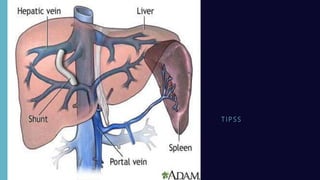
Transjugular intrahepatic portosystemic stent shunt (TIPSS)
• MC
• Life saving in hemodynamically unstable patients
EMERGENT SHUNTING
T I P S S
TREATMENT IN GASTRIC VARICES
• Because of diffuse nature of gastric abnormalities,bleeding from portal hypertensive
gastropathy is not amendable to endoscopic treatment..
• Pharmacological therapies aimed at decreasing the portal tension ar aimed
• If pharmacological therapy fails to control acute hemorrage, TIPS should be considered
Splenic vein thromobosis  isolated gastric varices ( MC seen in setting of pancreatistis).
In these pts central portal pressures are normal.but left sided HTN ,decompressed from
spleen to short gastric vessels produce varices…..best treated by SPLENECTOMY
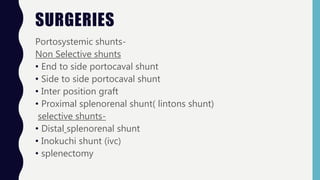
SURGERIES
Portosystemic shunts-
Non Selective shunts
• End to side portocaval shunt
• Side to side portocaval shunt
• Inter position graft
• Proximal splenorenal shunt( lintons shunt)
selective shunts-
• Distal splenorenal shunt
• Inokuchi shunt (ivc)
• splenectomy
N O N S E L E C T I V E
S H U N T S
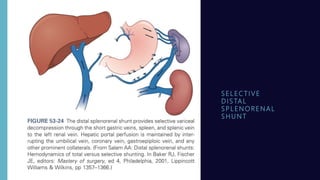
S E L E C T I V E
D I S TA L
S P L E N O R E N A L
S H U N T
TIPS VS SURGICAL DECOMPRESSION
• CHOICE DEPENDS ON RESIDUAL LIVER FUNCTION
• PT WITH POOR LIVER FUNCTION,WHO ARE ON TRANSPLANT-TIPS IS CONSIDERED-
AVOIDS POSTOP SCARRING AT PORTAHEPATIS,WHICH COULD COMPLICATE
TRANSPLANT PROCEDURE
• DISADVANTAGE OF TIPS- HEPATIC ENCEPHALOPATHY WITHIN 1 YR IN 50% PER
• PATIENT WITH GOOD LIVER FUCTION,WHO DONOT QUALIFY FOR A TRANSPLANT-
SURGICAL DECOMPRESSION IS PREFERRED
PREVENTION OF REBLEEDING
• If no therapy is taken,70 % patients ll have another
bleed within 2 months.
• Medical therapy to prevent recurrence- non skective
beta blocker such as nadolol + anti ulcer agent like
ppi /sucralfate combined with endoscopic band
ligation every 10-14 days until all varices have been
eradicated
TREATMENT BEFORE THE FIRST BLEED
• The prognosis depends more on the degree of hepatic
insufficiency rather than on the severity of the varices
• Mild varices do not require treatment
• Pronounced varices with a high bleeding risk can be treated
medically with propranolol, which may be combined with 40-
80 mg/day isosorbide mononitrate.
• Spironolactone in a dose of 100−200 mg/day can be
considered as an alternative to beta-blockers
• No endoscopic, operative or TIPS insertion treatment
required
UPPER GASTROINTESTINAL BLEEDING

UPPER GASTROINTESTINAL BLEEDING

  • 1.
    UGI BLEEDING D R. N AV YA T E J A
  • 2.
    •BLEEDING THAT ARISESFROM GI TRACT PROXIMAL TO LIGAMENT OF TREITZ. •ACCOUNTS FOR 80% OF SIGNIFICANT GI HEMORRAGE
  • 3.
    G E NE R A L A P P R OAC H F O R A PAT I E N T W I T H U G I B L E E D
  • 4.
    • -INITIAL ASSESSMENT -ABC,HEMODYNAMIC STATUS -HEMATOCRIT IS NOT A USEFUL PARAMETER IN ACUTE SETTING BCZ PROPORTION OF RBCS & PLASMA LOST INITIALLY IS CONSTANT.HEMATOCRIT DOESN’T FALL UNTIL PLASMA IS REDISTRIBUTED INTO INTRAVASCULAR SPACE & RESUSCITATION WITH CRYSTALLOID IS NBEGUN -ABSENCE OF TACHYCARDIA MAY BE MISLEADING-PTS WITH SEVERE BLOOD LOSS MAY ACTUALLY HAVE BRADYCARDIA SEC TO VAGAL SLOWING OF HEART • HEMODYNAMIC SIGNS LESS RELIABLE IN ELDERLY & PTS TAKING BETABLOCKERS
  • 5.
    S E VE R A L R I S K S T R AT I F I C AT I O N S C O R E S H AV E B E E N D E V E LO P E D TO A S S I S T I N I D E N T I F I C AT I O N O F PAT I E N T S W H O R E Q U I R E C LO S E M O N I TO R I N G A N D A R E AT R I S K O F R E B L E E D I N G . T H E T W O M O S T C O M M O N LY U S E D TO O L S A R E T H E R O C K A L L S C O R E A N D T H E L E S S E R U S E D B L ATC H F O R D S C O R E
  • 6.
    RESUSCITATION • More severethe bleeding, the more aggressive the resuscitation. • Intubation and ventilation should be initiated early if there is any question of respiratory compromise. • Unstable patients should receive a 2-liter bolus of crystalloid solution, usually lactated Ringer • The response to the fluid resuscitation should be noted. Routine blood investigations, grouping and cross matching • A Foley catheter should also be inserted for assessment of end- organ perfusion. • In older patients and patients with significant cardiac, pulmonary, or renal disease - central venous or pulmonary artery catheter • The oxygen-carrying capacity of the blood can be maximized by administering supplemental oxygen.
  • 7.
    BLOOD TRANSFUSION The decisionto transfuse blood depends on • the response to the fluid challenge, • age of the patient, • whether concomitant cardiopulmonary disease is present & • whether the bleeding continues. • The initial effects of crystalloid infusion and the patient’s ongoing hemodynamic parameters should be the primary criteria.
  • 8.
    • In general,the hematocrit should be maintained above 30% in older adults and above 20% in young, otherwise healthy patients. • Packed red blood cells are the preferred form of transfusion • Whole blood, preferably warmed, may be used in scenarios of massive blood loss. • Defects in coagulation and platelets should be replaced as they are detected. • Patients who require high volume blood transfusion should receive fresh-frozen plasma, platelets, and calcium empirically.
  • 9.
    HISTORY AND PHYSICAL EXAMINATION•Once the severity of the bleeding is assessed and resuscitation initiated, attention is directed to the history and physical examination. • The time of onset, volume, and frequency are important in estimating blood loss. • The medical history may provide clues to the diagnosis. • Antecedent vomiting - Mallory-Weiss tear • Weight loss in malignancy. • Past history of GI disease, bleeding, or operation. • Antecedent epigastric distress in peptic ulcer • Previous aortic surgery - aortoenteric fistula. • history of liver disease prompts a consideration of variceal bleeding. • Medication use – NSAIDS and SSRIs
  • 10.
    PHYSICAL EXAMINATION • Theoropharynx and nose can occasionally simulate symptoms from a more distal source and should always be examined. • Epigastric tenderness - gastritis or peptic ulceration. • The stigmata of liver disease, including jaundice, ascites, palmar erythema, and caput medusae, may suggest bleeding related to varices,
  • 11.
    LOCALIZATION • Subsequent managementof the patient with acute GI hemorrhage depends on localization of the site of the bleeding.
  • 12.
    A LG OR I T H M F O R D I AG N O S I S O F AC U T E G I B L E E D
  • 13.
  • 14.
  • 15.
    • Most frequentcause of upper GI hemorrhage, accounting for approximately 40% of all cases. • Approximately 10% to 15% of patients with PUD develop bleeding at some point in the course of their disease. • Bleeding is the most frequent indication for operation and the principal cause for death in PUD. • Bleeding develops as a consequence of peptic acid erosion of the mucosal surface • The most significant hemorrhage occurs when duodenal or gastric ulcers penetrate into branches of the gastroduodenal artery or left gastric arteries, respectively.
  • 16.
    F O RR E S T C L A S S I F I C AT I O N F O R E N D O S CO P I C F I N D I N G S A N D R E B L E E D I N G R I S K S I N P E P T I C U LC E R D I S E A S E
  • 17.
    A LG OR I T H M F O R T H E D I AG N O S I S A N D M A N AG E M E N T O F N O N - VA R I C E A L U P P E R G I B L E E D I N G .
  • 18.
    • STOP Allulcerogenic medications ; nonulcerogenic alternatives prescribed. ERADICATION OF H. PYLORI AND LONG-TERM ACID SUPPRESSION. – • H. pylori infection reported in only 60–70% of bleeding ulcers. • Recent data show that treating patients positive for H. pylori with eradication therapy reduces the risk of rebleeding and obviates the need for long-term acid sup- pression; • hence H. pylori eradication is recommended in all bleeders infected with H. pylori. Proton Pump Inhibitors (PPIs) • reduce the risk of rebleeding and • the need for surgical intervention. • Therefore, patients with a suspected or confirmed • ulcer should be started on a PPI.
  • 19.
    ENDOSCOPIC MANAGEMENT • Timing- patients with clinical evidence of a GI bleed should receive an endoscopy within 24 hours and, while awaiting this procedure, they should be treated with a PPI. • Techniques : Injection techniques Thermal techniques Mechanical therapy • A combination of injection with thermal therapy achieves hemostasis in 90% of bleeding PUDs.
  • 20.
    INJECTION TECHNIQUES • Primarymechanism – tamponade, resulting from a volume effect • Commonest injection fluid - Epinephrine (1 : 10,000) injected in all four quadrants of the lesion, optimum injection volume – >13ml • Epinephrine alone is associated with a high rebleeding rate; therefore used in combination with thermal therapy
  • 21.
    THERMAL TECHNIQUES Include • Heaterprobes • Argon Plasma coagulation –primarily used for superficial lesions such as vascular abnormalities • Electrocautery (monopolar or bipolar) – for bleeding ulcers
  • 22.
    M E CH A N I C A L T H E R A P Y Use of device that causes physical tamponade of the bleeding site e.g. Haemoclips and bands May be particularly effective when dealing with a spurting vessel because they provide immediate control of hemorrhage.
  • 23.
    SECOND LOOK ENDOSCOPY •Defined as preplanned systematic second endoscopy performed 16-24 hours after the initial endoscopy. • In those who rebleed, the role of a second attempt at endoscopic control has been controversial but has been validated. • Most clinicians now encourage a second attempt at endoscopic control before subjecting the patient to surgery.
  • 24.
    POST ENDOSCOPY PPIS •Post endoscopy high dose IV PPI infusion is effective in reducing rebleeding and the need for surgery. • Regimen – Omeprazole or Pantoprazole 80mg bolus, followed by an 8mg/hr infusion for 72 hours
  • 25.
    REBLEEDING FOLLOWING ENDOSCOPIC THERAPY •Percutaneous angio-embolization or • transarterial embolization can be considered as an alternative to surgery in case of persistent or recurrent bleeding refractory to endoscopic therapy
  • 26.
    SURGICAL MANAGEMENT Indications forSurgery in Peptic Ulcer Bleeding Absolute indications • Persistent blood loss refractory to endoscopic therapy • Shock with recurrent hemorrhage • Slow blood loss requiring >3/day units blood on admission • Transfusion in excess of 6 units Relative indications • Elderly patient • Severe comorbidity • Rare blood type/refusal of transfusion • Suspicion of malignancy in a gastric ulcer
  • 27.
    DUODENAL ULCER- SURGICAL MANAGEMENT •A longitudinal duodenotomy or duodenopyloromyotomy provides good exposure of bleeding sites in the duodenal bulb, the most common site of duodenal ulcers. • Direct pressure provides temporary arrest of the bleeding, and it should be followed by suture ligation with a nonabsorbable suture such as Prolene. • Four-quadrant suture ligation will achieve hemostasis in anterior ulcers. • Posterior ulcers, particularly if involving the pancreaticoduodenal or gastroduodenal artery – will require suture ligation of the artery both proximal and distal to the ulcer for adequate control of hemorrhage, as well as placement of a 3 point U-stitch underneath the ulcer to
  • 28.
    S U TU R E CO N T R O L O F B L E E D I N G D U O D E N A L U LC E R S . A LO N G I T U D I N A L P Y LO R I C I N C I S I O N I S M A D E A N D F I G U R E - O F - E I G H T S U T U R E S A R E P L AC E D AT T H E C E P H A L A D A N D C AU DA D A S P E C T S O F T H E U LC E R TO O CC LU D E T H E G A S T R O D U O D E N A L A R T E R Y.
  • 29.
    SURGICAL MANAGEMENT OFGASTRIC ULCERS • Although it may initially require gastrotomy and suture ligation, this alone is associated with a high risk of rebleeding of almost 30%. • In addition, because of a 10% incidence of malignancy, gastric ulcer resection is generally indicated. • Simple excision alone is associated with rebleeding in as many as 20% of patients so distal gastrectomy is generally preferred, although excision combined with vagotomy and pyloroplasty may be considered for the high-risk patient. • Bleeding ulcers of the proximal stomach near the gastroesophageal junction are more difficult to manage.
  • 31.
    • Proximal ornear-total gastrectomy is associated with a particularly high mortality in the setting of acute • hemorrhage. • Options include distal gastrectomy combined with resection of a tongue of proximal stomach to include the ulcer, and vagotomy and pyloroplasty combined with wedge resection or simple oversewing of the ulcer.
  • 32.
    UPPER GI RADIOGRAPHY •DEMONSTARTION OF BARIUM WITHIN ULCER CRATER,WHICH IS USUALLY ROUND OR OVAL & MAY OR MAY NOT BE SURROUNDED BY EDEMA • USED TO DETERMINE THE -LOCATION & DEPTH OF PENETRATION. -EXTENT OF DEFORMATION FROM CHRONIC FIBROSIS • DOUBLE CONTRAST STUDIES –PREFERRED • REPLACED BY FLEXIBLE UPPER ENDOSCOPY
  • 33.
    MALLORY-WEISS TEAR • FORCEFULVOMITTING,RETCHING,COUGHING OR STRAINING THAT RESULTS IN DISRUPTION OF GASTRIC MUCOSA HIGH ON LESSER CURVE IN GE JUNCTION. • FORCEFUL CONTRACTION OF ABDOMINAL WALL AGAINST UNRELAXED CARDIA INCREASED INTRAGASTRIC PRESSURE MUCOSAL LACERATION OF THE CARDIA • 15 % OF ACUTE UGI,RARELY ASSOCIATED WITH MASSIVE BLEED • MORTALITY – 3-4 % • CAN OCCUR IN ANY PATIENT WITH HISTORY OF REPEATED EMESIS.GREATER RISK IN ALCOHOLIC PATIENTS WITH PRE EXISTING PORTAL HYPERTENSION • MOST PTS CAN BE MANAGED BY ENDOSCOPIC METHODS SUCH AS MULTIPOLAR ELECTROCOAGULATION,EPINEPHRINE INJECTION,ENDOSCOPIC BAND LIGATION OR CLIPPING • IN SELECT HIGH RISK CASES- ANGIOGRAPHIC INTRA ARTERIAL INFUSION OF VASOPRESSIN OR TRANSCATHETER EMBOLIZATION • IF SURGERY IS NEEDED, LESION AT GE JUNCTION IS APPROACHED THROUGH ANTERIOR GASTROTOMY..BLEEDING OVERSEWN WITH SEVERAL DEEP 2-0 SILK LIGATURE
  • 34.
    STRESS GASTRITIS • APPEARANCEOF MULTIPLE, SUPERFICIAL ( NON ULCERATING ) EROSIONS THAT BEGIN IN PROXIMAL/ ACID SECRETING PORTION OF STOMACH & PROGRESS DISTALLY • OCCURS AFTER PHYSICAL TRAUMA,SHOCK,SEPSIS,HEMORRHAGE OR RESPIRATORY FAILURE. • PATHOPHYSIOLOGY – STRESS REDUCTION IN BF,MUCUS,HCO3- SECRETION BY MUCOSAL CELLS(IMPAIRED MUCOSAL DEFENSE MECHANISMS)MUCOSAL ISCHEMIADAMAGE DUE TO LUMINAL ACID
  • 35.
    PRESENTATION • DEVLOPS WITHIN1-2 DAYS AFTER TRAUMATIC EVENT IN MORE THAN 50% OF PTS. • PAINLESS UPPER GI BLEEDING THAT MAY BE DELAYED IN ONSET • BLEEDING IS USUALLY SLOW,DETECTED BY ONLY A FEW FLECKS OF BLOOD IN NG TUBE OR UNEXPLAINED DECREASE IN HB LEVEL • IF PROFOUND UGI HEMORRAGE –HEMATEMESIS & HYPOTENSION PRESENT • HEMATOCHEZIA OR MALENA –RARE BUT FECAL OCCULT BLOOD TEST POSITIVE • ENDOSOPY – REQUIRED TO DIFFERENTIATE STRESS GASTRITIS FROM OTHER SOURCES OF GI HEMORRAGE
  • 36.
    • 2 STRONGRISK FACTORS FOR DEVELOPING CLINICALLY SIGNIFICANT BLEEDING FROM GASTRIC STRESS ULCERS ARE - COAGULOPATHY & -RESPIRATORY FAILURE REQUIRING PROLONGED MECH VENTILATION >48HRS PROPHYLACTICALLY INCREASING GASTRIC PH- INCREASED RATES OF VENTILATOR ASS PNEUMONIA & CLOSTRIDIUM DIFFICILE INFECTION • ENTERAL NUTRITION DECREASES THE RISK OF STRESS ULCER FORMATION & SHOULD BE INITIATED AS SOON AS POSSIBLE
  • 37.
    DEFINITIVE TREATMENT • FLUIDRESUSCITATION • CORRECTION OF COAGULATION / PLATELET ABNORMALITIES • TREATMENT OF UNDERLYING SEPSIS • SELECTIVE INFUSION OF VASOPRESSIN INTO SPLANCHNIC CIRCULATION THROUGH LEFT GASTRIC ARTERY. VASOPRESSIN ADMINISTERED BY CONTINIOUS INFUSION THROUGH THE CATHETER @ 0.2-0.4 IU/MIN FOR A MAX OF 48-72 HRS ( VASOPRESSIN CONTRAINDICATED IN CASE OF UNDERLYING LIVER OR CARDIAC DISEASE) • EMBOLIZATION OF LEFT GASTRIC ARTERY IF BLEEDING IS IDENTIFIED ON ANGIOGRAPHY
  • 38.
    • BLEEDING THATRECURS OR PERSISTS ,REQUIRING > 6 UNITS OF BLOOD IS AN INDICATION FOR SURGERY. • ANTERIOR GASTROTOMY GASTRIC LUMEN CLEARED OF BLOOD & MUCOSAL SURFACE INSPECTED FOR BLEEDING POINTS BLEEDING POINTS OVERSEWN WITH FIGURE OF 8 STITCHES TAKEN DEEP WITHIN THE GASTRIC WALL.SUPERFICIAL EROSIONS WHICH ARE NOT ACTIVELY BLEEDING DON’T NEEDLIGATION UNLESS A BLOOD VESSEL IS SEEN AT THE BASE CLOSURE OF ANT. GASTOTOMY + TRUNCAL VAGOTOMY + PYLOROPLASTY ( TO REDUCE ACID SECRETION) • PARTIAL GASTRECTOMY + VAGOTOMY – LESS COMMON • TOTAL GASTRECTOMY – IN LIFE THREATENING HEMORRAGE REFRACTORY TO OTHER FORMS OF THERAPY
  • 39.
    ESOPHAGITIS • Esophagus -infrequent source for significant hemorrhage. • Most commonly the result of esophagitis. Seen in - • Gastroesophageal reflux disease (GERD). Ulceration may accompany this but the superficial mucosal ulcerations generally do not bleed acutely • Infectious agents may also cause esophagitis, particularly in the immunocompromised host. With infection, hemorrhage can occasionally be massive. • Other causes of esophageal bleeding include medications, Crohn’s disease, and radiation.
  • 40.
    Treatment: • Acid suppressivetherapy • Endoscopic control of the hemorrhage, usually with electrocoagulation or a heater probe, is often successful. • In patients with an infectious cause, targeted therapy is appropriate. • Surgery is seldom necessary.
  • 42.
    DIEULAFOY LESION • Theyare vascular malformations found primarily along the lesser curve of the stomach within 6 cm of the gastroesophageal junction, although they can occur elsewhere in the GI tract. • They represent rupture of unusually large vessels (1 to 3 mm) found in the gastric submucosa. • Erosion of the gastric mucosa overlying these vessels leads to hemorrhage. • The mucosal defect is usually small (2 to 5 mm) and may be difficult to identify. Bleeding can be massive
  • 43.
    TREATMENT- • Initially –endoscopic thermal or sclerosant therapy • In cases that fail endoscopic therapy, angiographic coil embolization can be successful. • If these approaches are unsuccessful, surgical intervention may be necessary. A gastrostomy is performed and attempts are made at identifying the bleeding source. The lesion can then be oversewn. • In patients in whom the bleeding point is not identified, a partial gastrectomy may be necessary.
  • 44.
  • 45.
    GASTRIC ANTRAL VASCULARECTASIA • Also known as watermelon stomach. • Characterized by a collection of dilated venules appearing as linear red streaks converging on the antrum in a longitudinal fashion, giving it the appearance of a watermelon. • Acute severe hemorrhage is rare in GAVE. • Most patients present with persistent iron deficiency anemia from continued occult blood loss.
  • 46.
    TREATMENT • Endoscopic therapyis indicated for persistent, transfusion- dependent bleeding and has been reportedly successful in up 90% of patients. • The preferred endoscopic therapy is APC (Argon Plasma coagulation) • Patients failing endoscopic therapy should be considered for antrectomy.
  • 47.
    WAT E RM E LO N S TO M AC H
  • 49.
    MALIGNANCY • Malignancies ofthe upper GI tract are usually associated with chronic anemia or hemoccult-positive stool rather than episodes of significant hemorrhage. • Occasionally they may present as ulcerative lesions that bleed persistently. • Most characteristic of the GI stromal tumor (GIST), although it may occur with other lesions, including leiomyomas and lymphomas.
  • 50.
    Treatment: • Although endoscopictherapy is often successful in controlling these bleeds, the rebleeding rate is high; • Therefore, when a malignancy is diagnosed, surgical is indicated.
  • 51.
    AORTO ENTERIC FISTULA •Primary aortoduodenal fistulas are rare lesions. • They typically develop in the setting of a previous abdominal aortic aneurysm repair. • Although, they may occur as a result of an inflammatory or infectious aortitis, and they may develop in up to 1% of aortic graft cases. • The median interval between surgery and hemorrhage is approximately 3 years.
  • 52.
    • Development ofpseudo aneurysm at proximal anastomotic sutureline due to infection  subsequent fistulization into overlying duodenum • This diagnosis should be considered in all bleedi g patients with known abdominal aortic aneurysm or previous prosthetic aneurysm repair • Typically, patients will present first with a sentinel bleed. Self- limited episode - heralds the subsequent massive and often fatal hemorrhage. • Diagnosis : • EGD- any evidence of bleeding in distal (3rd or 4th ) duodenum • CT scan- air around the graft suggestive of infection. • possible pseudo aneurysm
  • 53.
    Therapy includes • ligationof the aorta proximal to graft, • removal of the infected prosthesis, and • an extra-anatomic bypass. • defect in the duodenum is often small and can be repaired primarily.
  • 55.
    HEMOBILIA • Difficult diagnosisto make. • Typically associated with trauma, recent instrumentation of the biliary tree, or hepatic neoplasms. • Should be suspected in anyone who presents with hemorrhage, right upper quadrant pain, and jaundice. • This triad is seen in less than 50% of patientsAngiography is the diagnostic procedure of choice. • If diagnosis is confirmed, angiographic embolization is the preferred treatment.
  • 56.
    HEMOSUCCUS PANCREATICUS • Anotherrare cause of upper GI bleeding is bleeding from the pancreatic duct. • This is often caused by erosion of a pancreatic pseudocyst into the splenic artery. • Presents with abdominal pain and hematochezia. • High index of suspicion in patients with abdominal pain, blood loss, and a past history of pancreatitis. • Angiography is diagnostic and permits embolization, which is often therapeutic. • In patients amenable to a distal pancreatectomy, the procedure often results in cure.
  • 57.
    IATROGENIC BLEEDING • Percutaneoustranshepatic procedures • Endoscopic sphincterotomy • Percutaneous endoscopic gastrostomy (PEG)
  • 58.
  • 59.
    • Hemorrhage relatedto portal hypertension is usually the result of bleeding from varices. • These dilated submucosal veins develop in response to the portal hypertension, providing a collateral pathway for decompression of the portal system into the systemic venous circulation. • They are most common in the distal esophagus and can reach sizes of 1 to 2 cm. • As they enlarge, the overlying mucosa becomes increasingly tenuous, excoriating with minimal trauma.
  • 60.
    • Varices canalso be seen in hemorroidal plexus of rectum & stomach (portal hypertensive gastropathy) • Gastroesophaeal varices devlop in 30% of pts with cirrhosis & portal hypertension • 30 % in this devlop variceal bleeding • Variceal bleeding – ass with increased risk of rebleeding,need of more transfusins,increased mortality • Hemorrage is frequently massive with hematemesis & hemodynamic instability • Hepatic functional reserve calculated by child criteria closely corelates with outcome in pts
  • 62.
    G R AD I N G O F E S O P H AG E A L VA R I C E S
  • 66.
    A LG OR I T H M F O R D I AG N O S I S A N D M A N AG E M E N T O F G I H E M O R R H AG E R E L AT E D TO P O R TA L H Y P E R T E N S I O N
  • 67.
    MANAGEMENT OF VARICEAL BLEEDING Vasopressinanalogues • Vasopressin – given as IV infusion due to short half life • Terlipressin – longer half life, can be given every 4-6 hours safer. -Vasopressin combined with nitroglycerine given in clinical practice Somatostatin analogues • Somatostatin • Octreotide (synthetic analogue) – vasoactive agent of choice in US
  • 68.
    ENDOSCOPIC TECHNIQUES -unlike inpeptic ulcer, if done within 15 hrs can affect survival rates -Endoscopic sclerotherapy easier to perform but associated with complications- perforation,mediastinitis & stricture -Endoscopic variceal ligation • Modality of choice for endoscopic treatment of esophageal varices • Multiple sessions repeated every 10-14 days needed to achieve complete obliteration of varices (2-4 sessions on an average)
  • 69.
    S E NG S TA K E N B L A K E M O R E T U B E
  • 70.
    • Minnesota tube– includes proximal esophageal lumen for aspirating swallowed secretions • Both are ass. With high complications related to aspiration,esophageal perforation when placed inappropriately • On deflation,hemorrage recurs in more than 50% of patients.
  • 71.
    Transjugular intrahepatic portosystemicstent shunt (TIPSS) • MC • Life saving in hemodynamically unstable patients EMERGENT SHUNTING
  • 72.
    T I PS S
  • 73.
    TREATMENT IN GASTRICVARICES • Because of diffuse nature of gastric abnormalities,bleeding from portal hypertensive gastropathy is not amendable to endoscopic treatment.. • Pharmacological therapies aimed at decreasing the portal tension ar aimed • If pharmacological therapy fails to control acute hemorrage, TIPS should be considered Splenic vein thromobosis  isolated gastric varices ( MC seen in setting of pancreatistis). In these pts central portal pressures are normal.but left sided HTN ,decompressed from spleen to short gastric vessels produce varices…..best treated by SPLENECTOMY
  • 74.
    SURGERIES Portosystemic shunts- Non Selectiveshunts • End to side portocaval shunt • Side to side portocaval shunt • Inter position graft • Proximal splenorenal shunt( lintons shunt) selective shunts- • Distal splenorenal shunt • Inokuchi shunt (ivc) • splenectomy
  • 75.
    N O NS E L E C T I V E S H U N T S
  • 76.
    S E LE C T I V E D I S TA L S P L E N O R E N A L S H U N T
  • 77.
    TIPS VS SURGICALDECOMPRESSION • CHOICE DEPENDS ON RESIDUAL LIVER FUNCTION • PT WITH POOR LIVER FUNCTION,WHO ARE ON TRANSPLANT-TIPS IS CONSIDERED- AVOIDS POSTOP SCARRING AT PORTAHEPATIS,WHICH COULD COMPLICATE TRANSPLANT PROCEDURE • DISADVANTAGE OF TIPS- HEPATIC ENCEPHALOPATHY WITHIN 1 YR IN 50% PER • PATIENT WITH GOOD LIVER FUCTION,WHO DONOT QUALIFY FOR A TRANSPLANT- SURGICAL DECOMPRESSION IS PREFERRED
  • 78.
    PREVENTION OF REBLEEDING •If no therapy is taken,70 % patients ll have another bleed within 2 months. • Medical therapy to prevent recurrence- non skective beta blocker such as nadolol + anti ulcer agent like ppi /sucralfate combined with endoscopic band ligation every 10-14 days until all varices have been eradicated
  • 79.
    TREATMENT BEFORE THEFIRST BLEED • The prognosis depends more on the degree of hepatic insufficiency rather than on the severity of the varices • Mild varices do not require treatment • Pronounced varices with a high bleeding risk can be treated medically with propranolol, which may be combined with 40- 80 mg/day isosorbide mononitrate. • Spironolactone in a dose of 100−200 mg/day can be considered as an alternative to beta-blockers • No endoscopic, operative or TIPS insertion treatment required