SURGICAL OPTICS LLC
ENDOSCOPE INSERVICE
INTRODUCTION
• 70% of endoscope repairs are caused by accidents
• Cost of equipment failure is more than repair or replacement
cost
• Education / Training
• Accident Prevention
• Demystifies diagnostics & facilitates informed repair decisions
• Managing repair expenditure is a cross-functional effort
• This presentation is Chapter I …
GOALS FOR THIS SESSION
• Fundamentals of endoscope (functionality, construction,
nomenclature, common issues)
• Enhance awareness of proper “care and feeding” of these
high precision, delicate, expensive devices
• Provide a starting point and roadmap for on-going repair cost
management
ENDOSCOPES OVERVIEW
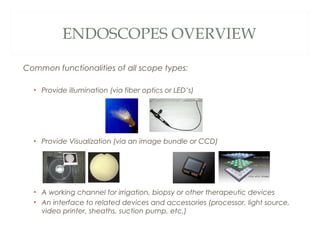
Common functionalities of all scope types:
• Provide illumination (via fiber optics or LED’s)
• Provide Visualization (via an image bundle or CCD)
• A working channel for irrigation, biopsy or other therapeutic devices
• An interface to related devices and accessories (processor, light source,
video printer, sheaths, suction pump, etc.)
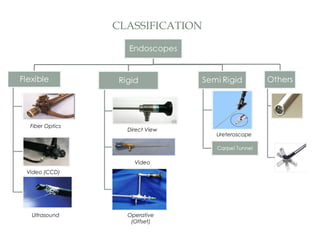
CLASSIFICATION
Fiber Optics
Video (CCD)
Ultrasound
Direct View
Video
Ureteroscope
Operative
(Offset)
COMMON SPECIFICATIONS
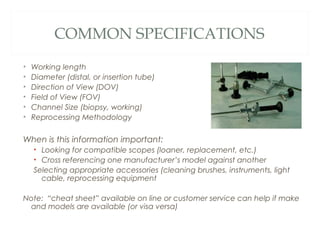
• Working length
• Diameter (distal, or insertion tube)
• Direction of View (DOV)
• Field of View (FOV)
• Channel Size (biopsy, working)
• Reprocessing Methodology
When is this information important:
• Looking for compatible scopes (loaner, replacement, etc.)
• Cross referencing one manufacturer’s model against another
Selecting appropriate accessories (cleaning brushes, instruments, light
cable, reprocessing equipment
Note: “cheat sheet” available on line or customer service can help if make
and models are available (or visa versa)
COMMENTS ON NOMENCLATURES
• Terminologies are not universal and vary by manufacturer or
user
e.g. telescope, lens refer to the same instrument…
• Or too general so that they create confusion
e.g. a cystoscope can be a rigid scope or a flexible scope.
• Or different names for the exact same device:
e.g. A rigid cystoscope and a hysteroscope
e.g. a 4mm 30 deg arthroscope is physically the same as a 4mm 30
deg ENT scope or SinuScope
• Awareness of these issues reduces stress and confusion!
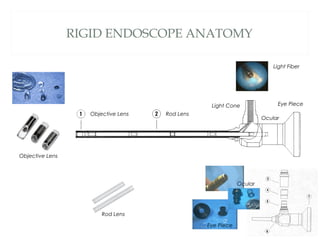
RIGID ENDOSCOPE ANATOMY
Objective Lens
Objective Lens
Light Fiber
Rod Lens
Ocular
Ocular
Eye Piece
Eye Piece
Rod Lens
Light Cone
COMMON FAILURES
POOR IMAGE QUALITY
Partial Image
Scratched lens Foggy Image
Rainbow Image
Debris in view
Out of focus Shadows in view
COMMON FAILURE
ILLUMINATION & MECHANICAL
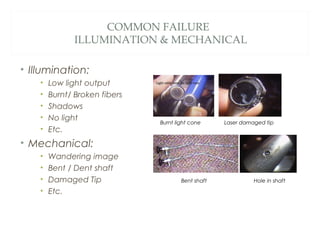
• Illumination:
• Low light output
• Burnt/ Broken fibers
• Shadows
• No light
• Etc.
• Mechanical:
• Wandering image
• Bent / Dent shaft
• Damaged Tip
• Etc.
Burnt light cone Laser damaged tip
Bent shaft Hole in shaft
FAILURE MODES
• Impact, shock or stress – Glass components easily damaged
• Reprocessing (chemical, heat, pressure)
• Accelerates aging and staining of lenses
• Reduces light transmission
• Darkens image overall
• Wear and Tear
• Lens delaminate
• Fiber bundle becomes porous, retains moisture
• Other joints, seals failure causing leakage
• Spacer coating flakes off, casting off debris
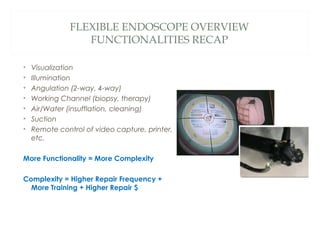
FLEXIBLE ENDOSCOPE OVERVIEW
FUNCTIONALITIES RECAP
• Visualization
• Illumination
• Angulation (2-way, 4-way)
• Working Channel (biopsy, therapy)
• Air/Water (insufflation, cleaning)
• Suction
• Remote control of video capture, printer,
etc.
More Functionality = More Complexity
Complexity = Higher Repair Frequency +
More Training + Higher Repair $
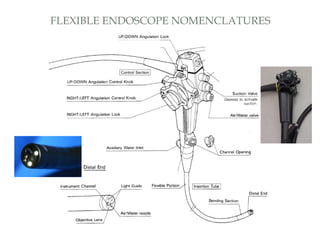
FLEXIBLE ENDOSCOPE NOMENCLATURES
CONTINUED
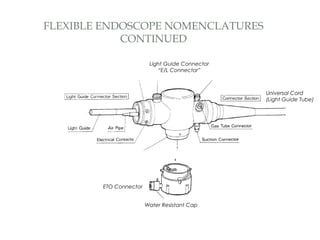
ETO Connector
Water Resistant Cap
Universal Cord
(Light Guide Tube)
Light Guide Connector
“E/L Connector”
WHAT’S INSIDE
COMMON FAILURES
FLUID INVASION
Inside view of punctured
channel
Failed Water(resistant) Cap Internal Corosion
COMMON FAILURES
IMPACT & STRESS
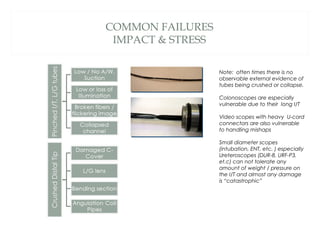
Note: often times there is no
observable external evidence of
tubes being crushed or collapse.
Colonoscopes are especially
vulnerable due to their long I/T
Video scopes with heavy U-cord
connectors are also vulnerable
to handling mishaps
Small diameter scopes
(intubation, ENT, etc. ) especially
Ureteroscopes (DUR-8, URF-P3,
et.c) can not tolerate any
amount of weight / pressure on
the I/T and almost any damage
is “catastrophic”
COMMON FAILURES
ANGULATION SYSTEM & TUBES
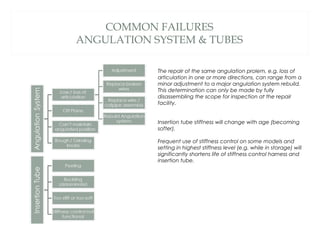
The repair of the same angulation prolem, e.g. loss of
articulation in one or more directions, can range from a
minor adjustment to a major angulation system rebuild.
This determination can only be made by fully
disassembling the scope for inspection at the repair
facility.
Insertion tube stiffness will change with age (becoming
softer).
Frequent use of stiffness control on some models and
setting in highest stiffness level (e.g. while in storage) will
significantly shortens life of stiffness control harness and
insertion tube.
A BRIEF COMPILATION OF BEST PRACTICES
• Leak Test
• Best defense against
catastrophic failure /damage.
• Simple procedure but must be
properly done
• Learn about “false positives” as
well as “false negatives” in leak
testing
• Handling
• Practice handling with colonoscope
• Practice switching hands.
• Observe “coiling radius”
• Minimize number of hand-offs from
bed side to processing and back
• Plugging in and removing E/L
connector to light source
• Protect distal end at all times
Complete
document
available on line
or via email
BEST PRACTICES CONTINUED
• Work Flow
• On alert during vacations & holidays
• Staff turnover (shift change, new personnel, rotation, etc.)
• Case load vs. inventory
• Bench Marking – Data collection & analysis
• What metrics to measure? Cost / procedure, MTBF, cost of
ownership, repair history, failure analysis, etc.
• Pay-as-you-go or service contract? What kind of contract?
• Working with Vendors
• Insist on explanation of repairs and any options available (in
language that you can understand)
• Review history and expenditure and ask for help identifying any
trends or opportunities for reducing expenditures
• Maintain or have vendor maintain complete repair history
• Seek a second opinion for major repairs
RECAP
 Majority of repairs are from accidents
 Training helps in accident avoidance
 Scopes are delicate, sophisticated, expensive devices (electro, opto,
mechanical) operating in very harsh environment of water,
chemical, heat, and sharp tools.
 Surveyed a large swath of endoscope landscape and terminologies
frequently encountered
 Reviewed a number frequently encountered failures, and causes
 Reviewed a number of best practices for managing repair
expenditures
FURTHER READING
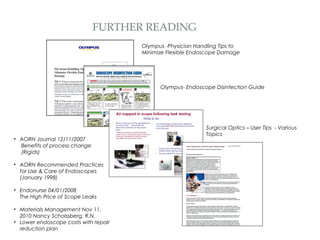
Olympus -Physician Handling Tips to
Minimize Flexible Endoscope Damage
Olympus- Endoscope Disinfection Guide
Surgical Optics – User Tips - Various
Topics
• AORN Journal 12/11/2007
Benefits of process change
(Rigids)
• AORN Recommended Practices
for Use & Care of Endoscopes
(January 1998)
• Endonurse 04/01/2008
The High Price of Scope Leaks
• Materials Management Nov 11,
2010 Nancy Scholssberg, R.N.
• Lower endoscope costs with repair
reduction plan
RESOURCES
• To request electronic copy of this presentation
• To schedule department specific sessions
• To get help with work flow, or repair history review/analysis
• Discuss repair cost reduction plans
Contact: Surgical Optics LLC
www.surgical-optics.com
email: sales@surgical-optics.com
Cell phone: 408-569-9029

Endoscope In-Service

  • 1.
  • 2.
    INTRODUCTION • 70% ofendoscope repairs are caused by accidents • Cost of equipment failure is more than repair or replacement cost • Education / Training • Accident Prevention • Demystifies diagnostics & facilitates informed repair decisions • Managing repair expenditure is a cross-functional effort • This presentation is Chapter I …
  • 3.
    GOALS FOR THISSESSION • Fundamentals of endoscope (functionality, construction, nomenclature, common issues) • Enhance awareness of proper “care and feeding” of these high precision, delicate, expensive devices • Provide a starting point and roadmap for on-going repair cost management
  • 4.
    ENDOSCOPES OVERVIEW Common functionalitiesof all scope types: • Provide illumination (via fiber optics or LED’s) • Provide Visualization (via an image bundle or CCD) • A working channel for irrigation, biopsy or other therapeutic devices • An interface to related devices and accessories (processor, light source, video printer, sheaths, suction pump, etc.)
  • 5.
    CLASSIFICATION Fiber Optics Video (CCD) Ultrasound DirectView Video Ureteroscope Operative (Offset)
  • 6.
    COMMON SPECIFICATIONS • Workinglength • Diameter (distal, or insertion tube) • Direction of View (DOV) • Field of View (FOV) • Channel Size (biopsy, working) • Reprocessing Methodology When is this information important: • Looking for compatible scopes (loaner, replacement, etc.) • Cross referencing one manufacturer’s model against another Selecting appropriate accessories (cleaning brushes, instruments, light cable, reprocessing equipment Note: “cheat sheet” available on line or customer service can help if make and models are available (or visa versa)
  • 7.
    COMMENTS ON NOMENCLATURES •Terminologies are not universal and vary by manufacturer or user e.g. telescope, lens refer to the same instrument… • Or too general so that they create confusion e.g. a cystoscope can be a rigid scope or a flexible scope. • Or different names for the exact same device: e.g. A rigid cystoscope and a hysteroscope e.g. a 4mm 30 deg arthroscope is physically the same as a 4mm 30 deg ENT scope or SinuScope • Awareness of these issues reduces stress and confusion!
  • 8.
    RIGID ENDOSCOPE ANATOMY ObjectiveLens Objective Lens Light Fiber Rod Lens Ocular Ocular Eye Piece Eye Piece Rod Lens Light Cone
  • 9.
    COMMON FAILURES POOR IMAGEQUALITY Partial Image Scratched lens Foggy Image Rainbow Image Debris in view Out of focus Shadows in view
  • 10.
    COMMON FAILURE ILLUMINATION &MECHANICAL • Illumination: • Low light output • Burnt/ Broken fibers • Shadows • No light • Etc. • Mechanical: • Wandering image • Bent / Dent shaft • Damaged Tip • Etc. Burnt light cone Laser damaged tip Bent shaft Hole in shaft
  • 11.
    FAILURE MODES • Impact,shock or stress – Glass components easily damaged • Reprocessing (chemical, heat, pressure) • Accelerates aging and staining of lenses • Reduces light transmission • Darkens image overall • Wear and Tear • Lens delaminate • Fiber bundle becomes porous, retains moisture • Other joints, seals failure causing leakage • Spacer coating flakes off, casting off debris
  • 12.
    FLEXIBLE ENDOSCOPE OVERVIEW FUNCTIONALITIESRECAP • Visualization • Illumination • Angulation (2-way, 4-way) • Working Channel (biopsy, therapy) • Air/Water (insufflation, cleaning) • Suction • Remote control of video capture, printer, etc. More Functionality = More Complexity Complexity = Higher Repair Frequency + More Training + Higher Repair $
  • 13.
  • 14.
    FLEXIBLE ENDOSCOPE NOMENCLATURES CONTINUED ETOConnector Water Resistant Cap Universal Cord (Light Guide Tube) Light Guide Connector “E/L Connector”
  • 15.
  • 16.
    COMMON FAILURES FLUID INVASION Insideview of punctured channel Failed Water(resistant) Cap Internal Corosion
  • 17.
    COMMON FAILURES IMPACT &STRESS Note: often times there is no observable external evidence of tubes being crushed or collapse. Colonoscopes are especially vulnerable due to their long I/T Video scopes with heavy U-cord connectors are also vulnerable to handling mishaps Small diameter scopes (intubation, ENT, etc. ) especially Ureteroscopes (DUR-8, URF-P3, et.c) can not tolerate any amount of weight / pressure on the I/T and almost any damage is “catastrophic”
  • 18.
    COMMON FAILURES ANGULATION SYSTEM& TUBES The repair of the same angulation prolem, e.g. loss of articulation in one or more directions, can range from a minor adjustment to a major angulation system rebuild. This determination can only be made by fully disassembling the scope for inspection at the repair facility. Insertion tube stiffness will change with age (becoming softer). Frequent use of stiffness control on some models and setting in highest stiffness level (e.g. while in storage) will significantly shortens life of stiffness control harness and insertion tube.
  • 19.
    A BRIEF COMPILATIONOF BEST PRACTICES • Leak Test • Best defense against catastrophic failure /damage. • Simple procedure but must be properly done • Learn about “false positives” as well as “false negatives” in leak testing • Handling • Practice handling with colonoscope • Practice switching hands. • Observe “coiling radius” • Minimize number of hand-offs from bed side to processing and back • Plugging in and removing E/L connector to light source • Protect distal end at all times Complete document available on line or via email
  • 20.
    BEST PRACTICES CONTINUED •Work Flow • On alert during vacations & holidays • Staff turnover (shift change, new personnel, rotation, etc.) • Case load vs. inventory • Bench Marking – Data collection & analysis • What metrics to measure? Cost / procedure, MTBF, cost of ownership, repair history, failure analysis, etc. • Pay-as-you-go or service contract? What kind of contract? • Working with Vendors • Insist on explanation of repairs and any options available (in language that you can understand) • Review history and expenditure and ask for help identifying any trends or opportunities for reducing expenditures • Maintain or have vendor maintain complete repair history • Seek a second opinion for major repairs
  • 21.
    RECAP  Majority ofrepairs are from accidents  Training helps in accident avoidance  Scopes are delicate, sophisticated, expensive devices (electro, opto, mechanical) operating in very harsh environment of water, chemical, heat, and sharp tools.  Surveyed a large swath of endoscope landscape and terminologies frequently encountered  Reviewed a number frequently encountered failures, and causes  Reviewed a number of best practices for managing repair expenditures
  • 22.
    FURTHER READING Olympus -PhysicianHandling Tips to Minimize Flexible Endoscope Damage Olympus- Endoscope Disinfection Guide Surgical Optics – User Tips - Various Topics • AORN Journal 12/11/2007 Benefits of process change (Rigids) • AORN Recommended Practices for Use & Care of Endoscopes (January 1998) • Endonurse 04/01/2008 The High Price of Scope Leaks • Materials Management Nov 11, 2010 Nancy Scholssberg, R.N. • Lower endoscope costs with repair reduction plan
  • 23.
    RESOURCES • To requestelectronic copy of this presentation • To schedule department specific sessions • To get help with work flow, or repair history review/analysis • Discuss repair cost reduction plans Contact: Surgical Optics LLC www.surgical-optics.com email: sales@surgical-optics.com Cell phone: 408-569-9029

Editor's Notes

  • #9 Inside stainless steel tubes are mostly very expensive lenses or fiber…. All GLASS! Objective is most expensive component and exposed to both sharp instruments like shaver, laser and other instruments. The objective lens itself is a subassembly of yet smaller parts comprising of minimally a field lens, a negative lens, a prism, a mask and a window. These components are bonded in place with optical adhesive. Rod lens – some can contain up to 18 different rod lenses. Each rod lens again comprises of multiple lenses at each end laminated together with optical adhesive Small lens diameters are 1.1mm for rod lenses, 1mm for objectives.