Complex Surgical
Instruments
ANES 1502
ANESTHESIA TECHNOLOGY FUNDAMENTALS
COLLEGE OF DUPAGE
Objectives:
As a result of successfully completing this chapter, students will be able
to:
 Provide an overview of and discuss procedures to care for and
effectively process powered surgical instruments.
 Explain basic concerns important when handling and processing
endoscopic instruments.
 Discuss detailed information about flexible endoscopes.
 Review general processing and inspection requirements for rigid and
semi-rigid endoscopes and laparoscopic instruments.
 Identify basic protocols important at each step in the loaner
instrumentation process.
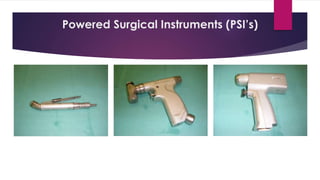
Powered Surgical Instruments (PSI’s)
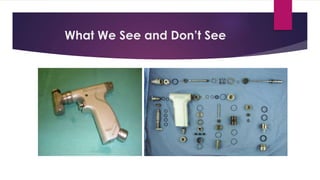
What We See and Don’t See
Powered Surgical Instruments
Look Simple – Are Complex
Look Durable – Are Delicate
Look Plain – Are Expensive
Look Easy to Clean – Are Difficult to Clean
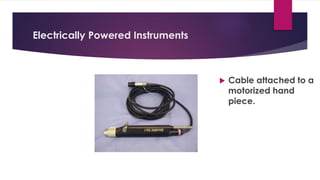
Electrically Powered Instruments
 Cable attached to a
motorized hand
piece.
Electrical Powered Instruments
 Require a cable that can be sterilized. One end attached to the instrument
handpiece and the other to a motor or adapter that is connected to a 110
volt outlet.
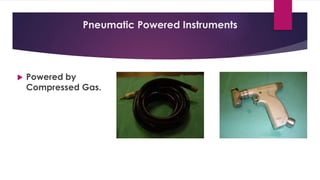
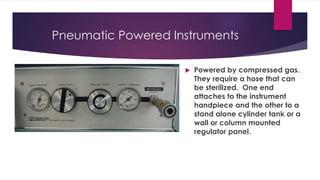
Pneumatic Powered Instruments
 Powered by
Compressed Gas.
Pneumatic Powered Instruments
 Powered by compressed gas.
They require a hose that can
be sterilized. One end
attaches to the instrument
handpiece and the other to a
stand alone cylinder tank or a
wall or column mounted
regulator panel.
Battery Powered Instruments
 Least cumbersome because there is no cord or cable. Requires batteries
and a battery charger.
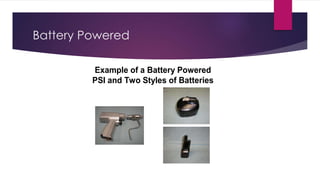
Battery Powered
Example of a Battery Powered
PSI and Two Styles of Batteries
PSI Processing Concerns
 PSIs are complex instruments that are difficult to clean and easy to
damage.
 Central Service Technicians should follow manufacturer’s processing
instructions carefully.
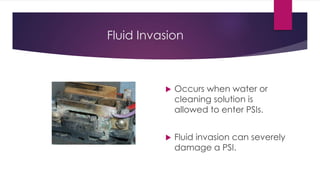
Fluid Invasion
 Occurs when water or
cleaning solution is
allowed to enter PSIs.
 Fluid invasion can severely
damage a PSI.
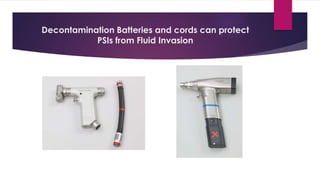
Decontamination Batteries and cords can protect
PSIs from Fluid Invasion
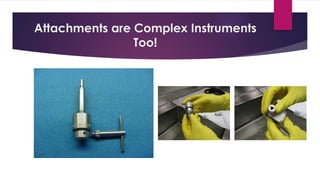
Attachments are Complex Instruments
Too!
PSI Accessories
 Chucks
 Keys
 Burr Guards
 Cords
 Batteries
 …and much, much more!
Common PSIs
 Dermatomes/Dermabraiders – used to harvest skin grafts or reshape
skin surfaces
 Cebatomes – used to remove cement
 Sternal Saws – used to split the sternum for open heart surgery
 Dental Drills – used for teeth and jawbones
 Micro Drills – used for middle ear bones and to drive very small wires
 Wire Drivers, Drills and Saws – come in various sizes and are used to
work on small to large bones.
 Saws - designed to perform specific cutting actions such as
reciprocating or oscillating
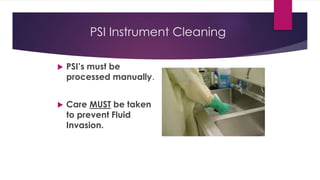
PSI Instrument Cleaning
 PSI’s must be
processed manually.
 Care MUST be taken
to prevent Fluid
Invasion.
Basic PSI Processing Procedure
(You MUST Follow Manufacturer’s Specific Instructions)
 Remove all bits, burrs and blades from the unit, disconnect from the power source.
 Disassemble and remove debris at point of use, keep the instrument moist.
 Separate devices with internal mechanisms from simple devices. Generally, simple components can
be soaked.
 Attach handpiece to a hose of specialized cleaning attachment to reduce the risk of fluid invasion
during cleaning.
 Clean the exterior with an approved germicidal detergent.
 Pay special attention to recessed areas, moving levers, switches, etc.
 Clean recessions and cannulas using a stiff bristle brush.
Basic PSI Processing Procedure
(You MUST Follow Manufacturer’s Specific Instructions)
 Clean, rinse and inspect the hose, cable or battery
pack. Look for signs of damage or excessive wear.
 Lubricate and test as required by the manufacturer.
 Dry all components.
 Package and sterilize as recommended by the
manufacturer.
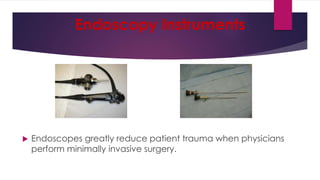
Endoscopy Instruments
 Endoscopes greatly reduce patient trauma when physicians
perform minimally invasive surgery.
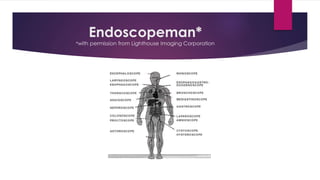
Endoscopeman*
*with permission from Lighthouse Imaging Corporation
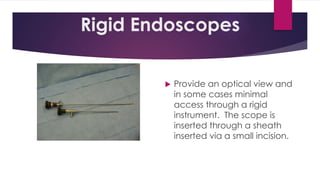
Rigid Endoscopes
 Provide an optical view and
in some cases minimal
access through a rigid
instrument. The scope is
inserted through a sheath
inserted via a small incision.
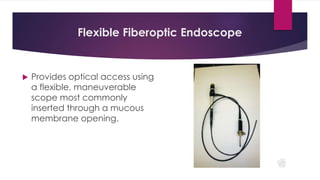
Flexible Fiberoptic Endoscope
 Provides optical access using
a flexible, maneuverable
scope most commonly
inserted through a mucous
membrane opening.
Regulations and Guidelines
 Several regulatory agencies and professional associations provide input
into proper scope handling and processing practices.
 For a list, please refer to pages 207-209 in the text.
Infection Control Concerns
 Flexible endoscopes pose significant infection control challenges. Their
configuration makes them difficult to clean and dry and they can harbor
bacteria.
Infection Control Issues
 Inadequate training of employees who clean and handle scopes.
 Adequate time for thorough processing.
 Commitment of employees (and policy writers) to safely reprocess
scopes.
 Failure to adequate inspect scopes prior to processing.
 Failure to follow manufacturer’s instructions for reprocessing.
Infection Control Issues
 Failure to follow label direction on processing chemicals.
 Using the scope without a leak test.
 Poor manual cleaning habits.
 Failure to use automatic endoscope reprocessors in accordance with
manufacturer’s instructions.
 Improper drying and storing procedures.
Additional Concerns:
 Failure to leak test correctly.
 Failure to manually clean all channels.
 Failure to flush all channels with disinfectant solution.
 Failure to fully immerse.
 Failure to adequately time the length of disinfectant contact.
 Use of disinfectant solutions after their expiration date.
Additional Concerns:
 Failure to process all scopes in the same manner (Standard Precautions).
 Failure to sterilize biopsy forceps.
 Inaccessible manufacturer’s instructions.
 Variations in staff training.
 Improper reprocessing of reusable cleaning supplies.
 Inadequately trained personnel.
Additional Concerns:
 Lack of competence reviews for scope processing and procedures.
 Improper storage and transport.
 Pressure from physicians to process scopes more quickly so they can
perform more procedures on more patients.
 Difficulties processing these complex instruments.
 Space constraints.
Additional Concerns:
 Absence of, or an inadequate quality control program.
 Poor water quality.
 Facility processing equipment.
 In order for endoscope processing to be successful,
each of these concerns must be addressed.
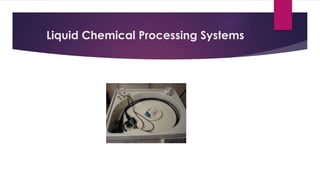
Liquid Chemical Processing Systems
Glutaraldehyde
 High Level Disinfectant
 Can be used manually or in automatic processors.
 Must be tested.
 Takes Time.
 Employee Safety Concerns (ventilation a must!)
Ortho-Phthaladehyde (OPA)
 High Level Disinfectant
 May be used manually or in an automatic processor.
 Must be tested.
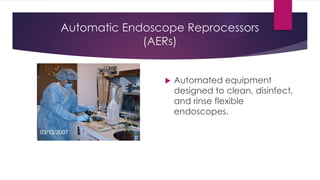
Automatic Endoscope Reprocessors
(AERs)
 Automated equipment
designed to clean, disinfect,
and rinse flexible
endoscopes.
Advantages of AERs
 Process consistency
 Reduced staff exposure to chemicals
 Timed cleaning
 Consistent exposure to the cleaning
agent
 Timed contact with liquid
disinfectants
 An air flush cycle to remove excess
moisture
 Use of copious and consistent
amounts of rinse water
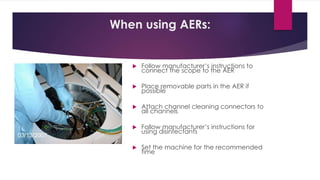
When using AERs:
 Follow manufacturer’s instructions to
connect the scope to the AER
 Place removable parts in the AER if
possible
 Attach channel cleaning connectors to
all channels
 Follow manufacturer’s instructions for
using disinfectants
 Set the machine for the recommended
time
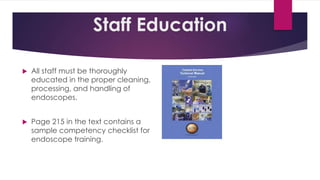
Staff Education
 All staff must be thoroughly
educated in the proper cleaning,
processing, and handling of
endoscopes.
 Page 215 in the text contains a
sample competency checklist for
endoscope training.
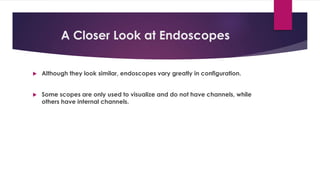
A Closer Look at Endoscopes
 Although they look similar, endoscopes vary greatly in configuration.
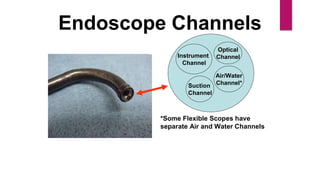
 Some scopes are only used to visualize and do not have channels, while
others have internal channels.
Endoscope Channels
Instrument
Channel
Optical
Channel
Air/Water
Channel*Suction
Channel
*Some Flexible Scopes have
separate Air and Water Channels
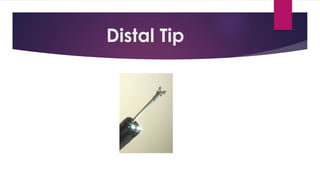
Distal Tip
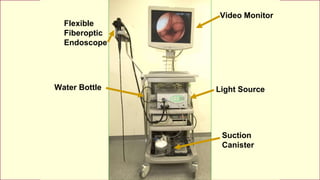
Flexible
Fiberoptic
Endoscope
Video Monitor
Water Bottle Light Source
Suction
Canister
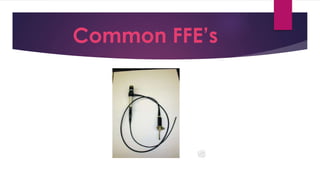
Common FFE’s
Bronchoscope
 Used for the direct visualization of the tracheobronchial tree.
Cystoscope
Ureteroscope
 Used to visualize the urethra and bladder (cystoscope)
and to look for obstructions such as kidney stones
(ureteroscope).
Gastroscope Esophagoscope
 Used for the visual inspection of the upper GI tract
(gastroscope) and for the direct visualization of the
esophagus and the cardia of the stomach
(esophagoscope).
Colonoscope Sigmoidoscope
 Used for the visual inspection of the entire large intestine
(colonoscope) and the visual inspection of the lower
part of the large intestine (sigmoidoscope).
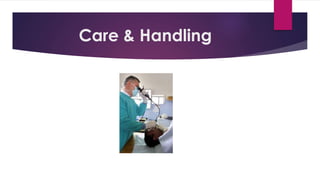
Care & Handling
Steps in Endoscope Processing
1. Preclean
2. Leak Test
3. Clean
4. High-Level Disinfect or Sterilize
5. Dry
6. Store
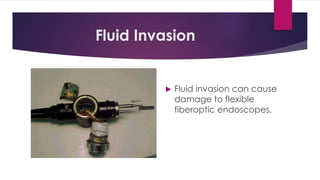
Fluid Invasion
 Fluid invasion can cause
damage to flexible
fiberoptic endoscopes.
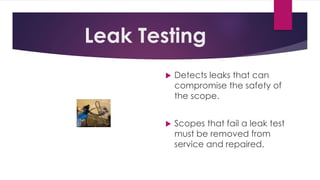
Leak Testing
 Detects leaks that can
compromise the safety of
the scope.
 Scopes that fail a leak test
must be removed from
service and repaired.
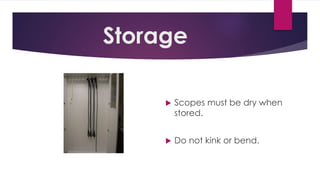
Storage
 Scopes must be dry when
stored.
 Do not kink or bend.
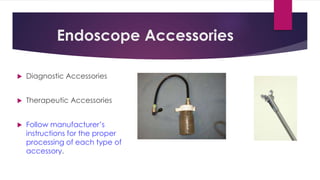
Endoscope Accessories
 Diagnostic Accessories
 Therapeutic Accessories
 Follow manufacturer’s
instructions for the proper
processing of each type of
accessory.
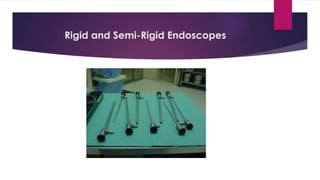
Rigid and Semi-Rigid Endoscopes
An Important Note:
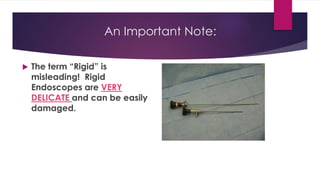
 The term “Rigid” is
misleading! Rigid
Endoscopes are VERY
DELICATE and can be easily
damaged.
Rigid Endoscope Guidelines
 Always follow manufacturers’ recommendations.
 Never soak instruments for cleaning or high level disinfection in a metal
soak pan.
 Instruments may need to be soaked in a vertical position.
 Utilize flush ports when available to circulate (under pressure) enzymatic
detergent through the channels.
 Lenses must never be placed in an ultrasonic cleaner.
Rigid Scope Guidelines - continued
 Gently brush clean the exterior and accessible lumens with the
appropriate brush.
 Thoroughly rinse with distilled water and rough dry.
 Inspect instruments for cleanliness, missing parts, and damage.
 Thoroughly air-dry instruments.
 Remember that these instruments are fragile and must be handled
carefully.
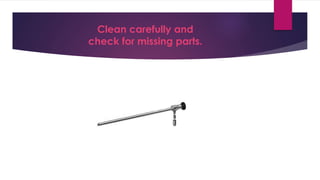
Clean carefully and
check for missing parts.
Inspection
 Check surfaces of the telescope for visible damage
 Inspect for clarity using white paper with writing on it
 Check the eyepiece seal for visible damage
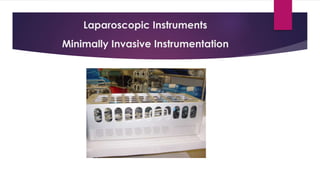
Laparoscopic Instruments
Minimally Invasive Instrumentation
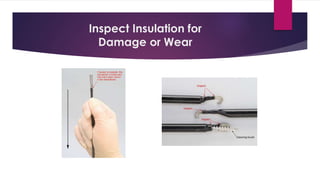
Inspect Insulation for
Damage or Wear
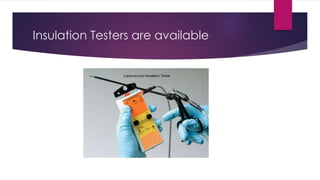
Insulation Testers are available
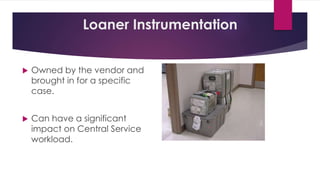
Loaner Instrumentation
 Owned by the vendor and
brought in for a specific
case.
 Can have a significant
impact on Central Service
workload.
Loaner Instrument Processes
 Log Receipt of Loaner Instruments and Implants. Include the
following information:
 Date
 Time
 Signature of delivery person
 Initials of receiving person
 Doctor’s name
 Patient’s last name
 Number of trays
 Inventory check of tray(s) for completeness
 Inventory check of tray(s) for damaged items.
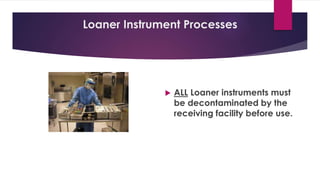
Loaner Instrument Processes
 ALL Loaner instruments must
be decontaminated by the
receiving facility before use.
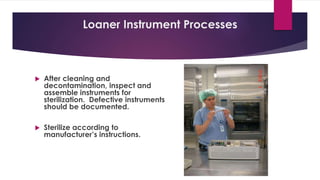
Loaner Instrument Processes
 After cleaning and
decontamination, inspect and
assemble instruments for
sterilization. Defective instruments
should be documented.
 Sterilize according to
manufacturer’s instructions.
Loaner Instrument Processes
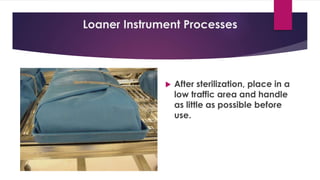
 After sterilization, place in a
low traffic area and handle
as little as possible before
use.
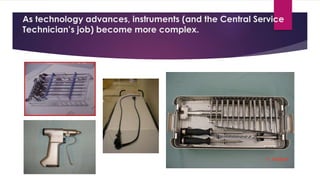
As technology advances, instruments (and the Central Service
Technician’s job) become more complex.

ANES 1502 - M13 PPT: Complex Surgical Instruments

  • 1.
    Complex Surgical Instruments ANES 1502 ANESTHESIATECHNOLOGY FUNDAMENTALS COLLEGE OF DUPAGE
  • 2.
    Objectives: As a resultof successfully completing this chapter, students will be able to:  Provide an overview of and discuss procedures to care for and effectively process powered surgical instruments.  Explain basic concerns important when handling and processing endoscopic instruments.  Discuss detailed information about flexible endoscopes.  Review general processing and inspection requirements for rigid and semi-rigid endoscopes and laparoscopic instruments.  Identify basic protocols important at each step in the loaner instrumentation process.
  • 3.
  • 4.
    What We Seeand Don’t See
  • 5.
    Powered Surgical Instruments LookSimple – Are Complex Look Durable – Are Delicate Look Plain – Are Expensive Look Easy to Clean – Are Difficult to Clean
  • 6.
    Electrically Powered Instruments Cable attached to a motorized hand piece.
  • 7.
    Electrical Powered Instruments Require a cable that can be sterilized. One end attached to the instrument handpiece and the other to a motor or adapter that is connected to a 110 volt outlet.
  • 8.
    Pneumatic Powered Instruments Powered by Compressed Gas.
  • 9.
    Pneumatic Powered Instruments Powered by compressed gas. They require a hose that can be sterilized. One end attaches to the instrument handpiece and the other to a stand alone cylinder tank or a wall or column mounted regulator panel.
  • 10.
    Battery Powered Instruments Least cumbersome because there is no cord or cable. Requires batteries and a battery charger.
  • 11.
    Battery Powered Example ofa Battery Powered PSI and Two Styles of Batteries
  • 12.
    PSI Processing Concerns PSIs are complex instruments that are difficult to clean and easy to damage.  Central Service Technicians should follow manufacturer’s processing instructions carefully.
  • 13.
    Fluid Invasion  Occurswhen water or cleaning solution is allowed to enter PSIs.  Fluid invasion can severely damage a PSI.
  • 14.
    Decontamination Batteries andcords can protect PSIs from Fluid Invasion
  • 15.
    Attachments are ComplexInstruments Too!
  • 16.
    PSI Accessories  Chucks Keys  Burr Guards  Cords  Batteries  …and much, much more!
  • 17.
    Common PSIs  Dermatomes/Dermabraiders– used to harvest skin grafts or reshape skin surfaces  Cebatomes – used to remove cement  Sternal Saws – used to split the sternum for open heart surgery  Dental Drills – used for teeth and jawbones  Micro Drills – used for middle ear bones and to drive very small wires  Wire Drivers, Drills and Saws – come in various sizes and are used to work on small to large bones.  Saws - designed to perform specific cutting actions such as reciprocating or oscillating
  • 18.
    PSI Instrument Cleaning PSI’s must be processed manually.  Care MUST be taken to prevent Fluid Invasion.
  • 19.
    Basic PSI ProcessingProcedure (You MUST Follow Manufacturer’s Specific Instructions)  Remove all bits, burrs and blades from the unit, disconnect from the power source.  Disassemble and remove debris at point of use, keep the instrument moist.  Separate devices with internal mechanisms from simple devices. Generally, simple components can be soaked.  Attach handpiece to a hose of specialized cleaning attachment to reduce the risk of fluid invasion during cleaning.  Clean the exterior with an approved germicidal detergent.  Pay special attention to recessed areas, moving levers, switches, etc.  Clean recessions and cannulas using a stiff bristle brush.
  • 20.
    Basic PSI ProcessingProcedure (You MUST Follow Manufacturer’s Specific Instructions)  Clean, rinse and inspect the hose, cable or battery pack. Look for signs of damage or excessive wear.  Lubricate and test as required by the manufacturer.  Dry all components.  Package and sterilize as recommended by the manufacturer.
  • 21.
    Endoscopy Instruments  Endoscopesgreatly reduce patient trauma when physicians perform minimally invasive surgery.
  • 22.
    Endoscopeman* *with permission fromLighthouse Imaging Corporation
  • 23.
    Rigid Endoscopes  Providean optical view and in some cases minimal access through a rigid instrument. The scope is inserted through a sheath inserted via a small incision.
  • 24.
    Flexible Fiberoptic Endoscope Provides optical access using a flexible, maneuverable scope most commonly inserted through a mucous membrane opening.
  • 25.
    Regulations and Guidelines Several regulatory agencies and professional associations provide input into proper scope handling and processing practices.  For a list, please refer to pages 207-209 in the text.
  • 26.
    Infection Control Concerns Flexible endoscopes pose significant infection control challenges. Their configuration makes them difficult to clean and dry and they can harbor bacteria.

  • 27.
    Infection Control Issues Inadequate training of employees who clean and handle scopes.  Adequate time for thorough processing.  Commitment of employees (and policy writers) to safely reprocess scopes.  Failure to adequate inspect scopes prior to processing.  Failure to follow manufacturer’s instructions for reprocessing.
  • 28.
    Infection Control Issues Failure to follow label direction on processing chemicals.  Using the scope without a leak test.  Poor manual cleaning habits.  Failure to use automatic endoscope reprocessors in accordance with manufacturer’s instructions.  Improper drying and storing procedures.
  • 29.
    Additional Concerns:  Failureto leak test correctly.  Failure to manually clean all channels.  Failure to flush all channels with disinfectant solution.  Failure to fully immerse.  Failure to adequately time the length of disinfectant contact.  Use of disinfectant solutions after their expiration date.
  • 30.
    Additional Concerns:  Failureto process all scopes in the same manner (Standard Precautions).  Failure to sterilize biopsy forceps.  Inaccessible manufacturer’s instructions.  Variations in staff training.  Improper reprocessing of reusable cleaning supplies.  Inadequately trained personnel.
  • 31.
    Additional Concerns:  Lackof competence reviews for scope processing and procedures.  Improper storage and transport.  Pressure from physicians to process scopes more quickly so they can perform more procedures on more patients.  Difficulties processing these complex instruments.  Space constraints.
  • 32.
    Additional Concerns:  Absenceof, or an inadequate quality control program.  Poor water quality.  Facility processing equipment.  In order for endoscope processing to be successful, each of these concerns must be addressed.
  • 33.
  • 34.
    Glutaraldehyde  High LevelDisinfectant  Can be used manually or in automatic processors.  Must be tested.  Takes Time.  Employee Safety Concerns (ventilation a must!)
  • 35.
    Ortho-Phthaladehyde (OPA)  HighLevel Disinfectant  May be used manually or in an automatic processor.  Must be tested.
  • 36.
    Automatic Endoscope Reprocessors (AERs) Automated equipment designed to clean, disinfect, and rinse flexible endoscopes.
  • 37.
    Advantages of AERs Process consistency  Reduced staff exposure to chemicals  Timed cleaning  Consistent exposure to the cleaning agent  Timed contact with liquid disinfectants  An air flush cycle to remove excess moisture  Use of copious and consistent amounts of rinse water
  • 38.
    When using AERs: Follow manufacturer’s instructions to connect the scope to the AER  Place removable parts in the AER if possible  Attach channel cleaning connectors to all channels  Follow manufacturer’s instructions for using disinfectants  Set the machine for the recommended time
  • 39.
    Staff Education  Allstaff must be thoroughly educated in the proper cleaning, processing, and handling of endoscopes.  Page 215 in the text contains a sample competency checklist for endoscope training.
  • 40.
    A Closer Lookat Endoscopes  Although they look similar, endoscopes vary greatly in configuration.  Some scopes are only used to visualize and do not have channels, while others have internal channels.
  • 41.
  • 42.
  • 43.
  • 44.
  • 45.
    Bronchoscope  Used forthe direct visualization of the tracheobronchial tree.
  • 46.
    Cystoscope Ureteroscope  Used tovisualize the urethra and bladder (cystoscope) and to look for obstructions such as kidney stones (ureteroscope).
  • 47.
    Gastroscope Esophagoscope  Usedfor the visual inspection of the upper GI tract (gastroscope) and for the direct visualization of the esophagus and the cardia of the stomach (esophagoscope).
  • 48.
    Colonoscope Sigmoidoscope  Usedfor the visual inspection of the entire large intestine (colonoscope) and the visual inspection of the lower part of the large intestine (sigmoidoscope).
  • 49.
  • 50.
    Steps in EndoscopeProcessing 1. Preclean 2. Leak Test 3. Clean 4. High-Level Disinfect or Sterilize 5. Dry 6. Store
  • 51.
    Fluid Invasion  Fluidinvasion can cause damage to flexible fiberoptic endoscopes.
  • 52.
    Leak Testing  Detectsleaks that can compromise the safety of the scope.  Scopes that fail a leak test must be removed from service and repaired.
  • 53.
    Storage  Scopes mustbe dry when stored.  Do not kink or bend.
  • 54.
    Endoscope Accessories  DiagnosticAccessories  Therapeutic Accessories  Follow manufacturer’s instructions for the proper processing of each type of accessory.
  • 55.
  • 56.
    An Important Note: The term “Rigid” is misleading! Rigid Endoscopes are VERY DELICATE and can be easily damaged.
  • 57.
    Rigid Endoscope Guidelines Always follow manufacturers’ recommendations.  Never soak instruments for cleaning or high level disinfection in a metal soak pan.  Instruments may need to be soaked in a vertical position.  Utilize flush ports when available to circulate (under pressure) enzymatic detergent through the channels.  Lenses must never be placed in an ultrasonic cleaner.
  • 58.
    Rigid Scope Guidelines- continued  Gently brush clean the exterior and accessible lumens with the appropriate brush.  Thoroughly rinse with distilled water and rough dry.  Inspect instruments for cleanliness, missing parts, and damage.  Thoroughly air-dry instruments.  Remember that these instruments are fragile and must be handled carefully.
  • 59.
    Clean carefully and checkfor missing parts.
  • 60.
    Inspection  Check surfacesof the telescope for visible damage  Inspect for clarity using white paper with writing on it  Check the eyepiece seal for visible damage
  • 61.
  • 62.
  • 63.
  • 64.
    Loaner Instrumentation  Ownedby the vendor and brought in for a specific case.  Can have a significant impact on Central Service workload.
  • 65.
    Loaner Instrument Processes Log Receipt of Loaner Instruments and Implants. Include the following information:  Date  Time  Signature of delivery person  Initials of receiving person  Doctor’s name  Patient’s last name  Number of trays  Inventory check of tray(s) for completeness  Inventory check of tray(s) for damaged items.
  • 66.
    Loaner Instrument Processes ALL Loaner instruments must be decontaminated by the receiving facility before use.
  • 67.
    Loaner Instrument Processes After cleaning and decontamination, inspect and assemble instruments for sterilization. Defective instruments should be documented.  Sterilize according to manufacturer’s instructions.
  • 68.
    Loaner Instrument Processes After sterilization, place in a low traffic area and handle as little as possible before use.
  • 69.
    As technology advances,instruments (and the Central Service Technician’s job) become more complex.