LAPAROSCOPY
Samha Ahmed Ibrahim Didi
Fathimath Aleefa
DN – 37th Batch
Objectives
At the end of this presentation you should be able to
understand and explain: -
• What laparoscopy is
• A brief history of laparoscopy
• How laparoscopy is done
• Who needs surgery and what laparoscopic surgery will be
done
• Benefits of laparoscopy
• Perioperative nursing care for laparoscopy
LAPAROSCOPY
Laparoscopy is also known as: -
“KEYHOLE SURGERY”
MINIMALLY INVASIVE SURGERY
MINIMALACCESS SURGERY
LAPAROSCOPY
• Word origin: Greek
• Lapara - "the soft parts of the body between the rib
margins and hips
• Skopein, which means "to see or view or examine."
• Laparoscope - endoscope inserted through an
incision in the abdominal wall in order to examine the
abdominal organs or to perform minor surgery
WHAT IS LAPAROSCOPY?
• Laparoscopic surgery (minimally invasive surgery) is the
performance of surgical procedures with the assistance of a
video camera and several thin instruments.
HISTORY
• 11th century - Abulkasim, Arab physician, used a speculum
illuminated by a set of light reflectors and candles - limited
applications because the heat produced by candles and other
artificial lights resulted in burns.
• 1901- George Kelling did the first laparoscopy on a dog
• 1911- The first laparoscopy in a human was done by a
Swedish physician H. C. Jacobeus.
Hans Christian Jacobaeus
HOW IT IS DONE?
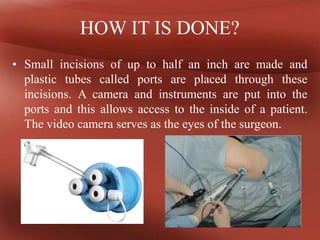
• Small incisions of up to half an inch are made and
plastic tubes called ports are placed through these
incisions. A camera and instruments are put into the
ports and this allows access to the inside of a patient.
The video camera serves as the eyes of the surgeon.
WHO & WHAT?
DIAGNOSIS SURGERY
Diverticulitis Bowel resection
Gastric Obstruction Bypass
Splenic disorders Splenectomy
Gallstone Cholecystectomy
Appendicitis Appendectomy
Hernia Hernia Repair
Perforated Ulcer Closure of Perforation
BENEFITS OF LAPAROSCOPY
• Shortens hospital stay - Quick recovery times
• Less post operative discomfort - smaller incisions = less
pain.
• Smaller scars
• Less internal scarring - Less Handling of intestines
results in little or no disturbance of normal function.
• Quicker return to activities of daily living - Avoidance
of the trauma of abdominal wall injury by the incision.
Perioperative Nursing Care
Preoperative Phase
• Nursing History
• Medical History
• Previous surgeries
• Medication History
• Physical assessment
• Clinical manifestations
• Laboratory & Diagnostic Studies
Perioperative Nursing Care
Preoperative Phase
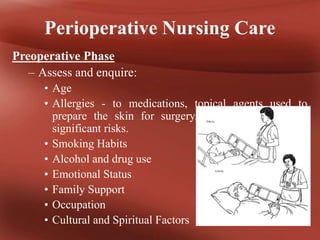
– Assess and enquire:
• Age
• Allergies - to medications, topical agents used to
prepare the skin for surgery, and latex can create
significant risks.
• Smoking Habits
• Alcohol and drug use
• Emotional Status
• Family Support
• Occupation
• Cultural and Spiritual Factors
Perioperative Nursing Care
Preoperative Nursing Diagnosis & Interventions
• Knowledge deficit – Health education
• Anxiety – Reassurance & family involvement in patient care.
• Risk for ineffective airway clearance – Maintain a patent
airway and monitor for complications
• Risk for ineffective peripheral tissue perfusion – Check
capillary refill, note skin colour and check temperature.
Perioperative Nursing Care
Final Preparation for surgery
• All personal belongings are identified and secured.
• Jewelry is removed & handed over to relatives.
• Dentures are removed, labeled and placed in a denture cup.
• Give preop medications as per physicians orders
Perioperative Nursing Care
Postoperative Phase
• Maintain a patent airway
• Stabilize vital signs - Presence of artificial airway, O2
saturation, BP , pulse, temperature.
• Provide pain relief
• Recognize & manage complications
Perioperative Nursing Care
Postoperative Phase
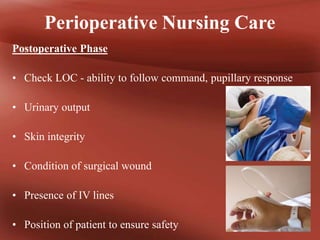
• Check LOC - ability to follow command, pupillary response
• Urinary output
• Skin integrity
• Condition of surgical wound
• Presence of IV lines
• Position of patient to ensure safety
Perioperative Nursing Care
Postoperative Nursing Diagnosis & Interventions
• Ineffective airway clearance because of increased secretions
due to anesthesia, ineffective cough, pain - maintain
adequate, patent airway
• Acute pain – Relieve pain
• Urinary retention – Catheterization
• Risk for infection – Maintain aseptic techniques during wound
dressing.
Appendectomy
Cholecystectomy
Inguinal Hernia Repair
SUMMARY
• Laparoscopy is the performance of surgical procedures using a
video camera and several thin instruments.
• To perform laparoscopy, small incisions are made and ports are
placed through these incisions through which camera and
instruments allow access to the inside of a patient.
• Laparoscopy is used for surgeries of the abdominopelvic
cavity. (appendectomy, cholecystectomy etc.)
• Laparoscopy causes less pain, less discomfort, decreases
recovery time and less scarring on the inside and out than an
open surgery.
• Perioperative nursing care for laparoscopy includes history,
assessment, relieving anxiety, preparation for surgery, pain
relief, aseptic techniques etc.

Laparoscopy

  • 1.
    LAPAROSCOPY Samha Ahmed IbrahimDidi Fathimath Aleefa DN – 37th Batch
  • 2.
    Objectives At the endof this presentation you should be able to understand and explain: - • What laparoscopy is • A brief history of laparoscopy • How laparoscopy is done • Who needs surgery and what laparoscopic surgery will be done • Benefits of laparoscopy • Perioperative nursing care for laparoscopy
  • 3.
    LAPAROSCOPY Laparoscopy is alsoknown as: - “KEYHOLE SURGERY” MINIMALLY INVASIVE SURGERY MINIMALACCESS SURGERY
  • 4.
    LAPAROSCOPY • Word origin:Greek • Lapara - "the soft parts of the body between the rib margins and hips • Skopein, which means "to see or view or examine." • Laparoscope - endoscope inserted through an incision in the abdominal wall in order to examine the abdominal organs or to perform minor surgery
  • 5.
    WHAT IS LAPAROSCOPY? •Laparoscopic surgery (minimally invasive surgery) is the performance of surgical procedures with the assistance of a video camera and several thin instruments.
  • 6.
    HISTORY • 11th century- Abulkasim, Arab physician, used a speculum illuminated by a set of light reflectors and candles - limited applications because the heat produced by candles and other artificial lights resulted in burns. • 1901- George Kelling did the first laparoscopy on a dog • 1911- The first laparoscopy in a human was done by a Swedish physician H. C. Jacobeus. Hans Christian Jacobaeus
  • 7.
    HOW IT ISDONE? • Small incisions of up to half an inch are made and plastic tubes called ports are placed through these incisions. A camera and instruments are put into the ports and this allows access to the inside of a patient. The video camera serves as the eyes of the surgeon.
  • 8.
    WHO & WHAT? DIAGNOSISSURGERY Diverticulitis Bowel resection Gastric Obstruction Bypass Splenic disorders Splenectomy Gallstone Cholecystectomy Appendicitis Appendectomy Hernia Hernia Repair Perforated Ulcer Closure of Perforation
  • 9.
    BENEFITS OF LAPAROSCOPY •Shortens hospital stay - Quick recovery times • Less post operative discomfort - smaller incisions = less pain. • Smaller scars • Less internal scarring - Less Handling of intestines results in little or no disturbance of normal function. • Quicker return to activities of daily living - Avoidance of the trauma of abdominal wall injury by the incision.
  • 10.
    Perioperative Nursing Care PreoperativePhase • Nursing History • Medical History • Previous surgeries • Medication History • Physical assessment • Clinical manifestations • Laboratory & Diagnostic Studies
  • 11.
    Perioperative Nursing Care PreoperativePhase – Assess and enquire: • Age • Allergies - to medications, topical agents used to prepare the skin for surgery, and latex can create significant risks. • Smoking Habits • Alcohol and drug use • Emotional Status • Family Support • Occupation • Cultural and Spiritual Factors
  • 12.
    Perioperative Nursing Care PreoperativeNursing Diagnosis & Interventions • Knowledge deficit – Health education • Anxiety – Reassurance & family involvement in patient care. • Risk for ineffective airway clearance – Maintain a patent airway and monitor for complications • Risk for ineffective peripheral tissue perfusion – Check capillary refill, note skin colour and check temperature.
  • 13.
    Perioperative Nursing Care FinalPreparation for surgery • All personal belongings are identified and secured. • Jewelry is removed & handed over to relatives. • Dentures are removed, labeled and placed in a denture cup. • Give preop medications as per physicians orders
  • 14.
    Perioperative Nursing Care PostoperativePhase • Maintain a patent airway • Stabilize vital signs - Presence of artificial airway, O2 saturation, BP , pulse, temperature. • Provide pain relief • Recognize & manage complications
  • 15.
    Perioperative Nursing Care PostoperativePhase • Check LOC - ability to follow command, pupillary response • Urinary output • Skin integrity • Condition of surgical wound • Presence of IV lines • Position of patient to ensure safety
  • 16.
    Perioperative Nursing Care PostoperativeNursing Diagnosis & Interventions • Ineffective airway clearance because of increased secretions due to anesthesia, ineffective cough, pain - maintain adequate, patent airway • Acute pain – Relieve pain • Urinary retention – Catheterization • Risk for infection – Maintain aseptic techniques during wound dressing.
  • 17.
  • 18.
  • 19.
  • 20.
    SUMMARY • Laparoscopy isthe performance of surgical procedures using a video camera and several thin instruments. • To perform laparoscopy, small incisions are made and ports are placed through these incisions through which camera and instruments allow access to the inside of a patient. • Laparoscopy is used for surgeries of the abdominopelvic cavity. (appendectomy, cholecystectomy etc.) • Laparoscopy causes less pain, less discomfort, decreases recovery time and less scarring on the inside and out than an open surgery. • Perioperative nursing care for laparoscopy includes history, assessment, relieving anxiety, preparation for surgery, pain relief, aseptic techniques etc.