INTRODUCTION TO
ENDOCRINE SYSTEM
The endocrine system is a network of glands
that produce and release hormones to regulate
various bodily functions, including metabolism,
growth, reproduction, and mood.
Introduction to endocrine
system
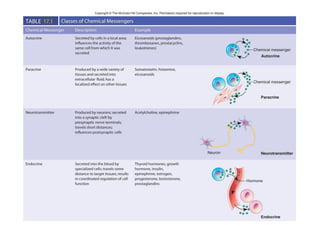
Classes of Chemical Messengers
1. Autocrine chemical messengers: released by cells and have
a
local effect on the same cell type from which chemical signals
released; e.g., prostaglandin
2. Paracrine chemical messengers: released by cells and affect
other cell types locally without being transported in blood;
e.g., somatostatin
3. Neurotransmitter: produced by neurons and secreted
into
extracellular spaces by presynaptic nerve terminals; travels
short distances; influences postsynaptic cells; e.g.,
acetylcholine.
4. Endocrine chemical messengers: type of intercellular
signal.
Produced by cells of endocrine glands, enter circulatory system,
and affect distant cells; e.g., estrogen
Principal functions of the endocrine
system
• Maintenance of the internal environment in the
body (maintaining the optimum biochemical
environment).
• Integration and regulation of growth
and development.
• Control, maintenance and instigation of
sexual reproduction, including
gametogenesis, coitus, fertilization, fetal
growth and development and nourishment of
the newborn.
Endocrine System
Helps to maintain homeostasis by
Integration & control.
Secretion of chemical signals called
hormones that travel through the
bloodstream to act on target cells.
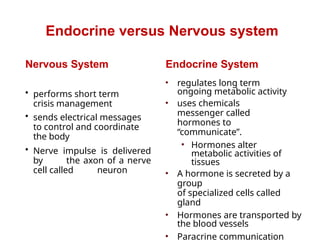
Nervous System Endocrine System
• regulates long term
ongoing metabolic activity
• uses chemicals
messenger called
hormones to
“communicate”.
• Hormones alter
metabolic activities of
tissues
• A hormone is secreted by a
group
of specialized cells called
gland
• Hormones are transported by
the blood vessels
• Paracrine communication
Endocrine versus Nervous system
• performs short term
crisis management
• sends electrical messages
to control and coordinate
the body
• Nerve impulse is delivered
by the axon of a nerve
cell called neuron
Endocrine system
• Includes all cells and endocrine tissues that produce
hormones or
paracrine factors
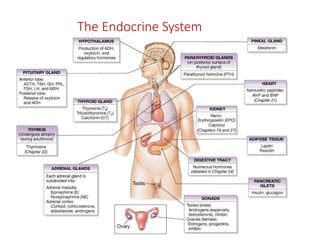
• Following are important endocrine glands
• Hypothalamus
• Pituitary gland
• Pineal Gland
• Thyroid gland
• Parathyroid gland
• Thymus
• Adrenal Gland
• Gonads (testes/ovaries)
• Pancreatic Islet
• Heart
• Kidney
• Digestive Tract
The Endocrine System
Hormone structure
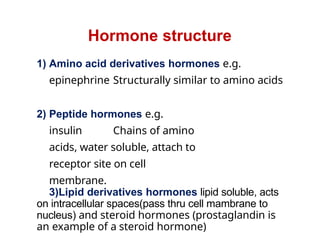
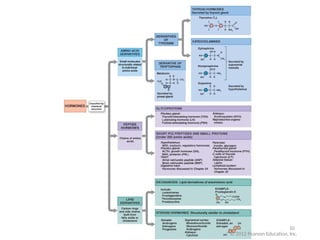
1) Amino acid derivatives hormones e.g.
epinephrine Structurally similar to amino acids
2) Peptide hormones e.g.
insulin Chains of amino
acids, water soluble, attach to
receptor site on cell
membrane.
3)Lipid derivatives hormones lipid soluble, acts
on intracellular spaces(pass thru cell mambrane to
nucleus) and steroid hormones (prostaglandin is
an example of a steroid hormone)
10
© 2012 Pearson Education, Inc.
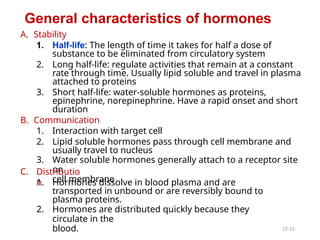
A. Stability
1. Half-life: The length of time it takes for half a dose of
substance to be eliminated from circulatory system
2. Long half-life: regulate activities that remain at a constant
rate through time. Usually lipid soluble and travel in plasma
attached to proteins
3. Short half-life: water-soluble hormones as proteins,
epinephrine, norepinephrine. Have a rapid onset and short
duration
B. Communication
1. Interaction with target cell
2. Lipid soluble hormones pass through cell membrane and
usually travel to nucleus
3. Water soluble hormones generally attach to a receptor site
on
cell membrane
C. Distributio
n
1. Hormones dissolve in blood plasma and are
transported in unbound or are reversibly bound to
plasma proteins.
2. Hormones are distributed quickly because they
circulate in the
blood.
General characteristics of hormones
17-11
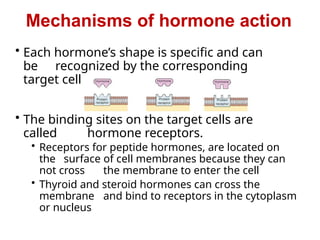
• Each hormone’s shape is specific and can
be recognized by the corresponding
target cells
• The binding sites on the target cells are
called hormone receptors.
• Receptors for peptide hormones, are located on
the surface of cell membranes because they can
not cross the membrane to enter the cell
• Thyroid and steroid hormones can cross the
membrane and bind to receptors in the cytoplasm
or nucleus
Mechanisms of hormone action
G Proteins and Hormone Activity
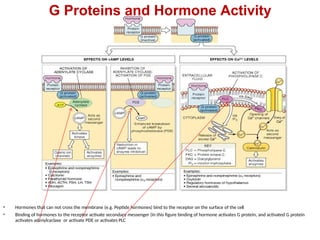
• Hormones that can not cross the membrane (e.g. Peptide hormones) bind to the receptor on the surface of the cell
• Binding of hormones to the receptor activate secondary messenger (in this figure binding of hormone activates G protein, and activated G protein
activates adenylcyclase or activate PDE or activates PLC
Hormone Effects on Gene Activity
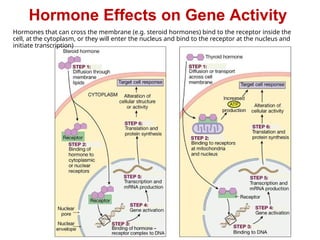
Hormones that can cross the membrane (e.g. steroid hormones) bind to the receptor inside the
cell, at the cytoplasm, or they will enter the nucleus and bind to the receptor at the nucleus and
initiate transcription)
Control of Hormone Synthesis and
Release
• Blood levels of hormones:
• Are controlled by negative feedback systems
• Vary only within a narrow desirable range
• Hormones are synthesized and released in response
to:
• Humoral stimuli
• Neural stimuli
• Hormonal stimuli
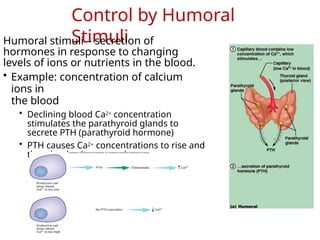
Control by Humoral
Stimuli
Humoral stimuli – secretion of
hormones in response to changing
levels of ions or nutrients in the blood.
• Example: concentration of calcium
ions in
the blood
• Declining blood Ca2+ concentration
stimulates the parathyroid glands to
secrete PTH (parathyroid hormone)
• PTH causes Ca2+ concentrations to rise and
the stimulus is removed
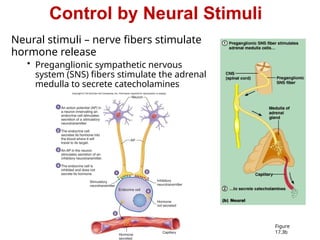
Control by Neural Stimuli
Neural stimuli – nerve fibers stimulate
hormone release
• Preganglionic sympathetic nervous
system (SNS) fibers stimulate the adrenal
medulla to secrete catecholamines
Figure
17.3b
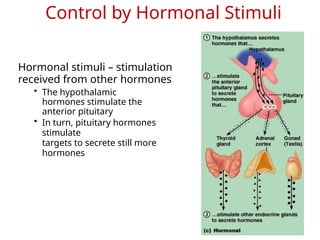
Control by Hormonal Stimuli
Hormonal stimuli – stimulation
received from other hormones
• The hypothalamic
hormones stimulate the
anterior pituitary
• In turn, pituitary hormones
stimulate
targets to secrete still more
hormones
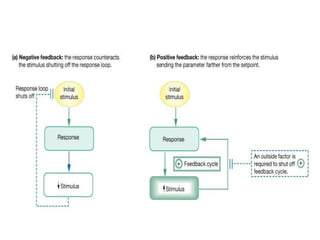
Feedback control of
hormone secretion
1) Negative feedback: Prevents over secretion of
the
hormone or over activity at the target tissue.
2) Positive feedback: There are two or more
variables, if one increases the second one ,the
second one in turn increases the first one or
the 3rd one. E.g. Ovulation.
3) Cyclical variations occur in hormone release
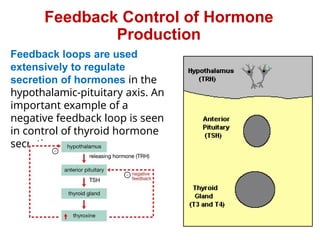
Feedback Control of Hormone
Production
Feedback loops are used
extensively to regulate
secretion of hormones in the
hypothalamic-pituitary axis. An
important example of a
negative feedback loop is seen
in control of thyroid hormone
secretion
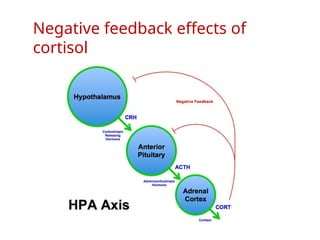
Negative feedback effects of
cortisol
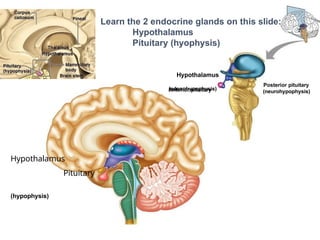
Hypothalamus
Pituitary
(hypophysis)
Hypothalamus
Anterior pituitary
(adenohypophysis)
Posterior pituitary
(neurohypophysis)
Learn the 2 endocrine glands on this slide:
Hypothalamus
Pituitary (hyophysis)
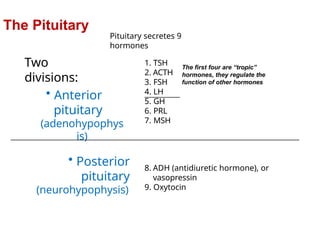
Two
divisions:
• Anterior
pituitary
(adenohypophys
is)
• Posterior
pituitary
(neurohypophysis)
Pituitary secretes 9
hormones
The Pituitary
1. TSH
2. ACTH
3. FSH
4. LH
5. GH
6. PRL
7. MSH
8. ADH (antidiuretic hormone), or
vasopressin
9. Oxytocin
The first four are “tropic”
hormones, they regulate the
function of other hormones
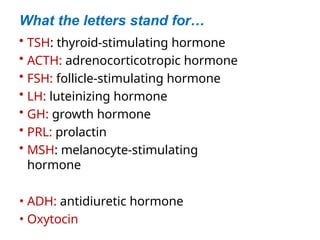
What the letters stand for…
• TSH: thyroid-stimulating hormone
• ACTH: adrenocorticotropic hormone
• FSH: follicle-stimulating hormone
• LH: luteinizing hormone
• GH: growth hormone
• PRL: prolactin
• MSH: melanocyte-stimulating
hormone
• ADH: antidiuretic hormone
• Oxytocin
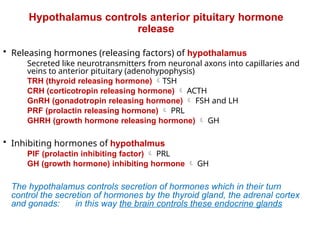
• Releasing hormones (releasing factors) of hypothalamus
Secreted like neurotransmitters from neuronal axons into capillaries and
veins to anterior pituitary (adenohypophysis)
TRH (thyroid releasing hormone) TSH
CRH (corticotropin releasing hormone)  ACTH
GnRH (gonadotropin releasing hormone)  FSH and LH
PRF (prolactin releasing hormone)  PRL
GHRH (growth hormone releasing hormone)  GH
• Inhibiting hormones of hypothalmus
PIF (prolactin inhibiting factor)  PRL
GH (growth hormone) inhibiting hormone  GH
The hypothalamus controls secretion of hormones which in their turn
control the secretion of hormones by the thyroid gland, the adrenal cortex
and gonads: in this way the brain controls these endocrine glands
Hypothalamus controls anterior pituitary hormone
release
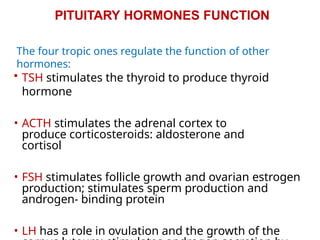
PITUITARY HORMONES FUNCTION
The four tropic ones regulate the function of other
hormones:
• TSH stimulates the thyroid to produce thyroid
hormone
• ACTH stimulates the adrenal cortex to
produce corticosteroids: aldosterone and
cortisol
• FSH stimulates follicle growth and ovarian estrogen
production; stimulates sperm production and
androgen- binding protein
• LH has a role in ovulation and the growth of the
The others from the anterior
pituitary…
• GH (somatrotropic hormone) stimulates
growth
• PRL stimulates mammary glands in breast
to make milk
• MSH stimulates melanocytes
From the posterior pituitary
(neurohypophysis)
• ADH (antidiuretic hormone vasopressin)
stimulates the kidneys to reclaim more water
from the urine, raises blood pressure
• Oxytocin prompts contraction of smooth
muscle in reproductive tracts, in females
initiating labor and ejection of milk from
breasts
• Endocrine glands throughout body are key to
chemical integration and homeostasis
• Protein, polypeptide, amine and a few steroid
hormones are plasma soluble and target membrane
• Surface receptors transduce signals into cell
and activate via second messengers
Summary
• Most steroid and some amine hormones are
lipophilic, can pass into cell, bind on cytoplasmic or
nuclear receptors and activate DNA for protein
synthesis
• Hypothalamus, pituitary trophic hormone
pathways coordinate endocrine regulation
Summary
s?

10-INTRODUCTION-TO-ENDOCRINE-SYSTEM.pptx

  • 1.
    INTRODUCTION TO ENDOCRINE SYSTEM Theendocrine system is a network of glands that produce and release hormones to regulate various bodily functions, including metabolism, growth, reproduction, and mood.
  • 2.
    Introduction to endocrine system Classesof Chemical Messengers 1. Autocrine chemical messengers: released by cells and have a local effect on the same cell type from which chemical signals released; e.g., prostaglandin 2. Paracrine chemical messengers: released by cells and affect other cell types locally without being transported in blood; e.g., somatostatin 3. Neurotransmitter: produced by neurons and secreted into extracellular spaces by presynaptic nerve terminals; travels short distances; influences postsynaptic cells; e.g., acetylcholine. 4. Endocrine chemical messengers: type of intercellular signal. Produced by cells of endocrine glands, enter circulatory system, and affect distant cells; e.g., estrogen
  • 4.
    Principal functions ofthe endocrine system • Maintenance of the internal environment in the body (maintaining the optimum biochemical environment). • Integration and regulation of growth and development. • Control, maintenance and instigation of sexual reproduction, including gametogenesis, coitus, fertilization, fetal growth and development and nourishment of the newborn.
  • 5.
    Endocrine System Helps tomaintain homeostasis by Integration & control. Secretion of chemical signals called hormones that travel through the bloodstream to act on target cells.
  • 6.
    Nervous System EndocrineSystem • regulates long term ongoing metabolic activity • uses chemicals messenger called hormones to “communicate”. • Hormones alter metabolic activities of tissues • A hormone is secreted by a group of specialized cells called gland • Hormones are transported by the blood vessels • Paracrine communication Endocrine versus Nervous system • performs short term crisis management • sends electrical messages to control and coordinate the body • Nerve impulse is delivered by the axon of a nerve cell called neuron
  • 7.
    Endocrine system • Includesall cells and endocrine tissues that produce hormones or paracrine factors • Following are important endocrine glands • Hypothalamus • Pituitary gland • Pineal Gland • Thyroid gland • Parathyroid gland • Thymus • Adrenal Gland • Gonads (testes/ovaries) • Pancreatic Islet • Heart • Kidney • Digestive Tract
  • 8.
  • 9.
    Hormone structure 1) Aminoacid derivatives hormones e.g. epinephrine Structurally similar to amino acids 2) Peptide hormones e.g. insulin Chains of amino acids, water soluble, attach to receptor site on cell membrane. 3)Lipid derivatives hormones lipid soluble, acts on intracellular spaces(pass thru cell mambrane to nucleus) and steroid hormones (prostaglandin is an example of a steroid hormone)
  • 10.
    10 © 2012 PearsonEducation, Inc.
  • 11.
    A. Stability 1. Half-life:The length of time it takes for half a dose of substance to be eliminated from circulatory system 2. Long half-life: regulate activities that remain at a constant rate through time. Usually lipid soluble and travel in plasma attached to proteins 3. Short half-life: water-soluble hormones as proteins, epinephrine, norepinephrine. Have a rapid onset and short duration B. Communication 1. Interaction with target cell 2. Lipid soluble hormones pass through cell membrane and usually travel to nucleus 3. Water soluble hormones generally attach to a receptor site on cell membrane C. Distributio n 1. Hormones dissolve in blood plasma and are transported in unbound or are reversibly bound to plasma proteins. 2. Hormones are distributed quickly because they circulate in the blood. General characteristics of hormones 17-11
  • 12.
    • Each hormone’sshape is specific and can be recognized by the corresponding target cells • The binding sites on the target cells are called hormone receptors. • Receptors for peptide hormones, are located on the surface of cell membranes because they can not cross the membrane to enter the cell • Thyroid and steroid hormones can cross the membrane and bind to receptors in the cytoplasm or nucleus Mechanisms of hormone action
  • 13.
    G Proteins andHormone Activity • Hormones that can not cross the membrane (e.g. Peptide hormones) bind to the receptor on the surface of the cell • Binding of hormones to the receptor activate secondary messenger (in this figure binding of hormone activates G protein, and activated G protein activates adenylcyclase or activate PDE or activates PLC
  • 14.
    Hormone Effects onGene Activity Hormones that can cross the membrane (e.g. steroid hormones) bind to the receptor inside the cell, at the cytoplasm, or they will enter the nucleus and bind to the receptor at the nucleus and initiate transcription)
  • 15.
    Control of HormoneSynthesis and Release • Blood levels of hormones: • Are controlled by negative feedback systems • Vary only within a narrow desirable range • Hormones are synthesized and released in response to: • Humoral stimuli • Neural stimuli • Hormonal stimuli
  • 16.
    Control by Humoral Stimuli Humoralstimuli – secretion of hormones in response to changing levels of ions or nutrients in the blood. • Example: concentration of calcium ions in the blood • Declining blood Ca2+ concentration stimulates the parathyroid glands to secrete PTH (parathyroid hormone) • PTH causes Ca2+ concentrations to rise and the stimulus is removed
  • 17.
    Control by NeuralStimuli Neural stimuli – nerve fibers stimulate hormone release • Preganglionic sympathetic nervous system (SNS) fibers stimulate the adrenal medulla to secrete catecholamines Figure 17.3b
  • 18.
    Control by HormonalStimuli Hormonal stimuli – stimulation received from other hormones • The hypothalamic hormones stimulate the anterior pituitary • In turn, pituitary hormones stimulate targets to secrete still more hormones
  • 19.
    Feedback control of hormonesecretion 1) Negative feedback: Prevents over secretion of the hormone or over activity at the target tissue. 2) Positive feedback: There are two or more variables, if one increases the second one ,the second one in turn increases the first one or the 3rd one. E.g. Ovulation. 3) Cyclical variations occur in hormone release
  • 21.
    Feedback Control ofHormone Production Feedback loops are used extensively to regulate secretion of hormones in the hypothalamic-pituitary axis. An important example of a negative feedback loop is seen in control of thyroid hormone secretion
  • 22.
  • 23.
  • 24.
    Two divisions: • Anterior pituitary (adenohypophys is) • Posterior pituitary (neurohypophysis) Pituitarysecretes 9 hormones The Pituitary 1. TSH 2. ACTH 3. FSH 4. LH 5. GH 6. PRL 7. MSH 8. ADH (antidiuretic hormone), or vasopressin 9. Oxytocin The first four are “tropic” hormones, they regulate the function of other hormones
  • 25.
    What the lettersstand for… • TSH: thyroid-stimulating hormone • ACTH: adrenocorticotropic hormone • FSH: follicle-stimulating hormone • LH: luteinizing hormone • GH: growth hormone • PRL: prolactin • MSH: melanocyte-stimulating hormone • ADH: antidiuretic hormone • Oxytocin
  • 26.
    • Releasing hormones(releasing factors) of hypothalamus Secreted like neurotransmitters from neuronal axons into capillaries and veins to anterior pituitary (adenohypophysis) TRH (thyroid releasing hormone) TSH CRH (corticotropin releasing hormone)  ACTH GnRH (gonadotropin releasing hormone)  FSH and LH PRF (prolactin releasing hormone)  PRL GHRH (growth hormone releasing hormone)  GH • Inhibiting hormones of hypothalmus PIF (prolactin inhibiting factor)  PRL GH (growth hormone) inhibiting hormone  GH The hypothalamus controls secretion of hormones which in their turn control the secretion of hormones by the thyroid gland, the adrenal cortex and gonads: in this way the brain controls these endocrine glands Hypothalamus controls anterior pituitary hormone release
  • 27.
    PITUITARY HORMONES FUNCTION Thefour tropic ones regulate the function of other hormones: • TSH stimulates the thyroid to produce thyroid hormone • ACTH stimulates the adrenal cortex to produce corticosteroids: aldosterone and cortisol • FSH stimulates follicle growth and ovarian estrogen production; stimulates sperm production and androgen- binding protein • LH has a role in ovulation and the growth of the
  • 28.
    The others fromthe anterior pituitary… • GH (somatrotropic hormone) stimulates growth • PRL stimulates mammary glands in breast to make milk • MSH stimulates melanocytes
  • 29.
    From the posteriorpituitary (neurohypophysis) • ADH (antidiuretic hormone vasopressin) stimulates the kidneys to reclaim more water from the urine, raises blood pressure • Oxytocin prompts contraction of smooth muscle in reproductive tracts, in females initiating labor and ejection of milk from breasts
  • 30.
    • Endocrine glandsthroughout body are key to chemical integration and homeostasis • Protein, polypeptide, amine and a few steroid hormones are plasma soluble and target membrane • Surface receptors transduce signals into cell and activate via second messengers Summary
  • 31.
    • Most steroidand some amine hormones are lipophilic, can pass into cell, bind on cytoplasmic or nuclear receptors and activate DNA for protein synthesis • Hypothalamus, pituitary trophic hormone pathways coordinate endocrine regulation Summary
  • 32.