Dr Y S Sumathy
CRD Batch 2
Bangalore Bioinnovation Centre
Endocrine System
• The endocrine system includes the endocrine glands
and their hormones
• The function of the endocrine system is to secrete
hormones into the bloodstream.
• Uses hormones to control and coordinate body's
metabolism, energy level, reproduction, growth and
development, and response to injury, stress, and
mood.
3
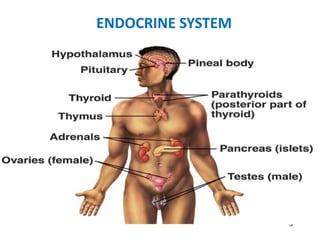
ENDOCRINE SYSTEM
4
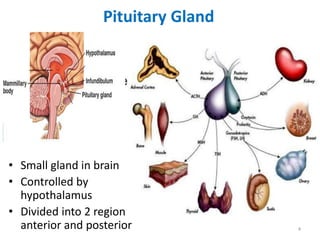
Pituitary Gland
• Small gland in brain
• Controlled by
hypothalamus
• Divided into 2 regions:
anterior and posterior
Anterior Pituitary Hormones
1. Thyroid Stimulating Hormone (TSH)
- regulates thyroid gland secretions
2. Luteinizing Hormone (LH)
- promotes ovulation and progesterone production in
females and sperm production and testosterone in males.
3. Follicle-stimulating Hormone (FSH)
-follicle maturation and estrogen secretion in females and
sperm production in males
4. Growth Hormone (GH)
- stimulates growth of bones, muscles, and organs
5. Adrenocorticotropic Hormone (ACTH)
-essential for the growth of the adrenal cortex
6. Prolactin (PRL) - milk production
7. Melanocyte-Stimulating Hormone (MSH): regulates skin
pigmentation and promotes the deposit of melanine in the skin
after exposure to sunlight
6
Posterior Pituitary Gland
1. Antidiuretic Hormone (ADH): Vasopressin
- stimulates the reabsorption of water by the renal tubules.
Hyposecretion of this hormone can result in diabetes insipidus.
2. Oxytocin
- stimulates the uterus to contract during labor, delivery, and
parturition. A synthetic version of this hormone, used to induce
labor, is called Pitocin. It also stimulates the mammary glands to
release milk.
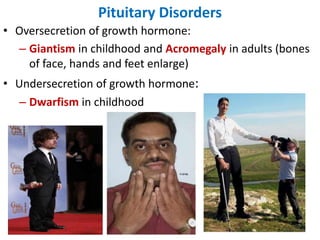
Pituitary Disorders
• Oversecretion of growth hormone:
– Giantism in childhood and Acromegaly in adults (bones
of face, hands and feet enlarge)
• Undersecretion of growth hormone:
– Dwarfism in childhood
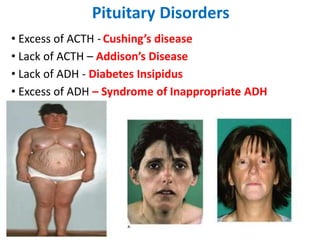
Pituitary Disorders
• Excess of ACTH -Cushing’s disease
• Lack of ACTH – Addison’s Disease
• Lack of ADH - Diabetes Insipidus
• Excess of ADH – Syndrome of Inappropriate ADH
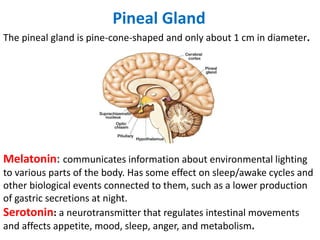
Melatonin: communicates information about environmental lighting
to various parts of the body. Has some effect on sleep/awake cycles and
other biological events connected to them, such as a lower production
of gastric secretions at night.
Serotonin: a neurotransmitter that regulates intestinal movements
and affects appetite, mood, sleep, anger, and metabolism.
The pineal gland is pine-cone-shaped and only about 1 cm in diameter.
Pineal Gland
10
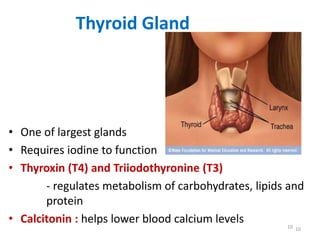
• One of largest glands
• Requires iodine to function
• Thyroxin (T4) and Triiodothyronine (T3)
- regulates metabolism of carbohydrates, lipids and
protein
• Calcitonin : helps lower blood calcium levels 10
Thy Thyroid Glandroid Gland
11
Abnormalities of Thyroid Gland
• Hypothyroidism:
– Decreased metabolism
– Weight gain, reduced
appetite, fatigue
– Low temp. and pulse
– Dry, cold skin
– Myxedema in adults
– Cretinism in infants
• Hyperthyroidism:
– Increased metabolism
– Weight loss, increased
appetite, nervousness
– Higher temp. and pulse
– Warm, flushed skin
– Graves’ disease (leads to
goiter)
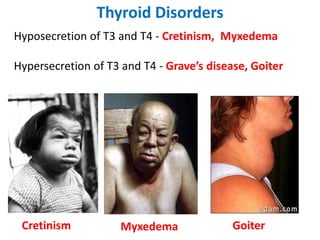
Thyroid Disorders
Cretinism Myxedema Goiter
Hyposecretion of T3 and T4 - Cretinism, Myxedema
Hypersecretion of T3 and T4 - Grave’s disease, Goiter
Parathyroid Gland
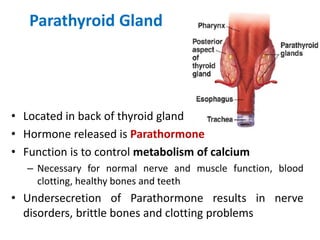
• Located in back of thyroid gland
• Hormone released is Parathormone
• Function is to control metabolism of calcium
– Necessary for normal nerve and muscle function, blood
clotting, healthy bones and teeth
• Undersecretion of Parathormone results in nerve
disorders, brittle bones and clotting problems
Parathyroid disorders
Hyperparathyroidism – Di George’s Syndrome
• Increased neuromuscular excitability
• Paresthesia
• Mental retardation
• ECG Changes – prolonged Q-T, S-T
Hyperparathyroidism
• Kidney stones
•Metastatic calcification of sift tissues
•Hypertension and heart palpitations
•Increase of gastric secretion
Osteodystrophy – bone malformation and short stature
in children, brittle bones in adults.
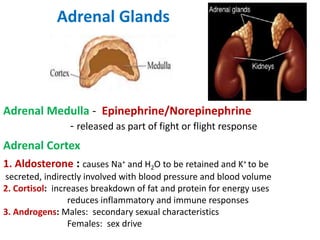
Adrenal Glands
Adrenal Medulla - Epinephrine/Norepinephrine
- released as part of fight or flight response
Adrenal Cortex
1. Aldosterone : causes Na+ and H2O to be retained and K+ to be
secreted, indirectly involved with blood pressure and blood volume
2. Cortisol: increases breakdown of fat and protein for energy uses
reduces inflammatory and immune responses
3. Androgens: Males: secondary sexual characteristics
Females: sex drive
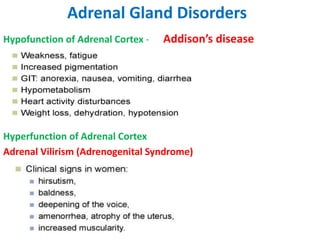
Adrenal Gland Disorders
Hypofunction of Adrenal Cortex - Addison’s disease
Hyperfunction of Adrenal Cortex
Adrenal Vilirism (Adrenogenital Syndrome)
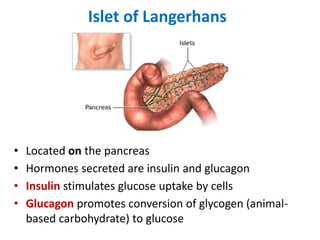
Islet of Langerhans
• Located on the pancreas
• Hormones secreted are insulin and glucagon
• Insulin stimulates glucose uptake by cells
• Glucagon promotes conversion of glycogen (animal-
based carbohydrate) to glucose
• Diabetes Type 1- Usually found in children and young adults;
the body doesn’t make enough insulin
• Frequent urination
• Unusual thirst
• Extreme hunger
• Unusual weight loss
• Extreme fatigue and Irritability
• Diabetes- Type 2 - Either the body doesn’t produce enough
insulin, or the cells ignore it.
• Frequent infections
• Blurred vision
• Cuts/bruises that are slow to heal
• Tingling/numbness in the hands/feet
• Recurring skin, gum, or bladder infections
Pancreatic Disorders
19
Testes
• Testosterone:
- aids in sperm and reproductive organ development and function
Ovaries
• Estrogen/Progesterone:
- involved in uterine and mammary gland development and
menstrual cycle
Thymus gland
• Thymosin:
- promotes immune system development and function
Pineal Gland
•Melatonin:
- plays a role in onset of puberty and controls circadian
rhythms. Light affects its function.
Endocrine Disruptors
Many chemicals, both natural and man-made, may mimic or interfere
with the body’s hormones are called endocrine disruptors.
Endocrine disruptors are found in many everyday products, including
some plastic bottles and containers, liners of metal food cans, detergents, flame
retardants, food, toys, cosmetics, and pesticides.
Bisphenol A (BPA) — used to make polycarbonate plastics and epoxy resins, which are found in
many plastic products including food storage containers
Dioxins — produced as a byproduct in herbicide production and paper bleaching, they are also
released into the environment during waste burning and wildfires
Perchlorate — a by-product of aerospace, weapon, and pharmaceutical industries found in
drinking water and fireworks
Perfluoroalkyl and Polyfluoroalkyl Substances (PFAS) — used widely in industrial applications,
such as firefighting foams and non-stick pan, paper, and textile coatings
Phthalates — used to make plastics more flexible, they are also found in some food packaging,
cosmetics, children’s toys, and medical devices
Phytoestrogens — naturally occurring substances in plants that have hormone-like activity, such
as genistein and daidzein that are in soy products, like tofu or soy milk
Polybrominated diphenyl ethers (PBDE) — used to make flame retardants for household
products such as furniture foam and carpets
Polychlorinated biphenyls (PCB) — used to make electrical equipment like transformers, and in
hydraulic fluids, heat transfer fluids, lubricants, and plasticizers
Research Scope
•Developing new models and tools to better understand how
endocrine disrupters work
•Developing and applying high throughout assays to identify
substances with endocrine disrupting activity
•Conducting animal and human health research to define linkages
between exposure to endocrine disrupters and health effects
•Developing new assessments and biomarkers of exposure and
toxicity
•Identifying and developing new intervention and prevention
strategies
1. DISEASES OF THE ENDOCRINE SYSTEM : Lectures from Endocrinology
- Stanislav Oravec, MD, PhD. Professor of Internal Medicine
Comenius University in Bratislava, Faculty of Medicine, 2018
2. THE ENDOCRINE SYSTEM - John S. Bevan
References
Endocrine system and related disorders.pptx

Endocrine system and related disorders.pptx

  • 1.
    Dr Y SSumathy CRD Batch 2 Bangalore Bioinnovation Centre
  • 2.
    Endocrine System • Theendocrine system includes the endocrine glands and their hormones • The function of the endocrine system is to secrete hormones into the bloodstream. • Uses hormones to control and coordinate body's metabolism, energy level, reproduction, growth and development, and response to injury, stress, and mood.
  • 3.
  • 4.
    4 Pituitary Gland • Smallgland in brain • Controlled by hypothalamus • Divided into 2 regions: anterior and posterior
  • 5.
    Anterior Pituitary Hormones 1.Thyroid Stimulating Hormone (TSH) - regulates thyroid gland secretions 2. Luteinizing Hormone (LH) - promotes ovulation and progesterone production in females and sperm production and testosterone in males. 3. Follicle-stimulating Hormone (FSH) -follicle maturation and estrogen secretion in females and sperm production in males 4. Growth Hormone (GH) - stimulates growth of bones, muscles, and organs 5. Adrenocorticotropic Hormone (ACTH) -essential for the growth of the adrenal cortex 6. Prolactin (PRL) - milk production 7. Melanocyte-Stimulating Hormone (MSH): regulates skin pigmentation and promotes the deposit of melanine in the skin after exposure to sunlight
  • 6.
    6 Posterior Pituitary Gland 1.Antidiuretic Hormone (ADH): Vasopressin - stimulates the reabsorption of water by the renal tubules. Hyposecretion of this hormone can result in diabetes insipidus. 2. Oxytocin - stimulates the uterus to contract during labor, delivery, and parturition. A synthetic version of this hormone, used to induce labor, is called Pitocin. It also stimulates the mammary glands to release milk.
  • 7.
    Pituitary Disorders • Oversecretionof growth hormone: – Giantism in childhood and Acromegaly in adults (bones of face, hands and feet enlarge) • Undersecretion of growth hormone: – Dwarfism in childhood
  • 8.
    Pituitary Disorders • Excessof ACTH -Cushing’s disease • Lack of ACTH – Addison’s Disease • Lack of ADH - Diabetes Insipidus • Excess of ADH – Syndrome of Inappropriate ADH
  • 9.
    Melatonin: communicates informationabout environmental lighting to various parts of the body. Has some effect on sleep/awake cycles and other biological events connected to them, such as a lower production of gastric secretions at night. Serotonin: a neurotransmitter that regulates intestinal movements and affects appetite, mood, sleep, anger, and metabolism. The pineal gland is pine-cone-shaped and only about 1 cm in diameter. Pineal Gland
  • 10.
    10 • One oflargest glands • Requires iodine to function • Thyroxin (T4) and Triiodothyronine (T3) - regulates metabolism of carbohydrates, lipids and protein • Calcitonin : helps lower blood calcium levels 10 Thy Thyroid Glandroid Gland
  • 11.
    11 Abnormalities of ThyroidGland • Hypothyroidism: – Decreased metabolism – Weight gain, reduced appetite, fatigue – Low temp. and pulse – Dry, cold skin – Myxedema in adults – Cretinism in infants • Hyperthyroidism: – Increased metabolism – Weight loss, increased appetite, nervousness – Higher temp. and pulse – Warm, flushed skin – Graves’ disease (leads to goiter)
  • 12.
    Thyroid Disorders Cretinism MyxedemaGoiter Hyposecretion of T3 and T4 - Cretinism, Myxedema Hypersecretion of T3 and T4 - Grave’s disease, Goiter
  • 13.
    Parathyroid Gland • Locatedin back of thyroid gland • Hormone released is Parathormone • Function is to control metabolism of calcium – Necessary for normal nerve and muscle function, blood clotting, healthy bones and teeth • Undersecretion of Parathormone results in nerve disorders, brittle bones and clotting problems
  • 14.
    Parathyroid disorders Hyperparathyroidism –Di George’s Syndrome • Increased neuromuscular excitability • Paresthesia • Mental retardation • ECG Changes – prolonged Q-T, S-T Hyperparathyroidism • Kidney stones •Metastatic calcification of sift tissues •Hypertension and heart palpitations •Increase of gastric secretion Osteodystrophy – bone malformation and short stature in children, brittle bones in adults.
  • 15.
    Adrenal Glands Adrenal Medulla- Epinephrine/Norepinephrine - released as part of fight or flight response Adrenal Cortex 1. Aldosterone : causes Na+ and H2O to be retained and K+ to be secreted, indirectly involved with blood pressure and blood volume 2. Cortisol: increases breakdown of fat and protein for energy uses reduces inflammatory and immune responses 3. Androgens: Males: secondary sexual characteristics Females: sex drive
  • 16.
    Adrenal Gland Disorders Hypofunctionof Adrenal Cortex - Addison’s disease Hyperfunction of Adrenal Cortex Adrenal Vilirism (Adrenogenital Syndrome)
  • 17.
    Islet of Langerhans •Located on the pancreas • Hormones secreted are insulin and glucagon • Insulin stimulates glucose uptake by cells • Glucagon promotes conversion of glycogen (animal- based carbohydrate) to glucose
  • 18.
    • Diabetes Type1- Usually found in children and young adults; the body doesn’t make enough insulin • Frequent urination • Unusual thirst • Extreme hunger • Unusual weight loss • Extreme fatigue and Irritability • Diabetes- Type 2 - Either the body doesn’t produce enough insulin, or the cells ignore it. • Frequent infections • Blurred vision • Cuts/bruises that are slow to heal • Tingling/numbness in the hands/feet • Recurring skin, gum, or bladder infections Pancreatic Disorders
  • 19.
    19 Testes • Testosterone: - aidsin sperm and reproductive organ development and function Ovaries • Estrogen/Progesterone: - involved in uterine and mammary gland development and menstrual cycle Thymus gland • Thymosin: - promotes immune system development and function Pineal Gland •Melatonin: - plays a role in onset of puberty and controls circadian rhythms. Light affects its function.
  • 20.
    Endocrine Disruptors Many chemicals,both natural and man-made, may mimic or interfere with the body’s hormones are called endocrine disruptors. Endocrine disruptors are found in many everyday products, including some plastic bottles and containers, liners of metal food cans, detergents, flame retardants, food, toys, cosmetics, and pesticides. Bisphenol A (BPA) — used to make polycarbonate plastics and epoxy resins, which are found in many plastic products including food storage containers Dioxins — produced as a byproduct in herbicide production and paper bleaching, they are also released into the environment during waste burning and wildfires Perchlorate — a by-product of aerospace, weapon, and pharmaceutical industries found in drinking water and fireworks Perfluoroalkyl and Polyfluoroalkyl Substances (PFAS) — used widely in industrial applications, such as firefighting foams and non-stick pan, paper, and textile coatings Phthalates — used to make plastics more flexible, they are also found in some food packaging, cosmetics, children’s toys, and medical devices Phytoestrogens — naturally occurring substances in plants that have hormone-like activity, such as genistein and daidzein that are in soy products, like tofu or soy milk Polybrominated diphenyl ethers (PBDE) — used to make flame retardants for household products such as furniture foam and carpets Polychlorinated biphenyls (PCB) — used to make electrical equipment like transformers, and in hydraulic fluids, heat transfer fluids, lubricants, and plasticizers
  • 21.
    Research Scope •Developing newmodels and tools to better understand how endocrine disrupters work •Developing and applying high throughout assays to identify substances with endocrine disrupting activity •Conducting animal and human health research to define linkages between exposure to endocrine disrupters and health effects •Developing new assessments and biomarkers of exposure and toxicity •Identifying and developing new intervention and prevention strategies
  • 22.
    1. DISEASES OFTHE ENDOCRINE SYSTEM : Lectures from Endocrinology - Stanislav Oravec, MD, PhD. Professor of Internal Medicine Comenius University in Bratislava, Faculty of Medicine, 2018 2. THE ENDOCRINE SYSTEM - John S. Bevan References