INTRODUCTION TO PATHOPHYSIOLOGY
By: Muhammad Aurangzeb
MPH, BSN
Instructor
KHYBER MEDICAL UNIVERSITY PESHAWAR
October 9th
2017
Aurangzeb 1
Objectives
In this session we will be focus on:
•Define Pathology and pathophysiology.
•Differentiate among pathophysiology and other
biomedical sciences.
•Discuss the basic concepts of disease and its
development.
•Briefly discuss each of the five component the disease
process:
•Prevalence, Etiology, Pathogenesis, Clinical
manifestation,Outcomes.
2
Pathology
• The word pathology is from Greek ,pathos, means
"feeling, or suffering"; and logia, means "the study
of".
• Pathology is a branch of medical science primarily
concerning the cause, origin and nature of disease.
• Body tissue, blood and other bodily fluids are
analyzed to assist medical practitioners in identifying
the cause and severity of disease, and to monitor
treatment.
3
Clinical pathology
• Clinical pathology is a medical specialty that is
concerned with the diagnosis of disease based on
the laboratory analysis of bodily fluids such as blood
and urine, as well as tissues, using the tools of
biochemistry, clinical microbiology, hematology,
immunology and molecular pathology e.g. PCR
(polymerase chain reaction).
Aurangzeb 4
Clinical biochemistry
• Clinical biochemistry (chemical pathology, clinical
chemistry) is the area of chemistry that is generally
concerned with analysis of bodily fluids
for diagnostic purposes.
• Blood, urine or bodily fluid for various tests e.g. RFTs,
LFTs, RBS, FBS, Serum Albumin, Serum Electrolytes
etc.
Aurangzeb 5
Clinical Microbiology
• Clinical Microbiology deals with isolation and
identification of infectious agents such as
bacteria, viruses, fungi and parasites that
cause disease.
• Specimens such as urines, feaces and swabs to
identify pathogens to select the appropriate
treatment.
e.g. Blood C/S, Urine C/S, Sputum C/S
6
Hematology
• Is the study of diseases which affect blood.
Investigations that take place the Hematology
laboratory include:
• Routine hematological testing
Specimens of whole blood are analyzed by a
specialized instrument called a Coulter Counter
which measures the number of the various blood
cells such as red cells, white cells and platelets
• E.g. Complete blood count, ESR, Blood smear etc
7
Clinical Immunology
• Clinical Immunology is concerned with the
diagnosis and management of diseases arising
from abnormal immune responses.
• In broad terms, these abnormalities may be
the result of either under activity
(immunodeficiency) or over activity
(autoimmunity and allergy) of the immune
system.
8
Molecular pathology
• Molecular pathology is an emerging discipline
within pathology which is focused in the study and
diagnosis of disease through the examination
of molecules within organs, tissues or bodily fluids.
• Molecular pathology is commonly used in diagnosis
of cancer and infectious diseases.
• E.g. DNA microarray, polymerase chain reaction
(PCR), genes analysis
Aurangzeb 9
Pathophysiology
1. Basically, pathophysiology is the disordered
physiological processes associated with injury
or disease (the immune system). This area
studies how the body reacts to injury or fights
off disease.
2. The functional changes associated with or
resulting from disease or injury.
e.g. inflammation in response to an injury
10
Disease
• The term disease literally means “without ease”
(uneasiness), when something is wrong with bodily
function.
• The term disease broadly refers to any condition that
impairs the normal functioning of the body.
• Diseases are associated with dysfunctioning of the
body's normal homeostatic processes.
Aurangzeb 11
Pathogenesis
• The word Pathogenesis comes from
the Greek pathos ("disease") and
genesis ("creation").
• The pathogenesis of a disease is the biological
mechanism that leads to the diseased state.
• The term can also describe the origin and
development of the disease, and whether it
is acute, chronic, or recurrent.
12
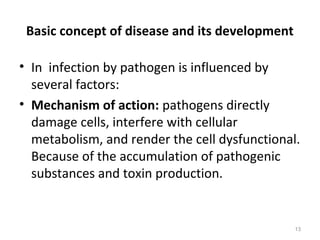
Basic concept of disease and its development
• In infection by pathogen is influenced by
several factors:
• Mechanism of action: pathogens directly
damage cells, interfere with cellular
metabolism, and render the cell dysfunctional.
Because of the accumulation of pathogenic
substances and toxin production.
13
Conti…
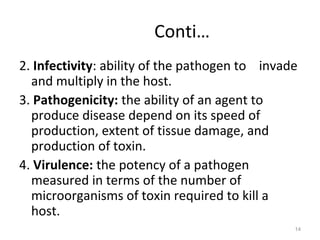
2. Infectivity: ability of the pathogen to invade
and multiply in the host.
3. Pathogenicity: the ability of an agent to
produce disease depend on its speed of
production, extent of tissue damage, and
production of toxin.
4. Virulence: the potency of a pathogen
measured in terms of the number of
microorganisms of toxin required to kill a
host.
14
Cont…
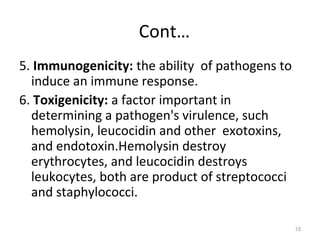
5. Immunogenicity: the ability of pathogens to
induce an immune response.
6. Toxigenicity: a factor important in
determining a pathogen's virulence, such
hemolysin, leucocidin and other exotoxins,
and endotoxin.Hemolysin destroy
erythrocytes, and leucocidin destroys
leukocytes, both are product of streptococci
and staphylococci.
15
Cont…
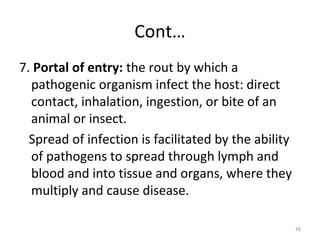
7. Portal of entry: the rout by which a
pathogenic organism infect the host: direct
contact, inhalation, ingestion, or bite of an
animal or insect.
Spread of infection is facilitated by the ability
of pathogens to spread through lymph and
blood and into tissue and organs, where they
multiply and cause disease.
16
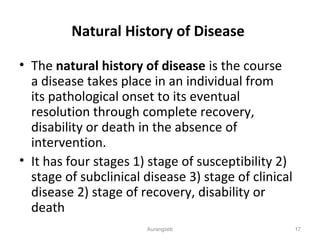
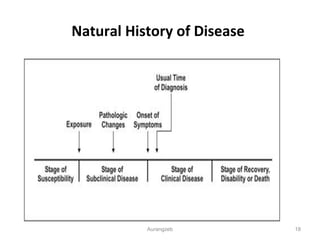
Natural History of Disease
• The natural history of disease is the course
a disease takes place in an individual from
its pathological onset to its eventual
resolution through complete recovery,
disability or death in the absence of
intervention.
• It has four stages 1) stage of susceptibility 2)
stage of subclinical disease 3) stage of clinical
disease 2) stage of recovery, disability or
death
Aurangzeb 17
Natural History of Disease
Aurangzeb 18
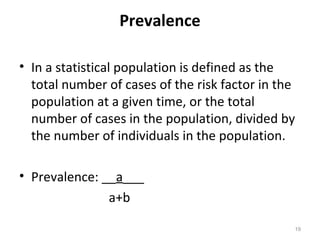
Prevalence
• In a statistical population is defined as the
total number of cases of the risk factor in the
population at a given time, or the total
number of cases in the population, divided by
the number of individuals in the population.
• Prevalence: __a___
a+b
19
Etiology
• Etiology, is the study of causation or
origination. The word is derived from the
Greek, aitiologia, "giving a reason for“
• Used in medical and philosophical theories,
where it is used to refer to the study of why
things occur, or even the reasons behind the
way that things act.
20
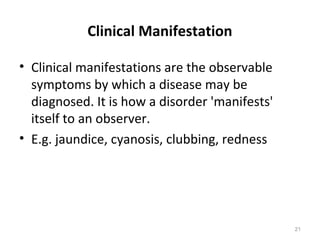
Clinical Manifestation
• Clinical manifestations are the observable
symptoms by which a disease may be
diagnosed. It is how a disorder 'manifests'
itself to an observer.
• E.g. jaundice, cyanosis, clubbing, redness
21
Outcome
• The consequence of disease or end of the disease is
known as outcome which may any of the following
form
– Complete recovery
– Recovery with disability
– Death
22
References
• L.kathryn,(2002), THE BIOLOGIC BASIS FOR
DISEASE ,chap 1st
Ed 4th
page 242_247.
• www.google.com.
23
THANKS YOU
ALL
34 24

Lecture 1 pathophysiology

  • 1.
    INTRODUCTION TO PATHOPHYSIOLOGY By:Muhammad Aurangzeb MPH, BSN Instructor KHYBER MEDICAL UNIVERSITY PESHAWAR October 9th 2017 Aurangzeb 1
  • 2.
    Objectives In this sessionwe will be focus on: •Define Pathology and pathophysiology. •Differentiate among pathophysiology and other biomedical sciences. •Discuss the basic concepts of disease and its development. •Briefly discuss each of the five component the disease process: •Prevalence, Etiology, Pathogenesis, Clinical manifestation,Outcomes. 2
  • 3.
    Pathology • The wordpathology is from Greek ,pathos, means "feeling, or suffering"; and logia, means "the study of". • Pathology is a branch of medical science primarily concerning the cause, origin and nature of disease. • Body tissue, blood and other bodily fluids are analyzed to assist medical practitioners in identifying the cause and severity of disease, and to monitor treatment. 3
  • 4.
    Clinical pathology • Clinicalpathology is a medical specialty that is concerned with the diagnosis of disease based on the laboratory analysis of bodily fluids such as blood and urine, as well as tissues, using the tools of biochemistry, clinical microbiology, hematology, immunology and molecular pathology e.g. PCR (polymerase chain reaction). Aurangzeb 4
  • 5.
    Clinical biochemistry • Clinicalbiochemistry (chemical pathology, clinical chemistry) is the area of chemistry that is generally concerned with analysis of bodily fluids for diagnostic purposes. • Blood, urine or bodily fluid for various tests e.g. RFTs, LFTs, RBS, FBS, Serum Albumin, Serum Electrolytes etc. Aurangzeb 5
  • 6.
    Clinical Microbiology • ClinicalMicrobiology deals with isolation and identification of infectious agents such as bacteria, viruses, fungi and parasites that cause disease. • Specimens such as urines, feaces and swabs to identify pathogens to select the appropriate treatment. e.g. Blood C/S, Urine C/S, Sputum C/S 6
  • 7.
    Hematology • Is thestudy of diseases which affect blood. Investigations that take place the Hematology laboratory include: • Routine hematological testing Specimens of whole blood are analyzed by a specialized instrument called a Coulter Counter which measures the number of the various blood cells such as red cells, white cells and platelets • E.g. Complete blood count, ESR, Blood smear etc 7
  • 8.
    Clinical Immunology • ClinicalImmunology is concerned with the diagnosis and management of diseases arising from abnormal immune responses. • In broad terms, these abnormalities may be the result of either under activity (immunodeficiency) or over activity (autoimmunity and allergy) of the immune system. 8
  • 9.
    Molecular pathology • Molecularpathology is an emerging discipline within pathology which is focused in the study and diagnosis of disease through the examination of molecules within organs, tissues or bodily fluids. • Molecular pathology is commonly used in diagnosis of cancer and infectious diseases. • E.g. DNA microarray, polymerase chain reaction (PCR), genes analysis Aurangzeb 9
  • 10.
    Pathophysiology 1. Basically, pathophysiologyis the disordered physiological processes associated with injury or disease (the immune system). This area studies how the body reacts to injury or fights off disease. 2. The functional changes associated with or resulting from disease or injury. e.g. inflammation in response to an injury 10
  • 11.
    Disease • The termdisease literally means “without ease” (uneasiness), when something is wrong with bodily function. • The term disease broadly refers to any condition that impairs the normal functioning of the body. • Diseases are associated with dysfunctioning of the body's normal homeostatic processes. Aurangzeb 11
  • 12.
    Pathogenesis • The wordPathogenesis comes from the Greek pathos ("disease") and genesis ("creation"). • The pathogenesis of a disease is the biological mechanism that leads to the diseased state. • The term can also describe the origin and development of the disease, and whether it is acute, chronic, or recurrent. 12
  • 13.
    Basic concept ofdisease and its development • In infection by pathogen is influenced by several factors: • Mechanism of action: pathogens directly damage cells, interfere with cellular metabolism, and render the cell dysfunctional. Because of the accumulation of pathogenic substances and toxin production. 13
  • 14.
    Conti… 2. Infectivity: abilityof the pathogen to invade and multiply in the host. 3. Pathogenicity: the ability of an agent to produce disease depend on its speed of production, extent of tissue damage, and production of toxin. 4. Virulence: the potency of a pathogen measured in terms of the number of microorganisms of toxin required to kill a host. 14
  • 15.
    Cont… 5. Immunogenicity: theability of pathogens to induce an immune response. 6. Toxigenicity: a factor important in determining a pathogen's virulence, such hemolysin, leucocidin and other exotoxins, and endotoxin.Hemolysin destroy erythrocytes, and leucocidin destroys leukocytes, both are product of streptococci and staphylococci. 15
  • 16.
    Cont… 7. Portal ofentry: the rout by which a pathogenic organism infect the host: direct contact, inhalation, ingestion, or bite of an animal or insect. Spread of infection is facilitated by the ability of pathogens to spread through lymph and blood and into tissue and organs, where they multiply and cause disease. 16
  • 17.
    Natural History ofDisease • The natural history of disease is the course a disease takes place in an individual from its pathological onset to its eventual resolution through complete recovery, disability or death in the absence of intervention. • It has four stages 1) stage of susceptibility 2) stage of subclinical disease 3) stage of clinical disease 2) stage of recovery, disability or death Aurangzeb 17
  • 18.
    Natural History ofDisease Aurangzeb 18
  • 19.
    Prevalence • In astatistical population is defined as the total number of cases of the risk factor in the population at a given time, or the total number of cases in the population, divided by the number of individuals in the population. • Prevalence: __a___ a+b 19
  • 20.
    Etiology • Etiology, isthe study of causation or origination. The word is derived from the Greek, aitiologia, "giving a reason for“ • Used in medical and philosophical theories, where it is used to refer to the study of why things occur, or even the reasons behind the way that things act. 20
  • 21.
    Clinical Manifestation • Clinicalmanifestations are the observable symptoms by which a disease may be diagnosed. It is how a disorder 'manifests' itself to an observer. • E.g. jaundice, cyanosis, clubbing, redness 21
  • 22.
    Outcome • The consequenceof disease or end of the disease is known as outcome which may any of the following form – Complete recovery – Recovery with disability – Death 22
  • 23.
    References • L.kathryn,(2002), THEBIOLOGIC BASIS FOR DISEASE ,chap 1st Ed 4th page 242_247. • www.google.com. 23
  • 24.