Endocrine system & Hormones
Good videos by Khan academy
• Endocrine system (major hormones & functions)
https://www.youtube.com/watch?v=ySkk7U_4PeY
• Hormones – Intro & working
https://www.youtube.com/watch?v=gaN0ceyrpqQ
• Endocrine system physiology
(https://www.youtube.com/watch?v=ER49EweKwW8)
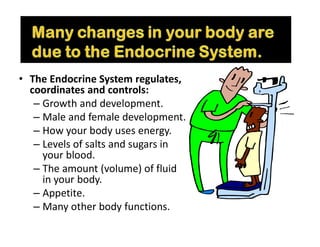
• The Endocrine System regulates,
coordinates and controls:
– Growth and development.
– Male and female development.
– How your body uses energy.
– Levels of salts and sugars in
your blood.
– The amount (volume) of fluid
in your body.
– Appetite.
– Many other body functions.
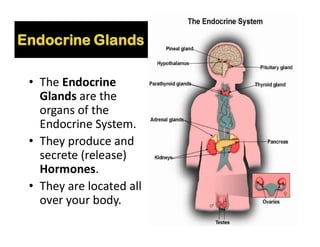
• The Endocrine
Glands are the
organs of the
Endocrine System.
• They produce and
secrete (release)
Hormones.
• They are located all
over your body.
• The answer is
Hormones!
How do you think the Endocrine
Glands get their jobs done?
Definition
Hormones are chemical messengers
that are secreted (released) from
glands into the blood and affect
cells in another part of the body.
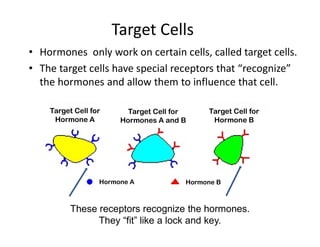
• Hormones only work on certain cells, called target cells.
• The target cells have special receptors that “recognize”
the hormones and allow them to influence that cell.
These receptors recognize the hormones.
They “fit” like a lock and key.
Target Cell for
Hormone A
Target Cell for
Hormones A and B
Target Cell for
Hormone B
Target Cell for
Hormone A
Hormone B
Hormone A
Target Cells
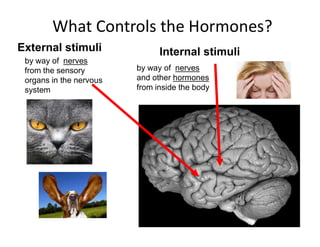
by way of nerves
from the sensory
organs in the nervous
system
Internal stimuli
External stimuli
by way of nerves
and other hormones
from inside the body
What Controls the Hormones?
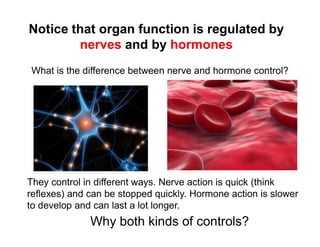
Why both kinds of controls?
What is the difference between nerve and hormone control?
They control in different ways. Nerve action is quick (think
reflexes) and can be stopped quickly. Hormone action is slower
to develop and can last a lot longer.
Notice that organ function is regulated by
nerves and by hormones
MCQs
1. Difference between endocrine and exocrine glands
is that
(a) endocrine glands release hormones, exocrine glands
release waste
(b) endocrine glands are interconnected, exocrine
glands are totally independent
(c) endocrine glands are formed by epithelial tissue,
exocrine glands are connective tissues primarily
(d) endocrine glands are ductless, exocrine glands
release secretions into ducts or at the surface of the
body
2. These hormones are responsible for “fight-or-flight”
response
(a) Thyroxine and melatonin
(b) insulin and glucagon
(c) epinephrine and norepinephrine
(d) oestrogen and progesterone
3. After consuming a banana, which hormones would be
expected to increase?
(a) Prolactin
(b) Glucagon
(c) Insulin
(d) Parathyroid hormone
4. Which of the following hormones would be expected to
increase if you were studying all day for a test and
skipped breakfast and lunch?
(a) Glucagon
(b) Growth hormone
(c) Insulin
(d) Calcitonin
5. Which hormone increases basal metabolic rate (BMR) in
the body?
(a) Thyroid hormone
(b) Glucagon
(c) Secretin
(d) Parathyroid hormone
6. Where pituitary gland lies in our body?
(a) In abdominal cavity
(b) At the base of the brain
(c) In larynx
(d) In epithelial tissue
7. Where adrenal glands are located?
(a) On top of each kidney
(b) Upper part of trachea
(c) Back of abdomen
(d) Central part of brain
8. The adrenal gland is made up f 2 parts -
(a) Exocrine and endocrine
(b) Medulla and cortex
(c) Posterior and anterior
(d) None of these
9. The largest endocrine gland is
(a) Thymus
(b) Pituitary
(c) Thyroid
(d) Adrenal
10. Which of the following is not part of the
endocrine system?
(a) Thyroid
(b) Adrenals
(c) Appendix
(d) Pituitary
Hormone feedback mechanism
https://www.youtube.com/watch?v=6llFB_yr1WI
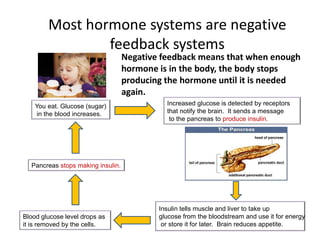
Negative feedback means that when enough
hormone is in the body, the body stops
producing the hormone until it is needed
again.
You eat. Glucose (sugar)
in the blood increases.
Increased glucose is detected by receptors
that notify the brain. It sends a message
to the pancreas to produce insulin.
Insulin tells muscle and liver to take up
glucose from the bloodstream and use it for energy
or store it for later. Brain reduces appetite.
Blood glucose level drops as
it is removed by the cells.
Pancreas stops making insulin.
Most hormone systems are negative
feedback systems
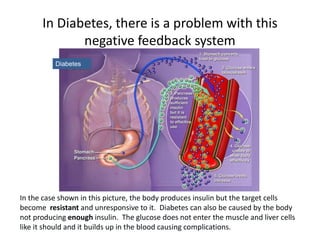
In the case shown in this picture, the body produces insulin but the target cells
become resistant and unresponsive to it. Diabetes can also be caused by the body
not producing enough insulin. The glucose does not enter the muscle and liver cells
like it should and it builds up in the blood causing complications.
Diabetes
In Diabetes, there is a problem with this
negative feedback system
Nature/Kinds of hormones
Q. What are the three basic types of hormones?
Ans. Hormones can be grouped into three main types:
• Amino acid derivatives, these are simple molecules (ending
in '-ine') are derived from tyrosine and tryptophan and
include epinephrine and norepinephrine (produced by the
adrenal medulla), thyroxine (produced by the thryoid
gland) and melatonin (produced by the pineal gland).
• proteins and peptides which are made from chains of
amino acids, include molecules such as oxytocin (short
polypeptide chain) or growth hormones ( proteins ).
• Steroid hormones are lipids hormones derived from
cholesterol (ending in '-ol' or '-one') include estradiol,
testosterone, aldosterone, and cortisol.
Some Common Hormones
Where each hormone comes from?
Where it acts ?
What the action is?
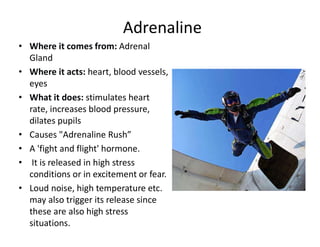
• Where it comes from: Adrenal
Gland
• Where it acts: heart, blood vessels,
eyes
• What it does: stimulates heart
rate, increases blood pressure,
dilates pupils
• Causes "Adrenaline Rush”
• A 'fight and flight' hormone.
• It is released in high stress
conditions or in excitement or fear.
• Loud noise, high temperature etc.
may also trigger its release since
these are also high stress
situations.
Adrenaline
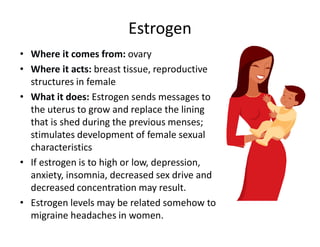
• Where it comes from: ovary
• Where it acts: breast tissue, reproductive
structures in female
• What it does: Estrogen sends messages to
the uterus to grow and replace the lining
that is shed during the previous menses;
stimulates development of female sexual
characteristics
• If estrogen is to high or low, depression,
anxiety, insomnia, decreased sex drive and
decreased concentration may result.
• Estrogen levels may be related somehow to
migraine headaches in women.
Estrogen
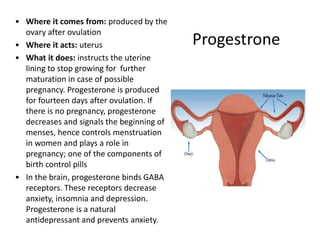
• Where it comes from: produced by the
ovary after ovulation
• Where it acts: uterus
• What it does: instructs the uterine
lining to stop growing for further
maturation in case of possible
pregnancy. Progesterone is produced
for fourteen days after ovulation. If
there is no pregnancy, progesterone
decreases and signals the beginning of
menses, hence controls menstruation
in women and plays a role in
pregnancy; one of the components of
birth control pills
• In the brain, progesterone binds GABA
receptors. These receptors decrease
anxiety, insomnia and depression.
Progesterone is a natural
antidepressant and prevents anxiety.
Progestrone
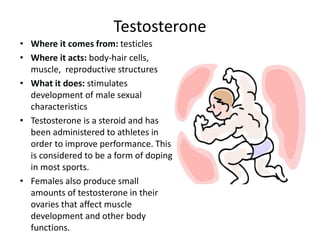
• Where it comes from: testicles
• Where it acts: body-hair cells,
muscle, reproductive structures
• What it does: stimulates
development of male sexual
characteristics
• Testosterone is a steroid and has
been administered to athletes in
order to improve performance. This
is considered to be a form of doping
in most sports.
• Females also produce small
amounts of testosterone in their
ovaries that affect muscle
development and other body
functions.
Testosterone
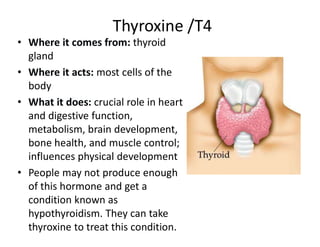
• Where it comes from: thyroid
gland
• Where it acts: most cells of the
body
• What it does: crucial role in heart
and digestive function,
metabolism, brain development,
bone health, and muscle control;
influences physical development
• People may not produce enough
of this hormone and get a
condition known as
hypothyroidism. They can take
thyroxine to treat this condition.
Thyroxine /T4
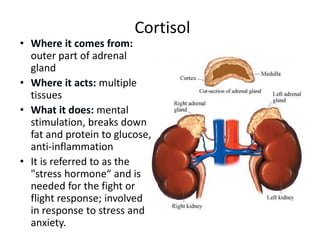
• Where it comes from:
outer part of adrenal
gland
• Where it acts: multiple
tissues
• What it does: mental
stimulation, breaks down
fat and protein to glucose,
anti-inflammation
• It is referred to as the
"stress hormone“ and is
needed for the fight or
flight response; involved
in response to stress and
anxiety.
Cortisol
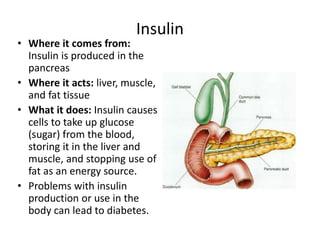
• Where it comes from:
Insulin is produced in the
pancreas
• Where it acts: liver, muscle,
and fat tissue
• What it does: Insulin causes
cells to take up glucose
(sugar) from the blood,
storing it in the liver and
muscle, and stopping use of
fat as an energy source.
• Problems with insulin
production or use in the
body can lead to diabetes.
Insulin
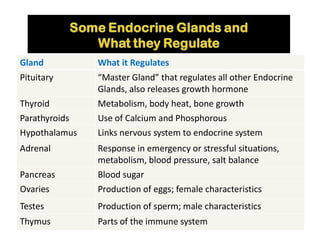
Gland What it Regulates
Pituitary “Master Gland” that regulates all other Endocrine
Glands, also releases growth hormone
Thyroid Metabolism, body heat, bone growth
Parathyroids Use of Calcium and Phosphorous
Hypothalamus Links nervous system to endocrine system
Adrenal Response in emergency or stressful situations,
metabolism, blood pressure, salt balance
Pancreas Blood sugar
Ovaries Production of eggs; female characteristics
Testes Production of sperm; male characteristics
Thymus Parts of the immune system
The Endocrine System
(continued)
• The glands most closely involved with the
stress response are the:
– pituitary
– thyroid
– adrenal
Other Stress-Related Hormones
• DHEA (Dehydroepiandrosterone) – an important
precursor hormone; highest circulating steroid
present in the human body; powerful when
converted into hormones such
as testosterone and estradiol
• Melatonin - produced at night and plays a
fundamental role in regulating the body's biological
clock; governs the entire sleep/wake cycle
• Serotonin - involved more specifically in
wakefulness, in triggering sleep, and in REM sleep.
Modern techniques to study brain &
nervous system
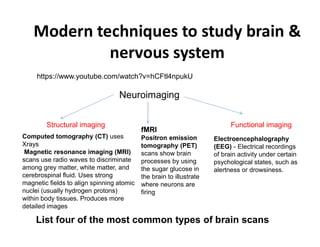
Electroencephalography
(EEG) - Electrical recordings
of brain activity under certain
psychological states, such as
alertness or drowsiness.
https://www.youtube.com/watch?v=hCFtl4npukU
List four of the most common types of brain scans
Neuroimaging
Structural imaging Functional imaging
Computed tomography (CT) uses
Xrays
Magnetic resonance imaging (MRI)
scans use radio waves to discriminate
among grey matter, white matter, and
cerebrospinal fluid. Uses strong
magnetic fields to align spinning atomic
nuclei (usually hydrogen protons)
within body tissues. Produces more
detailed images
fMRI
Positron emission
tomography (PET)
scans show brain
processes by using
the sugar glucose in
the brain to illustrate
where neurons are
firing
A Decade of Brain Research
(1992–2002)
• Use of MRIs to measure conscious thoughts
• Repeated exposure to cortisol increases aging
process of brain
• Repeated exposure to cortisol damages/ shrinks
brain tissue
• Damage due to repeated exposure to cortisol
appears to be irreversible
• We are “wired for stress” for physical threats yet
all threats set the alarm
Insomnia and Brain Physiology
• Various neurochemicals are released in the
brain during episodes of stress that can greatly
affect one’s quality of sleep.
• The brain chemistry equation for sleep involves
many neurochemicals including a delicate
balance between seratonin (neurotransmitter)
and melatonin (neurotransmitter like
substance) .
Insomnia and Brain Physiology
(continued)
• As night time approaches and daylight
decreases, melatonin levels increase to
help promote sleep.
• Various factors affect seratonin levels,
including light, food chemistry
(carbohydrates), pharmaceutical use, and
emotional stress, which in turn affect
melatonin levels and hence the quality of
sleep.
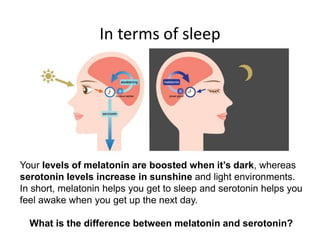
In terms of sleep
Your levels of melatonin are boosted when it’s dark, whereas
serotonin levels increase in sunshine and light environments.
In short, melatonin helps you get to sleep and serotonin helps you
feel awake when you get up the next day.
What is the difference between melatonin and serotonin?

Hormones and endocrine system.pdf

  • 1.
    Endocrine system &Hormones Good videos by Khan academy • Endocrine system (major hormones & functions) https://www.youtube.com/watch?v=ySkk7U_4PeY • Hormones – Intro & working https://www.youtube.com/watch?v=gaN0ceyrpqQ • Endocrine system physiology (https://www.youtube.com/watch?v=ER49EweKwW8)
  • 2.
    • The EndocrineSystem regulates, coordinates and controls: – Growth and development. – Male and female development. – How your body uses energy. – Levels of salts and sugars in your blood. – The amount (volume) of fluid in your body. – Appetite. – Many other body functions.
  • 3.
    • The Endocrine Glandsare the organs of the Endocrine System. • They produce and secrete (release) Hormones. • They are located all over your body.
  • 4.
    • The answeris Hormones! How do you think the Endocrine Glands get their jobs done?
  • 5.
    Definition Hormones are chemicalmessengers that are secreted (released) from glands into the blood and affect cells in another part of the body.
  • 6.
    • Hormones onlywork on certain cells, called target cells. • The target cells have special receptors that “recognize” the hormones and allow them to influence that cell. These receptors recognize the hormones. They “fit” like a lock and key. Target Cell for Hormone A Target Cell for Hormones A and B Target Cell for Hormone B Target Cell for Hormone A Hormone B Hormone A Target Cells
  • 7.
    by way ofnerves from the sensory organs in the nervous system Internal stimuli External stimuli by way of nerves and other hormones from inside the body What Controls the Hormones?
  • 8.
    Why both kindsof controls? What is the difference between nerve and hormone control? They control in different ways. Nerve action is quick (think reflexes) and can be stopped quickly. Hormone action is slower to develop and can last a lot longer. Notice that organ function is regulated by nerves and by hormones
  • 9.
    MCQs 1. Difference betweenendocrine and exocrine glands is that (a) endocrine glands release hormones, exocrine glands release waste (b) endocrine glands are interconnected, exocrine glands are totally independent (c) endocrine glands are formed by epithelial tissue, exocrine glands are connective tissues primarily (d) endocrine glands are ductless, exocrine glands release secretions into ducts or at the surface of the body
  • 10.
    2. These hormonesare responsible for “fight-or-flight” response (a) Thyroxine and melatonin (b) insulin and glucagon (c) epinephrine and norepinephrine (d) oestrogen and progesterone 3. After consuming a banana, which hormones would be expected to increase? (a) Prolactin (b) Glucagon (c) Insulin (d) Parathyroid hormone
  • 11.
    4. Which ofthe following hormones would be expected to increase if you were studying all day for a test and skipped breakfast and lunch? (a) Glucagon (b) Growth hormone (c) Insulin (d) Calcitonin 5. Which hormone increases basal metabolic rate (BMR) in the body? (a) Thyroid hormone (b) Glucagon (c) Secretin (d) Parathyroid hormone
  • 12.
    6. Where pituitarygland lies in our body? (a) In abdominal cavity (b) At the base of the brain (c) In larynx (d) In epithelial tissue 7. Where adrenal glands are located? (a) On top of each kidney (b) Upper part of trachea (c) Back of abdomen (d) Central part of brain 8. The adrenal gland is made up f 2 parts - (a) Exocrine and endocrine (b) Medulla and cortex (c) Posterior and anterior (d) None of these
  • 13.
    9. The largestendocrine gland is (a) Thymus (b) Pituitary (c) Thyroid (d) Adrenal 10. Which of the following is not part of the endocrine system? (a) Thyroid (b) Adrenals (c) Appendix (d) Pituitary
  • 14.
  • 15.
    Negative feedback meansthat when enough hormone is in the body, the body stops producing the hormone until it is needed again. You eat. Glucose (sugar) in the blood increases. Increased glucose is detected by receptors that notify the brain. It sends a message to the pancreas to produce insulin. Insulin tells muscle and liver to take up glucose from the bloodstream and use it for energy or store it for later. Brain reduces appetite. Blood glucose level drops as it is removed by the cells. Pancreas stops making insulin. Most hormone systems are negative feedback systems
  • 16.
    In the caseshown in this picture, the body produces insulin but the target cells become resistant and unresponsive to it. Diabetes can also be caused by the body not producing enough insulin. The glucose does not enter the muscle and liver cells like it should and it builds up in the blood causing complications. Diabetes In Diabetes, there is a problem with this negative feedback system
  • 17.
    Nature/Kinds of hormones Q.What are the three basic types of hormones? Ans. Hormones can be grouped into three main types: • Amino acid derivatives, these are simple molecules (ending in '-ine') are derived from tyrosine and tryptophan and include epinephrine and norepinephrine (produced by the adrenal medulla), thyroxine (produced by the thryoid gland) and melatonin (produced by the pineal gland). • proteins and peptides which are made from chains of amino acids, include molecules such as oxytocin (short polypeptide chain) or growth hormones ( proteins ). • Steroid hormones are lipids hormones derived from cholesterol (ending in '-ol' or '-one') include estradiol, testosterone, aldosterone, and cortisol.
  • 18.
    Some Common Hormones Whereeach hormone comes from? Where it acts ? What the action is?
  • 19.
    • Where itcomes from: Adrenal Gland • Where it acts: heart, blood vessels, eyes • What it does: stimulates heart rate, increases blood pressure, dilates pupils • Causes "Adrenaline Rush” • A 'fight and flight' hormone. • It is released in high stress conditions or in excitement or fear. • Loud noise, high temperature etc. may also trigger its release since these are also high stress situations. Adrenaline
  • 20.
    • Where itcomes from: ovary • Where it acts: breast tissue, reproductive structures in female • What it does: Estrogen sends messages to the uterus to grow and replace the lining that is shed during the previous menses; stimulates development of female sexual characteristics • If estrogen is to high or low, depression, anxiety, insomnia, decreased sex drive and decreased concentration may result. • Estrogen levels may be related somehow to migraine headaches in women. Estrogen
  • 21.
    • Where itcomes from: produced by the ovary after ovulation • Where it acts: uterus • What it does: instructs the uterine lining to stop growing for further maturation in case of possible pregnancy. Progesterone is produced for fourteen days after ovulation. If there is no pregnancy, progesterone decreases and signals the beginning of menses, hence controls menstruation in women and plays a role in pregnancy; one of the components of birth control pills • In the brain, progesterone binds GABA receptors. These receptors decrease anxiety, insomnia and depression. Progesterone is a natural antidepressant and prevents anxiety. Progestrone
  • 22.
    • Where itcomes from: testicles • Where it acts: body-hair cells, muscle, reproductive structures • What it does: stimulates development of male sexual characteristics • Testosterone is a steroid and has been administered to athletes in order to improve performance. This is considered to be a form of doping in most sports. • Females also produce small amounts of testosterone in their ovaries that affect muscle development and other body functions. Testosterone
  • 23.
    • Where itcomes from: thyroid gland • Where it acts: most cells of the body • What it does: crucial role in heart and digestive function, metabolism, brain development, bone health, and muscle control; influences physical development • People may not produce enough of this hormone and get a condition known as hypothyroidism. They can take thyroxine to treat this condition. Thyroxine /T4
  • 24.
    • Where itcomes from: outer part of adrenal gland • Where it acts: multiple tissues • What it does: mental stimulation, breaks down fat and protein to glucose, anti-inflammation • It is referred to as the "stress hormone“ and is needed for the fight or flight response; involved in response to stress and anxiety. Cortisol
  • 25.
    • Where itcomes from: Insulin is produced in the pancreas • Where it acts: liver, muscle, and fat tissue • What it does: Insulin causes cells to take up glucose (sugar) from the blood, storing it in the liver and muscle, and stopping use of fat as an energy source. • Problems with insulin production or use in the body can lead to diabetes. Insulin
  • 26.
    Gland What itRegulates Pituitary “Master Gland” that regulates all other Endocrine Glands, also releases growth hormone Thyroid Metabolism, body heat, bone growth Parathyroids Use of Calcium and Phosphorous Hypothalamus Links nervous system to endocrine system Adrenal Response in emergency or stressful situations, metabolism, blood pressure, salt balance Pancreas Blood sugar Ovaries Production of eggs; female characteristics Testes Production of sperm; male characteristics Thymus Parts of the immune system
  • 27.
    The Endocrine System (continued) •The glands most closely involved with the stress response are the: – pituitary – thyroid – adrenal
  • 28.
    Other Stress-Related Hormones •DHEA (Dehydroepiandrosterone) – an important precursor hormone; highest circulating steroid present in the human body; powerful when converted into hormones such as testosterone and estradiol • Melatonin - produced at night and plays a fundamental role in regulating the body's biological clock; governs the entire sleep/wake cycle • Serotonin - involved more specifically in wakefulness, in triggering sleep, and in REM sleep.
  • 29.
    Modern techniques tostudy brain & nervous system Electroencephalography (EEG) - Electrical recordings of brain activity under certain psychological states, such as alertness or drowsiness. https://www.youtube.com/watch?v=hCFtl4npukU List four of the most common types of brain scans Neuroimaging Structural imaging Functional imaging Computed tomography (CT) uses Xrays Magnetic resonance imaging (MRI) scans use radio waves to discriminate among grey matter, white matter, and cerebrospinal fluid. Uses strong magnetic fields to align spinning atomic nuclei (usually hydrogen protons) within body tissues. Produces more detailed images fMRI Positron emission tomography (PET) scans show brain processes by using the sugar glucose in the brain to illustrate where neurons are firing
  • 30.
    A Decade ofBrain Research (1992–2002) • Use of MRIs to measure conscious thoughts • Repeated exposure to cortisol increases aging process of brain • Repeated exposure to cortisol damages/ shrinks brain tissue • Damage due to repeated exposure to cortisol appears to be irreversible • We are “wired for stress” for physical threats yet all threats set the alarm
  • 31.
    Insomnia and BrainPhysiology • Various neurochemicals are released in the brain during episodes of stress that can greatly affect one’s quality of sleep. • The brain chemistry equation for sleep involves many neurochemicals including a delicate balance between seratonin (neurotransmitter) and melatonin (neurotransmitter like substance) .
  • 32.
    Insomnia and BrainPhysiology (continued) • As night time approaches and daylight decreases, melatonin levels increase to help promote sleep. • Various factors affect seratonin levels, including light, food chemistry (carbohydrates), pharmaceutical use, and emotional stress, which in turn affect melatonin levels and hence the quality of sleep.
  • 33.
    In terms ofsleep Your levels of melatonin are boosted when it’s dark, whereas serotonin levels increase in sunshine and light environments. In short, melatonin helps you get to sleep and serotonin helps you feel awake when you get up the next day. What is the difference between melatonin and serotonin?