Testosterone
Dr. Nabeel Beeran MBBS, MD
Department of Physiology
09/08/2019
1
Specific Learning Objectives
At the end of the class you should be able to:
• What is semen analysis and understand the
importance of semen analysis
• Explain the source, normal plasma concentration and
physiological actions of testosterone
• Describe the regulation of testicular functions
• Explain cryptorchidism and castration
2
3
Semen Analysis
• Volume: 2- 5 ml
• Milky apperance
• Alkaline pH: 7.5
• Specific gravity: 1.028
• Composition:
- Spermatozoa
- Epididymal secretion
- Secretions of seminal vesicles: fructose, fibrinogen,
prostaglandins, flavins, vit C.
- Secretion of prostate gland: spermine, citric acid,
cholesterol, clotting enzymes, fibrinolysin, zinc, acid
phosphatase, Prostate specific antigen (PSA)
- Secretion of bulbourethral gland: mucoid consistency
4
Testosterone
• Source:
• DHT> Testosterone> Androsterone> DHEA
• Normal plasma concentration:
• Males: 300-1000ng/dL
• Females: 30-70ng/dL
5
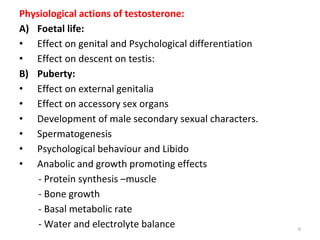
Physiological actions of testosterone:
A) Foetal life:
• Effect on genital and Psychological differentiation
• Effect on descent on testis:
B) Puberty:
• Effect on external genitalia
• Effect on accessory sex organs
• Development of male secondary sexual characters.
• Spermatogenesis
• Psychological behaviour and Libido
• Anabolic and growth promoting effects
- Protein synthesis –muscle
- Bone growth
- Basal metabolic rate
- Water and electrolyte balance 6
C) In adults:
• Hair growth
• Psyche
• Bone
• Spermatogenesis
• Hematopoiesis
• Regulation of gonadotropin secretion
7
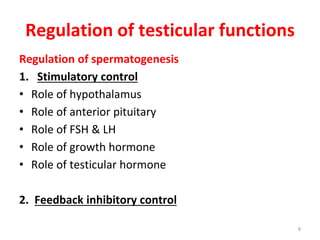
Regulation of testicular functions
Regulation of spermatogenesis
1. Stimulatory control
• Role of hypothalamus
• Role of anterior pituitary
• Role of FSH & LH
• Role of growth hormone
• Role of testicular hormone
2. Feedback inhibitory control
8
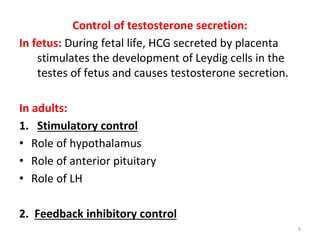
Control of testosterone secretion:
In fetus: During fetal life, HCG secreted by placenta
stimulates the development of Leydig cells in the
testes of fetus and causes testosterone secretion.
In adults:
1. Stimulatory control
• Role of hypothalamus
• Role of anterior pituitary
• Role of LH
2. Feedback inhibitory control
9
Applied Aspects
1. Cryptorchidism
2. Extirpation (Castration)
3. Hypogonadism in males
4. Hypergonadism in males
10
Cryptorchidism
• Refers to a condition in which the descent of
testes may fail to occur or may be
incomplete.
• Undescended testes may lie in the lumbar
region, in the iliac fossa, in the inguinal canal,
or in the upper part of scrotum.
11
• Treatment : -Surgical correction.
-Administration of testosterone
or gonadotrophic hormone can cause the
testis to descend provided the inguinal canal is
large enough to allow passage of testis.
• Complication: Spermatogenesis often fails to
occur in cryptorchidism (due to high
temperature of the abdominal cavity)
resulting in sterility.
12
Extirpation/ castration:
Effects of castration before puberty:
• Permanent sterility.
• Underdevelopment of external genitalia and
accessory sex organs.
• Underdevelopment of secondary sexual characters.
• Abnormal bone growth.
Effects of castration after puberty:
• Accessory sex organs – atrophy.
• Sexual desire and activity is slightly diminished.
13
Summary
14
References
• Guyton and Hall Textbook of Medical Physiology ,
• GK Pal Comprehensive textbook of Medical
Physiology. Volume 1
• Textbook of Medical Physiology (2nd edition)- Indu
Khurana
15
Thank
16

TESTOSTERONE

  • 1.
    Testosterone Dr. Nabeel BeeranMBBS, MD Department of Physiology 09/08/2019 1
  • 2.
    Specific Learning Objectives Atthe end of the class you should be able to: • What is semen analysis and understand the importance of semen analysis • Explain the source, normal plasma concentration and physiological actions of testosterone • Describe the regulation of testicular functions • Explain cryptorchidism and castration 2
  • 3.
  • 4.
    Semen Analysis • Volume:2- 5 ml • Milky apperance • Alkaline pH: 7.5 • Specific gravity: 1.028 • Composition: - Spermatozoa - Epididymal secretion - Secretions of seminal vesicles: fructose, fibrinogen, prostaglandins, flavins, vit C. - Secretion of prostate gland: spermine, citric acid, cholesterol, clotting enzymes, fibrinolysin, zinc, acid phosphatase, Prostate specific antigen (PSA) - Secretion of bulbourethral gland: mucoid consistency 4
  • 5.
    Testosterone • Source: • DHT>Testosterone> Androsterone> DHEA • Normal plasma concentration: • Males: 300-1000ng/dL • Females: 30-70ng/dL 5
  • 6.
    Physiological actions oftestosterone: A) Foetal life: • Effect on genital and Psychological differentiation • Effect on descent on testis: B) Puberty: • Effect on external genitalia • Effect on accessory sex organs • Development of male secondary sexual characters. • Spermatogenesis • Psychological behaviour and Libido • Anabolic and growth promoting effects - Protein synthesis –muscle - Bone growth - Basal metabolic rate - Water and electrolyte balance 6
  • 7.
    C) In adults: •Hair growth • Psyche • Bone • Spermatogenesis • Hematopoiesis • Regulation of gonadotropin secretion 7
  • 8.
    Regulation of testicularfunctions Regulation of spermatogenesis 1. Stimulatory control • Role of hypothalamus • Role of anterior pituitary • Role of FSH & LH • Role of growth hormone • Role of testicular hormone 2. Feedback inhibitory control 8
  • 9.
    Control of testosteronesecretion: In fetus: During fetal life, HCG secreted by placenta stimulates the development of Leydig cells in the testes of fetus and causes testosterone secretion. In adults: 1. Stimulatory control • Role of hypothalamus • Role of anterior pituitary • Role of LH 2. Feedback inhibitory control 9
  • 10.
    Applied Aspects 1. Cryptorchidism 2.Extirpation (Castration) 3. Hypogonadism in males 4. Hypergonadism in males 10
  • 11.
    Cryptorchidism • Refers toa condition in which the descent of testes may fail to occur or may be incomplete. • Undescended testes may lie in the lumbar region, in the iliac fossa, in the inguinal canal, or in the upper part of scrotum. 11
  • 12.
    • Treatment :-Surgical correction. -Administration of testosterone or gonadotrophic hormone can cause the testis to descend provided the inguinal canal is large enough to allow passage of testis. • Complication: Spermatogenesis often fails to occur in cryptorchidism (due to high temperature of the abdominal cavity) resulting in sterility. 12
  • 13.
    Extirpation/ castration: Effects ofcastration before puberty: • Permanent sterility. • Underdevelopment of external genitalia and accessory sex organs. • Underdevelopment of secondary sexual characters. • Abnormal bone growth. Effects of castration after puberty: • Accessory sex organs – atrophy. • Sexual desire and activity is slightly diminished. 13
  • 14.
  • 15.
    References • Guyton andHall Textbook of Medical Physiology , • GK Pal Comprehensive textbook of Medical Physiology. Volume 1 • Textbook of Medical Physiology (2nd edition)- Indu Khurana 15
  • 16.