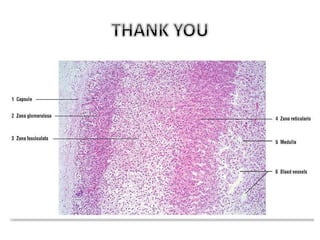
ADRENAL GLAND 
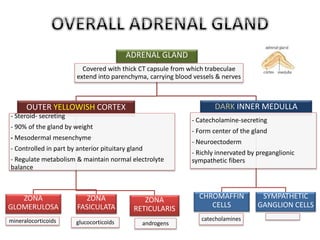
Covered with thick CT capsule from which trabeculae 
extend into parenchyma, carrying blood vessels & nerves 
OUTER YELLOWISH CORTEX 
- Steroid- secreting 
- 90% of the gland by weight 
- Mesodermal mesenchyme 
- Controlled in part by anterior pituitary gland 
- Regulate metabolism & maintain normal electrolyte 
balance 
ZONA 
GLOMERULOSA 
mineralocorticoids 
ZONA 
FASICULATA 
glucocorticoids 
ZONA 
RETICULARIS 
androgens 
DARK INNER MEDULLA 
- Catecholamine-secreting 
- Form center of the gland 
- Neuroectoderm 
- Richly innervated by preganglionic 
sympathetic fibers 
CHROMAFFIN 
CELLS 
catecholamines 
SYMPATHETIC 
GANGLION CELLS
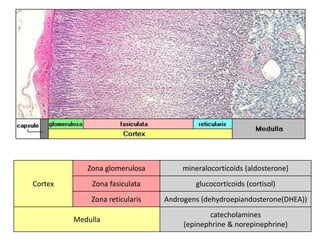
Cortex 
Zona glomerulosa mineralocorticoids (aldosterone) 
Zona fasiculata glucocorticoids (cortisol) 
Zona reticularis Androgens (dehydroepiandosterone(DHEA)) 
Medulla 
catecholamines 
(epinephrine & norepinephrine)
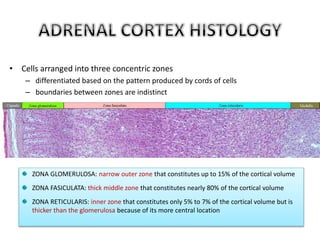
• Cells arranged into three concentric zones 
– differentiated based on the pattern produced by cords of cells 
– boundaries between zones are indistinct 
ZONA GLOMERULOSA: narrow outer zone that constitutes up to 15% of the cortical volume 
ZONA FASICULATA: thick middle zone that constitutes nearly 80% of the cortical volume 
ZONA RETICULARIS: inner zone that constitutes only 5% to 7% of the cortical volume but is 
thicker than the glomerulosa because of its more central location
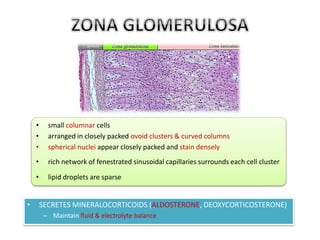
• small columnar cells 
• arranged in closely packed ovoid clusters & curved columns 
• spherical nuclei appear closely packed and stain densely 
• rich network of fenestrated sinusoidal capillaries surrounds each cell cluster 
• lipid droplets are sparse 
• SECRETES MINERALOCORTICOIDS (ALDOSTERONE, DEOXYCORTICOSTERONE) 
– Maintain fluid & electrolyte balance
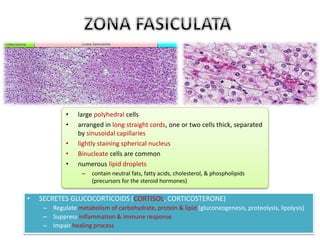
• large polyhedral cells 
• arranged in long straight cords, one or two cells thick, separated 
by sinusoidal capillaries 
• lightly staining spherical nucleus 
• Binucleate cells are common 
• numerous lipid droplets 
– contain neutral fats, fatty acids, cholesterol, & phospholipids 
(precursors for the steroid hormones) 
• SECRETES GLUCOCORTICOIDS (CORTISOL, CORTICOSTERONE) 
– Regulate metabolism of carbohydrate, protein & lipid (gluconeogenesis, proteolysis, lipolysis) 
– Suppress inflammation & immune response 
– Impair healing process
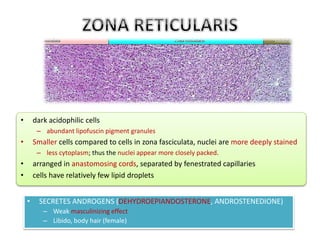
• dark acidophilic cells 
– abundant lipofuscin pigment granules 
• Smaller cells compared to cells in zona fasciculata, nuclei are more deeply stained 
– less cytoplasm; thus the nuclei appear more closely packed. 
• arranged in anastomosing cords, separated by fenestrated capillaries 
• cells have relatively few lipid droplets 
• SECRETES ANDROGENS (DEHYDROEPIANDOSTERONE, ANDROSTENEDIONE) 
– Weak masculinizing effect 
– Libido, body hair (female)
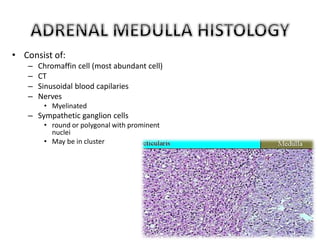
• Consist of: 
– Chromaffin cell (most abundant cell) 
– CT 
– Sinusoidal blood capilaries 
– Nerves 
• Myelinated 
– Sympathetic ganglion cells 
• round or polygonal with prominent 
nuclei 
• May be in cluster
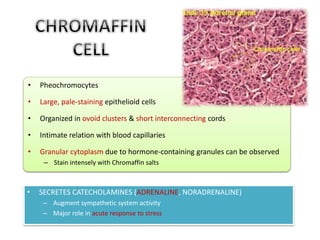
• Pheochromocytes 
• Large, pale-staining epithelioid cells 
• Organized in ovoid clusters & short interconnecting cords 
• Intimate relation with blood capillaries 
• Granular cytoplasm due to hormone-containing granules can be observed 
– Stain intensely with Chromaffin salts 
• SECRETES CATECHOLAMINES (ADRENALINE, NORADRENALINE) 
– Augment sympathetic system activity 
– Major role in acute response to stress
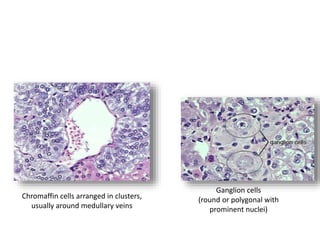
Chromaffin cells arranged in clusters, 
usually around medullary veins 
Ganglion cells 
(round or polygonal with 
prominent nuclei)
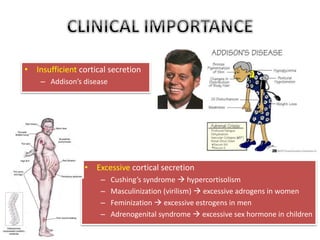
• Insufficient cortical secretion 
– Addison’s disease 
• Excessive cortical secretion 
– Cushing’s syndrome  hypercortisolism 
– Masculinization (virilism)  excessive adrogens in women 
– Feminization  excessive estrogens in men 
– Adrenogenital syndrome  excessive sex hormone in children
• Abnormal medullary secretion 
– Hyposecretion 
• Not much problem if sympathetic function is normal 
• Some attenuation of acute response to stress 
– Hypersecretion 
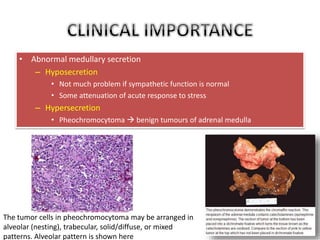
• Pheochromocytoma  benign tumours of adrenal medulla 
The tumor cells in pheochromocytoma may be arranged in 
alveolar (nesting), trabecular, solid/diffuse, or mixed 
patterns. Alveolar pattern is shown here
• Histology of adrenal gland 
– http://arbl.cvmbs.colostate.edu/hbooks/pathphys/endocrine/adrenal/histo_overview.html 
• Histology: A Text and Atlas 
by Ross M.H. and Pawlina W. 
– https://www.inkling.com/read/histology-michael-ross-and-wojciech-pawlina-6th/chapter- 
21/adrenal-glands#4652fc36484946c9a323b2baa04cd87b 
• DiFiore's Atlas of Histology with Functional Correlations 
By Victor P. Eroschenko, Mariano S. H. di Fiore 
– http://books.google.com.my/books?id=sH87M12QswcC&pg=PA463&lpg=PA463&dq=histologi 
cal+structure+adrenal+gland%27s+correlation+with+function&source=bl&ots=zP80SNqbej&si 
g=Cxhx-znWfbs0TdVCSrUFGTdCxBk& 
hl=en&sa=X&ei=LJwAVOapO5CcugSGuoLQDg&redir_esc=y#v=on 
epage&q=histological%20structure%20adrenal%20gland's%20correlation%20with%20functio 
n&f=false 
• Adrenal Medulla Development Movie 
– http://embryology.med.unsw.edu.au/embryology/index.php?title=Adrenal_Medulla_Develop 
ment_Movie

HISTOLOGY OF ADRENAL GLAND & CORRELATION WITH FUNCTION

  • 2.
    ADRENAL GLAND Coveredwith thick CT capsule from which trabeculae extend into parenchyma, carrying blood vessels & nerves OUTER YELLOWISH CORTEX - Steroid- secreting - 90% of the gland by weight - Mesodermal mesenchyme - Controlled in part by anterior pituitary gland - Regulate metabolism & maintain normal electrolyte balance ZONA GLOMERULOSA mineralocorticoids ZONA FASICULATA glucocorticoids ZONA RETICULARIS androgens DARK INNER MEDULLA - Catecholamine-secreting - Form center of the gland - Neuroectoderm - Richly innervated by preganglionic sympathetic fibers CHROMAFFIN CELLS catecholamines SYMPATHETIC GANGLION CELLS
  • 3.
    Cortex Zona glomerulosamineralocorticoids (aldosterone) Zona fasiculata glucocorticoids (cortisol) Zona reticularis Androgens (dehydroepiandosterone(DHEA)) Medulla catecholamines (epinephrine & norepinephrine)
  • 4.
    • Cells arrangedinto three concentric zones – differentiated based on the pattern produced by cords of cells – boundaries between zones are indistinct ZONA GLOMERULOSA: narrow outer zone that constitutes up to 15% of the cortical volume ZONA FASICULATA: thick middle zone that constitutes nearly 80% of the cortical volume ZONA RETICULARIS: inner zone that constitutes only 5% to 7% of the cortical volume but is thicker than the glomerulosa because of its more central location
  • 5.
    • small columnarcells • arranged in closely packed ovoid clusters & curved columns • spherical nuclei appear closely packed and stain densely • rich network of fenestrated sinusoidal capillaries surrounds each cell cluster • lipid droplets are sparse • SECRETES MINERALOCORTICOIDS (ALDOSTERONE, DEOXYCORTICOSTERONE) – Maintain fluid & electrolyte balance
  • 6.
    • large polyhedralcells • arranged in long straight cords, one or two cells thick, separated by sinusoidal capillaries • lightly staining spherical nucleus • Binucleate cells are common • numerous lipid droplets – contain neutral fats, fatty acids, cholesterol, & phospholipids (precursors for the steroid hormones) • SECRETES GLUCOCORTICOIDS (CORTISOL, CORTICOSTERONE) – Regulate metabolism of carbohydrate, protein & lipid (gluconeogenesis, proteolysis, lipolysis) – Suppress inflammation & immune response – Impair healing process
  • 7.
    • dark acidophiliccells – abundant lipofuscin pigment granules • Smaller cells compared to cells in zona fasciculata, nuclei are more deeply stained – less cytoplasm; thus the nuclei appear more closely packed. • arranged in anastomosing cords, separated by fenestrated capillaries • cells have relatively few lipid droplets • SECRETES ANDROGENS (DEHYDROEPIANDOSTERONE, ANDROSTENEDIONE) – Weak masculinizing effect – Libido, body hair (female)
  • 8.
    • Consist of: – Chromaffin cell (most abundant cell) – CT – Sinusoidal blood capilaries – Nerves • Myelinated – Sympathetic ganglion cells • round or polygonal with prominent nuclei • May be in cluster
  • 9.
    • Pheochromocytes •Large, pale-staining epithelioid cells • Organized in ovoid clusters & short interconnecting cords • Intimate relation with blood capillaries • Granular cytoplasm due to hormone-containing granules can be observed – Stain intensely with Chromaffin salts • SECRETES CATECHOLAMINES (ADRENALINE, NORADRENALINE) – Augment sympathetic system activity – Major role in acute response to stress
  • 10.
    Chromaffin cells arrangedin clusters, usually around medullary veins Ganglion cells (round or polygonal with prominent nuclei)
  • 11.
    • Insufficient corticalsecretion – Addison’s disease • Excessive cortical secretion – Cushing’s syndrome  hypercortisolism – Masculinization (virilism)  excessive adrogens in women – Feminization  excessive estrogens in men – Adrenogenital syndrome  excessive sex hormone in children
  • 12.
    • Abnormal medullarysecretion – Hyposecretion • Not much problem if sympathetic function is normal • Some attenuation of acute response to stress – Hypersecretion • Pheochromocytoma  benign tumours of adrenal medulla The tumor cells in pheochromocytoma may be arranged in alveolar (nesting), trabecular, solid/diffuse, or mixed patterns. Alveolar pattern is shown here
  • 14.
    • Histology ofadrenal gland – http://arbl.cvmbs.colostate.edu/hbooks/pathphys/endocrine/adrenal/histo_overview.html • Histology: A Text and Atlas by Ross M.H. and Pawlina W. – https://www.inkling.com/read/histology-michael-ross-and-wojciech-pawlina-6th/chapter- 21/adrenal-glands#4652fc36484946c9a323b2baa04cd87b • DiFiore's Atlas of Histology with Functional Correlations By Victor P. Eroschenko, Mariano S. H. di Fiore – http://books.google.com.my/books?id=sH87M12QswcC&pg=PA463&lpg=PA463&dq=histologi cal+structure+adrenal+gland%27s+correlation+with+function&source=bl&ots=zP80SNqbej&si g=Cxhx-znWfbs0TdVCSrUFGTdCxBk& hl=en&sa=X&ei=LJwAVOapO5CcugSGuoLQDg&redir_esc=y#v=on epage&q=histological%20structure%20adrenal%20gland's%20correlation%20with%20functio n&f=false • Adrenal Medulla Development Movie – http://embryology.med.unsw.edu.au/embryology/index.php?title=Adrenal_Medulla_Develop ment_Movie

Editor's Notes

  • #3 Week 4 - coelomic epithelium (mesothelium) cells proliferate initially forming small buds that separate from the epithelium. Week 6 - these now mesenchymal cells surrounding the developing medulla cells differentiate first form the fetal adrenal cortex which will be later replaced by the adult cortex. Week 8 to 9 - fetal adrenal cortex synthesizes cortisol and is maximal at 8-9 weeks post conception (wpc) under the regulation of ACTH (also stimulates androstenedione and testosterone secretion).[5] Adult cortex - mesothelium mesenchyme encloses fetal cortex. Late Fetal Period - differentiates to form cortical zones. Birth - zona glomerulosa, zona fasiculata present. Year 3 - zona reticularis present.
  • #5 Zona glomerulosa columnar in shape arranged in irregular cords Zona fasiculata  largest of the three zones in the cortex polyhedral cells & usually have a foamy appearance due to abundant lipid droplets arranged in distinctively straight cords that radiate toward the medulla Zona reticularis arranged in cords that project in many different directions & anastomose with one another.
  • #6 Increase sodium reabsorption & potassium excretion
  • #7 In general, the cytoplasm is acidophilic and contains numerous lipid droplets, although it usually appears vacuolated in routine histologic sections because of the extraction of lipid during dehydration Func: elevates blood glucose, plasma amino acid level and free fatty acids- prepare for acute stress reaction
  • #8 exhibit features of steroid-secreting cells, namely, a well-developed sER and numerous elongated mitochondria with tubular cristae, but they have little rER
  • #11 name derives from the phenomenon that if fixed in a solution containing chromium salts, it takes on a brownish appearance due to oxidation of catecholamines to melanin
  • #14 Female pseudohermaphroditism excessive adrogens in female foetus , in male excessive growth of external genital organ Addison’s – muscular weakness, low BP, anaemia, pigmentation, renal failure cushing’s – obesity, hirsutism, diabetes, hypogonadism
  • #15 Pheochromocytoma- hypertension + palpitation, headache, excessive sweating, pallor of skin