Capacitors Physics 102:   Lecture 04
Recall from last lecture….. Electric Fields, Electric Potential
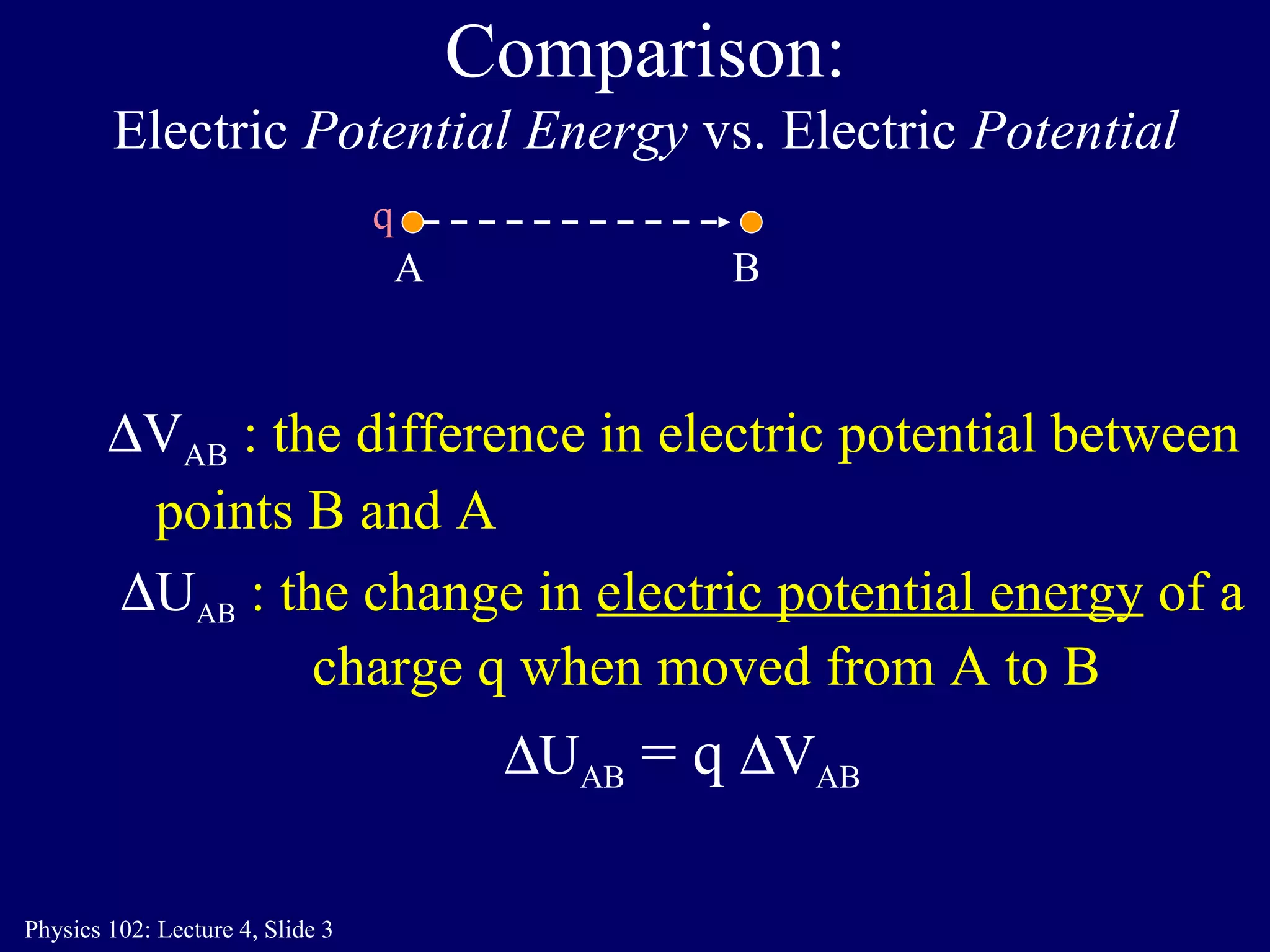
Comparison: Electric  Potential Energy  vs. Electric  Potential    V AB   : the difference in electric potential between points B and A  U AB  : the change in  electric potential energy  of a charge q when moved from A to B  U AB  = q   V AB q A B
 
Electric Potential:  Summary E field lines point from  higher  to  lower  potential For positive charges, going from  higher to lower  potential is  “downhill” For a battery, the (+) terminal is at a higher potential than the (–) terminal Positive charges tend to go “downhill”, from + to   Negative charges go in the opposite direction, from    to +  U AB  = q   V AB
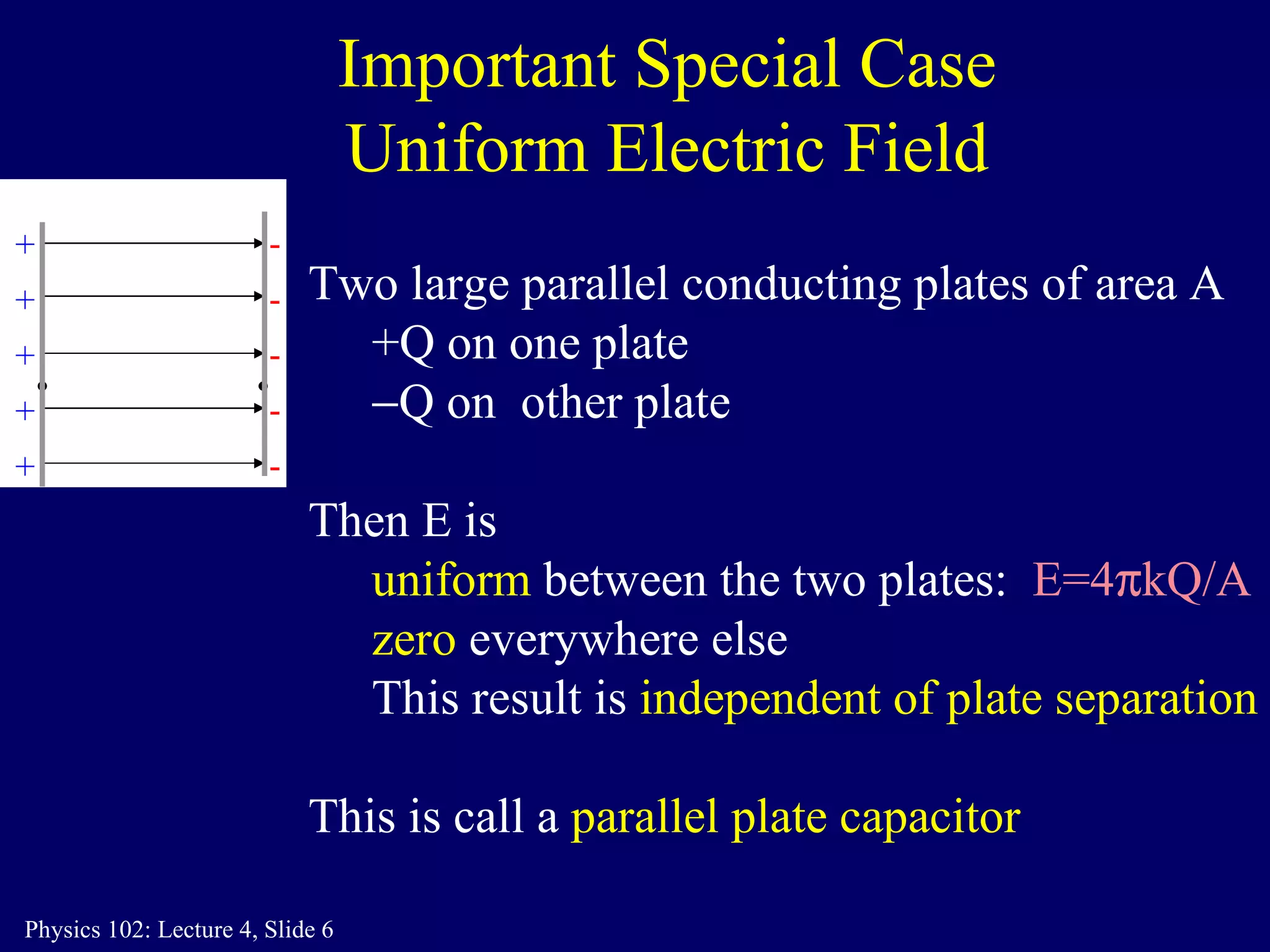
Important Special Case Uniform Electric Field + + + + + - - - - - Two large parallel conducting plates of area A +Q on one plate  Q on  other plate Then E is  uniform  between the two plates:  E=4  kQ/A zero  everywhere else This result is  independent of plate separation This is call a  parallel plate capacitor
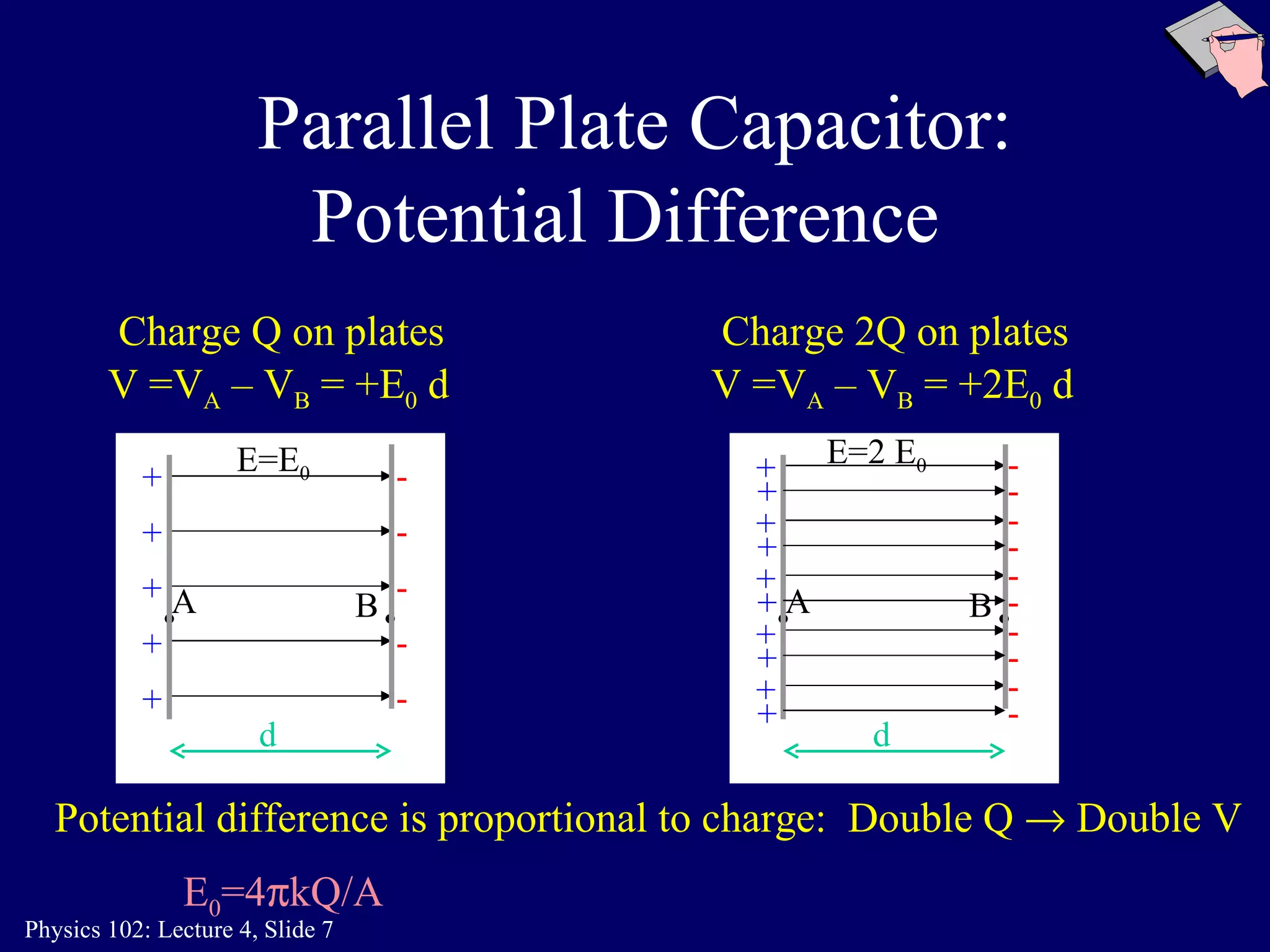
Parallel Plate Capacitor: Potential Difference  E=E 0 d V =V A  – V B  = +E 0  d + + + + + - - - - - A B d + + + + + - - - - - + + + + + - - - - - E=2 E 0 V =V A  – V B  = +2E 0  d Potential difference is proportional to charge:  Double Q    Double V Charge Q on plates Charge 2Q on plates  E 0 =4  kQ/A A B
 
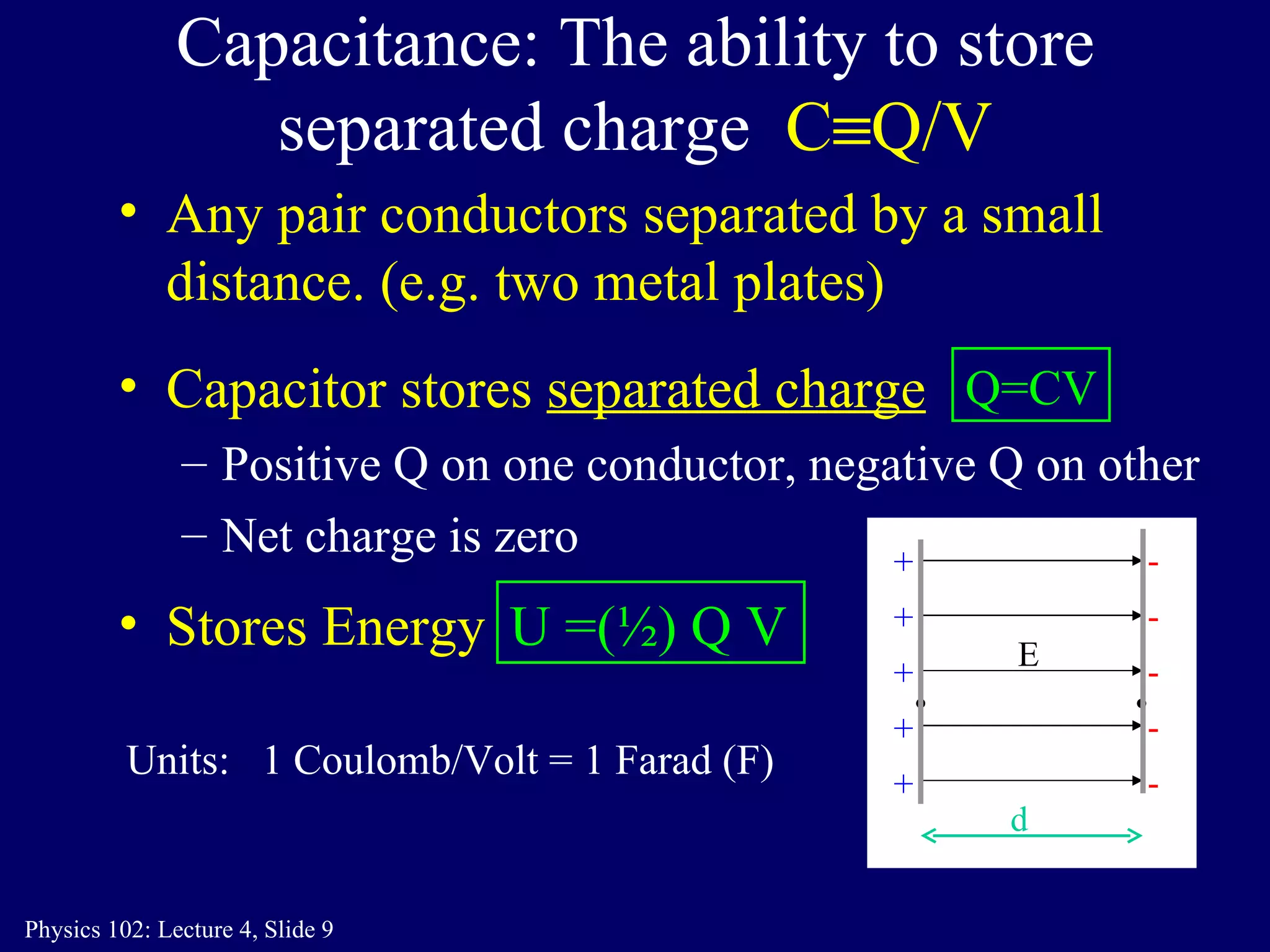
Capacitance: The ability to store separated charge  C  Q/V Any pair conductors separated by a small distance. (e.g. two metal plates)  Capacitor stores  separated charge   Positive Q on one conductor, negative Q on other Net charge is zero Q=CV U =(½) Q V   Stores Energy Units:  1 Coulomb/Volt = 1 Farad (F) E d + + + + + - - - - -
Why Separate Charge? Camera Flash Defibrillator—see ex. 17.12 in text AC  ->  DC Tuners  Radio Cell phones Analogy to a waterfall
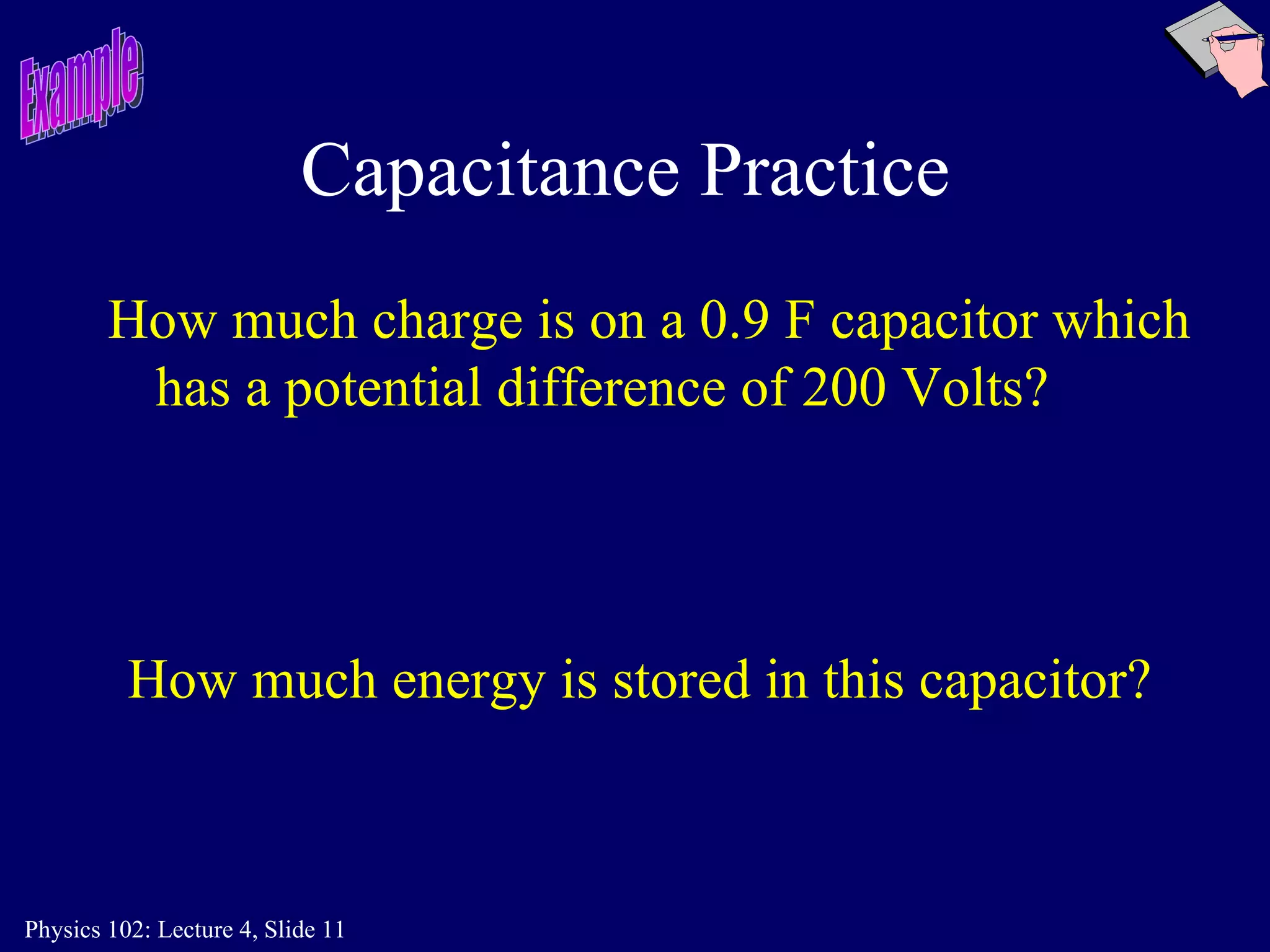
Capacitance Practice   How much charge is on a 0.9 F capacitor which has a potential difference of 200 Volts? How much energy is stored in this capacitor? Example
 
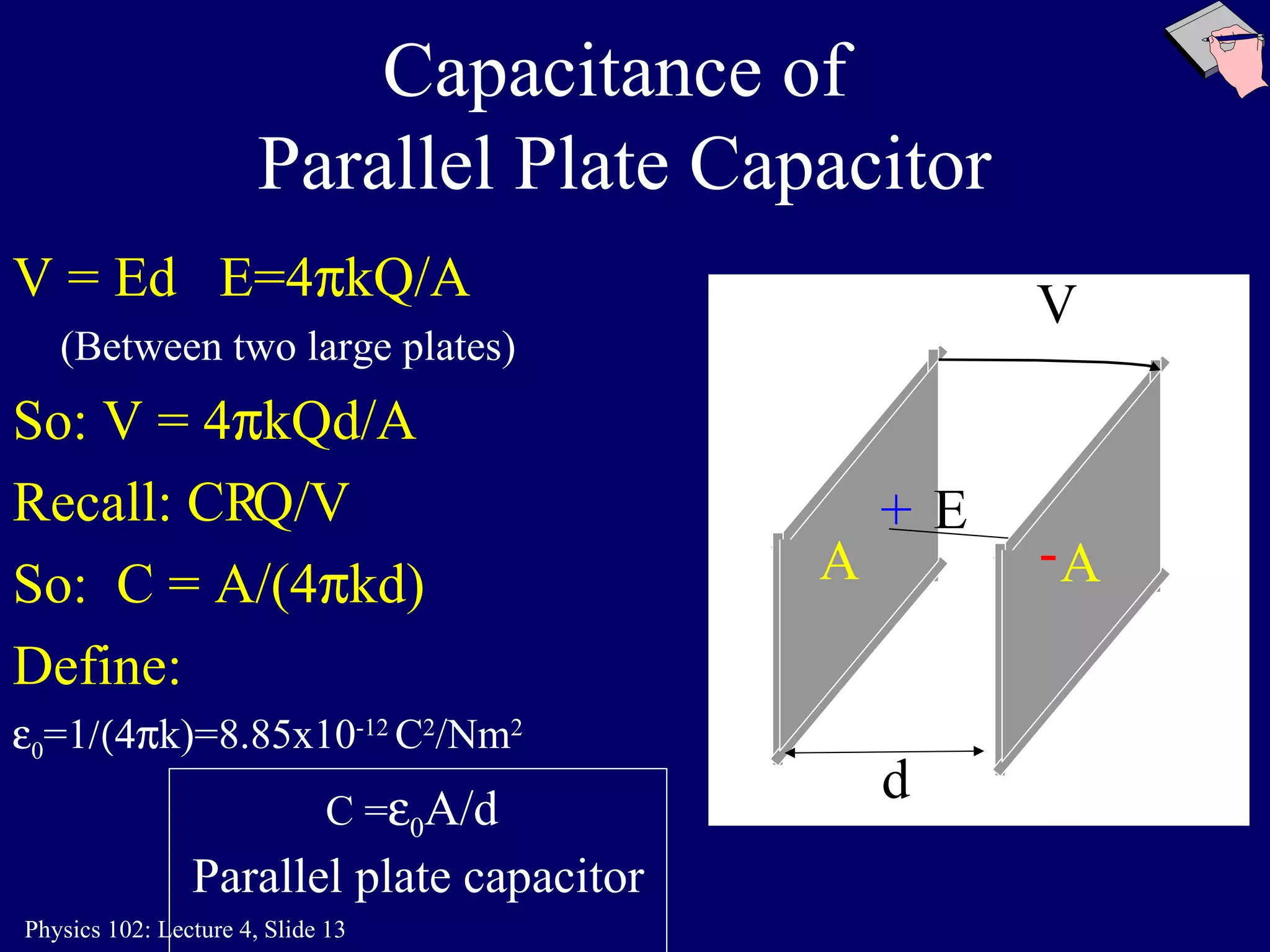
Capacitance of  Parallel Plate Capacitor V = Ed  E=4  kQ/A (Between two large plates) So: V = 4  kQd/A Recall: C  Q/V  So:  C = A/(4  kd) Define:   0 =1  k)=8.85x10 -12  C 2 /Nm 2 A d A E + - V C =  0 A/d  Parallel plate capacitor
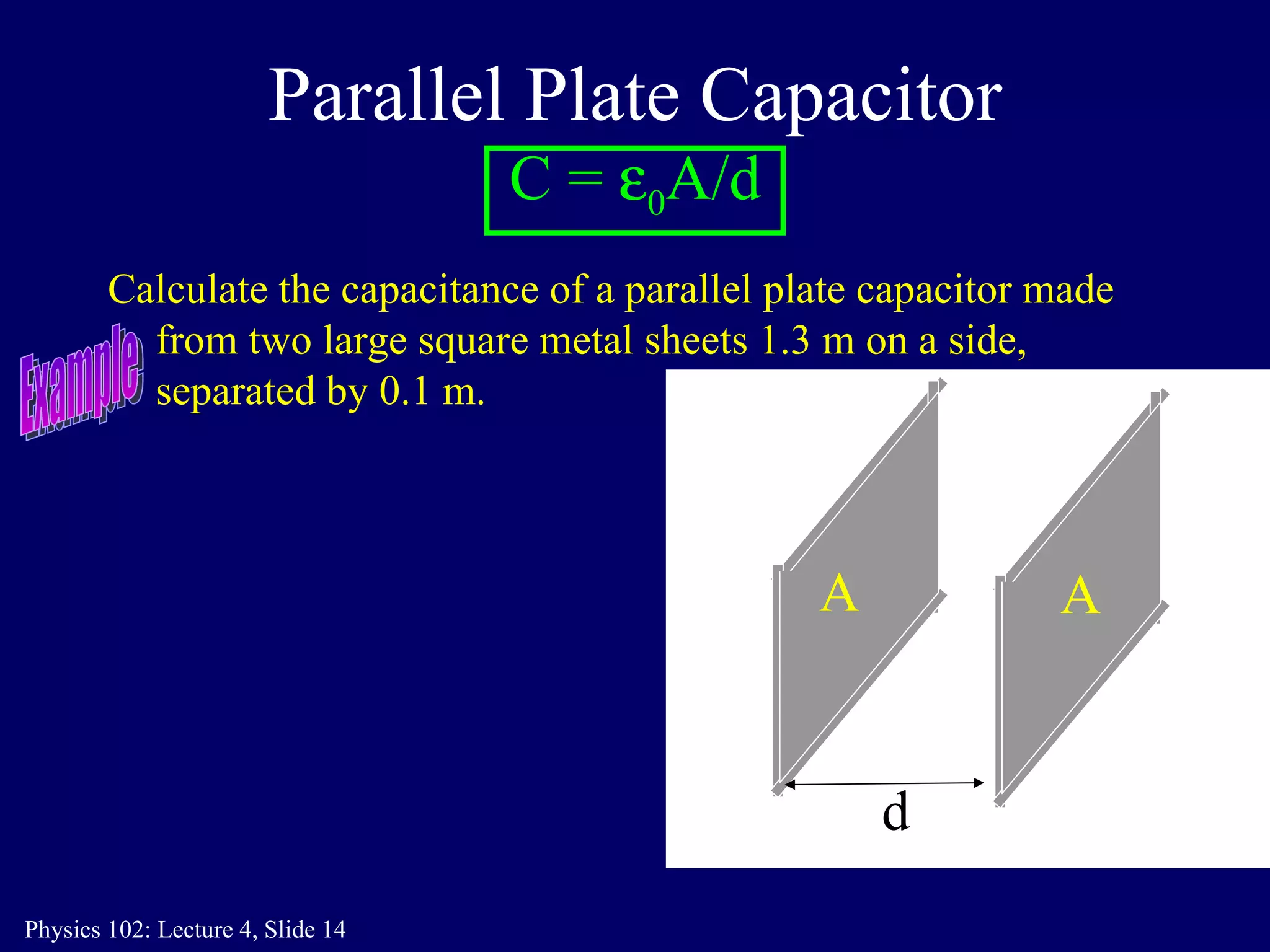
Parallel Plate Capacitor C =   0 A/d Calculate the capacitance of a parallel plate capacitor made from two large square metal sheets 1.3 m on a side, separated by 0.1 m. A d A Example
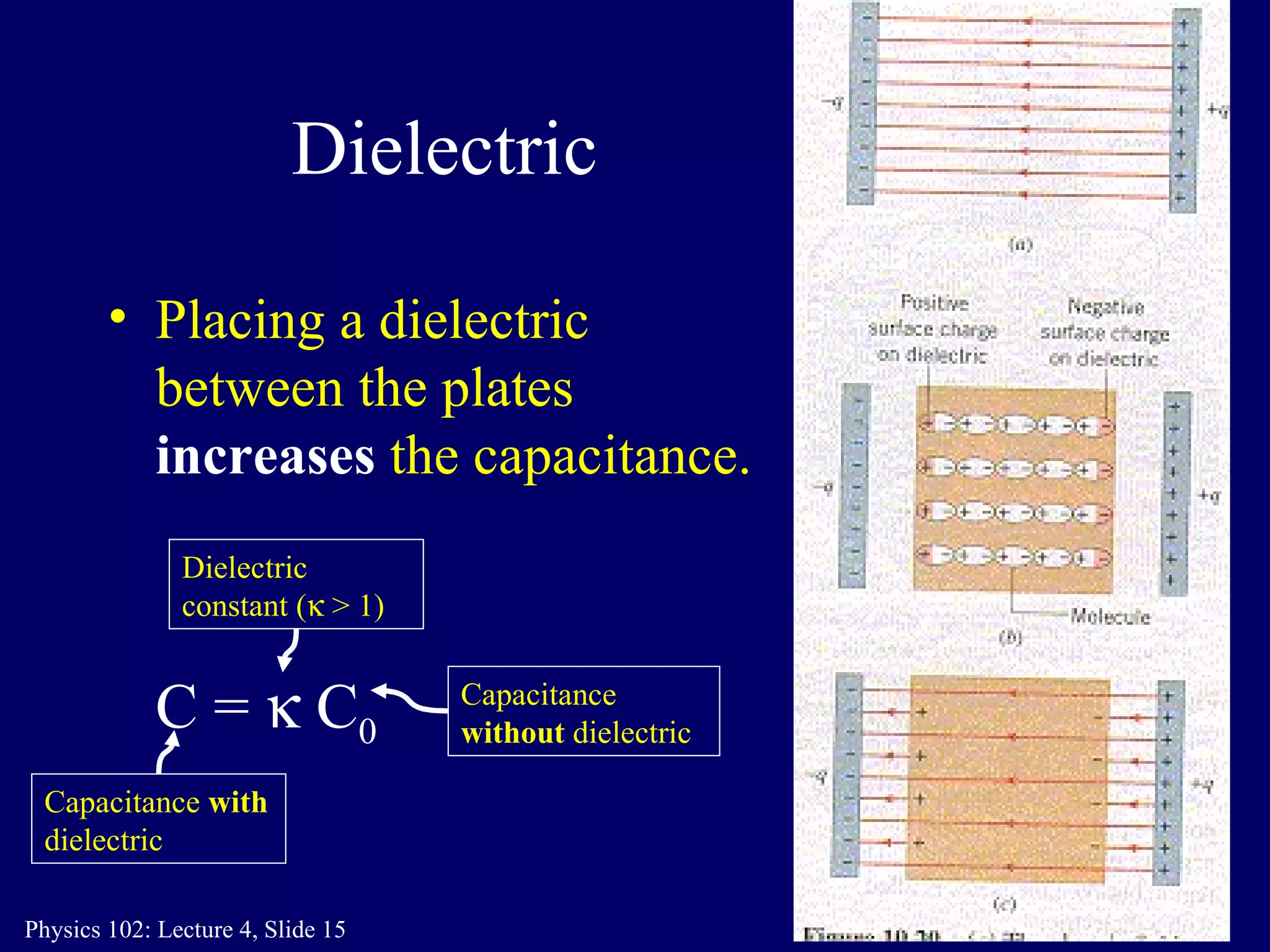
Dielectric Placing a dielectric between the plates  increases  the capacitance. C =    C 0 Capacitance  with  dielectric Dielectric constant (   > 1) Capacitance  without  dielectric
 
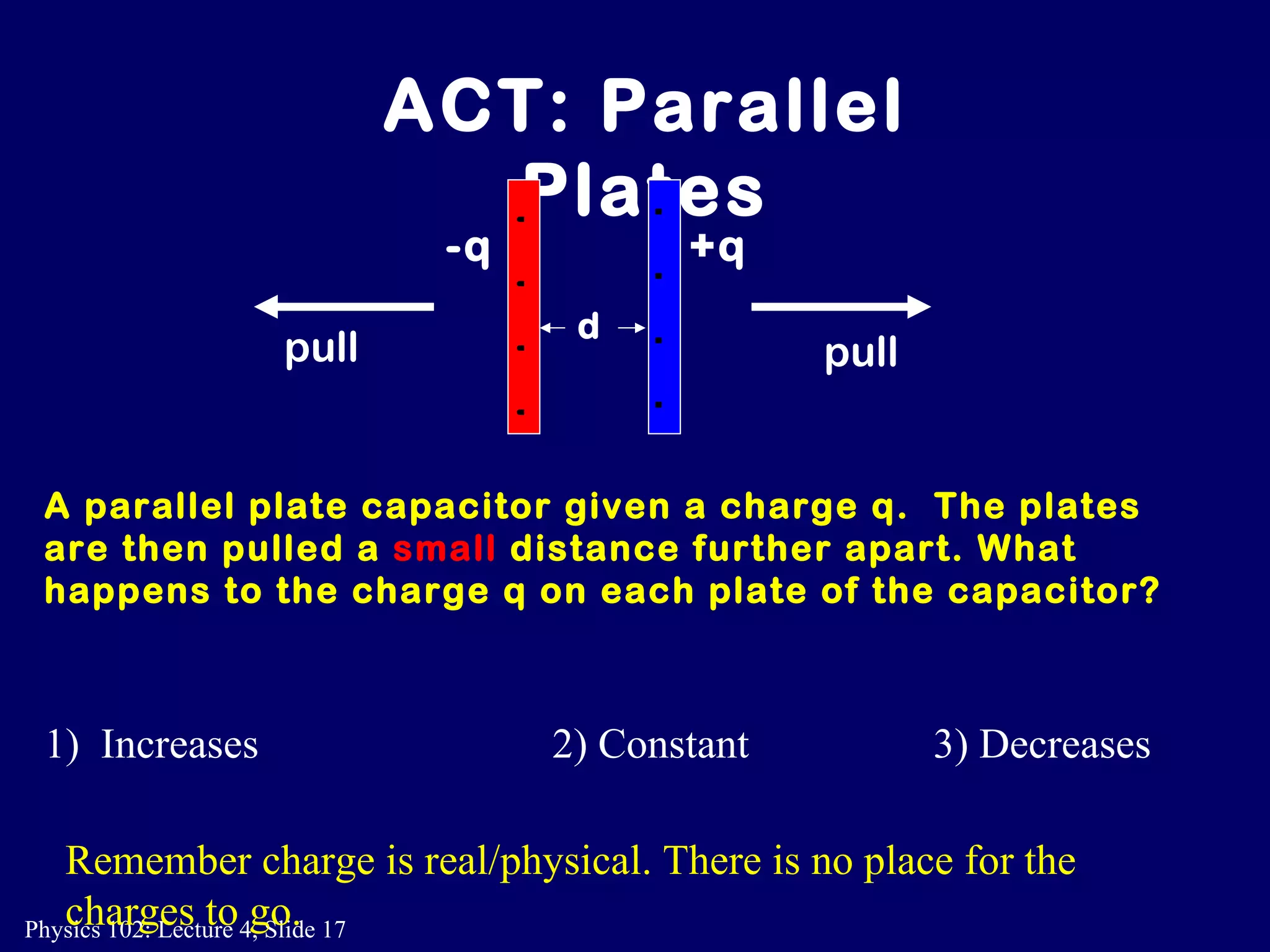
A parallel plate capacitor given a charge q.  The plates are then pulled a  small  distance further apart. What happens to the charge q on each plate of the capacitor? ACT: Parallel Plates 1)  Increases 2) Constant 3) Decreases Remember charge is real/physical. There is no place for the charges to go.  +q -q + + + + - - - - d pull pull
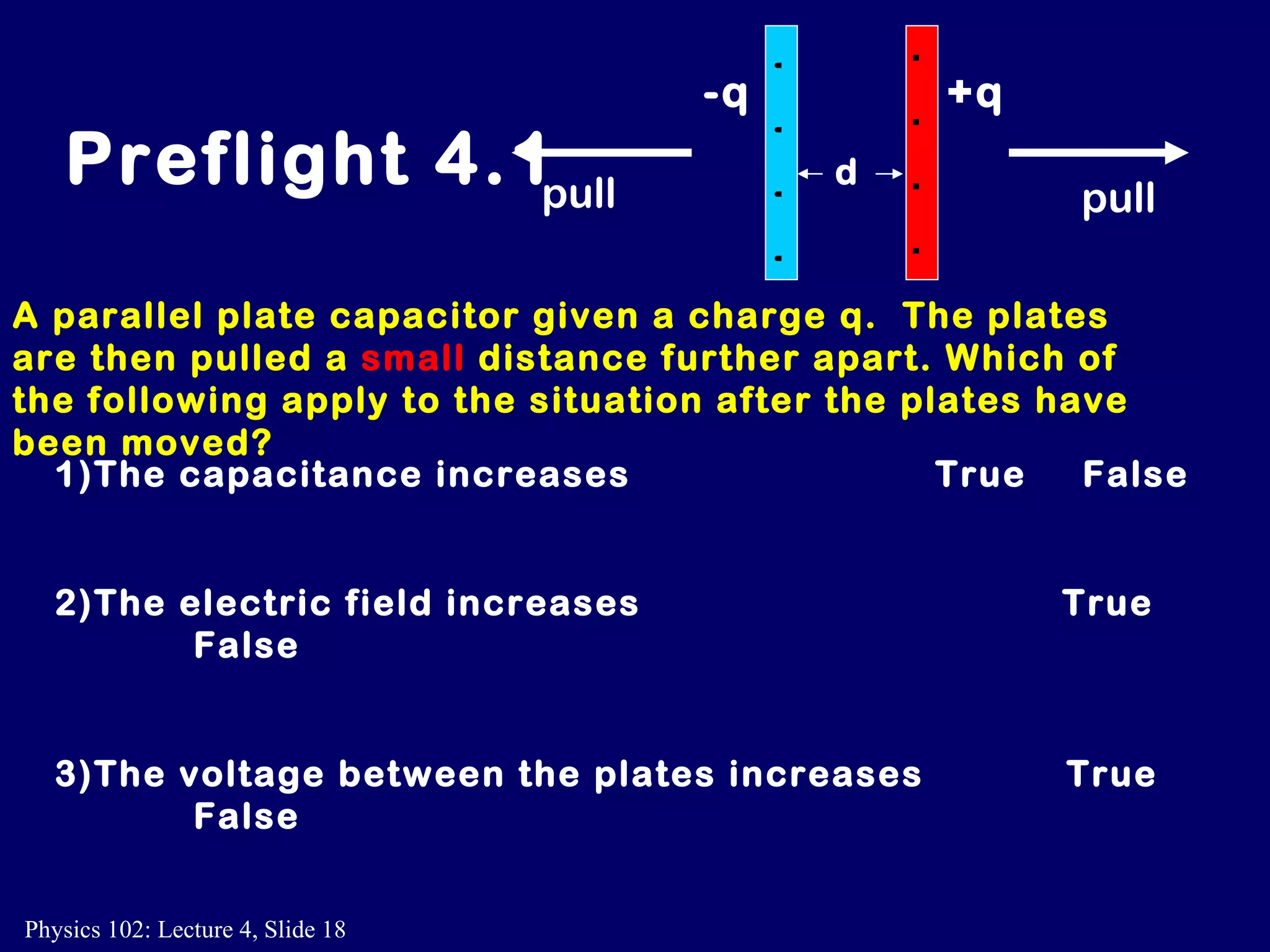
A parallel plate capacitor given a charge q.  The plates are then pulled a  small   distance further apart. Which of the following apply to the situation after the plates have been moved? 1)The capacitance increases    True  False 2)The electric field increases      True  False 3)The voltage between the plates increases  True  False Preflight 4.1 +q -q + + + + - - - - d pull pull
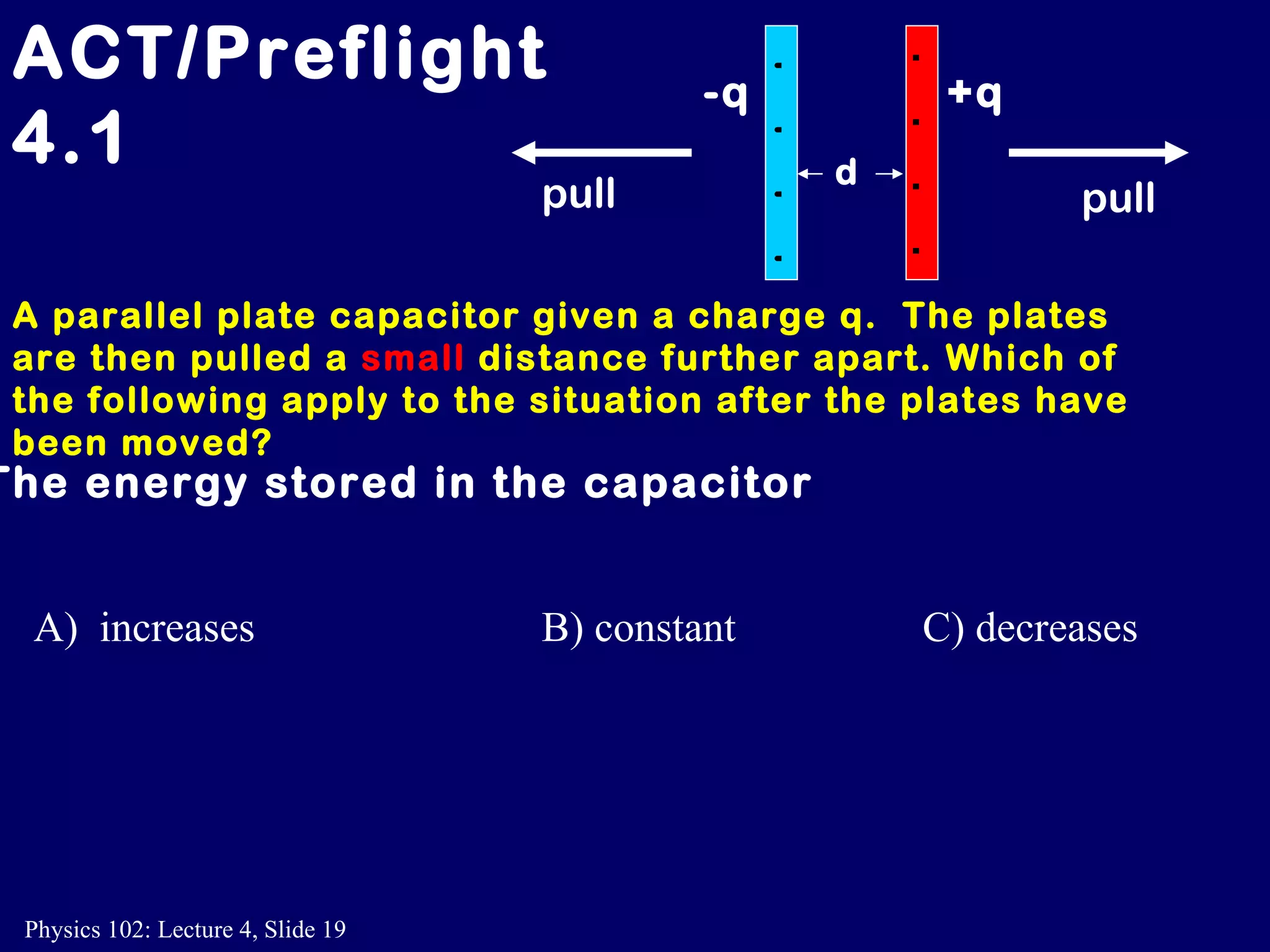
A parallel plate capacitor given a charge q.  The plates are then pulled a  small  distance further apart. Which of the following apply to the situation after the plates have been moved? ACT/Preflight 4.1 The energy stored in the capacitor A)  increases B) constant C) decreases +q -q + + + + - - - - d pull pull
 
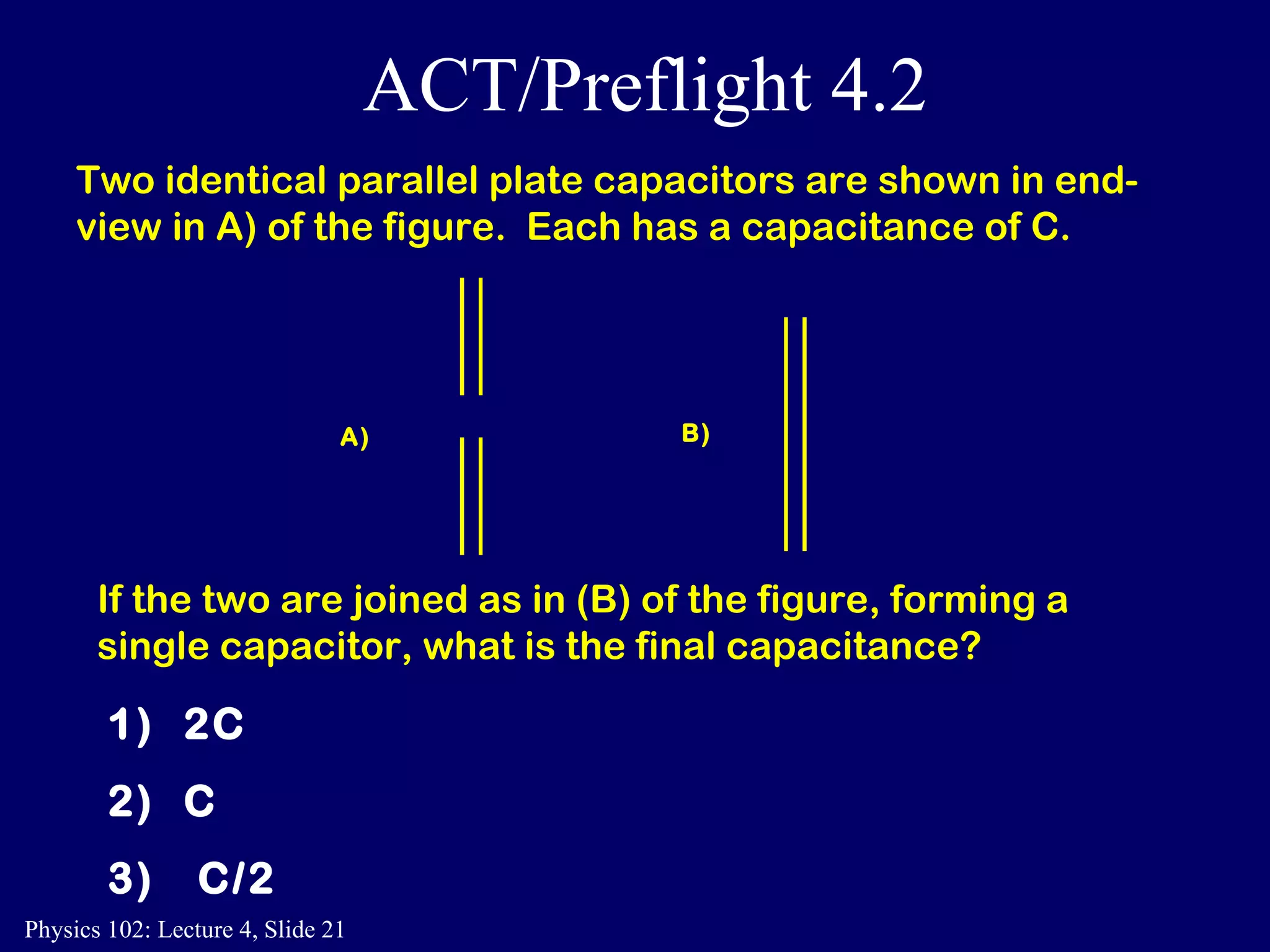
Two identical parallel plate capacitors are shown in end-view in A) of the figure.  Each has a capacitance of C. A ) B ) If the two are joined as in (B) of the figure, forming a single capacitor, what is the final capacitance? 1)  2C  2)  C  3)  C/2  ACT/Preflight 4.2
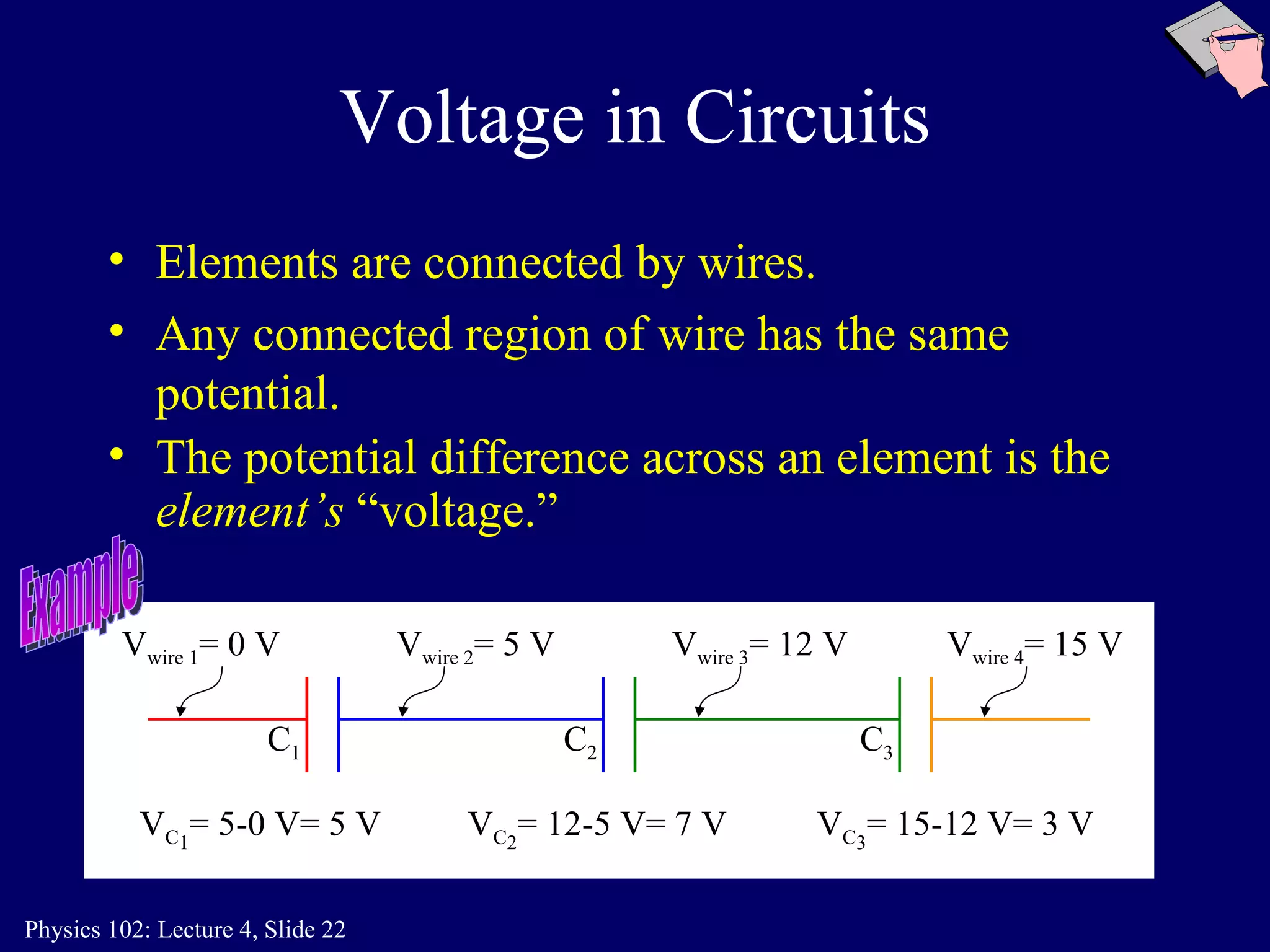
Voltage in Circuits Elements are connected by wires.  Any connected region of wire has the same potential. V C 1 = 5-0 V= 5 V V C 3 = 15-12 V= 3 V V C 2 = 12-5 V= 7 V C 1 C 2 C 3 Example The potential difference across an element is the  element’s  “voltage.” V wire 1 = 0 V V wire 2 = 5 V V wire 3 = 12 V V wire 4 = 15 V
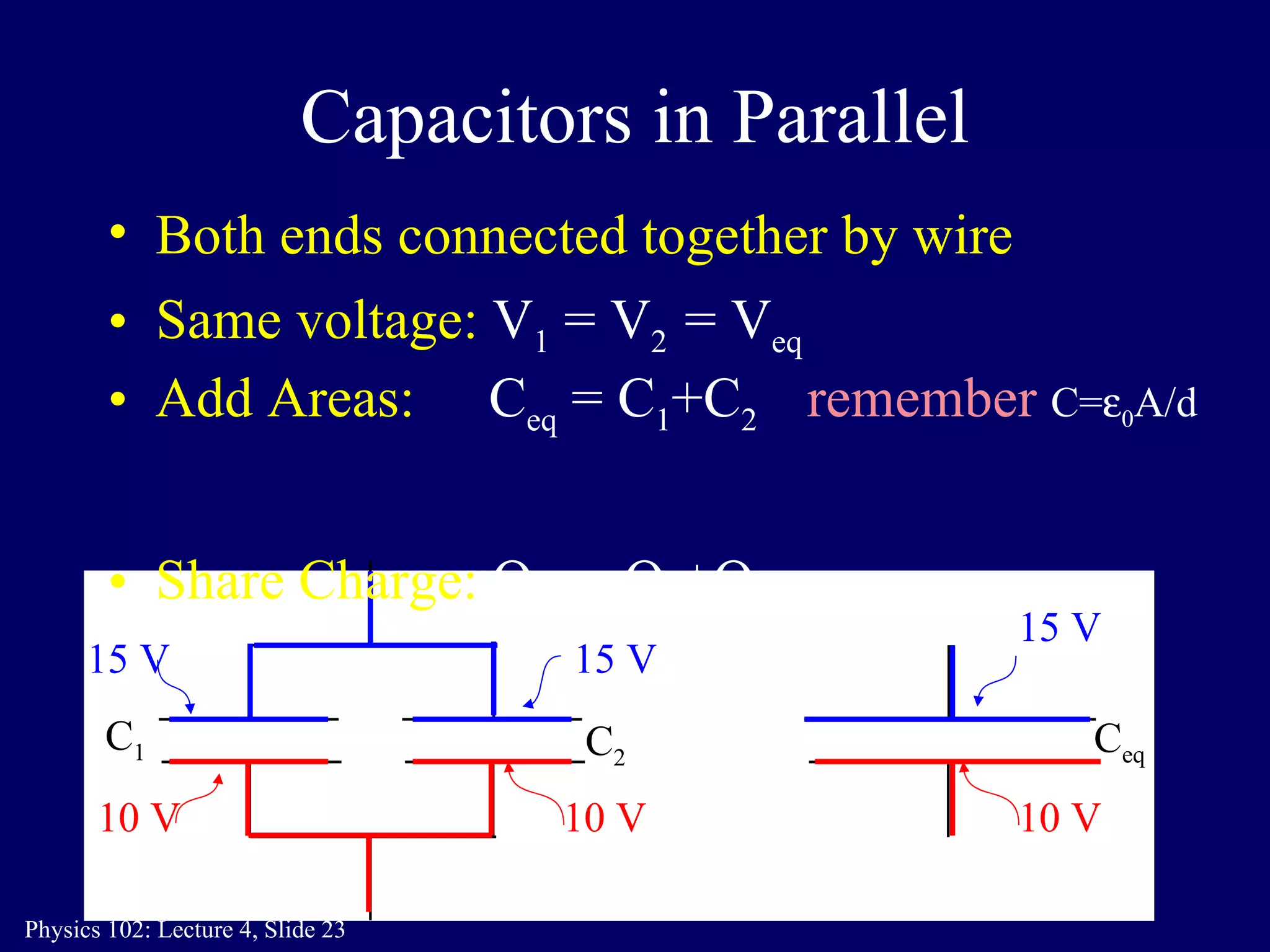
Capacitors in Parallel Both ends connected together by wire C 1 C 2 15 V 10 V 15 V 10 V Add Areas: C eq  = C 1 +C 2  remember  C=  0 A/d   Share Charge:  Q eq  = Q 1 +Q 2 = V eq  Same voltage:  V 1  = V 2 C eq 15 V 10 V
 
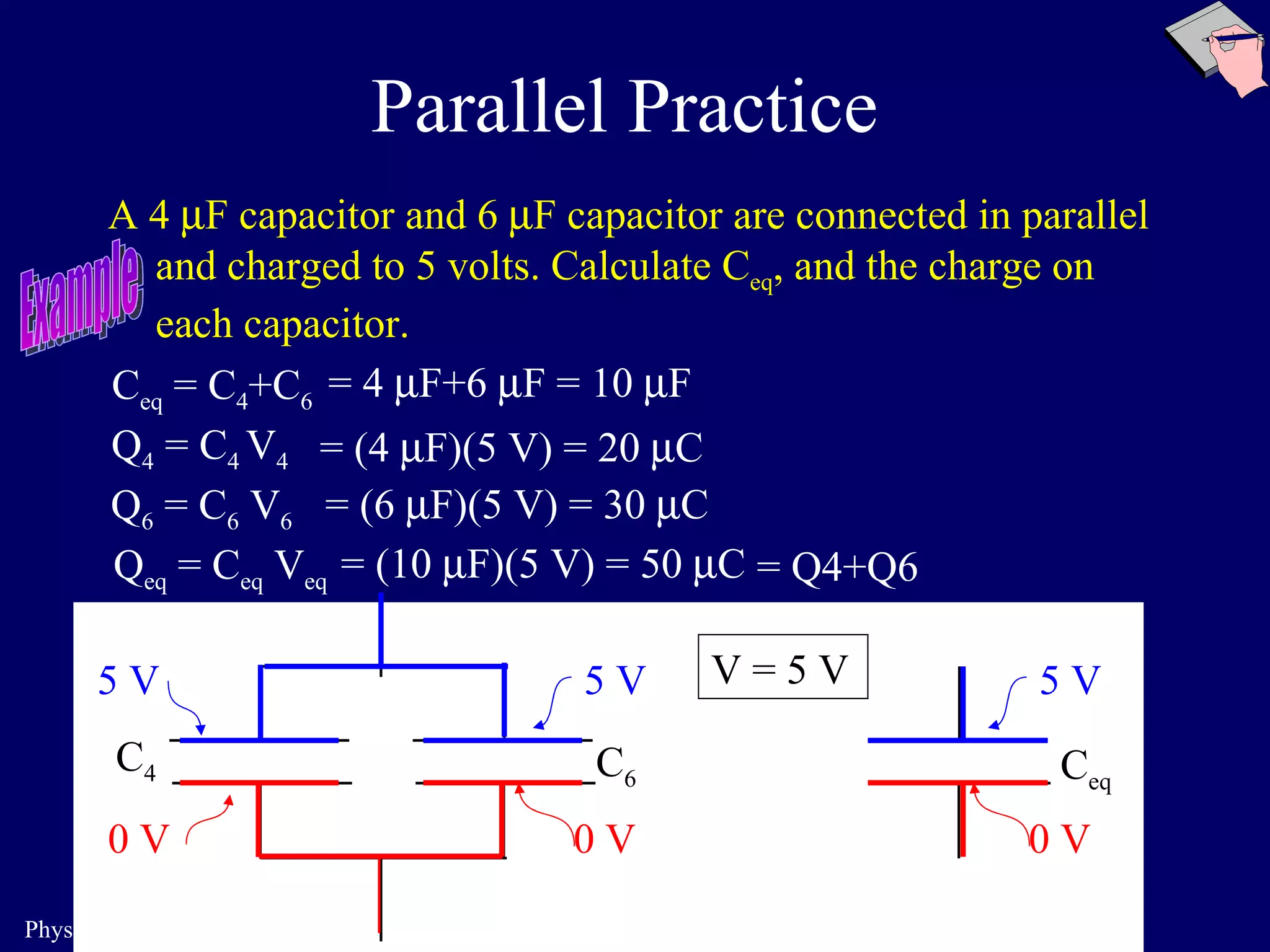
Parallel Practice A 4   F capacitor and 6   F capacitor are connected in parallel and charged to 5 volts. Calculate C eq , and the charge on each capacitor. C 4 C 6 C eq 5 V 0 V 5 V 0 V 5 V 0 V C eq  = C 4 +C 6 Q 4  = C 4  V 4 Q 6  = C 6  V 6 Q eq  = C eq  V eq = 4   F+6   F = 10   F = (4   F)(5 V) = 20   C = (6   F)(5 V) = 30   C = (10   F)(5 V) = 50   C = Q4+Q6 V =  5 V Example
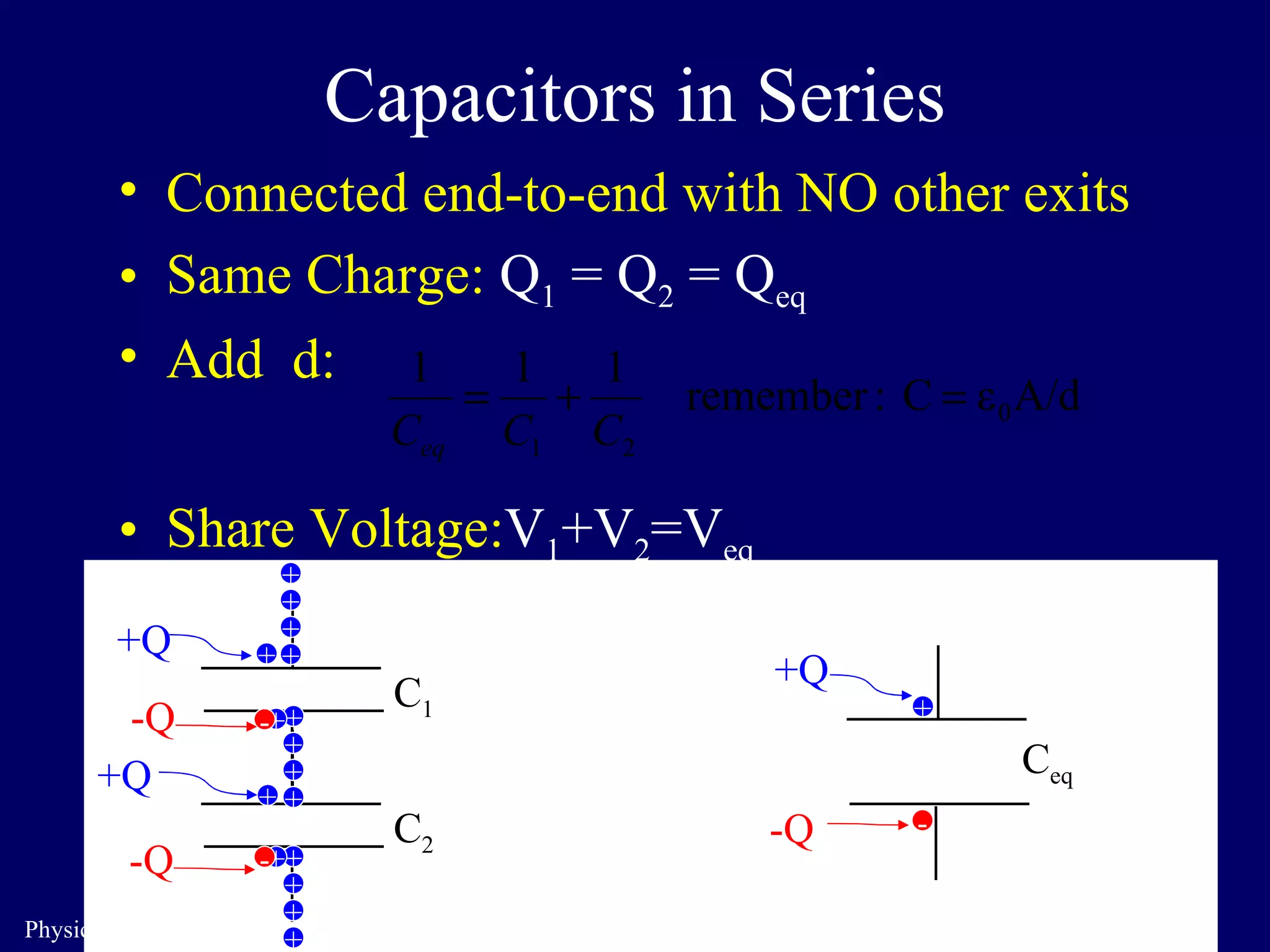
Capacitors in Series Connected end-to-end with NO other exits Same Charge:  Q 1  = Q 2  = Q eq Add  d: C 1 C 2 + + + + + + + + + + + + + - + - + - +Q  -Q  Share Voltage: V 1 +V 2 =V eq C eq - + - + +Q  -Q  +Q  -Q
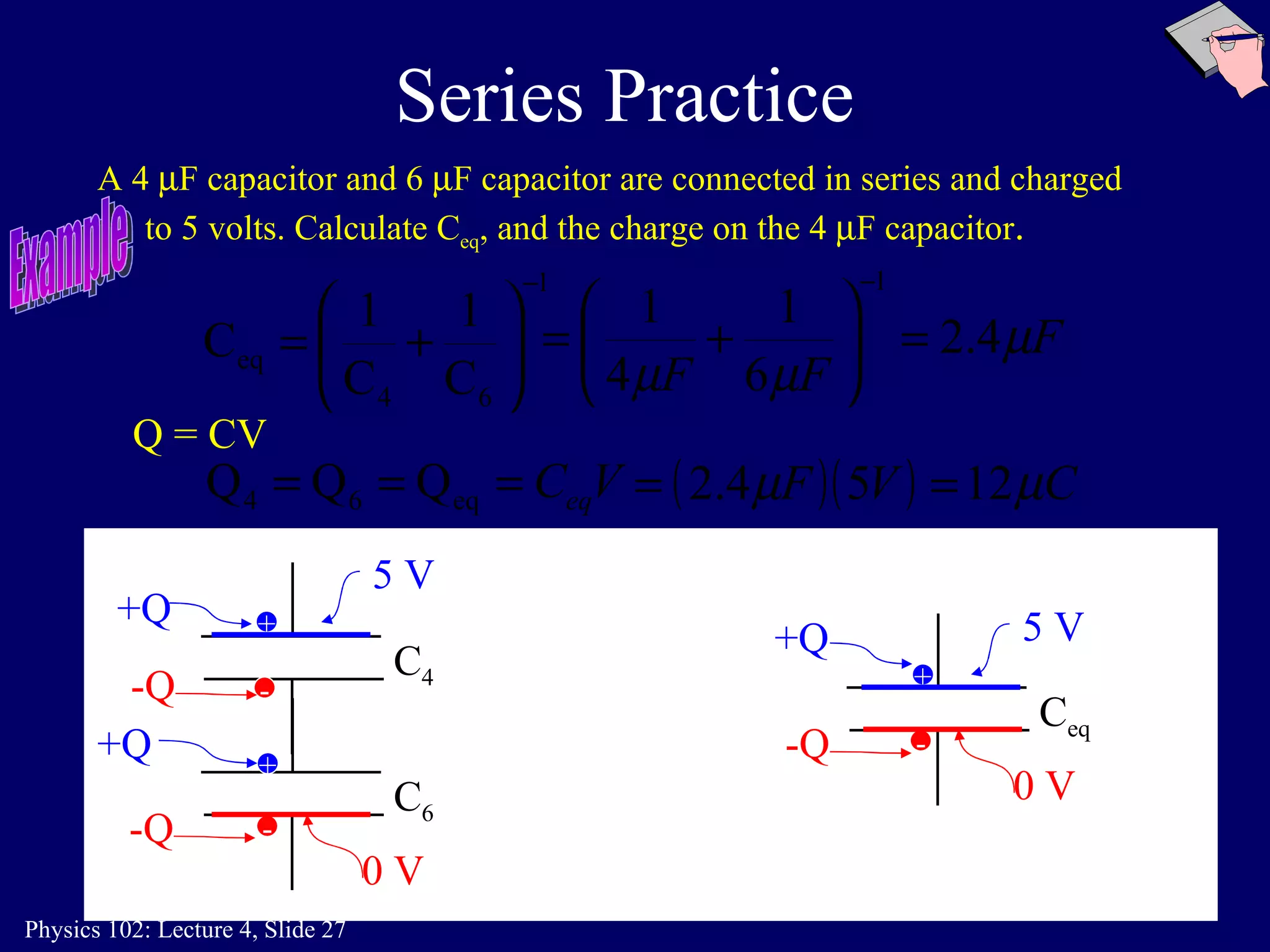
Series Practice A 4   F capacitor and 6   F capacitor are connected in series and charged to 5 volts. Calculate C eq , and the charge on the 4   F capacitor . C eq C 4 C 6 + - + - 5 V 0 V Q = CV Example + - +Q  -Q  +Q  -Q  +Q  -Q  5 V 0 V
 
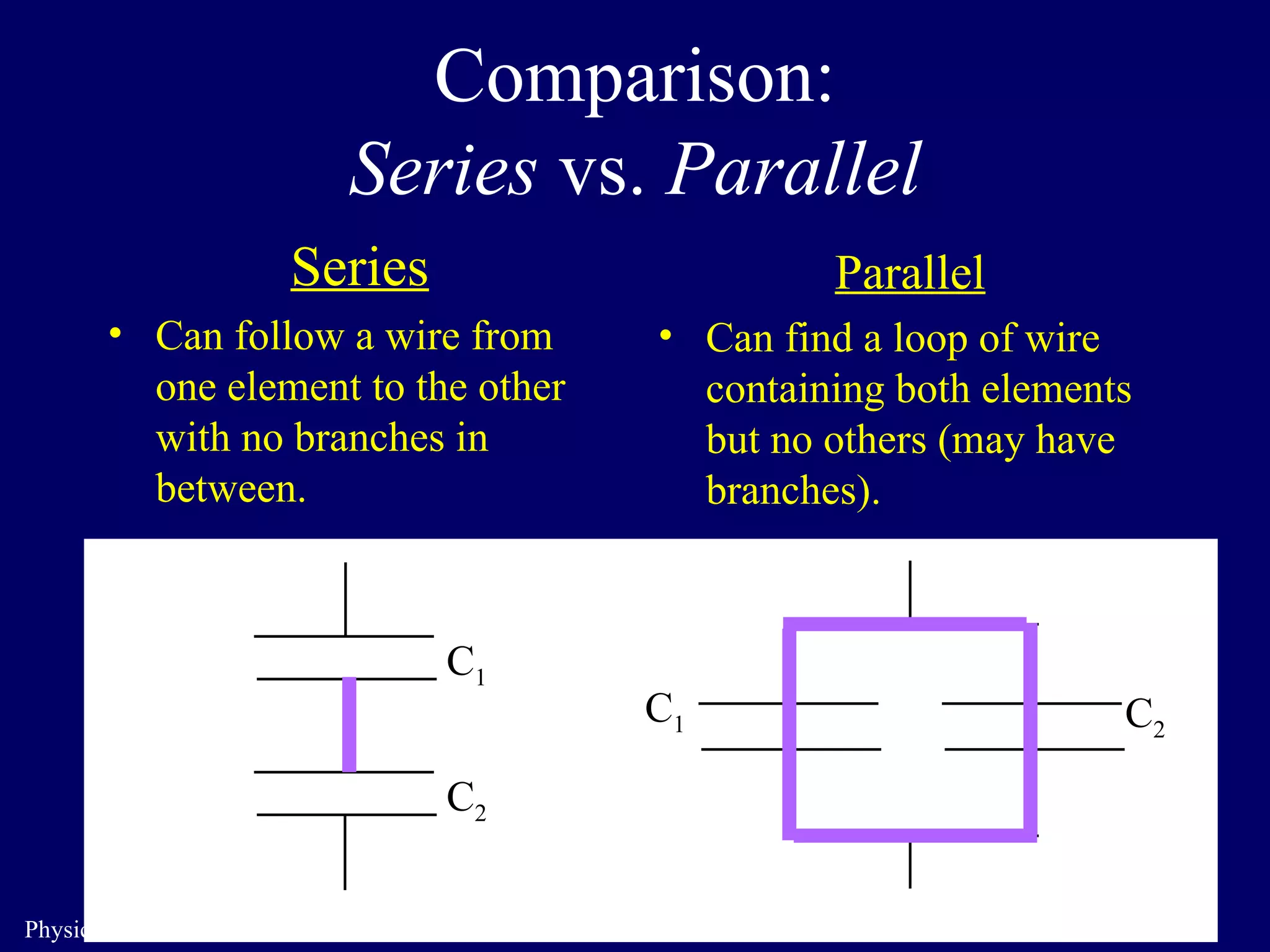
Comparison: Series  vs.  Parallel Series Can follow a wire from one element to the other with no branches in between.  Parallel Can find a loop of wire containing both elements but no others (may have branches). C 1 C 2 C 2 C 1
Electromotive Force Battery Maintains constant potential difference V  Does NOT produce or supply charges, just “pushes” them. + -
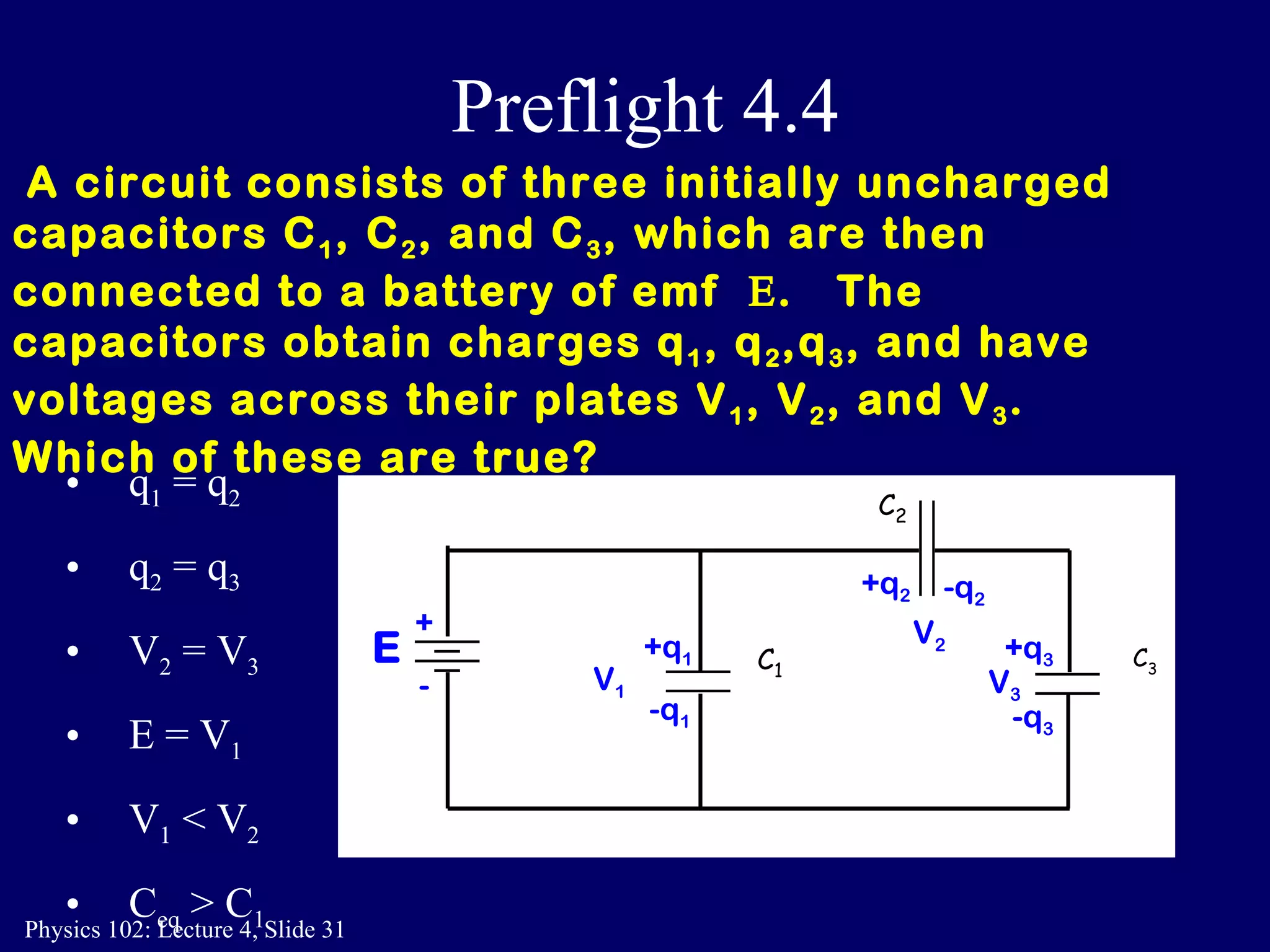
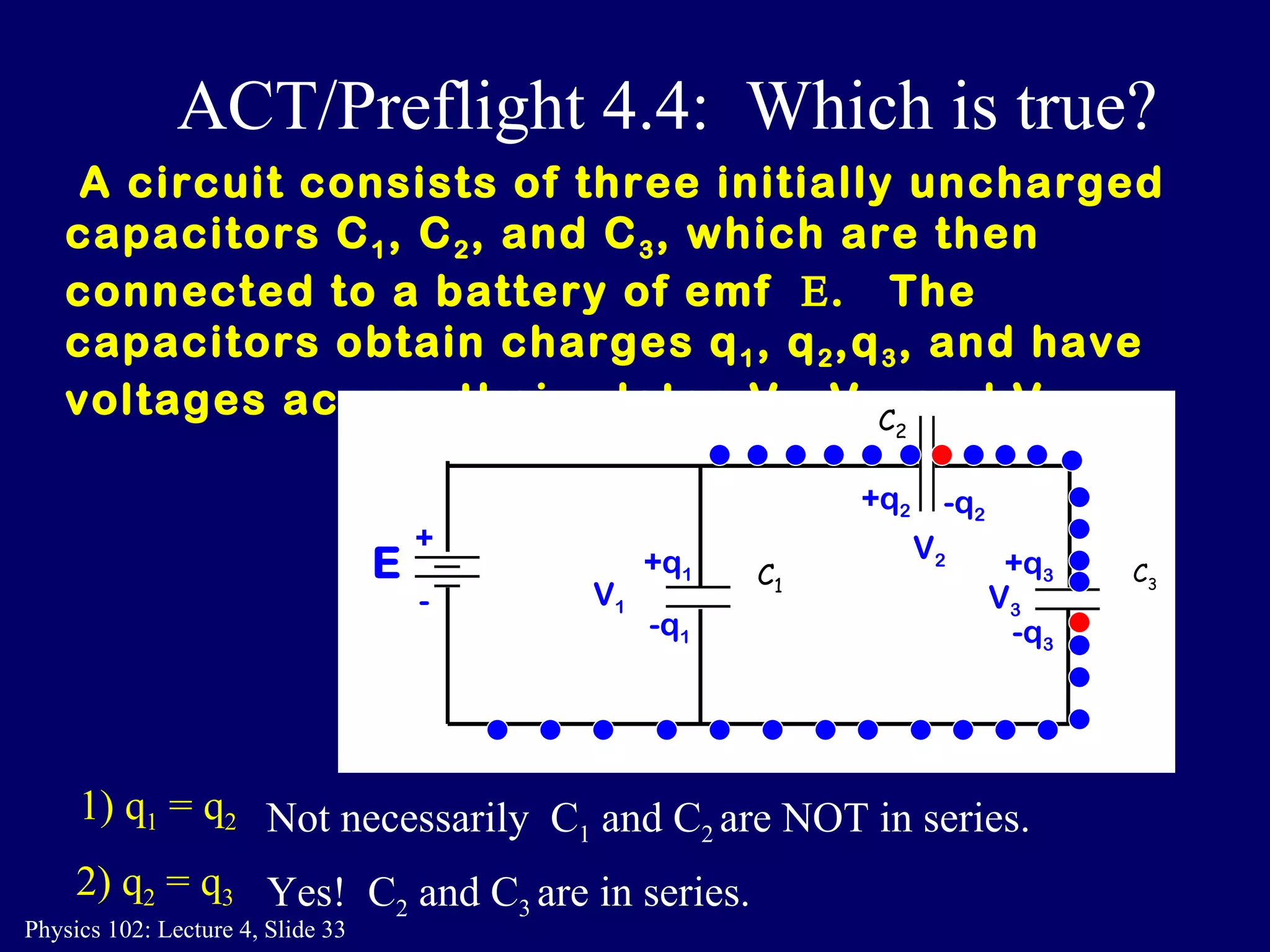
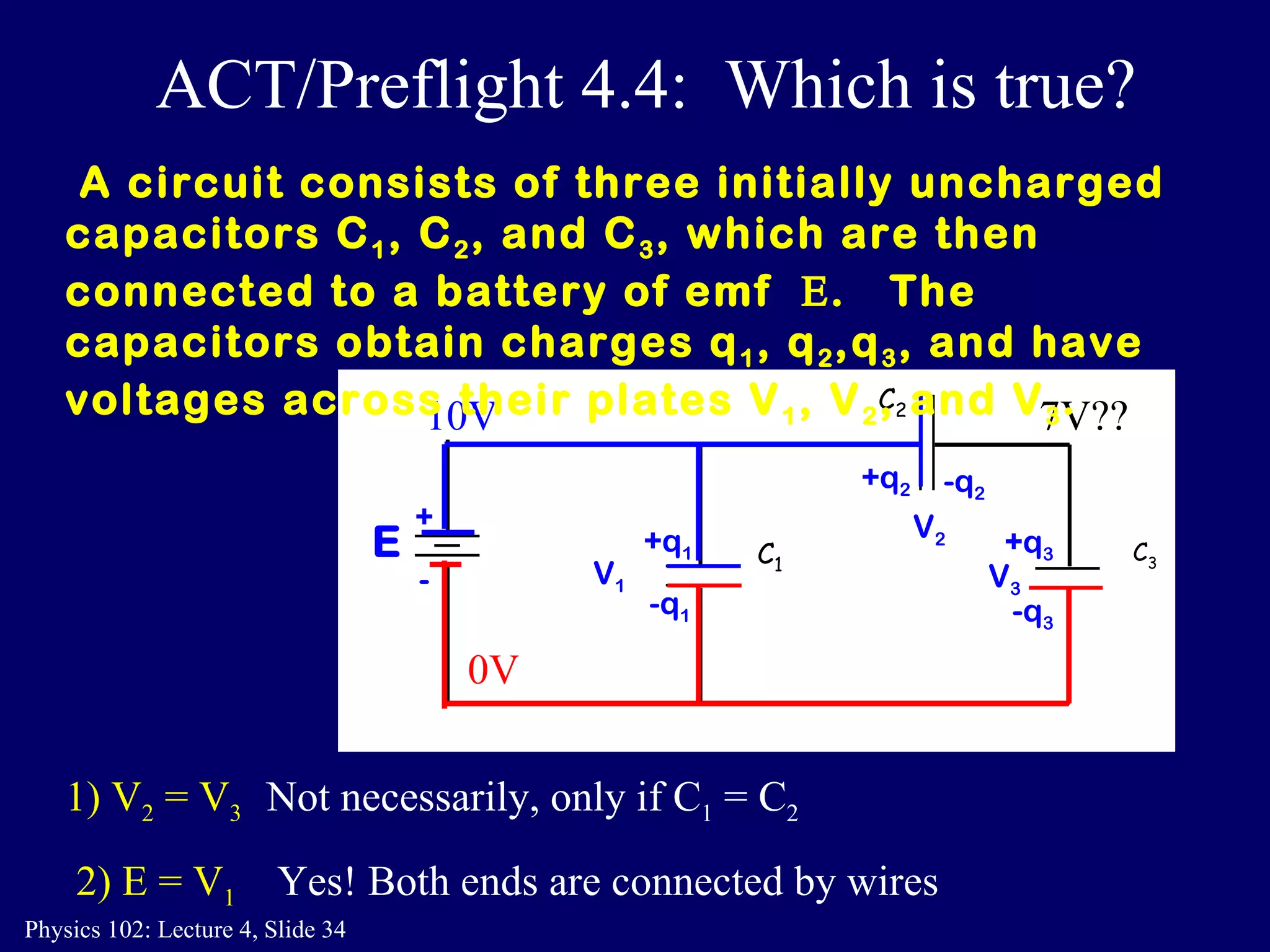
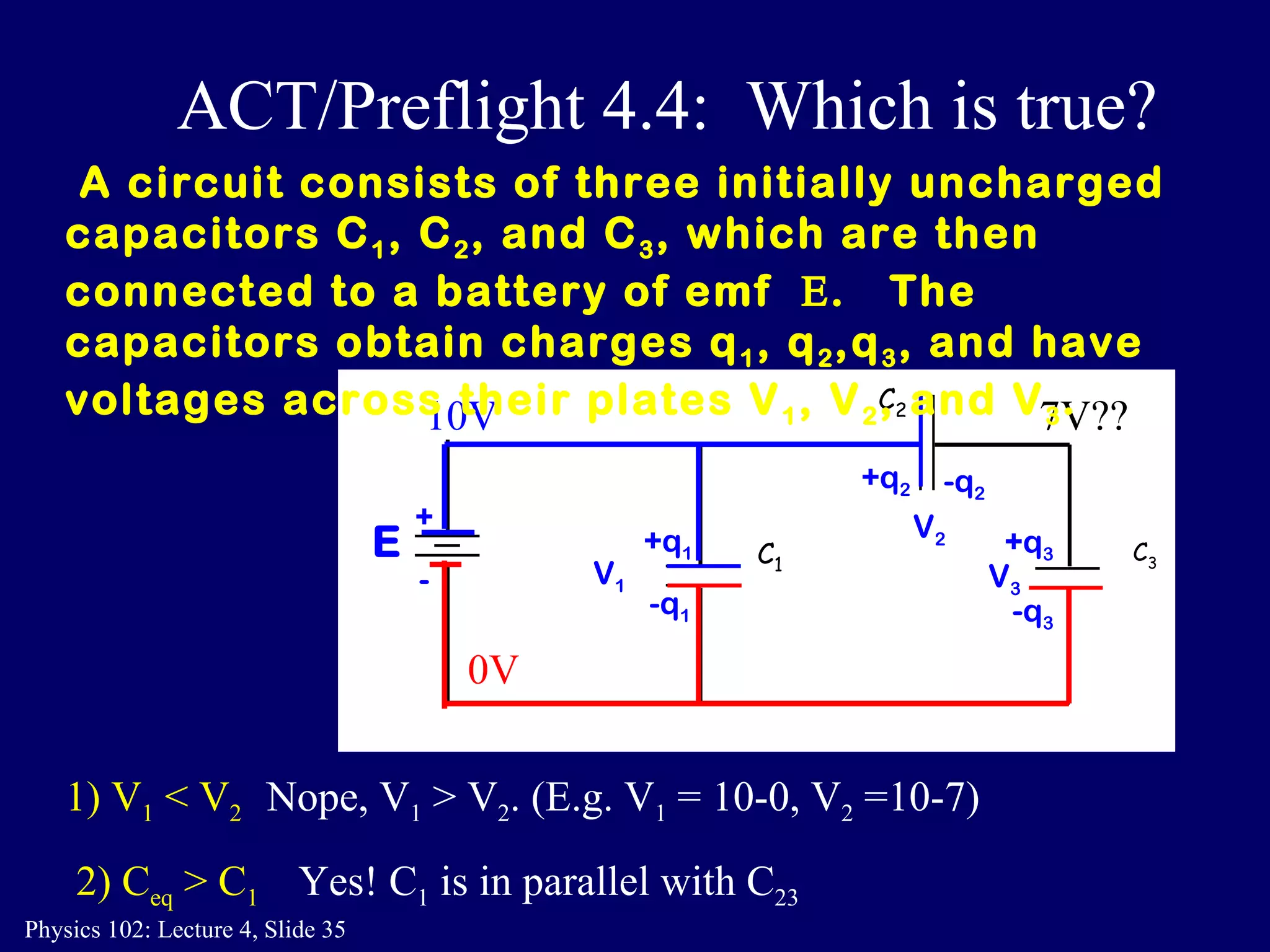
Preflight 4.4 A circuit consists of three initially uncharged capacitors C 1 , C 2 , and C 3 , which are then connected to a battery of emf   .  The  capacitors obtain charges q 1 , q 2 ,q 3 , and have voltages across their plates V 1 , V 2 , and V 3 .   Which of these are true?   q 1  = q 2 q 2  = q 3 V 2  = V 3 E = V 1 V 1  < V 2 C eq  > C 1 C 2 C 3 C 1 E + - -q 2 +q 1 -q 1 +q 3   -q 3 +q 2 V 1 V 2 V 3
 
A circuit consists of three initially uncharged capacitors C 1 , C 2 , and C 3 , which are then connected to a battery of emf   .  The  capacitors obtain charges q 1 , q 2 ,q 3 , and have voltages across their plates V 1 , V 2 , and V 3 .  1) q 1  = q 2 Not necessarily  C 1  and C 2  are NOT in series. 2) q 2  = q 3 Yes!  C 2  and C 3  are in series. ACT/Preflight 4.4:  Which is true? C 2 C 3 C 1 E + - -q 2 +q 1 -q 1 +q 3   -q 3 +q 2 V 1 V 2 V 3
1) V 2  = V 3 Not necessarily, only if C 1  = C 2 2) E = V 1 Yes! Both ends are connected by wires A circuit consists of three initially uncharged capacitors C 1 , C 2 , and C 3 , which are then connected to a battery of emf   .  The  capacitors obtain charges q 1 , q 2 ,q 3 , and have voltages across their plates V 1 , V 2 , and V 3 .  ACT/Preflight 4.4:  Which is true? C 2 C 3 C 1 E + - -q 2 +q 1 -q 1 +q 3   -q 3 +q 2 V 1 V 2 V 3 10V 0V 7V??
1) V 1  < V 2 Nope, V 1  > V 2 . (E.g. V 1  = 10-0, V 2  =10-7)  2) C eq  > C 1 Yes! C 1  is in parallel with C 23 A circuit consists of three initially uncharged capacitors C 1 , C 2 , and C 3 , which are then connected to a battery of emf   .  The  capacitors obtain charges q 1 , q 2 ,q 3 , and have voltages across their plates V 1 , V 2 , and V 3 .  ACT/Preflight 4.4:  Which is true? C 2 C 3 C 1 E + - -q 2 +q 1 -q 1 +q 3   -q 3 +q 2 V 1 V 2 V 3 10V 0V 7V??
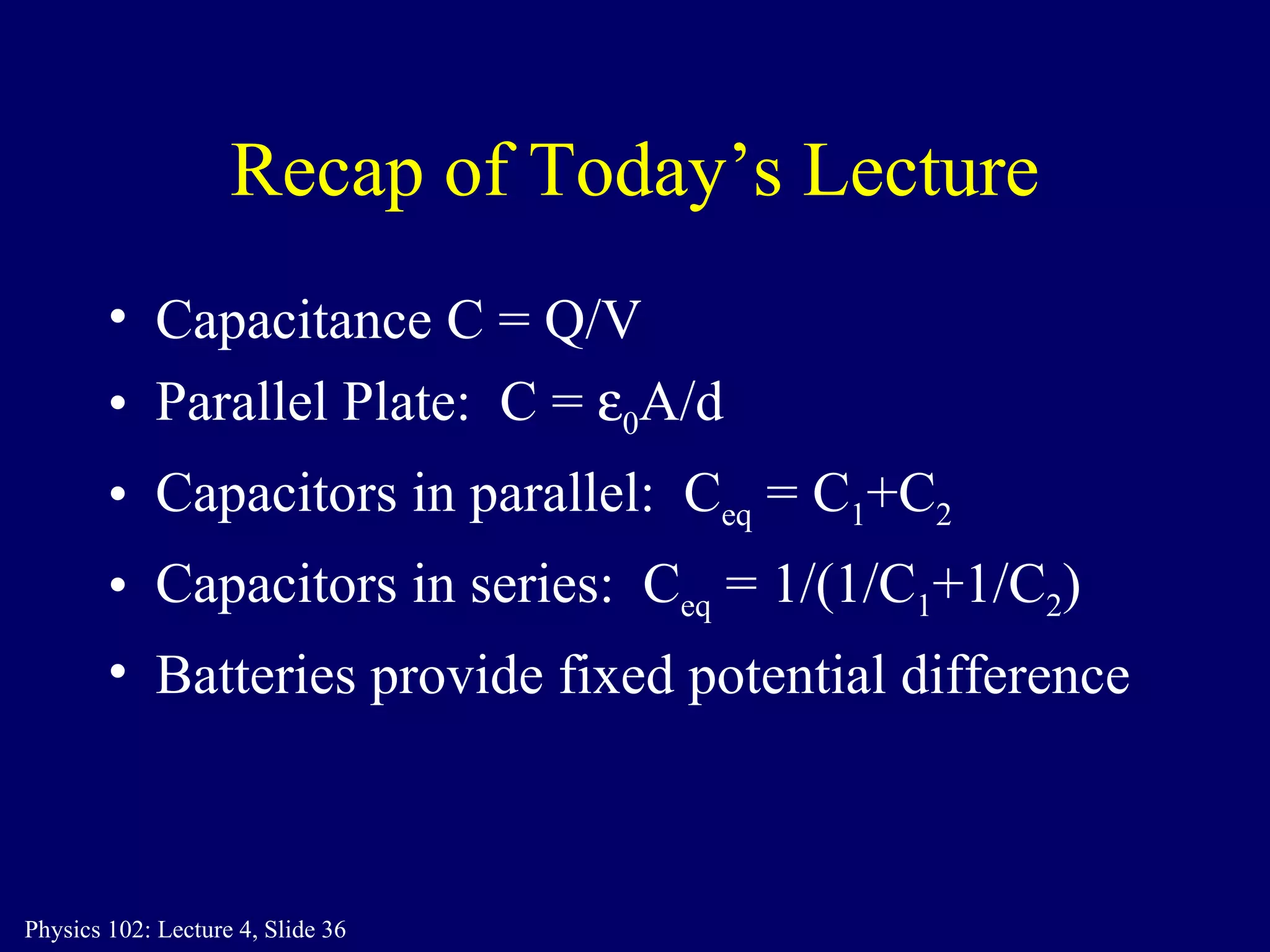
Capacitance C = Q/V Parallel Plate:  C =   0 A/d Capacitors in parallel:  C eq  = C 1 +C 2 Capacitors in series:  C eq  = 1/(1/C 1 +1/C 2 ) Batteries provide fixed potential difference Recap of Today’s Lecture

Lect04 handout

  • 1.
  • 2.
    Recall from lastlecture….. Electric Fields, Electric Potential
  • 3.
    Comparison: Electric Potential Energy vs. Electric Potential  V AB : the difference in electric potential between points B and A  U AB : the change in electric potential energy of a charge q when moved from A to B  U AB = q  V AB q A B
  • 4.
  • 5.
    Electric Potential: Summary E field lines point from higher to lower potential For positive charges, going from higher to lower potential is “downhill” For a battery, the (+) terminal is at a higher potential than the (–) terminal Positive charges tend to go “downhill”, from + to  Negative charges go in the opposite direction, from  to +  U AB = q  V AB
  • 6.
    Important Special CaseUniform Electric Field + + + + + - - - - - Two large parallel conducting plates of area A +Q on one plate  Q on other plate Then E is uniform between the two plates: E=4  kQ/A zero everywhere else This result is independent of plate separation This is call a parallel plate capacitor
  • 7.
    Parallel Plate Capacitor:Potential Difference E=E 0 d V =V A – V B = +E 0 d + + + + + - - - - - A B d + + + + + - - - - - + + + + + - - - - - E=2 E 0 V =V A – V B = +2E 0 d Potential difference is proportional to charge: Double Q  Double V Charge Q on plates Charge 2Q on plates E 0 =4  kQ/A A B
  • 8.
  • 9.
    Capacitance: The abilityto store separated charge C  Q/V Any pair conductors separated by a small distance. (e.g. two metal plates) Capacitor stores separated charge Positive Q on one conductor, negative Q on other Net charge is zero Q=CV U =(½) Q V Stores Energy Units: 1 Coulomb/Volt = 1 Farad (F) E d + + + + + - - - - -
  • 10.
    Why Separate Charge?Camera Flash Defibrillator—see ex. 17.12 in text AC -> DC Tuners Radio Cell phones Analogy to a waterfall
  • 11.
    Capacitance Practice How much charge is on a 0.9 F capacitor which has a potential difference of 200 Volts? How much energy is stored in this capacitor? Example
  • 12.
  • 13.
    Capacitance of Parallel Plate Capacitor V = Ed E=4  kQ/A (Between two large plates) So: V = 4  kQd/A Recall: C  Q/V So: C = A/(4  kd) Define:  0 =1  k)=8.85x10 -12 C 2 /Nm 2 A d A E + - V C =  0 A/d Parallel plate capacitor
  • 14.
    Parallel Plate CapacitorC =  0 A/d Calculate the capacitance of a parallel plate capacitor made from two large square metal sheets 1.3 m on a side, separated by 0.1 m. A d A Example
  • 15.
    Dielectric Placing adielectric between the plates increases the capacitance. C =  C 0 Capacitance with dielectric Dielectric constant (  > 1) Capacitance without dielectric
  • 16.
  • 17.
    A parallel platecapacitor given a charge q. The plates are then pulled a small distance further apart. What happens to the charge q on each plate of the capacitor? ACT: Parallel Plates 1) Increases 2) Constant 3) Decreases Remember charge is real/physical. There is no place for the charges to go. +q -q + + + + - - - - d pull pull
  • 18.
    A parallel platecapacitor given a charge q. The plates are then pulled a small distance further apart. Which of the following apply to the situation after the plates have been moved? 1)The capacitance increases True False 2)The electric field increases True False 3)The voltage between the plates increases True False Preflight 4.1 +q -q + + + + - - - - d pull pull
  • 19.
    A parallel platecapacitor given a charge q. The plates are then pulled a small distance further apart. Which of the following apply to the situation after the plates have been moved? ACT/Preflight 4.1 The energy stored in the capacitor A) increases B) constant C) decreases +q -q + + + + - - - - d pull pull
  • 20.
  • 21.
    Two identical parallelplate capacitors are shown in end-view in A) of the figure. Each has a capacitance of C. A ) B ) If the two are joined as in (B) of the figure, forming a single capacitor, what is the final capacitance? 1) 2C 2) C 3) C/2 ACT/Preflight 4.2
  • 22.
    Voltage in CircuitsElements are connected by wires. Any connected region of wire has the same potential. V C 1 = 5-0 V= 5 V V C 3 = 15-12 V= 3 V V C 2 = 12-5 V= 7 V C 1 C 2 C 3 Example The potential difference across an element is the element’s “voltage.” V wire 1 = 0 V V wire 2 = 5 V V wire 3 = 12 V V wire 4 = 15 V
  • 23.
    Capacitors in ParallelBoth ends connected together by wire C 1 C 2 15 V 10 V 15 V 10 V Add Areas: C eq = C 1 +C 2 remember C=  0 A/d Share Charge: Q eq = Q 1 +Q 2 = V eq Same voltage: V 1 = V 2 C eq 15 V 10 V
  • 24.
  • 25.
    Parallel Practice A4  F capacitor and 6  F capacitor are connected in parallel and charged to 5 volts. Calculate C eq , and the charge on each capacitor. C 4 C 6 C eq 5 V 0 V 5 V 0 V 5 V 0 V C eq = C 4 +C 6 Q 4 = C 4 V 4 Q 6 = C 6 V 6 Q eq = C eq V eq = 4  F+6  F = 10  F = (4  F)(5 V) = 20  C = (6  F)(5 V) = 30  C = (10  F)(5 V) = 50  C = Q4+Q6 V = 5 V Example
  • 26.
    Capacitors in SeriesConnected end-to-end with NO other exits Same Charge: Q 1 = Q 2 = Q eq Add d: C 1 C 2 + + + + + + + + + + + + + - + - + - +Q -Q Share Voltage: V 1 +V 2 =V eq C eq - + - + +Q -Q +Q -Q
  • 27.
    Series Practice A4  F capacitor and 6  F capacitor are connected in series and charged to 5 volts. Calculate C eq , and the charge on the 4  F capacitor . C eq C 4 C 6 + - + - 5 V 0 V Q = CV Example + - +Q -Q +Q -Q +Q -Q 5 V 0 V
  • 28.
  • 29.
    Comparison: Series vs. Parallel Series Can follow a wire from one element to the other with no branches in between. Parallel Can find a loop of wire containing both elements but no others (may have branches). C 1 C 2 C 2 C 1
  • 30.
    Electromotive Force BatteryMaintains constant potential difference V Does NOT produce or supply charges, just “pushes” them. + -
  • 31.
    Preflight 4.4 Acircuit consists of three initially uncharged capacitors C 1 , C 2 , and C 3 , which are then connected to a battery of emf  . The capacitors obtain charges q 1 , q 2 ,q 3 , and have voltages across their plates V 1 , V 2 , and V 3 . Which of these are true? q 1 = q 2 q 2 = q 3 V 2 = V 3 E = V 1 V 1 < V 2 C eq > C 1 C 2 C 3 C 1 E + - -q 2 +q 1 -q 1 +q 3 -q 3 +q 2 V 1 V 2 V 3
  • 32.
  • 33.
    A circuit consistsof three initially uncharged capacitors C 1 , C 2 , and C 3 , which are then connected to a battery of emf  . The capacitors obtain charges q 1 , q 2 ,q 3 , and have voltages across their plates V 1 , V 2 , and V 3 . 1) q 1 = q 2 Not necessarily C 1 and C 2 are NOT in series. 2) q 2 = q 3 Yes! C 2 and C 3 are in series. ACT/Preflight 4.4: Which is true? C 2 C 3 C 1 E + - -q 2 +q 1 -q 1 +q 3 -q 3 +q 2 V 1 V 2 V 3
  • 34.
    1) V 2 = V 3 Not necessarily, only if C 1 = C 2 2) E = V 1 Yes! Both ends are connected by wires A circuit consists of three initially uncharged capacitors C 1 , C 2 , and C 3 , which are then connected to a battery of emf  . The capacitors obtain charges q 1 , q 2 ,q 3 , and have voltages across their plates V 1 , V 2 , and V 3 . ACT/Preflight 4.4: Which is true? C 2 C 3 C 1 E + - -q 2 +q 1 -q 1 +q 3 -q 3 +q 2 V 1 V 2 V 3 10V 0V 7V??
  • 35.
    1) V 1 < V 2 Nope, V 1 > V 2 . (E.g. V 1 = 10-0, V 2 =10-7) 2) C eq > C 1 Yes! C 1 is in parallel with C 23 A circuit consists of three initially uncharged capacitors C 1 , C 2 , and C 3 , which are then connected to a battery of emf  . The capacitors obtain charges q 1 , q 2 ,q 3 , and have voltages across their plates V 1 , V 2 , and V 3 . ACT/Preflight 4.4: Which is true? C 2 C 3 C 1 E + - -q 2 +q 1 -q 1 +q 3 -q 3 +q 2 V 1 V 2 V 3 10V 0V 7V??
  • 36.
    Capacitance C =Q/V Parallel Plate: C =  0 A/d Capacitors in parallel: C eq = C 1 +C 2 Capacitors in series: C eq = 1/(1/C 1 +1/C 2 ) Batteries provide fixed potential difference Recap of Today’s Lecture

Editor's Notes

  • #3 Electric potential energy Potential difference PED = qV V = Ed
  • #8 Use fire extinguisher analogy?
  • #10 Stores energy….electrical potential energy. If the plates were free to move, they would collapse on each other. Just like releasing a brick from height h above the floor. Or, if charges were free to move, the capacitor would “discharge”. Demo. Can I make U more plausible?
  • #15 Here note that this is small number for such a big device. How do they make “real” capacitors?
  • #16 Same Q, smaller E, therefore smaller V, larger Q