YOU’RE NOT TOO
YOUNG FOR
EMOTIONAL
INTELLIGENCE
HUMAN RESOURCES DEPARTMENT
MONDAY, MAY 18, 2020
LEARNING OBJECTIVES
By the conclusion of this training, interns will be able to:
•Define emotional intelligence
•Identify and define common emotions
•Use strategies to overcome negative thinking
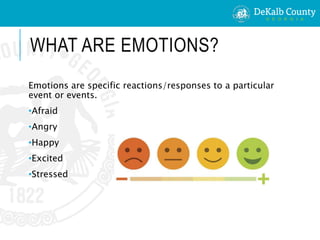
WHAT ARE EMOTIONS?
Emotions are specific reactions/responses to a particular
event or events.
•Afraid
•Angry
•Happy
•Excited
•Stressed
WHAT IS EMOTIONAL
INTELLIGENCE?
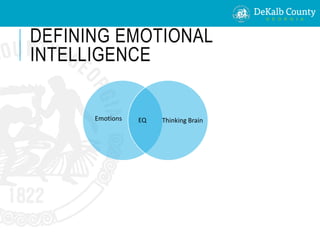
Emotional Intelligence (EQ) refers to:
•Recognizing our feelings and those of others
•Motivating ourselves
•Managing relationships (personal and professionally)
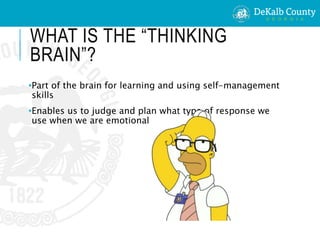
WHAT IS THE “THINKING
BRAIN”?
•Part of the brain for learning and using self-management
skills
•Enables us to judge and plan what type of response we
use when we are emotional
DEFINING EMOTIONAL
INTELLIGENCE
Emotions Thinking BrainEQ
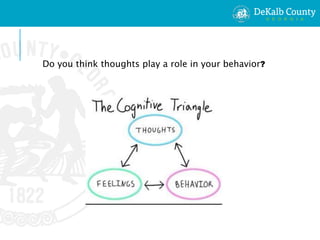
Do you think thoughts play a role in your behavior?
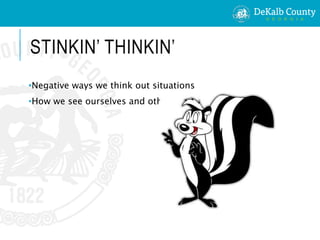
STINKIN’ THINKIN’
•Negative ways we think out situations
•How we see ourselves and others
WHAT’S YOUR PROBLEM?
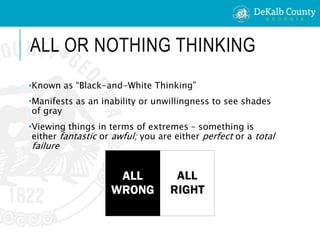
ALL OR NOTHING THINKING
•Known as “Black-and-White Thinking”
•Manifests as an inability or unwillingness to see shades
of gray
•Viewing things in terms of extremes – something is
either fantastic or awful; you are either perfect or a total
failure
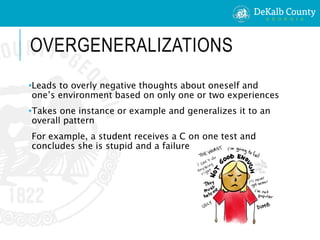
OVERGENERALIZATIONS
•Leads to overly negative thoughts about oneself and
one’s environment based on only one or two experiences
•Takes one instance or example and generalizes it to an
overall pattern
For example, a student receives a C on one test and
concludes she is stupid and a failure
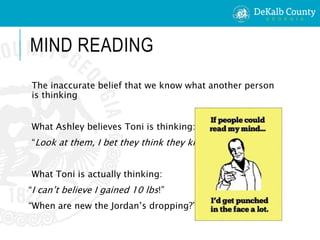
MIND READING
The inaccurate belief that we know what another person
is thinking
What Ashley believes Toni is thinking:
“Look at them, I bet they think they know me.”
What Toni is actually thinking:
“I can’t believe I gained 10 lbs!”
“When are new the Jordan’s dropping?”
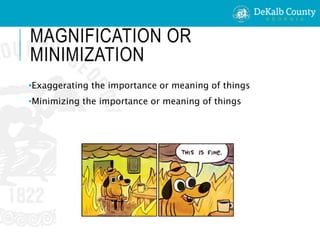
MAGNIFICATION OR
MINIMIZATION
•Exaggerating the importance or meaning of things
•Minimizing the importance or meaning of things
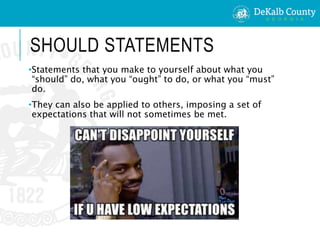
SHOULD STATEMENTS
•Statements that you make to yourself about what you
“should” do, what you “ought” to do, or what you “must”
do.
•They can also be applied to others, imposing a set of
expectations that will not sometimes be met.
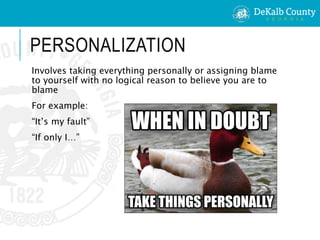
PERSONALIZATION
Involves taking everything personally or assigning blame
to yourself with no logical reason to believe you are to
blame
For example:
“It’s my fault”
“If only I…”
ALWAYS BEING RIGHT
•Belief that we must always be right, correct, or accurate
•Idea that we could be wrong is absolutely unacceptable,
and will fight to prove that we are right
HOW TO DEVELOP YOUR EQ
Self-awareness
 In tune with yourself and how you feel in any given situation
Self-regulation
 Know your values (what’s important to you)
 Hold yourself accountable “Oops, I shouldn’t have said or I should’ve phrased
that differently”
Motivation
 Know your “why”
 Know what brings you joy (of course not at another’s expense)
Empathy
 Being able to put yourself in another’s position
 Understand their perspective
Social skills
 Learn how to deal with conflict
 Learn how to praise others
 Develop your communication skills
HUMAN RESOURCES DEPARTMENT
CONTACTS
Benita Ransom
Human Resources Director
404-687-3588
Fabienne Niles
Organization & Employee Development Manager
404-371-4937
Jami Mack
Employee Development Trainer
404-371-2107
Ashley Swan
Employee Development Specialist
404-371-2849
Karen Grant
Human Resources Specialist
404-371-2320

Emotional Intelligence PowerPoint

  • 1.
    YOU’RE NOT TOO YOUNGFOR EMOTIONAL INTELLIGENCE HUMAN RESOURCES DEPARTMENT MONDAY, MAY 18, 2020
  • 2.
    LEARNING OBJECTIVES By theconclusion of this training, interns will be able to: •Define emotional intelligence •Identify and define common emotions •Use strategies to overcome negative thinking
  • 3.
    WHAT ARE EMOTIONS? Emotionsare specific reactions/responses to a particular event or events. •Afraid •Angry •Happy •Excited •Stressed
  • 4.
    WHAT IS EMOTIONAL INTELLIGENCE? EmotionalIntelligence (EQ) refers to: •Recognizing our feelings and those of others •Motivating ourselves •Managing relationships (personal and professionally)
  • 5.
    WHAT IS THE“THINKING BRAIN”? •Part of the brain for learning and using self-management skills •Enables us to judge and plan what type of response we use when we are emotional
  • 6.
  • 7.
    Do you thinkthoughts play a role in your behavior?
  • 8.
    STINKIN’ THINKIN’ •Negative wayswe think out situations •How we see ourselves and others
  • 9.
  • 10.
    ALL OR NOTHINGTHINKING •Known as “Black-and-White Thinking” •Manifests as an inability or unwillingness to see shades of gray •Viewing things in terms of extremes – something is either fantastic or awful; you are either perfect or a total failure
  • 11.
    OVERGENERALIZATIONS •Leads to overlynegative thoughts about oneself and one’s environment based on only one or two experiences •Takes one instance or example and generalizes it to an overall pattern For example, a student receives a C on one test and concludes she is stupid and a failure
  • 12.
    MIND READING The inaccuratebelief that we know what another person is thinking What Ashley believes Toni is thinking: “Look at them, I bet they think they know me.” What Toni is actually thinking: “I can’t believe I gained 10 lbs!” “When are new the Jordan’s dropping?”
  • 13.
    MAGNIFICATION OR MINIMIZATION •Exaggerating theimportance or meaning of things •Minimizing the importance or meaning of things
  • 14.
    SHOULD STATEMENTS •Statements thatyou make to yourself about what you “should” do, what you “ought” to do, or what you “must” do. •They can also be applied to others, imposing a set of expectations that will not sometimes be met.
  • 15.
    PERSONALIZATION Involves taking everythingpersonally or assigning blame to yourself with no logical reason to believe you are to blame For example: “It’s my fault” “If only I…”
  • 16.
    ALWAYS BEING RIGHT •Beliefthat we must always be right, correct, or accurate •Idea that we could be wrong is absolutely unacceptable, and will fight to prove that we are right
  • 17.
    HOW TO DEVELOPYOUR EQ Self-awareness  In tune with yourself and how you feel in any given situation Self-regulation  Know your values (what’s important to you)  Hold yourself accountable “Oops, I shouldn’t have said or I should’ve phrased that differently” Motivation  Know your “why”  Know what brings you joy (of course not at another’s expense) Empathy  Being able to put yourself in another’s position  Understand their perspective Social skills  Learn how to deal with conflict  Learn how to praise others  Develop your communication skills
  • 18.
    HUMAN RESOURCES DEPARTMENT CONTACTS BenitaRansom Human Resources Director 404-687-3588 Fabienne Niles Organization & Employee Development Manager 404-371-4937 Jami Mack Employee Development Trainer 404-371-2107 Ashley Swan Employee Development Specialist 404-371-2849 Karen Grant Human Resources Specialist 404-371-2320