1
By: Timothy Hogan
Emotional Intelligence
A Scientifically Proven Method for Developing the Skills of Success
Objectives
• This course will increase your ability to:
• Know the difference between IQ and EQ.
• Manage your emotions by recognizing how
thoughts and
• emotions are connected.
• Improve your self-control by
identifying physical cues that indicate
your emotions may be taking over.
• Discover how emotional intelligence can help
you develop more positive relationships at
work and a more optimistic outlook.
2
Objectives
(cont.)
• This course will increase your ability to:
• Learn how to use assertive communication to
express your needs and feelings
appropriately.
• Explore how to use emotional intelligence
to bounce back from setbacks.
3
Definition of
Intellectual
Intelligence
• Adaptability to a new or changing
environment
• Capacity for knowledge and the ability to
acquire it
• Capacity for reason and abstract thought
• Ability to comprehend relationships
• Ability to evaluate and judge
• Capacity for original and productive thought
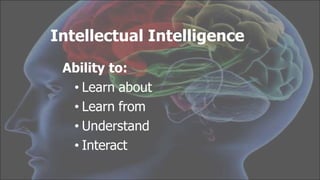
Intellectual Intelligence
Ability to:
• Learn about
• Learn from
• Understand
• Interact
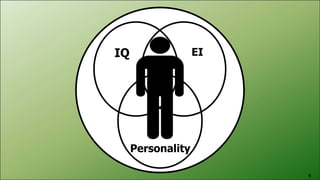
Personality
IQ EI
6
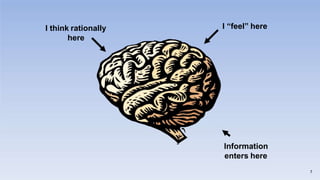
Information
enters here
I “feel” here
I think rationally
here
7
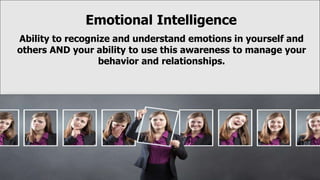
Emotional Intelligence
Ability to recognize and understand emotions in yourself and
others AND your ability to use this awareness to manage your
behavior and relationships.
It is very important to understand that emotional
intelligence is not the opposite of intelligence, it
is not the triumph of heart over head – it is the
unique intersection of both.
David Caruso, Ph.D.
“Emotional What”
9
Self
Assessment
40
Emotional
Intelligence is
Comprised of
Four Skills
• Intrapersonal Skills
• Self-Awareness
• Interpersonal
• Social Awareness
• Adaptability
• Relationship Management
• Resilience
• Self-Management
• People with EQs have better success in
business and in relationships
10
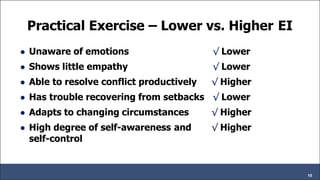
● Unaware of emotions
● Shows little empathy
● Able to resolve conflict productively
● Has trouble recovering from setbacks
● Adapts to changing circumstances
● High degree of self-awareness and
self-control
√ Lower
√ Lower
√ Higher
√ Lower
√ Higher
√ Higher
Practical Exercise – Lower vs. Higher EI
10
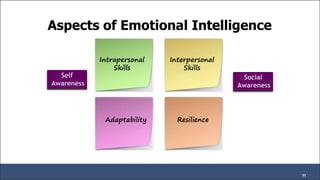
Aspects of Emotional Intelligence
11
Intrapersonal
Skills
Interpersonal
Skills
Adaptability Resilience
Self
Awareness
Social
Awareness
12
Intrapersonal Skills
12
Self-Awareness is the ability to perceive your emotions at
the moment and understand your tendencies across
situations – it is good to understand yourself, the good
and the bad.
Ask yourself…..
What am I feeling? Why am I feeling it?
Reflect on your behaviors. Know your triggers.
Self-Awareness is not
about discovering deep
dark secrets or
unconscious motivations,
but developing a
straightforward and honest
understanding of what
makes
you tick.
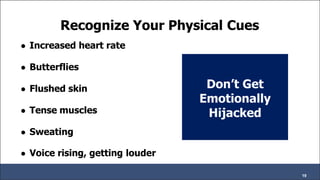
Recognize Your Physical Cues
● Increased heart rate
● Butterflies
● Flushed skin
● Tense muscles
● Sweating
● Voice rising, getting louder
19
Don’t Get
Emotionally
Hijacked
Interpersonal Skills
20
Social-Awareness is the ability to recognize others’
emotions. Showing empathy enables you to have more
positive relationships and minimize unproductive
conflict.
Ask yourself…..
Am I listening? Did I ask questions?
Did I adjust my body language, facial expressions, tone of voice to
meet their needs?
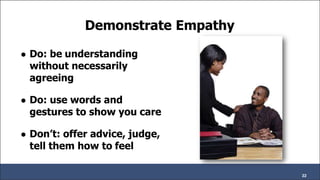
Demonstrate Empathy
● Do: be understanding
without necessarily
agreeing
● Do: use words and
gestures to show you care
● Don’t: offer advice, judge,
tell them how to feel
22
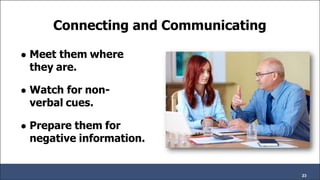
Connecting and Communicating
● Meet them where
they are.
● Watch for non-
verbal cues.
● Prepare them for
negative information.
23
Assertive Communication
● Use the Assertive Communication Process
● Employ Assertive Communication Techniques
● What do you do when you don’t get the
response you’re looking for?
24
25
Conflict Management
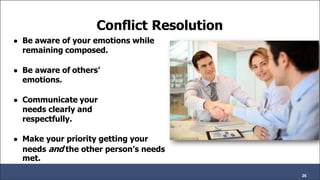
Conflict Resolution
● Be aware of your emotions while
remaining composed.
● Be aware of others’
emotions.
● Communicate your
needs clearly and
respectfully.
● Make your priority getting your
needs and the other person’s needs
met.
26
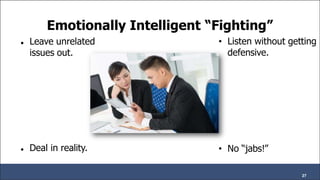
Emotionally Intelligent “Fighting”
● Leave unrelated
issues out.
● Deal in reality.
27
• Listen without getting
defensive.
• No “jabs!”
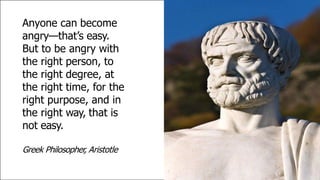
Anyone can become
angry—that’s easy.
But to be angry with
the right person, to
the right degree, at
the right time, for the
right purpose, and in
the right way, that is
not easy.
Greek Philosopher, Aristotle
Adaptability
29
Flexibility is the ability to adjust your thoughts,
feelings, and behavior to unfamiliar, unpredictable, or
changing conditions.
Ask yourself…..
Are you being open-minded? Am I focused on outcomes? Am I
willing to put aside the need to be “right?” Am I unwilling to
compromise principles or values?
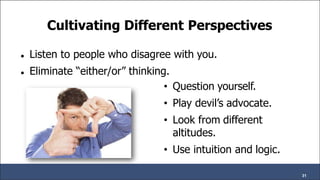
Cultivating Different Perspectives
31
● Listen to people who disagree with you.
● Eliminate “either/or” thinking.
• Question yourself.
• Play devil’s advocate.
• Look from different
altitudes.
• Use intuition and logic.
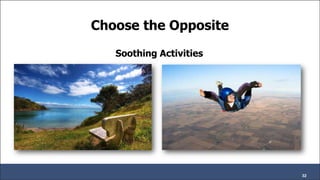
Choose the Opposite
Soothing Activities
32
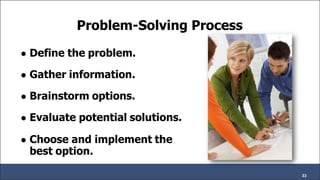
Problem-Solving Process
● Define the problem.
● Gather information.
● Brainstorm options.
● Evaluate potential solutions.
● Choose and implement the
best option.
33
Resilience
34
Resilience is the ability to bounce back from setbacks
and failure, to find a silver lining and see a hopeful
future. The first aspect of resilience that we’ll look at is
gaining an accurate perspective.
Ask yourself…..
What am I feeling? What do I want to feel? What do I need to
feel that way? Why do I need to feel this way?
Reframe Your Thinking
● Change your perspective
● Translate your negative thoughts into neutral or
positive statements.
◦ Change “We’re never going to find a way to pay for this.”
◦ To this: “I have dealt with budget shortfalls before and will
use my experience to find a solution to this challenge.”
36
Optimist's Explanatory Style
● Permanence: Setbacks are temporary and positive
events are permanent.
● Pervasiveness: Setbacks are compartmentalized.
● Personalization: Positive events due to personal
ability; negative events due to external circumstances.
37
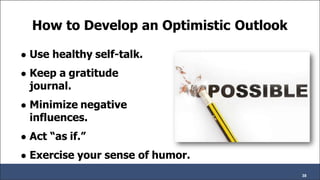
How to Develop an Optimistic Outlook
● Use healthy self-talk.
● Keep a gratitude
journal.
● Minimize negative
influences.
● Act “as if.”
● Exercise your sense of humor.
38
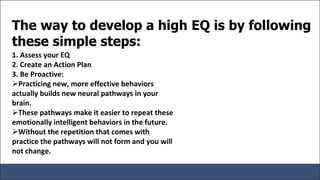
The way to develop a high EQ is by following
these simple steps:
1. Assess your EQ
2. Create an Action Plan
3. Be Proactive:
Practicing new, more effective behaviors
actually builds new neural pathways in your
brain.
These pathways make it easier to repeat these
emotionally intelligent behaviors in the future.
Without the repetition that comes with
practice the pathways will not form and you will
not change.
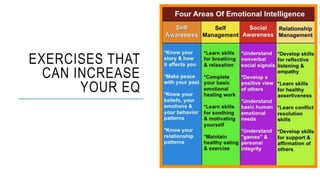
EXERCISES THAT
CAN INCREASE
YOUR EQ
42
43
©API Fund for
Payroll Education,
THANK YOU!
43Inc.

Emotional Intelligence Presentation Draft

  • 1.
    1 By: Timothy Hogan EmotionalIntelligence A Scientifically Proven Method for Developing the Skills of Success
  • 2.
    Objectives • This coursewill increase your ability to: • Know the difference between IQ and EQ. • Manage your emotions by recognizing how thoughts and • emotions are connected. • Improve your self-control by identifying physical cues that indicate your emotions may be taking over. • Discover how emotional intelligence can help you develop more positive relationships at work and a more optimistic outlook. 2
  • 3.
    Objectives (cont.) • This coursewill increase your ability to: • Learn how to use assertive communication to express your needs and feelings appropriately. • Explore how to use emotional intelligence to bounce back from setbacks. 3
  • 4.
    Definition of Intellectual Intelligence • Adaptabilityto a new or changing environment • Capacity for knowledge and the ability to acquire it • Capacity for reason and abstract thought • Ability to comprehend relationships • Ability to evaluate and judge • Capacity for original and productive thought
  • 5.
    Intellectual Intelligence Ability to: •Learn about • Learn from • Understand • Interact
  • 6.
  • 7.
    Information enters here I “feel”here I think rationally here 7
  • 8.
    Emotional Intelligence Ability torecognize and understand emotions in yourself and others AND your ability to use this awareness to manage your behavior and relationships.
  • 9.
    It is veryimportant to understand that emotional intelligence is not the opposite of intelligence, it is not the triumph of heart over head – it is the unique intersection of both. David Caruso, Ph.D. “Emotional What” 9
  • 10.
  • 11.
    Emotional Intelligence is Comprised of FourSkills • Intrapersonal Skills • Self-Awareness • Interpersonal • Social Awareness • Adaptability • Relationship Management • Resilience • Self-Management • People with EQs have better success in business and in relationships 10
  • 12.
    ● Unaware ofemotions ● Shows little empathy ● Able to resolve conflict productively ● Has trouble recovering from setbacks ● Adapts to changing circumstances ● High degree of self-awareness and self-control √ Lower √ Lower √ Higher √ Lower √ Higher √ Higher Practical Exercise – Lower vs. Higher EI 10
  • 13.
    Aspects of EmotionalIntelligence 11 Intrapersonal Skills Interpersonal Skills Adaptability Resilience Self Awareness Social Awareness
  • 14.
  • 15.
    Self-Awareness is theability to perceive your emotions at the moment and understand your tendencies across situations – it is good to understand yourself, the good and the bad. Ask yourself….. What am I feeling? Why am I feeling it? Reflect on your behaviors. Know your triggers.
  • 16.
    Self-Awareness is not aboutdiscovering deep dark secrets or unconscious motivations, but developing a straightforward and honest understanding of what makes you tick.
  • 21.
    Recognize Your PhysicalCues ● Increased heart rate ● Butterflies ● Flushed skin ● Tense muscles ● Sweating ● Voice rising, getting louder 19 Don’t Get Emotionally Hijacked
  • 22.
  • 23.
    Social-Awareness is theability to recognize others’ emotions. Showing empathy enables you to have more positive relationships and minimize unproductive conflict. Ask yourself….. Am I listening? Did I ask questions? Did I adjust my body language, facial expressions, tone of voice to meet their needs?
  • 24.
    Demonstrate Empathy ● Do:be understanding without necessarily agreeing ● Do: use words and gestures to show you care ● Don’t: offer advice, judge, tell them how to feel 22
  • 25.
    Connecting and Communicating ●Meet them where they are. ● Watch for non- verbal cues. ● Prepare them for negative information. 23
  • 26.
    Assertive Communication ● Usethe Assertive Communication Process ● Employ Assertive Communication Techniques ● What do you do when you don’t get the response you’re looking for? 24
  • 27.
  • 28.
    Conflict Resolution ● Beaware of your emotions while remaining composed. ● Be aware of others’ emotions. ● Communicate your needs clearly and respectfully. ● Make your priority getting your needs and the other person’s needs met. 26
  • 29.
    Emotionally Intelligent “Fighting” ●Leave unrelated issues out. ● Deal in reality. 27 • Listen without getting defensive. • No “jabs!”
  • 30.
    Anyone can become angry—that’seasy. But to be angry with the right person, to the right degree, at the right time, for the right purpose, and in the right way, that is not easy. Greek Philosopher, Aristotle
  • 31.
  • 32.
    Flexibility is theability to adjust your thoughts, feelings, and behavior to unfamiliar, unpredictable, or changing conditions. Ask yourself….. Are you being open-minded? Am I focused on outcomes? Am I willing to put aside the need to be “right?” Am I unwilling to compromise principles or values?
  • 33.
    Cultivating Different Perspectives 31 ●Listen to people who disagree with you. ● Eliminate “either/or” thinking. • Question yourself. • Play devil’s advocate. • Look from different altitudes. • Use intuition and logic.
  • 34.
  • 35.
    Problem-Solving Process ● Definethe problem. ● Gather information. ● Brainstorm options. ● Evaluate potential solutions. ● Choose and implement the best option. 33
  • 36.
  • 37.
    Resilience is theability to bounce back from setbacks and failure, to find a silver lining and see a hopeful future. The first aspect of resilience that we’ll look at is gaining an accurate perspective. Ask yourself….. What am I feeling? What do I want to feel? What do I need to feel that way? Why do I need to feel this way?
  • 38.
    Reframe Your Thinking ●Change your perspective ● Translate your negative thoughts into neutral or positive statements. ◦ Change “We’re never going to find a way to pay for this.” ◦ To this: “I have dealt with budget shortfalls before and will use my experience to find a solution to this challenge.” 36
  • 39.
    Optimist's Explanatory Style ●Permanence: Setbacks are temporary and positive events are permanent. ● Pervasiveness: Setbacks are compartmentalized. ● Personalization: Positive events due to personal ability; negative events due to external circumstances. 37
  • 40.
    How to Developan Optimistic Outlook ● Use healthy self-talk. ● Keep a gratitude journal. ● Minimize negative influences. ● Act “as if.” ● Exercise your sense of humor. 38
  • 42.
    The way todevelop a high EQ is by following these simple steps: 1. Assess your EQ 2. Create an Action Plan 3. Be Proactive: Practicing new, more effective behaviors actually builds new neural pathways in your brain. These pathways make it easier to repeat these emotionally intelligent behaviors in the future. Without the repetition that comes with practice the pathways will not form and you will not change.
  • 44.
  • 45.
  • 46.
    43 ©API Fund for PayrollEducation, THANK YOU! 43Inc.