Conflict Resolution,
Problem Solving,
& Decision-Making
Dekalb Works Academy Summer Program 2020
CONFLICT RESOLUTION
◦ Conflicts are inevitable when number of
people will be working together. Conflict is
defined as “difference in opinion or some
kind of disagreement between two or more
parties”.
◦ Conflicts need to be resolved effectively.
CONFLICT RESOLUTION
◦ Hence it is important to understand clearly, what is a
conflict, why conflict occurs, challenges in resolving
conflicts and various methods for resolving conflicts.
◦ There are two views on conflicts or the so-called differences
in opinion between people.
◦ The traditional view says, “conflicts are bad and should be
totally discouraged”.
◦ The new modern view says” conflicts can be constructive
and good and different ways of thinking should be
encouraged to get multiple ideas and solutions to problems
in hand”.
CONFLICT
RESOLUTION
TECHNIQUES
1. Problem Solving/
Collaboration / Confronting
◦ In this method, people involved in the conflict or
having a difference in opinion, they come forward to
discuss the problem at hand with a very open mind.
◦ They focus on resolving the conflict and finding the
best alternative/solution for the team. They discuss by
rising above personal emotions with the sole intention
to finding what is best for the team.
◦ This leads to a win-win kind of an outcome. Here
everyone collaborates.
2.Compromising/
Reconciling
◦ Sometimes for certain conflicts, there will be a need
for the involved parties to think of a middle path
wherein both parties decide to give up something and
identify a resolution.
◦ This kind of solution will be temporary for that
moment and are not long-lasting solution.
◦ This leads to lose-lose kind of an outcome as both
parties may feel they have lost something.
3. Withdrawing/Avoiding
◦ In some situation one of the parties in the conflict may
decide to retract from the discussion and allows going with
the other person’s opinion.
◦ Or some situation, one of the parties may decide to
completely avoid the conflict by maintaining silence. This
works well in situation where one of the parties in the
conflict is emotionally charged up or is angry.
◦ Hence avoiding any conflict resolution provides a “cooling
off” period to the people involved so that they can later come
back for meaningful resolution.
4. Forcing/Competing
◦ In some situations, a person with authority and power can
force his/her opinion and resolves the conflict without
giving any chance to the other party/person.
◦ This leads to a win-lose kind of an outcome. Someone may
end up feeling as a loser while the other person with
authority may feel as a winner. This technique can be used
if we see the conflicts are unnecessary and mostly
destructive for the team.
5. Smoothing/Accommodating
◦ This is a technique which is used when the atmosphere
seems to be filled with apprehension/distrust among the
parties involved. And no one is coming forward for resolving
the conflict.
◦ In these kind of scenarios, one of the parties can take
charge and tries to smooth the surrounding by using nice
words and by emphasizing on the points of agreements and
playing down on the points of disagreements.
◦ This can work as catalyst to break the discomfort between
the involved parties by creating a feeling of trust and
encourages them to come forward and resolve the conflict.
PROBLEM SOLVING
&
DECISION -MAKING
PROBLEM SOLVING
&
DECISION-MAKING
◦ Making decision which are timely, and which are
based on careful analysis of various information is
critical to our success.
◦ Decisions should neither be taken in haste nor be
procrastinated indefinitely.
◦ Decision making can be hard sometimes.
◦ Decision making is a habit as well as a process that
leads to problem solving.
PROBLEMSOLVING
&
DECISION-MAKING
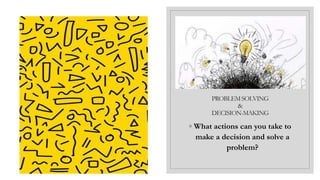
◦ What actions can you take to
make a decision and solve a
problem?
PROBLEM SOLVING
&
DECISION-MAKING STEPS
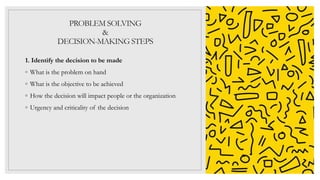
1. Identify the decision to be made
◦ What is the problem on hand
◦ What is the objective to be achieved
◦ How the decision will impact people or the organization
◦ Urgency and criticality of the decision
PROBLEM SOLVING
&
DECISION-MAKING STEPS
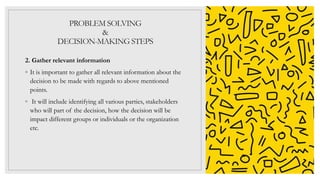
2. Gather relevant information
◦ It is important to gather all relevant information about the
decision to be made with regards to above mentioned
points.
◦ It will include identifying all various parties, stakeholders
who will part of the decision, how the decision will be
impact different groups or individuals or the organization
etc.
PROBLEM SOLVING
&
DECISION-MAKING STEPS
3. Identify the options
◦ Identify clearly all the available alternative options, paths or
actions for the decision to be made.
PROBLEM SOLVING
&
DECISION-MAKING STEPS
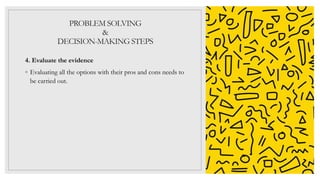
4. Evaluate the evidence
◦ Evaluating all the options with their pros and cons needs to
be carried out.
PROBLEM SOLVING
&
DECISION-MAKING STEPS
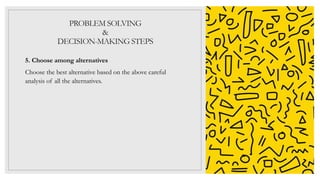
5. Choose among alternatives
Choose the best alternative based on the above careful
analysis of all the alternatives.
PROBLEM SOLVING
&
DECISION-MAKING STEPS
6. Implement the chosen alternative
◦ Implement the actions associated with the alternative path
or option being selected.
PROBLEM SOLVING
&
DECISION-MAKING STEPS
7. Analyze the results
◦ Analyze the outcome achieved after the implementation of
the actions selected in the above step.
CONCLUSION
oNow that you have watched this power
point...
oLet's discuss and complete the
interactive scenario on this topic!!!

Problem Solving, Decision Making, & Conflict Resolution PowerPoint

  • 1.
    Conflict Resolution, Problem Solving, &Decision-Making Dekalb Works Academy Summer Program 2020
  • 2.
    CONFLICT RESOLUTION ◦ Conflictsare inevitable when number of people will be working together. Conflict is defined as “difference in opinion or some kind of disagreement between two or more parties”. ◦ Conflicts need to be resolved effectively.
  • 3.
    CONFLICT RESOLUTION ◦ Henceit is important to understand clearly, what is a conflict, why conflict occurs, challenges in resolving conflicts and various methods for resolving conflicts. ◦ There are two views on conflicts or the so-called differences in opinion between people. ◦ The traditional view says, “conflicts are bad and should be totally discouraged”. ◦ The new modern view says” conflicts can be constructive and good and different ways of thinking should be encouraged to get multiple ideas and solutions to problems in hand”.
  • 4.
  • 5.
    1. Problem Solving/ Collaboration/ Confronting ◦ In this method, people involved in the conflict or having a difference in opinion, they come forward to discuss the problem at hand with a very open mind. ◦ They focus on resolving the conflict and finding the best alternative/solution for the team. They discuss by rising above personal emotions with the sole intention to finding what is best for the team. ◦ This leads to a win-win kind of an outcome. Here everyone collaborates.
  • 6.
    2.Compromising/ Reconciling ◦ Sometimes forcertain conflicts, there will be a need for the involved parties to think of a middle path wherein both parties decide to give up something and identify a resolution. ◦ This kind of solution will be temporary for that moment and are not long-lasting solution. ◦ This leads to lose-lose kind of an outcome as both parties may feel they have lost something.
  • 7.
    3. Withdrawing/Avoiding ◦ Insome situation one of the parties in the conflict may decide to retract from the discussion and allows going with the other person’s opinion. ◦ Or some situation, one of the parties may decide to completely avoid the conflict by maintaining silence. This works well in situation where one of the parties in the conflict is emotionally charged up or is angry. ◦ Hence avoiding any conflict resolution provides a “cooling off” period to the people involved so that they can later come back for meaningful resolution.
  • 8.
    4. Forcing/Competing ◦ Insome situations, a person with authority and power can force his/her opinion and resolves the conflict without giving any chance to the other party/person. ◦ This leads to a win-lose kind of an outcome. Someone may end up feeling as a loser while the other person with authority may feel as a winner. This technique can be used if we see the conflicts are unnecessary and mostly destructive for the team.
  • 9.
    5. Smoothing/Accommodating ◦ Thisis a technique which is used when the atmosphere seems to be filled with apprehension/distrust among the parties involved. And no one is coming forward for resolving the conflict. ◦ In these kind of scenarios, one of the parties can take charge and tries to smooth the surrounding by using nice words and by emphasizing on the points of agreements and playing down on the points of disagreements. ◦ This can work as catalyst to break the discomfort between the involved parties by creating a feeling of trust and encourages them to come forward and resolve the conflict.
  • 10.
  • 11.
    PROBLEM SOLVING & DECISION-MAKING ◦ Makingdecision which are timely, and which are based on careful analysis of various information is critical to our success. ◦ Decisions should neither be taken in haste nor be procrastinated indefinitely. ◦ Decision making can be hard sometimes. ◦ Decision making is a habit as well as a process that leads to problem solving.
  • 12.
    PROBLEMSOLVING & DECISION-MAKING ◦ What actionscan you take to make a decision and solve a problem?
  • 13.
    PROBLEM SOLVING & DECISION-MAKING STEPS 1.Identify the decision to be made ◦ What is the problem on hand ◦ What is the objective to be achieved ◦ How the decision will impact people or the organization ◦ Urgency and criticality of the decision
  • 14.
    PROBLEM SOLVING & DECISION-MAKING STEPS 2.Gather relevant information ◦ It is important to gather all relevant information about the decision to be made with regards to above mentioned points. ◦ It will include identifying all various parties, stakeholders who will part of the decision, how the decision will be impact different groups or individuals or the organization etc.
  • 15.
    PROBLEM SOLVING & DECISION-MAKING STEPS 3.Identify the options ◦ Identify clearly all the available alternative options, paths or actions for the decision to be made.
  • 16.
    PROBLEM SOLVING & DECISION-MAKING STEPS 4.Evaluate the evidence ◦ Evaluating all the options with their pros and cons needs to be carried out.
  • 17.
    PROBLEM SOLVING & DECISION-MAKING STEPS 5.Choose among alternatives Choose the best alternative based on the above careful analysis of all the alternatives.
  • 18.
    PROBLEM SOLVING & DECISION-MAKING STEPS 6.Implement the chosen alternative ◦ Implement the actions associated with the alternative path or option being selected.
  • 19.
    PROBLEM SOLVING & DECISION-MAKING STEPS 7.Analyze the results ◦ Analyze the outcome achieved after the implementation of the actions selected in the above step.
  • 20.
    CONCLUSION oNow that youhave watched this power point... oLet's discuss and complete the interactive scenario on this topic!!!