Emotions
An emotion is a natural instinctive state of mind deriving from one's
circumstances, mood, or relationships with others.
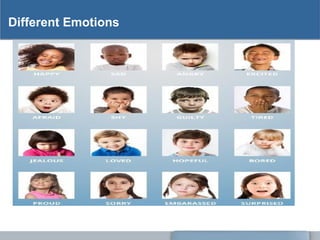
Some positive emotions : Love, Appreciation, Happiness, Hope,
Enthusiasm, Confidence, Gratitude, Patient, Optimistic, Appreciative.
Some negative emotions : Fear, Anger, Guilt, Depression, Jealousy,
Anxiety, Envy, Frustration, Shame, Resentful, Sad, Worried.
Different Emotions
Subjective feeling: That is how the individual interprets what they are
feeling at any point. These are inner personal experiences. Subjective
feelings in response to an emotion cannot be readily observed.
Expressive behaviour: This refers to the outward signs that an emotion
is being experienced. Such behaviour can be intentional or unintentional
and includes facial expressions as well as body language.
Physiological responses: This involves bodily changes which occur
when we experience an emotion. This involves the operation of the brain
as well as the Autonomic Nervous system and it also involves the cells in
our body.
Emotions Consist of …
Functions of Emotions
 Arousal - Emotions arouse us to move and take action.
 Motivation – Emotions motivate people to engage in actions that are important for
survival. For e.g. : Excitement (An emotion) motivates us to take on situations in
which we require energy & initiative like tackling a new career.
 Adaptive functions - Emotional responses provide us with adaptive responses
that assist us in coping with particular situations.
 Adding colour to our lives - This may not be all that scientific but it does take in
the fact that expression of emotions through art, poetry and literature provides us
with much that underpins the sense of being human.
 Regulating social interactions - Identifying the emotions that others are feeling
through their facial expressions and body language and tone of voice enables us
to work out the way to respond.
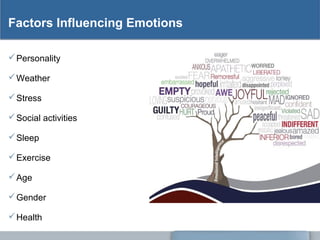
Factors Influencing Emotions
Personality
Weather
Stress
Social activities
Sleep
Exercise
Age
Gender
Health
Emotional Intelligence (EQ)
 Emotional intelligence (EQ) is the ability to identify, use, understand, and manage
emotions in positive ways to relieve stress, communicate effectively, empathize
with others, overcome challenges, and defuse conflict.
 Emotional intelligence impacts many different aspects of your daily life, such as
the way you behave and the way you interact with others.
 If you have a high emotional intelligence you are able to recognize your own
emotional state and the emotional states of others and engage with people in a
way that draws them to you.
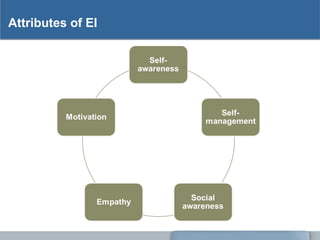
Attributes of EI
Self-awareness
 Self-awareness – People with high emotional intelligence are usually very self-
aware. They understand their emotions, and because of this, they don't let their
feelings rule them. They're confident – because they trust their intuition and don't
let their emotions get out of control.
 Self-management – This is the ability to control emotions and impulses. People
who self-regulate typically don't allow themselves to become too angry or jealous,
and they don't make impulsive, careless decisions. They think before they act.
Characteristics of self-regulation are thoughtfulness, comfort with change,
integrity, and the ability to say no.
Social awareness – You can understand the emotions, needs, and concerns
of other people, and recognize the power dynamics in a group or organization.
Empathy –Empathy is the ability to identify with and understand the wants,
needs, and viewpoints of those around you. They avoid stereotyping and
judging too quickly, and they live their lives in a very open, honest way.
Motivation – People with a high degree of emotional intelligence are usually
motivated. They're willing to defer immediate results for long-term success.
They're highly productive, love a challenge, and are very effective.
Importance
Emotional intelligence affects:
Your performance at work : Emotional intelligence can help you navigate the social
complexities of the workplace, lead and motivate others, and excel in your career.
Your physical health : If you‘re unable to manage your stress levels, it can lead to serious
health problems. Uncontrolled stress can raise blood pressure, suppress the immune system,
increase the risk of heart attack and speed up the aging process.
Your mental health : Uncontrolled stress can also impact your mental health, making you
vulnerable to anxiety and depression. If you are unable to understand and manage your
emotions, you‘ll also be open to mood swings, also leaving you feeling lonely and isolated.
Your relationships : By understanding your emotions and how to control them, you‘re better
able to express how you feel and understand how others are feeling.
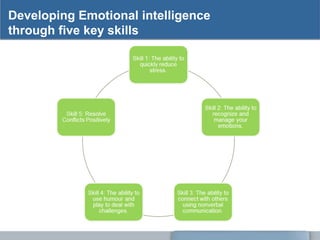
Developing Emotional intelligence
through five key skills
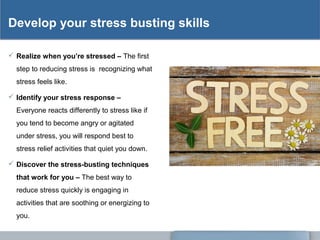
Develop your stress busting skills
 Realize when you’re stressed – The first
step to reducing stress is recognizing what
stress feels like.
 Identify your stress response –
Everyone reacts differently to stress like if
you tend to become angry or agitated
under stress, you will respond best to
stress relief activities that quiet you down.
 Discover the stress-busting techniques
that work for you – The best way to
reduce stress quickly is engaging in
activities that are soothing or energizing to
you.
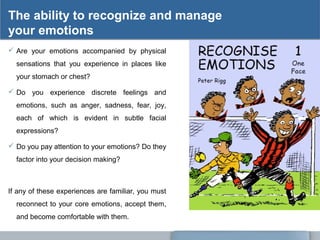
The ability to recognize and manage
your emotions
 Are your emotions accompanied by physical
sensations that you experience in places like
your stomach or chest?
 Do you experience discrete feelings and
emotions, such as anger, sadness, fear, joy,
each of which is evident in subtle facial
expressions?
 Do you pay attention to your emotions? Do they
factor into your decision making?
If any of these experiences are familiar, you must
reconnect to your core emotions, accept them,
and become comfortable with them.
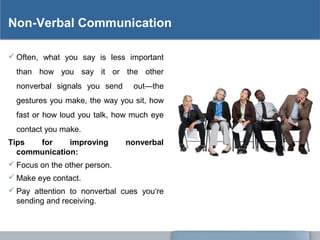
Non-Verbal Communication
 Often, what you say is less important
than how you say it or the other
nonverbal signals you send out—the
gestures you make, the way you sit, how
fast or how loud you talk, how much eye
contact you make.
Tips for improving nonverbal
communication:
 Focus on the other person.
 Make eye contact.
 Pay attention to nonverbal cues you‘re
sending and receiving.
Use humour and play to deal with challenges
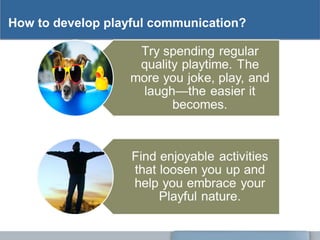
How to develop playful communication?
Resolve Conflicts Positively
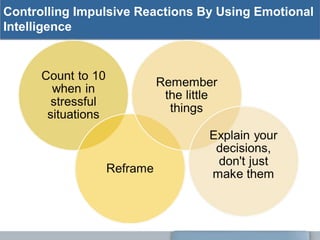
Controlling Impulsive Reactions By Using Emotional
Intelligence

Emotional Intelligence

  • 2.
    Emotions An emotion isa natural instinctive state of mind deriving from one's circumstances, mood, or relationships with others. Some positive emotions : Love, Appreciation, Happiness, Hope, Enthusiasm, Confidence, Gratitude, Patient, Optimistic, Appreciative. Some negative emotions : Fear, Anger, Guilt, Depression, Jealousy, Anxiety, Envy, Frustration, Shame, Resentful, Sad, Worried.
  • 3.
  • 4.
    Subjective feeling: Thatis how the individual interprets what they are feeling at any point. These are inner personal experiences. Subjective feelings in response to an emotion cannot be readily observed. Expressive behaviour: This refers to the outward signs that an emotion is being experienced. Such behaviour can be intentional or unintentional and includes facial expressions as well as body language. Physiological responses: This involves bodily changes which occur when we experience an emotion. This involves the operation of the brain as well as the Autonomic Nervous system and it also involves the cells in our body. Emotions Consist of …
  • 5.
    Functions of Emotions Arousal - Emotions arouse us to move and take action.  Motivation – Emotions motivate people to engage in actions that are important for survival. For e.g. : Excitement (An emotion) motivates us to take on situations in which we require energy & initiative like tackling a new career.  Adaptive functions - Emotional responses provide us with adaptive responses that assist us in coping with particular situations.  Adding colour to our lives - This may not be all that scientific but it does take in the fact that expression of emotions through art, poetry and literature provides us with much that underpins the sense of being human.  Regulating social interactions - Identifying the emotions that others are feeling through their facial expressions and body language and tone of voice enables us to work out the way to respond.
  • 6.
    Factors Influencing Emotions Personality Weather Stress Socialactivities Sleep Exercise Age Gender Health
  • 7.
    Emotional Intelligence (EQ) Emotional intelligence (EQ) is the ability to identify, use, understand, and manage emotions in positive ways to relieve stress, communicate effectively, empathize with others, overcome challenges, and defuse conflict.  Emotional intelligence impacts many different aspects of your daily life, such as the way you behave and the way you interact with others.  If you have a high emotional intelligence you are able to recognize your own emotional state and the emotional states of others and engage with people in a way that draws them to you.
  • 8.
  • 9.
    Self-awareness  Self-awareness –People with high emotional intelligence are usually very self- aware. They understand their emotions, and because of this, they don't let their feelings rule them. They're confident – because they trust their intuition and don't let their emotions get out of control.  Self-management – This is the ability to control emotions and impulses. People who self-regulate typically don't allow themselves to become too angry or jealous, and they don't make impulsive, careless decisions. They think before they act. Characteristics of self-regulation are thoughtfulness, comfort with change, integrity, and the ability to say no.
  • 10.
    Social awareness –You can understand the emotions, needs, and concerns of other people, and recognize the power dynamics in a group or organization. Empathy –Empathy is the ability to identify with and understand the wants, needs, and viewpoints of those around you. They avoid stereotyping and judging too quickly, and they live their lives in a very open, honest way. Motivation – People with a high degree of emotional intelligence are usually motivated. They're willing to defer immediate results for long-term success. They're highly productive, love a challenge, and are very effective.
  • 11.
    Importance Emotional intelligence affects: Yourperformance at work : Emotional intelligence can help you navigate the social complexities of the workplace, lead and motivate others, and excel in your career. Your physical health : If you‘re unable to manage your stress levels, it can lead to serious health problems. Uncontrolled stress can raise blood pressure, suppress the immune system, increase the risk of heart attack and speed up the aging process. Your mental health : Uncontrolled stress can also impact your mental health, making you vulnerable to anxiety and depression. If you are unable to understand and manage your emotions, you‘ll also be open to mood swings, also leaving you feeling lonely and isolated. Your relationships : By understanding your emotions and how to control them, you‘re better able to express how you feel and understand how others are feeling.
  • 12.
  • 13.
    Develop your stressbusting skills  Realize when you’re stressed – The first step to reducing stress is recognizing what stress feels like.  Identify your stress response – Everyone reacts differently to stress like if you tend to become angry or agitated under stress, you will respond best to stress relief activities that quiet you down.  Discover the stress-busting techniques that work for you – The best way to reduce stress quickly is engaging in activities that are soothing or energizing to you.
  • 14.
    The ability torecognize and manage your emotions  Are your emotions accompanied by physical sensations that you experience in places like your stomach or chest?  Do you experience discrete feelings and emotions, such as anger, sadness, fear, joy, each of which is evident in subtle facial expressions?  Do you pay attention to your emotions? Do they factor into your decision making? If any of these experiences are familiar, you must reconnect to your core emotions, accept them, and become comfortable with them.
  • 15.
    Non-Verbal Communication  Often,what you say is less important than how you say it or the other nonverbal signals you send out—the gestures you make, the way you sit, how fast or how loud you talk, how much eye contact you make. Tips for improving nonverbal communication:  Focus on the other person.  Make eye contact.  Pay attention to nonverbal cues you‘re sending and receiving.
  • 16.
    Use humour andplay to deal with challenges
  • 17.
    How to developplayful communication?
  • 18.
  • 19.
    Controlling Impulsive ReactionsBy Using Emotional Intelligence