STRATEGIC
MANAGEMENT
- Introduction
Arsh Sood
“
“Victorious warriors win first and then
go to war, while defeated warriors go
to war first and then seek to win.”
― Sun Tzu
Strategic Management
It refers to the set of managerial
decisions and actions that determines
the long-run performance of a
corporation, It includes:
◦ environmental scanning (internal &
external)
◦ strategy formulation
◦ strategy implementation
◦ evaluation and control
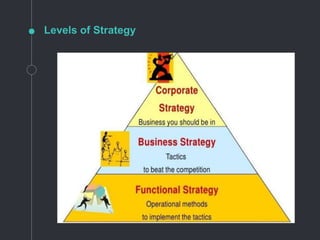
Levels of Strategy
Levels of Strategy - Corporate-level Strategy
◦ At this level, strategic decisions relate to
organization-wide policies and are taken
care by top-level management (BOD) with
a vision of determining ‘Where the company
wants to be?’
◦ It has two main aspects- Formulation of
Strategy (strategic planning) and Strategy
Implementation
◦ Major financial policy decisions involving
acquisition, diversification and structural
redesigning belong to this level.
Levels of Strategy - Business-level Strategy
◦ Business-level strategy is more likely related
to a unit within the whole. It is concerned with
competition in a market.
◦ The concerns are about what products or
services should be developed and offered to
which markets in order to meet customer
needs and organizational objectives.
◦ Decisions at this level include policies
involving new product development,
marketing mix, research & development,
personnel, etc.
Levels of Strategy - Functional level strategy
◦ Functional strategy involves decision-
making with respect to specific functional
areas- production, marketing, personnel,
finance etc.
◦ While corporate and business level
strategies are concerned with “Doing the
right things”, functional strategies stress on
“Doing things right”.
◦ Thus, functional level strategic management
is the management of relatively narrow
areas of activity, which are of vital, pervasive
or continuing importance to the total
organization.
Importance of Strategic Management
◦ It results in higher organizational
performance.
◦ It requires that managers examine
and adapt to business environment
changes.
◦ It coordinates diverse organizational
units, helping them focus on
organizational goals.
◦ It is very much involved in the
managerial decision-making process.
Importance of Strategic Management
◦ Strategic management takes into account the future
and anticipates for it.
◦ A strategy is made on rational and logical manner,
thus its efficiency and its success are ensured.
◦ Strategic management reduces frustration because it
has been planned in such a way that it follows a
procedure.
◦ It brings growth in the organization because it seeks
opportunities.
◦ With strategic management, organizations can avoid
misguidedness and they can work directionally.
◦ Strategic management also adds to the reputation of
the organization because of consistency that results
from organization’s success.
Importance of Strategic Management
◦ Often companies draw to a close because of lack of
proper strategy to run it. With strategic management
companies can foresee the events in future and that’s
why they can remain stable in the market.
◦ Strategic management looks at the threats present in
the external environment and thus companies can
either work to get rid of them or else neutralizes the
threats in such a way that they become an
opportunity for their success.
◦ Strategic management focuses on proactive
approach which enables organization to grasp every
opportunity that is available in the market.
Benefits of Strategic Management
▫ Clearer sense of strategic vision
▫ Sharper focus on what is strategically important
▫ Improved understanding of rapidly changing
environment
“
“If you can’t describe your strategy in
twenty minutes, simply and in plain
language, you haven’t got a plan. ‘But,’
people may say, ‘I’ve got a complex
strategy. It can’t be reduced to a page.’
That’s nonsense. That’s not a complex
strategy. It’s a complex thought about
the strategy.”
― Larry Bossidy,
Thanks!
ANY QUESTIONS?

Strategic Management

  • 1.
  • 2.
    “ “Victorious warriors winfirst and then go to war, while defeated warriors go to war first and then seek to win.” ― Sun Tzu
  • 3.
    Strategic Management It refersto the set of managerial decisions and actions that determines the long-run performance of a corporation, It includes: ◦ environmental scanning (internal & external) ◦ strategy formulation ◦ strategy implementation ◦ evaluation and control
  • 4.
  • 5.
    Levels of Strategy- Corporate-level Strategy ◦ At this level, strategic decisions relate to organization-wide policies and are taken care by top-level management (BOD) with a vision of determining ‘Where the company wants to be?’ ◦ It has two main aspects- Formulation of Strategy (strategic planning) and Strategy Implementation ◦ Major financial policy decisions involving acquisition, diversification and structural redesigning belong to this level.
  • 6.
    Levels of Strategy- Business-level Strategy ◦ Business-level strategy is more likely related to a unit within the whole. It is concerned with competition in a market. ◦ The concerns are about what products or services should be developed and offered to which markets in order to meet customer needs and organizational objectives. ◦ Decisions at this level include policies involving new product development, marketing mix, research & development, personnel, etc.
  • 7.
    Levels of Strategy- Functional level strategy ◦ Functional strategy involves decision- making with respect to specific functional areas- production, marketing, personnel, finance etc. ◦ While corporate and business level strategies are concerned with “Doing the right things”, functional strategies stress on “Doing things right”. ◦ Thus, functional level strategic management is the management of relatively narrow areas of activity, which are of vital, pervasive or continuing importance to the total organization.
  • 8.
    Importance of StrategicManagement ◦ It results in higher organizational performance. ◦ It requires that managers examine and adapt to business environment changes. ◦ It coordinates diverse organizational units, helping them focus on organizational goals. ◦ It is very much involved in the managerial decision-making process.
  • 9.
    Importance of StrategicManagement ◦ Strategic management takes into account the future and anticipates for it. ◦ A strategy is made on rational and logical manner, thus its efficiency and its success are ensured. ◦ Strategic management reduces frustration because it has been planned in such a way that it follows a procedure. ◦ It brings growth in the organization because it seeks opportunities. ◦ With strategic management, organizations can avoid misguidedness and they can work directionally. ◦ Strategic management also adds to the reputation of the organization because of consistency that results from organization’s success.
  • 10.
    Importance of StrategicManagement ◦ Often companies draw to a close because of lack of proper strategy to run it. With strategic management companies can foresee the events in future and that’s why they can remain stable in the market. ◦ Strategic management looks at the threats present in the external environment and thus companies can either work to get rid of them or else neutralizes the threats in such a way that they become an opportunity for their success. ◦ Strategic management focuses on proactive approach which enables organization to grasp every opportunity that is available in the market.
  • 11.
    Benefits of StrategicManagement ▫ Clearer sense of strategic vision ▫ Sharper focus on what is strategically important ▫ Improved understanding of rapidly changing environment
  • 12.
    “ “If you can’tdescribe your strategy in twenty minutes, simply and in plain language, you haven’t got a plan. ‘But,’ people may say, ‘I’ve got a complex strategy. It can’t be reduced to a page.’ That’s nonsense. That’s not a complex strategy. It’s a complex thought about the strategy.” ― Larry Bossidy,
  • 13.