Handwritten digit
recognition
Bhushan S. Tandale
Eckovation
MAIN GOAL & APPLICATIONS
• Handwritten Digit Recognition is used to recognize the Digits
which are written by
hand.
• A handwritten digit recognition system is used to visualize
artificial neural networks.
• It is already widely used in the automatic processing of bank
cheques, postal addresses, in mobile phones etc
INTRODUCTION
• Scientists believe that the most intelligent device is the Human
Brain.
• There is no computer which can beat the level of efficiency of
human brain. These Inefficiencies
of the computer has lead to evolution of “Artificial Neural Network”.
• They differ from conventional systems in the sense that rather
than being programmed these
system learn to recognize pattern.
NEURAL NETWORK
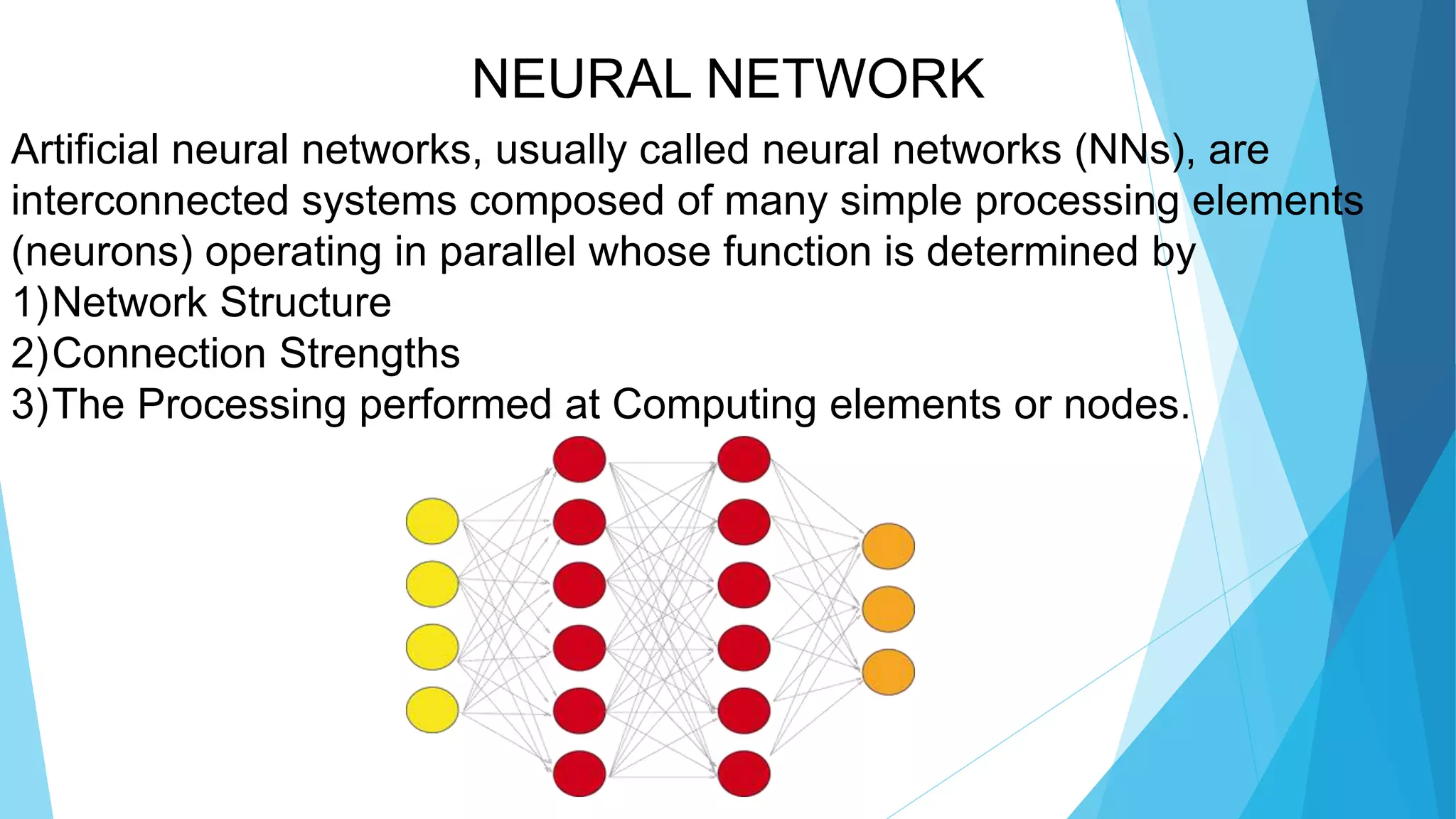
Artificial neural networks, usually called neural networks (NNs), are
interconnected systems composed of many simple processing elements
(neurons) operating in parallel whose function is determined by
1)Network Structure
2)Connection Strengths
3)The Processing performed at Computing elements or nodes.
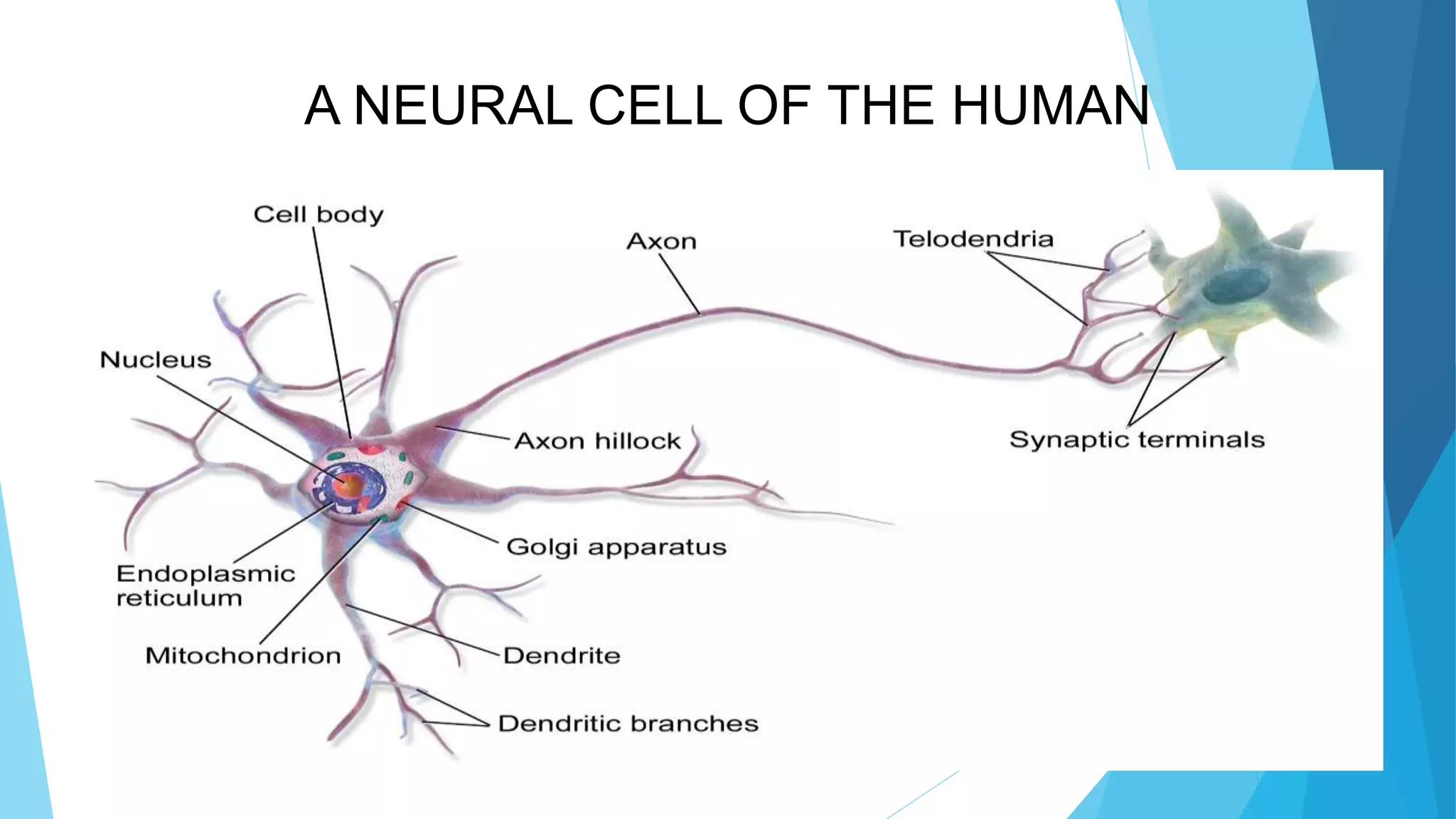
A NEURAL CELL OF THE HUMAN
THE MNIST DATABASE
• Training of the network is done by a dataset named
MNIST dataset.
• MNIST dataset has a training set of 60,000 examples,
and a test set of 10,000 examples.
• All the images in the dataset are of 28x28 pixels.
Why Convolutions?
Convolution is a simple mathematical operation between two matrices in
which one is multiplied to the other element wise and sum of all these
multiplications is calculated.
 Convolutions are performed for various reasons-
• Convolutions provide better feature extraction
• They save a lot of computation compared to ANNs.
• Less number of parameters are created than those in pure fully connected
layers.
• Due to less number of required parameters, lesser fully connected layers
are needed.
ARCHITECTURE OF CONVOLUTION NEURAL
NETWORK
• Two layers will be convolution layers the first with 64 channels, a 3 x 3
kernel and Rectifier Linear Unit (ReLu) function which will feed 64 images
into the second layer
• While the second layer will have 32 channels, a 3 x 3 kernel and Rectifier
Linear Unit (ReLu) function and feed 32 images into the third layer.
• The third layer is the flatten layer to transform the dimentionality of the
image to a 1-Dimension array to connect with the last layer which
contains 10 neurons and the activation function softmax.
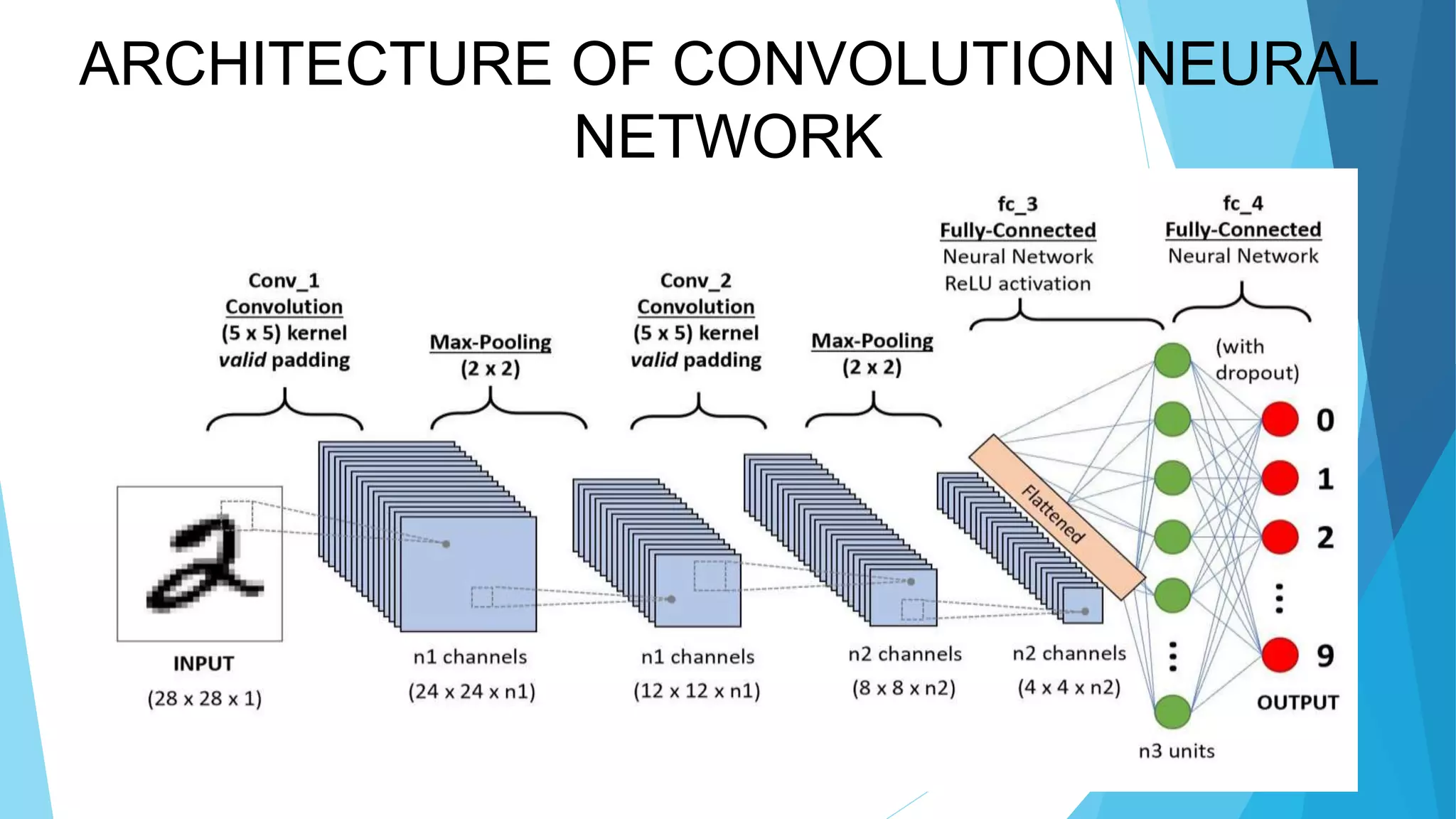
ARCHITECTURE OF CONVOLUTION NEURAL
NETWORK
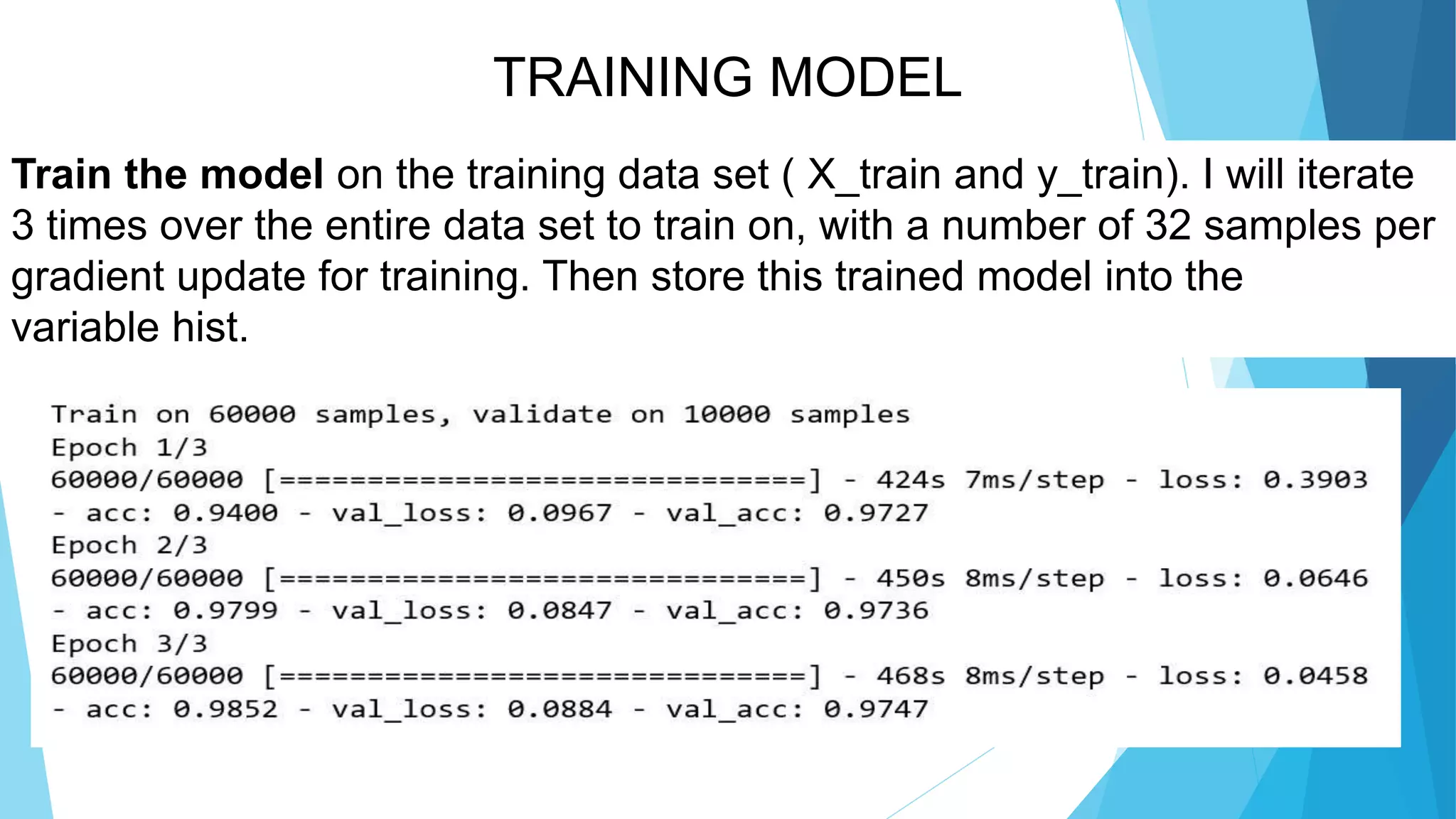
TRAINING MODEL
Train the model on the training data set ( X_train and y_train). I will iterate
3 times over the entire data set to train on, with a number of 32 samples per
gradient update for training. Then store this trained model into the
variable hist.
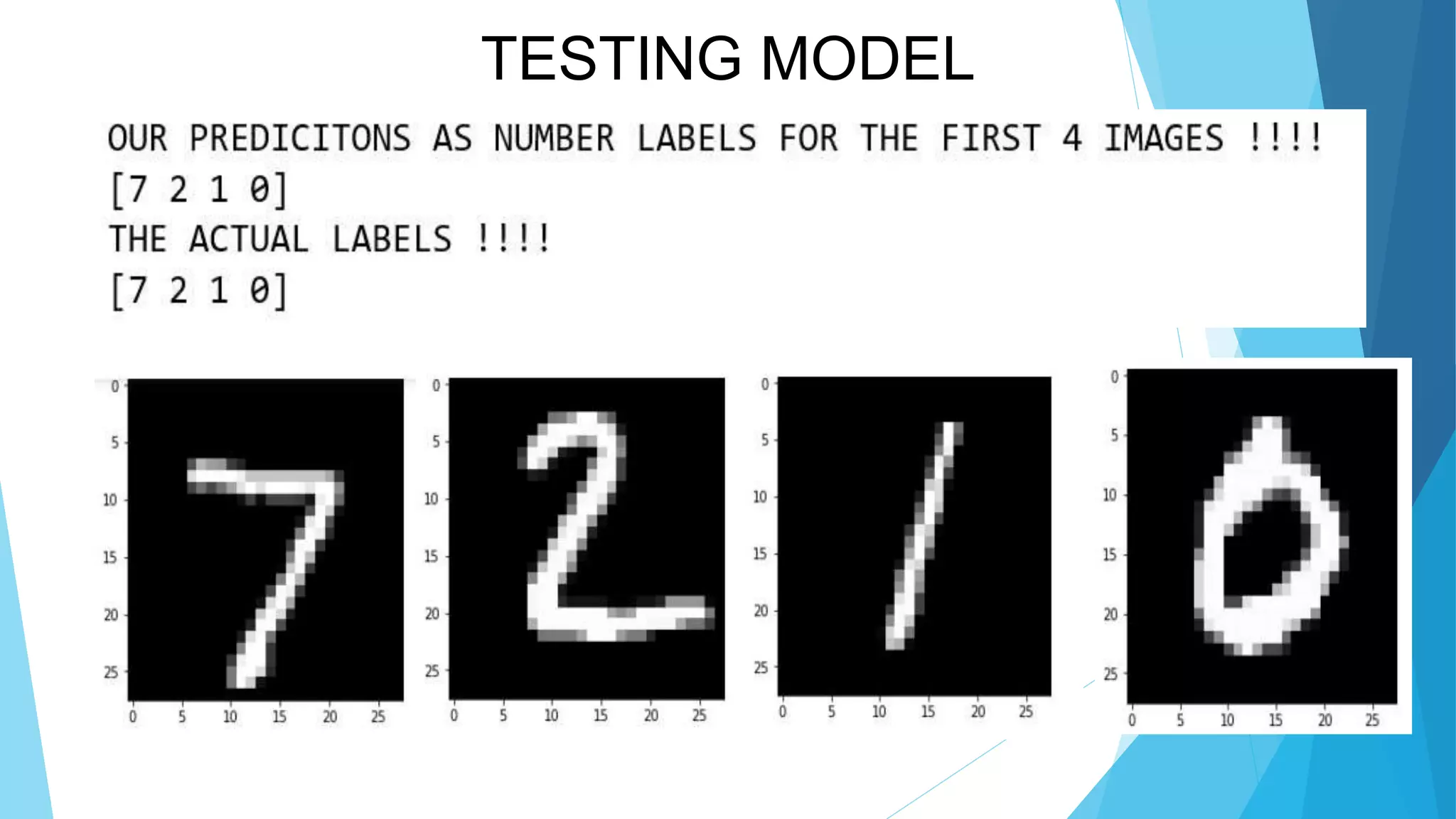
TESTING MODEL
CONCLUSION
• The handwritten digit recognition using convolutional neural
network has proved to be of a fairly good efficiency.
• It works better than any other algorithm, including artificial neural
networks.

Digit recognition

  • 1.
  • 2.
    MAIN GOAL &APPLICATIONS • Handwritten Digit Recognition is used to recognize the Digits which are written by hand. • A handwritten digit recognition system is used to visualize artificial neural networks. • It is already widely used in the automatic processing of bank cheques, postal addresses, in mobile phones etc
  • 3.
    INTRODUCTION • Scientists believethat the most intelligent device is the Human Brain. • There is no computer which can beat the level of efficiency of human brain. These Inefficiencies of the computer has lead to evolution of “Artificial Neural Network”. • They differ from conventional systems in the sense that rather than being programmed these system learn to recognize pattern.
  • 4.
    NEURAL NETWORK Artificial neuralnetworks, usually called neural networks (NNs), are interconnected systems composed of many simple processing elements (neurons) operating in parallel whose function is determined by 1)Network Structure 2)Connection Strengths 3)The Processing performed at Computing elements or nodes.
  • 5.
    A NEURAL CELLOF THE HUMAN
  • 6.
    THE MNIST DATABASE •Training of the network is done by a dataset named MNIST dataset. • MNIST dataset has a training set of 60,000 examples, and a test set of 10,000 examples. • All the images in the dataset are of 28x28 pixels.
  • 7.
    Why Convolutions? Convolution isa simple mathematical operation between two matrices in which one is multiplied to the other element wise and sum of all these multiplications is calculated.  Convolutions are performed for various reasons- • Convolutions provide better feature extraction • They save a lot of computation compared to ANNs. • Less number of parameters are created than those in pure fully connected layers. • Due to less number of required parameters, lesser fully connected layers are needed.
  • 8.
    ARCHITECTURE OF CONVOLUTIONNEURAL NETWORK • Two layers will be convolution layers the first with 64 channels, a 3 x 3 kernel and Rectifier Linear Unit (ReLu) function which will feed 64 images into the second layer • While the second layer will have 32 channels, a 3 x 3 kernel and Rectifier Linear Unit (ReLu) function and feed 32 images into the third layer. • The third layer is the flatten layer to transform the dimentionality of the image to a 1-Dimension array to connect with the last layer which contains 10 neurons and the activation function softmax.
  • 9.
  • 10.
    TRAINING MODEL Train themodel on the training data set ( X_train and y_train). I will iterate 3 times over the entire data set to train on, with a number of 32 samples per gradient update for training. Then store this trained model into the variable hist.
  • 11.
  • 12.
    CONCLUSION • The handwrittendigit recognition using convolutional neural network has proved to be of a fairly good efficiency. • It works better than any other algorithm, including artificial neural networks.