Abstract
• Human emotions are natural expressions that people tend to make naturally,
instead of any conscious effort that is accompanied by the reflexing of
facial muscles.
• Some of the common emotions are Happy, sad, surprised, anger and stable
(normal) which a human face can make according to the different situations
one may find itself in.
• We present the software which detects and recognizes faces as well as tells
a lot more about that person which could be used to get feedback from
customers or to know if a person needs motivation.
• The objective of the project is to be an affordable and efficient product.
Artificial Intelligence & Digital image processing technology used to make
the system in python.
• Detection of eye blinking is important in certain scenarios where to avoid
any accident or mishappening like in vehicles or in security vigilance.
• As the system also recognizes the identity card, this is a simple feature
wherein the camera installed is trained in such way that it firstly focuses on
the card and recognizes its shape and color.
Introduction
• The field of Artificial Intelligence and Digital Image Processing is
growing in our country slowly and steadily.
• Many areas of industry have started using the various techniques
and applications of AI and DIP.
• The project can be implemented for marketing purpose also, as it let
us know the feedback of any product.
• It provides accurate results as well as are easy to be implemented
and understood in the most common systems.
• Also, these features can be installed in a cost effective and efficient
manner in schools or colleges or any other area where surveillance is
required but lack of finances is a major factor.
• So, using our proposed project, surveillance could be provided
which results help in maintaining a regular health check and to
understand he emotion of a person at work place.
• It can also be used as feedback of workers after making some
changes at work place.
Cont….
• Artificial Intelligence & Digital image Processing technology used to make
the system which contain face recognition, emotion recognition;
• drowsiness detection and id card detection. In face recognition
conventional kNN algorithm is used.
• The given proposed work has shown us that the performance of face
recognition technique can be improved much better by mixing Gabor
wavelet and LBP for features extraction and the K Nearest Neighbour and
Sparse Representation Classifier (KNN- SRC) for classification.
• We can understand a person’s emotion if we are able to analyze it at
different stages.
• For this purpose, we have an aim to develop a Convolutional -Neural
Network (CNN) which is based on Facial Expression Recognition System
(FER).
• The algorithm used for drowsiness detection detects the blinking of the eye
through the camera installed using live video streams.
• The identity card detection is basically a feature which includes the use of
2 applications – First, the Shape Detection (Rectangle in this case) and
Second, the color of the card(using RGB2HSV).
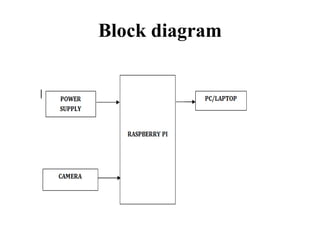
Block diagram
Facial Recognition & Detection
• The kNN algorithm trains the camera in such a way that after
capturing the frames, the next task is to take the input, the name of
that person whose face is captured and then save it to the database.
• This task will obviously be the first in its process as for the first time
when a new face is captured, the details of it are needed to be
entered.
• This process will continue for every new face the camera captures.
• When the name has been entered and saved in the database and
again the same face appears in front of the camera then the screen
will display the name of that person on top of the face successfully
recognizing the face and capturing each and every frame
successfully.
• For face recognition we have used the algorithm KNN which
expands to k Nearest Neighbour.
• We are going to show step by step how it captures, trains and predict
along with its advantages over existing algorithms.
Emotion Recognition
• Emotion Recognition The process of Emotion
recognition, as the name suggests itself, is basically
trying to capture the various moods or emotions that a
person makes through their faces to communicate with
one another.
• The various moods can be termed as the facial
expressions. We simply define the facial functions as
the way in which people tend to communicate with
each other by using their face instead of directly talking
or writing.
• In technical terms, it is the movement of muscles that
exist under the skin of human face which tend to move
when we express ourselves through our faces.
Drowsiness detection
• Drowsiness detection To view the eye region it
find the contour of the frame and we do this
through convex hull which finds if a curve is
convex.
• On each frame we check if the calculated eye
aspect ratio is less than the given threshold value,
if its more it saves the result.
• If it gets the eye aspect ratio as more than
threshold for consecutive three frames, the person
into consideration is declared to be drowsy and a
warning signal is generated.
Future Prospects
• Researchers are working day in and day out to get better
results from the previous times.
• The field of Artificial Intelligence and Digital Image
Processing is growing exponentially, so the future
prospective is really very bright.
• Many algorithms and techniques have been already
proposed but the better versions of them are on their way.
• Letting the machine decide what actions are needed to be
taken in certain circumstances is as simple as it sounds, but
the work to be done behind it is extremely complex.
• Training machines to think like humans can be an extremely
difficult task but the way the researches and other related
work that has been carried out till now is fantastic and in
the future, it will only tend to get better with the
advancements in the field of computer sciences.
References
• [1] Nian Zhang, Welezane Karimoune, Lara Thompson, and Hongmei Dang. “A
Between-Class Overlapping Coherence-Based Algorithm in KNN Classification”,
2017 IEEE International Conference on Systems, Man, and Cybernetics (SMC) Banff
Center, Banff, Canada, October 5-8, 2017
• [2] SeongJoon Baek and Koeng-Mo Sung, “Fast K-nearest-neighbour search
algorithm for nonparametric classification.”, ELECTRONICS LETTERS 12th October
2000 Vol. 36, No 21
• [3] Wen-Jyi Hwang and Kuo-Wei Wen. “Fast kNN classification algorithm based on
partial distance search.”, ELECTRONICS LETTER 15th October 1998 Vol. 34, No. 21
• [4] Bilel Ameur, Sabeur Masmoudi, Amira Guidara Derbel, Ahmed Ben Hamida.
“Fusing Gabor and LBP Feature Sets for KNN and SRC-based Face Recognition.” 2nd
International Conference on Advanced Technologies for Signal and Image
Processing
• [5] Vedat TÜMEN, Ömer Faruk SÖYLEMEZ, Burhan ERGEN. “Facial Emotion
Recognition on a Dataset Using Convolutional Neural Network.”
• [6] Lin-Lin Xu, Shu-Mei Zhang, Fu-Xing Wang. “CNN Expression Recognition Based
on Feature Graph.”

Emotion recognition and drowsiness detection using python.ppt

  • 1.
    Abstract • Human emotionsare natural expressions that people tend to make naturally, instead of any conscious effort that is accompanied by the reflexing of facial muscles. • Some of the common emotions are Happy, sad, surprised, anger and stable (normal) which a human face can make according to the different situations one may find itself in. • We present the software which detects and recognizes faces as well as tells a lot more about that person which could be used to get feedback from customers or to know if a person needs motivation. • The objective of the project is to be an affordable and efficient product. Artificial Intelligence & Digital image processing technology used to make the system in python. • Detection of eye blinking is important in certain scenarios where to avoid any accident or mishappening like in vehicles or in security vigilance. • As the system also recognizes the identity card, this is a simple feature wherein the camera installed is trained in such way that it firstly focuses on the card and recognizes its shape and color.
  • 2.
    Introduction • The fieldof Artificial Intelligence and Digital Image Processing is growing in our country slowly and steadily. • Many areas of industry have started using the various techniques and applications of AI and DIP. • The project can be implemented for marketing purpose also, as it let us know the feedback of any product. • It provides accurate results as well as are easy to be implemented and understood in the most common systems. • Also, these features can be installed in a cost effective and efficient manner in schools or colleges or any other area where surveillance is required but lack of finances is a major factor. • So, using our proposed project, surveillance could be provided which results help in maintaining a regular health check and to understand he emotion of a person at work place. • It can also be used as feedback of workers after making some changes at work place.
  • 3.
    Cont…. • Artificial Intelligence& Digital image Processing technology used to make the system which contain face recognition, emotion recognition; • drowsiness detection and id card detection. In face recognition conventional kNN algorithm is used. • The given proposed work has shown us that the performance of face recognition technique can be improved much better by mixing Gabor wavelet and LBP for features extraction and the K Nearest Neighbour and Sparse Representation Classifier (KNN- SRC) for classification. • We can understand a person’s emotion if we are able to analyze it at different stages. • For this purpose, we have an aim to develop a Convolutional -Neural Network (CNN) which is based on Facial Expression Recognition System (FER). • The algorithm used for drowsiness detection detects the blinking of the eye through the camera installed using live video streams. • The identity card detection is basically a feature which includes the use of 2 applications – First, the Shape Detection (Rectangle in this case) and Second, the color of the card(using RGB2HSV).
  • 4.
  • 5.
    Facial Recognition &Detection • The kNN algorithm trains the camera in such a way that after capturing the frames, the next task is to take the input, the name of that person whose face is captured and then save it to the database. • This task will obviously be the first in its process as for the first time when a new face is captured, the details of it are needed to be entered. • This process will continue for every new face the camera captures. • When the name has been entered and saved in the database and again the same face appears in front of the camera then the screen will display the name of that person on top of the face successfully recognizing the face and capturing each and every frame successfully. • For face recognition we have used the algorithm KNN which expands to k Nearest Neighbour. • We are going to show step by step how it captures, trains and predict along with its advantages over existing algorithms.
  • 6.
    Emotion Recognition • EmotionRecognition The process of Emotion recognition, as the name suggests itself, is basically trying to capture the various moods or emotions that a person makes through their faces to communicate with one another. • The various moods can be termed as the facial expressions. We simply define the facial functions as the way in which people tend to communicate with each other by using their face instead of directly talking or writing. • In technical terms, it is the movement of muscles that exist under the skin of human face which tend to move when we express ourselves through our faces.
  • 7.
    Drowsiness detection • Drowsinessdetection To view the eye region it find the contour of the frame and we do this through convex hull which finds if a curve is convex. • On each frame we check if the calculated eye aspect ratio is less than the given threshold value, if its more it saves the result. • If it gets the eye aspect ratio as more than threshold for consecutive three frames, the person into consideration is declared to be drowsy and a warning signal is generated.
  • 8.
    Future Prospects • Researchersare working day in and day out to get better results from the previous times. • The field of Artificial Intelligence and Digital Image Processing is growing exponentially, so the future prospective is really very bright. • Many algorithms and techniques have been already proposed but the better versions of them are on their way. • Letting the machine decide what actions are needed to be taken in certain circumstances is as simple as it sounds, but the work to be done behind it is extremely complex. • Training machines to think like humans can be an extremely difficult task but the way the researches and other related work that has been carried out till now is fantastic and in the future, it will only tend to get better with the advancements in the field of computer sciences.
  • 9.
    References • [1] NianZhang, Welezane Karimoune, Lara Thompson, and Hongmei Dang. “A Between-Class Overlapping Coherence-Based Algorithm in KNN Classification”, 2017 IEEE International Conference on Systems, Man, and Cybernetics (SMC) Banff Center, Banff, Canada, October 5-8, 2017 • [2] SeongJoon Baek and Koeng-Mo Sung, “Fast K-nearest-neighbour search algorithm for nonparametric classification.”, ELECTRONICS LETTERS 12th October 2000 Vol. 36, No 21 • [3] Wen-Jyi Hwang and Kuo-Wei Wen. “Fast kNN classification algorithm based on partial distance search.”, ELECTRONICS LETTER 15th October 1998 Vol. 34, No. 21 • [4] Bilel Ameur, Sabeur Masmoudi, Amira Guidara Derbel, Ahmed Ben Hamida. “Fusing Gabor and LBP Feature Sets for KNN and SRC-based Face Recognition.” 2nd International Conference on Advanced Technologies for Signal and Image Processing • [5] Vedat TÜMEN, Ömer Faruk SÖYLEMEZ, Burhan ERGEN. “Facial Emotion Recognition on a Dataset Using Convolutional Neural Network.” • [6] Lin-Lin Xu, Shu-Mei Zhang, Fu-Xing Wang. “CNN Expression Recognition Based on Feature Graph.”