AGE AND GENDER
DETECTION
A PROJECT ON DEEP LEARNING
TABLE OF CONTENTS
Agenda
Objectives
Dataset description
Methodology
Data pre-processing
Building a CNN model
Model compilation
Testing and deployment
Real world use-cases
AGENDA
The age and gender classification system is used to categorize human images into various groups
determined by facial features. Estimating human age group and gender automatically via facial image
analysis has lots of potential real-world applications, such as human computer interaction and
multimedia communication.
The successful applications of CNN on many computer-vision tasks have revealed that CNN is a
powerful tool in image learning. If enough training data are given, CNN is able to learn a compact and
discriminative image feature representation.
This project aims to detect age and gender which works on the mechanism of deep learning using
convolutional neural network.
OBJECTIVES
 To pretrain the age and gender detection model using the
public Datasets such as UTKFace.
 To use facial images to detect the age and gender provided to
the model
 To use model and expose it in as API using Flask or other.
DATASET DESCRIPTION
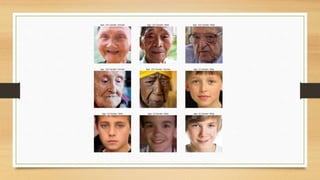
o UTKFace dataset is a large-scale face dataset with long age span (range from 0 to 116 years old).
o It has a total of 23708 images. The images cover large variations in facial expression, illumination,
pose, resolution and occlusion.
o We chose this dataset because of its relatively more uniform distributions, the diversity it has in
image characteristics such as brightness, occlusion and position and also it involves images of the
public data.
o Each image is labeled with a 3-element tuple, with age (in years), gender (Male-0, Female-1) and
races (White-0, Black-1, Asian-2, Indian-3 and Others-4) respectively.
o We used the same set of images for training, testing and validation, to have standardized results.
This was done by dividing the data sets into train, test in 80 : 20 ratios.
METHODOLOGY
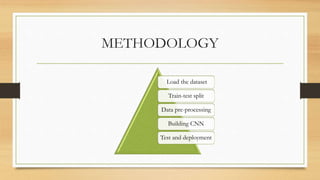
Load the dataset
Train-test split
Data pre-processing
Building CNN
Test and deployment
DATA PRE-PROCESSING
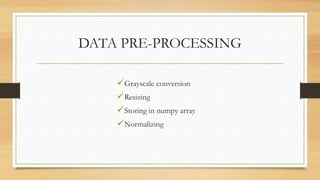
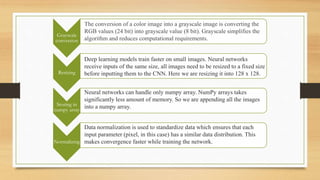
Grayscale conversion
Resizing
Storing in numpy array
Normalizing
Grayscale
conversion
Resizing
Storing in
numpy array
Normalizing
The conversion of a color image into a grayscale image is converting the
RGB values (24 bit) into grayscale value (8 bit). Grayscale simplifies the
algorithm and reduces computational requirements.
Deep learning models train faster on small images. Neural networks
receive inputs of the same size, all images need to be resized to a fixed size
before inputting them to the CNN. Here we are resizing it into 128 x 128.
Neural networks can handle only numpy array. NumPy arrays takes
significantly less amount of memory. So we are appending all the images
into a numpy array.
Data normalization is used to standardize data which ensures that each
input parameter (pixel, in this case) has a similar data distribution. This
makes convergence faster while training the network.
CNN MODEL
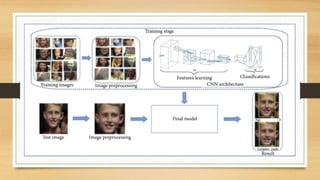
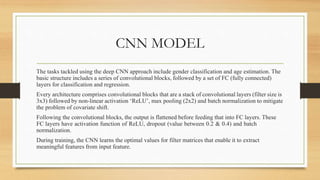
The tasks tackled using the deep CNN approach include gender classification and age estimation. The
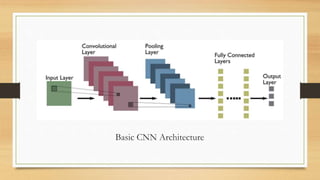
basic structure includes a series of convolutional blocks, followed by a set of FC (fully connected)
layers for classification and regression.
Every architecture comprises convolutional blocks that are a stack of convolutional layers (filter size is
3x3) followed by non-linear activation ‘ReLU’, max pooling (2x2) and batch normalization to mitigate
the problem of covariate shift.
Following the convolutional blocks, the output is flattened before feeding that into FC layers. These
FC layers have activation function of ReLU, dropout (value between 0.2 & 0.4) and batch
normalization.
During training, the CNN learns the optimal values for filter matrices that enable it to extract
meaningful features from input feature.
Basic CNN Architecture
MODEL COMPILATION
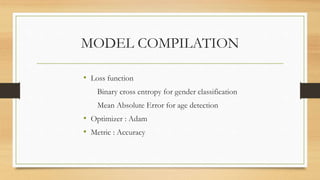
• Loss function
Binary cross entropy for gender classification
Mean Absolute Error for age detection
• Optimizer : Adam
• Metric : Accuracy
TESTING AND DEPLOYMENT
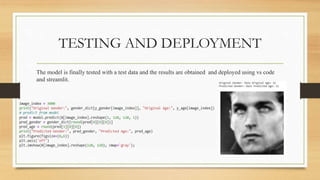
The model is finally tested with a test data and the results are obtained and deployed using vs code
and streamlit.
REAL WORLD USE CASES
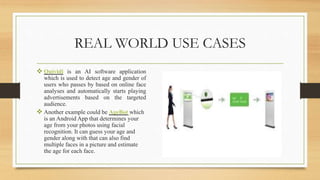
 Quividi is an AI software application
which is used to detect age and gender of
users who passes by based on online face
analyses and automatically starts playing
advertisements based on the targeted
audience.
 Another example could be AgeBot which
is an Android App that determines your
age from your photos using facial
recognition. It can guess your age and
gender along with that can also find
multiple faces in a picture and estimate
the age for each face.
THANK YOU!

AGE AND GENDER DETECTION.pptx

  • 1.
    AGE AND GENDER DETECTION APROJECT ON DEEP LEARNING
  • 2.
    TABLE OF CONTENTS Agenda Objectives Datasetdescription Methodology Data pre-processing Building a CNN model Model compilation Testing and deployment Real world use-cases
  • 3.
    AGENDA The age andgender classification system is used to categorize human images into various groups determined by facial features. Estimating human age group and gender automatically via facial image analysis has lots of potential real-world applications, such as human computer interaction and multimedia communication. The successful applications of CNN on many computer-vision tasks have revealed that CNN is a powerful tool in image learning. If enough training data are given, CNN is able to learn a compact and discriminative image feature representation. This project aims to detect age and gender which works on the mechanism of deep learning using convolutional neural network.
  • 4.
    OBJECTIVES  To pretrainthe age and gender detection model using the public Datasets such as UTKFace.  To use facial images to detect the age and gender provided to the model  To use model and expose it in as API using Flask or other.
  • 6.
    DATASET DESCRIPTION o UTKFacedataset is a large-scale face dataset with long age span (range from 0 to 116 years old). o It has a total of 23708 images. The images cover large variations in facial expression, illumination, pose, resolution and occlusion. o We chose this dataset because of its relatively more uniform distributions, the diversity it has in image characteristics such as brightness, occlusion and position and also it involves images of the public data. o Each image is labeled with a 3-element tuple, with age (in years), gender (Male-0, Female-1) and races (White-0, Black-1, Asian-2, Indian-3 and Others-4) respectively. o We used the same set of images for training, testing and validation, to have standardized results. This was done by dividing the data sets into train, test in 80 : 20 ratios.
  • 8.
    METHODOLOGY Load the dataset Train-testsplit Data pre-processing Building CNN Test and deployment
  • 9.
  • 10.
    Grayscale conversion Resizing Storing in numpy array Normalizing Theconversion of a color image into a grayscale image is converting the RGB values (24 bit) into grayscale value (8 bit). Grayscale simplifies the algorithm and reduces computational requirements. Deep learning models train faster on small images. Neural networks receive inputs of the same size, all images need to be resized to a fixed size before inputting them to the CNN. Here we are resizing it into 128 x 128. Neural networks can handle only numpy array. NumPy arrays takes significantly less amount of memory. So we are appending all the images into a numpy array. Data normalization is used to standardize data which ensures that each input parameter (pixel, in this case) has a similar data distribution. This makes convergence faster while training the network.
  • 11.
    CNN MODEL The taskstackled using the deep CNN approach include gender classification and age estimation. The basic structure includes a series of convolutional blocks, followed by a set of FC (fully connected) layers for classification and regression. Every architecture comprises convolutional blocks that are a stack of convolutional layers (filter size is 3x3) followed by non-linear activation ‘ReLU’, max pooling (2x2) and batch normalization to mitigate the problem of covariate shift. Following the convolutional blocks, the output is flattened before feeding that into FC layers. These FC layers have activation function of ReLU, dropout (value between 0.2 & 0.4) and batch normalization. During training, the CNN learns the optimal values for filter matrices that enable it to extract meaningful features from input feature.
  • 12.
  • 13.
    MODEL COMPILATION • Lossfunction Binary cross entropy for gender classification Mean Absolute Error for age detection • Optimizer : Adam • Metric : Accuracy
  • 14.
    TESTING AND DEPLOYMENT Themodel is finally tested with a test data and the results are obtained and deployed using vs code and streamlit.
  • 15.
    REAL WORLD USECASES  Quividi is an AI software application which is used to detect age and gender of users who passes by based on online face analyses and automatically starts playing advertisements based on the targeted audience.  Another example could be AgeBot which is an Android App that determines your age from your photos using facial recognition. It can guess your age and gender along with that can also find multiple faces in a picture and estimate the age for each face.
  • 16.