STUDY OF THE
EFFECT OF
METAL COUPLING ON
THE
RUSTING OF IRON
PRESENTED BY
NAME: MAYANK CHAUDHARY
CLASS: XII-A
YEAR: 2016-2017
CERTIFICATION :
It has been certified that MAYANK
CHAUDHARY , Studying in XII
A(Science), during the academic year
2016-17 has completed a project on
“the study of effect of metal coupling
on the rusting of iron” and has given a
satisfactory account of this in their
project report
(Chemistry Teacher)
Signature;
DECLARATION :
I MAYANK CHAUDHARY of Class XII A
(Science), JKG INTERNATIONAL
SCHOOL Indirapuram, declare that the
following project on “the study of the
effect of metal coupling on the rusting of
iron” has been accomplished under the
able guidance of our Chemistry Teacher,
Ms DEEPA ADHIKARI of
JKG INTERNATIONAL SCHOOL
Indirapuram , Ghaziabad
ACKNOWLEDGEMENT:
I would like to express our sincere
gratitude to Ms DEEPA ADHIKARI
mam , our chemistry teacher, whose
help and encouragement made this
project possible. I would also like to
thank Ms JHARNA mam , the lab
Assistant for her help during the
completion of this project.
XII A (Science)
JKG INTERNATIONAL SCHOOL
Indirapuram , Ghaziabad
INDEX:



Introduction
Mechanism of corrosion of meta
Electrochemical
Mechanism(rusting)
Methods of Prevention of Corrosion
Aim of this project
Requirements
Procedure
Observation
Conclusion
Bibliography
INTRODUCTION
Metal corrosion is the most common form of
corrosion. The corrosion occurs at the
surface of the metal in forms of chemical or
electrochemical reactions. This process
significantly reduces the strength, plasticity,
toughness and other mechanical properties of
the metallic material. However, because of
the metal and its alloys is still the most
important pipe and structure materials, the
cost of corrosion grows significantly with the
growth of industries. Thus many scientists
focus on the research of corrosion control in
order to reduce the cost of replacing the
rusting metal material. Nowadays, there are
mainly
two corrosion control methods that are
very popular in the world. One is
impressed current and another is
sacrificial anode cathode protection
system. In this project, we will focus on
the mechanism and application of the
sacrificial anode cathode protection
system.
Mechanismofcorrosionofmetal
General Principle of Corrosion:
Reaction is the fundamental reaction
during the corrosion process, which the
electron can flow from certain areas on
the metal surface to other areas through a
solution which can conduct electric
currents.
Basically,
both anodic and cathode reactions have to balance
each other out, resulting in a neutral reaction.
Both anodic and cathodic reactions occur
simultaneously at the same rates. What’s more, the
site of these electrodes may consist of either two
different kinds of metals, or they may
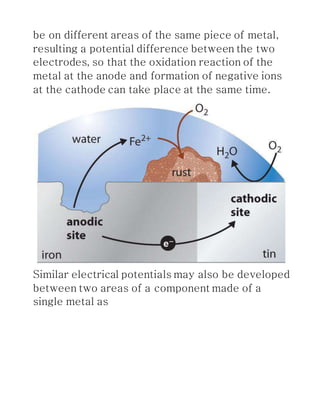
be on different areas of the same piece of metal,
resulting a potential difference between the two
electrodes, so that the oxidation reaction of the
metal at the anode and formation of negative ions
at the cathode can take place at the same time.
Similar electrical potentials may also be developed
between two areas of a component made of a
single metal as
result of small differences in composition or
structure or of differences in the conditions to
which the metal surface is exposed. That part of a
metal which becomes the corroding area is called
the “anode” ; that which acts as the other
electrode of the battery is called “cathode” which
does not corrode, but is an important part of the
system. In the corrosion systems commonly
involved, with water containing some salts in
solution as the electrolyte.Corrosion may even
take place with pure water, provided that oxygen
is present. In such cases oxygen combines with
the hydrogen generated at the cathode, removes.
Rusting: an Electrochemical Mechanism
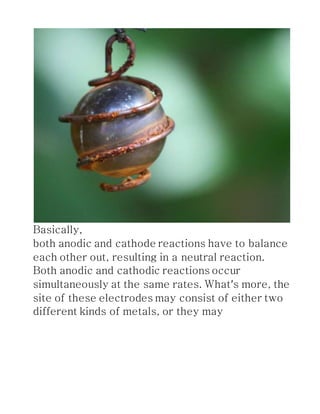
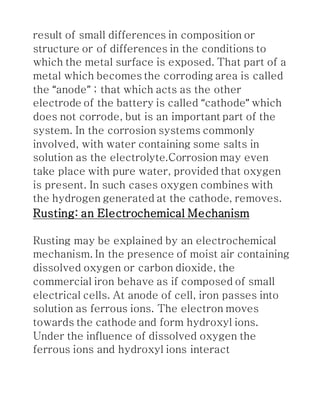
Rusting may be explained by an electrochemical
mechanism. In the presence of moist air containing
dissolved oxygen or carbon dioxide, the
commercial iron behave as if composed of small
electrical cells. At anode of cell, iron passes into
solution as ferrous ions. The electron moves
towards the cathode and form hydroxyl ions.
Under the influence of dissolved oxygen the
ferrous ions and hydroxyl ions interact
to form, i.e., hydrated ferric oxide.
Methods of Prevention of Corrosion and
Rusting
Some of the methods used:-
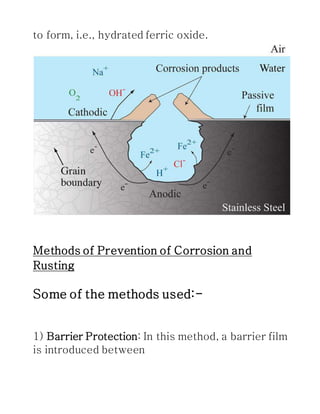
1) Barrier Protection: In this method, a barrier film
is introduced between
iron surface and atmospheric air. The film is
obtained by painting, varnishing etc.
2) Galvanization: The metallic iron is covered by a
layer of more reactive metal such as zinc. The
active metal The active metal losses electrons in
preference of iron.
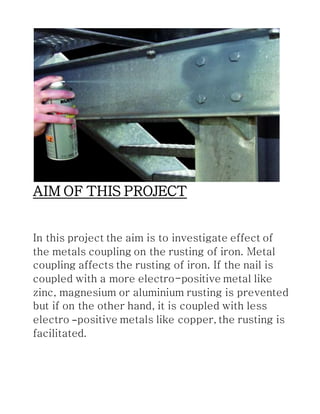
AIM OF THIS PROJECT
In this project the aim is to investigate effect of
the metals coupling on the rusting of iron. Metal
coupling affects the rusting of iron. If the nail is
coupled with a more electro-positive metal like
zinc, magnesium or aluminium rusting is prevented
but if on the other hand, it is coupled with less
electro –positive metals like copper, the rusting is
facilitated.
REQUIREMENTS
1) Two Petri dishes
2) Four test-tube
3) Four iron nails
4) Beaker
5) Sand paper
6) Wire gauge
7) Gelatin
8) Copper, Zinc and Magnesium strips
9) Potassium ferricyanide solutions
10) Phenolphthalein
PROCEDURE
1) At first we have to clean the surface of iron
nails with the help of sand paper.
2) After that we have to wind zinc strip around
one nail, a clean copper wire around the second
and clean magnesium strip around the third nail.
Then to put all these three and a fourth nail in
Petri dishes so that they are not in contact with
each other.
3) Then to fill the Petri dishes with hot agar agar
solution in such a way that only lower half of the
nails are covered with the liquids
4) Keep the covered Petri dishes for one day or
so.
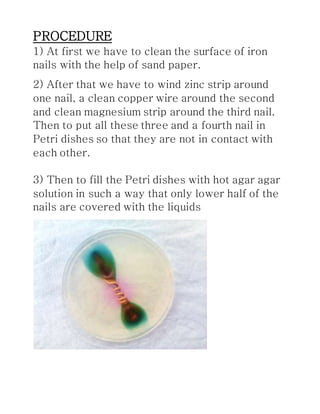
5) The liquids set to a gel on cooling. Two types
of patches are observed around the rusted nail,
one is blue and the other pink. Blue patch is due to
the formation of potassium ferro-ferricyanide
where pink patch is due to the formation of
hydroxyl ions which turns colorless
phenolphthalein to pink.
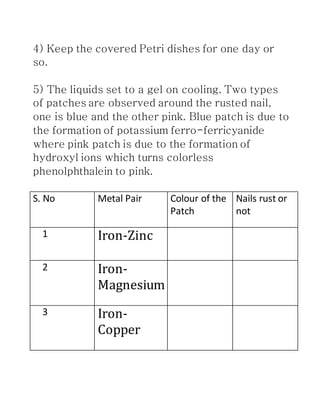
S. No Metal Pair Colour of the
Patch
Nails rust or
not
1 Iron-Zinc
2 Iron-
Magnesium
3 Iron-
Copper
CONCLUSION
It is clear from the observation that
coupling of iron with more
electropositive metals such as zinc and
magnesium resists corrosion and
rusting of iron. Coupling of iron with
less electropositive metals such as
copper increases rusting.
BIBLIOGRAPHY
For our project I have taken help from
following sources;
1) Comprehensive (practical
Chemistry-XII)
2) Internet- www.wikipedia.com
3) NCERT Chemistry Textbooks
4) http://projects.icbse.com/chemistry

Investigatory chemistry

  • 1.
    STUDY OF THE EFFECTOF METAL COUPLING ON THE RUSTING OF IRON PRESENTED BY NAME: MAYANK CHAUDHARY CLASS: XII-A YEAR: 2016-2017
  • 2.
    CERTIFICATION : It hasbeen certified that MAYANK CHAUDHARY , Studying in XII A(Science), during the academic year 2016-17 has completed a project on “the study of effect of metal coupling on the rusting of iron” and has given a satisfactory account of this in their project report (Chemistry Teacher) Signature;
  • 3.
    DECLARATION : I MAYANKCHAUDHARY of Class XII A (Science), JKG INTERNATIONAL SCHOOL Indirapuram, declare that the following project on “the study of the effect of metal coupling on the rusting of iron” has been accomplished under the able guidance of our Chemistry Teacher, Ms DEEPA ADHIKARI of JKG INTERNATIONAL SCHOOL Indirapuram , Ghaziabad
  • 4.
    ACKNOWLEDGEMENT: I would liketo express our sincere gratitude to Ms DEEPA ADHIKARI mam , our chemistry teacher, whose help and encouragement made this project possible. I would also like to thank Ms JHARNA mam , the lab Assistant for her help during the completion of this project. XII A (Science) JKG INTERNATIONAL SCHOOL Indirapuram , Ghaziabad
  • 5.
    INDEX:    Introduction Mechanism of corrosionof meta Electrochemical Mechanism(rusting) Methods of Prevention of Corrosion Aim of this project Requirements Procedure Observation Conclusion Bibliography
  • 6.
    INTRODUCTION Metal corrosion isthe most common form of corrosion. The corrosion occurs at the surface of the metal in forms of chemical or electrochemical reactions. This process significantly reduces the strength, plasticity, toughness and other mechanical properties of the metallic material. However, because of the metal and its alloys is still the most important pipe and structure materials, the cost of corrosion grows significantly with the growth of industries. Thus many scientists focus on the research of corrosion control in order to reduce the cost of replacing the rusting metal material. Nowadays, there are mainly
  • 7.
    two corrosion controlmethods that are very popular in the world. One is impressed current and another is sacrificial anode cathode protection system. In this project, we will focus on the mechanism and application of the sacrificial anode cathode protection system. Mechanismofcorrosionofmetal General Principle of Corrosion: Reaction is the fundamental reaction during the corrosion process, which the electron can flow from certain areas on the metal surface to other areas through a solution which can conduct electric currents.
  • 8.
    Basically, both anodic andcathode reactions have to balance each other out, resulting in a neutral reaction. Both anodic and cathodic reactions occur simultaneously at the same rates. What’s more, the site of these electrodes may consist of either two different kinds of metals, or they may
  • 9.
    be on differentareas of the same piece of metal, resulting a potential difference between the two electrodes, so that the oxidation reaction of the metal at the anode and formation of negative ions at the cathode can take place at the same time. Similar electrical potentials may also be developed between two areas of a component made of a single metal as
  • 10.
    result of smalldifferences in composition or structure or of differences in the conditions to which the metal surface is exposed. That part of a metal which becomes the corroding area is called the “anode” ; that which acts as the other electrode of the battery is called “cathode” which does not corrode, but is an important part of the system. In the corrosion systems commonly involved, with water containing some salts in solution as the electrolyte.Corrosion may even take place with pure water, provided that oxygen is present. In such cases oxygen combines with the hydrogen generated at the cathode, removes. Rusting: an Electrochemical Mechanism Rusting may be explained by an electrochemical mechanism. In the presence of moist air containing dissolved oxygen or carbon dioxide, the commercial iron behave as if composed of small electrical cells. At anode of cell, iron passes into solution as ferrous ions. The electron moves towards the cathode and form hydroxyl ions. Under the influence of dissolved oxygen the ferrous ions and hydroxyl ions interact
  • 11.
    to form, i.e.,hydrated ferric oxide. Methods of Prevention of Corrosion and Rusting Some of the methods used:- 1) Barrier Protection: In this method, a barrier film is introduced between
  • 12.
    iron surface andatmospheric air. The film is obtained by painting, varnishing etc. 2) Galvanization: The metallic iron is covered by a layer of more reactive metal such as zinc. The active metal The active metal losses electrons in preference of iron.
  • 13.
    AIM OF THISPROJECT In this project the aim is to investigate effect of the metals coupling on the rusting of iron. Metal coupling affects the rusting of iron. If the nail is coupled with a more electro-positive metal like zinc, magnesium or aluminium rusting is prevented but if on the other hand, it is coupled with less electro –positive metals like copper, the rusting is facilitated.
  • 14.
    REQUIREMENTS 1) Two Petridishes 2) Four test-tube 3) Four iron nails 4) Beaker 5) Sand paper 6) Wire gauge 7) Gelatin 8) Copper, Zinc and Magnesium strips 9) Potassium ferricyanide solutions 10) Phenolphthalein
  • 15.
    PROCEDURE 1) At firstwe have to clean the surface of iron nails with the help of sand paper. 2) After that we have to wind zinc strip around one nail, a clean copper wire around the second and clean magnesium strip around the third nail. Then to put all these three and a fourth nail in Petri dishes so that they are not in contact with each other. 3) Then to fill the Petri dishes with hot agar agar solution in such a way that only lower half of the nails are covered with the liquids
  • 16.
    4) Keep thecovered Petri dishes for one day or so. 5) The liquids set to a gel on cooling. Two types of patches are observed around the rusted nail, one is blue and the other pink. Blue patch is due to the formation of potassium ferro-ferricyanide where pink patch is due to the formation of hydroxyl ions which turns colorless phenolphthalein to pink. S. No Metal Pair Colour of the Patch Nails rust or not 1 Iron-Zinc 2 Iron- Magnesium 3 Iron- Copper
  • 17.
    CONCLUSION It is clearfrom the observation that coupling of iron with more electropositive metals such as zinc and magnesium resists corrosion and rusting of iron. Coupling of iron with less electropositive metals such as copper increases rusting.
  • 18.
    BIBLIOGRAPHY For our projectI have taken help from following sources; 1) Comprehensive (practical Chemistry-XII) 2) Internet- www.wikipedia.com 3) NCERT Chemistry Textbooks 4) http://projects.icbse.com/chemistry