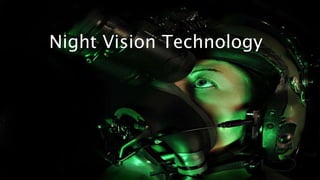
Night Vision Technology
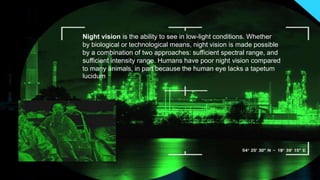
Night vision is the ability to see in low-light conditions. Whether
by biological or technological means, night vision is made possible
by a combination of two approaches: sufficient spectral range, and
sufficient intensity range. Humans have poor night vision compared
to many animals, in part because the human eye lacks a tapetum
lucidum
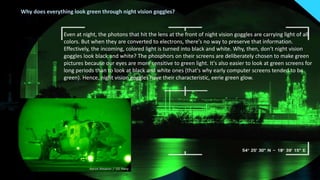
Even at night, the photons that hit the lens at the front of night vision goggles are carrying light of all
colors. But when they are converted to electrons, there's no way to preserve that information.
Effectively, the incoming, colored light is turned into black and white. Why, then, don't night vision
goggles look black and white? The phosphors on their screens are deliberately chosen to make green
pictures because our eyes are more sensitive to green light. It's also easier to look at green screens for
long periods than to look at black and white ones (that's why early computer screens tended to be
green). Hence, night vision goggles have their characteristic, eerie green glow.
Why does everything look green through night vision goggles?
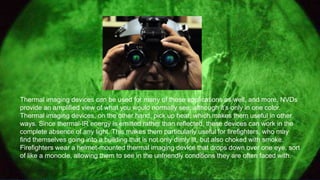
Thermal imaging devices can be used for many of these applications as well, and more. NVDs
provide an amplified view of what you would normally see, although it’s only in one color.
Thermal imaging devices, on the other hand, pick up heat, which makes them useful in other
ways. Since thermal-IR energy is emitted rather than reflected, these devices can work in the
complete absence of any light. This makes them particularly useful for firefighters, who may
find themselves going into a building that is not only dimly lit, but also choked with smoke.
Firefighters wear a helmet-mounted thermal imaging device that drops down over one eye, sort
of like a monocle, allowing them to see in the unfriendly conditions they are often faced with.
Night vision was originally developed for warfare. Information becomes even more valuable when
lives literally depend on it, and the locations of enemy troops and awareness of your own
surroundings are two of the most important types of information. The ability to gather this
information at night, when your enemies may be blind, is a huge advantage. The military uses a
variety of NVDs for these purposes – hand-held sighting scopes, weapon scopes, and night
vision goggles being the main three.
Military use isn’t the only application for night vision, though. Night vision cameras are often used
for security, as well. They are especially useful in less-populated areas where there is less light.
Law enforcement and the military also both use NVDs in helicopters for surveillance when
necessary.
Applications
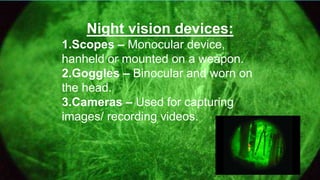
Night vision devices:
1.Scopes – Monocular device,
hanheld or mounted on a weapon.
2.Goggles – Binocular and worn on
the head.
3.Cameras – Used for capturing
images/ recording videos.
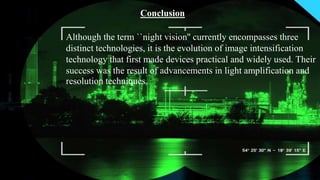
Although the term ``night vision'' currently encompasses three
distinct technologies, it is the evolution of image intensification
technology that first made devices practical and widely used. Their
success was the result of advancements in light amplification and
resolution techniques.
Conclusion

Night vision technology

  • 1.
  • 2.
    Night vision isthe ability to see in low-light conditions. Whether by biological or technological means, night vision is made possible by a combination of two approaches: sufficient spectral range, and sufficient intensity range. Humans have poor night vision compared to many animals, in part because the human eye lacks a tapetum lucidum
  • 3.
    Even at night,the photons that hit the lens at the front of night vision goggles are carrying light of all colors. But when they are converted to electrons, there's no way to preserve that information. Effectively, the incoming, colored light is turned into black and white. Why, then, don't night vision goggles look black and white? The phosphors on their screens are deliberately chosen to make green pictures because our eyes are more sensitive to green light. It's also easier to look at green screens for long periods than to look at black and white ones (that's why early computer screens tended to be green). Hence, night vision goggles have their characteristic, eerie green glow. Why does everything look green through night vision goggles?
  • 4.
    Thermal imaging devicescan be used for many of these applications as well, and more. NVDs provide an amplified view of what you would normally see, although it’s only in one color. Thermal imaging devices, on the other hand, pick up heat, which makes them useful in other ways. Since thermal-IR energy is emitted rather than reflected, these devices can work in the complete absence of any light. This makes them particularly useful for firefighters, who may find themselves going into a building that is not only dimly lit, but also choked with smoke. Firefighters wear a helmet-mounted thermal imaging device that drops down over one eye, sort of like a monocle, allowing them to see in the unfriendly conditions they are often faced with.
  • 5.
    Night vision wasoriginally developed for warfare. Information becomes even more valuable when lives literally depend on it, and the locations of enemy troops and awareness of your own surroundings are two of the most important types of information. The ability to gather this information at night, when your enemies may be blind, is a huge advantage. The military uses a variety of NVDs for these purposes – hand-held sighting scopes, weapon scopes, and night vision goggles being the main three. Military use isn’t the only application for night vision, though. Night vision cameras are often used for security, as well. They are especially useful in less-populated areas where there is less light. Law enforcement and the military also both use NVDs in helicopters for surveillance when necessary. Applications
  • 6.
    Night vision devices: 1.Scopes– Monocular device, hanheld or mounted on a weapon. 2.Goggles – Binocular and worn on the head. 3.Cameras – Used for capturing images/ recording videos.
  • 7.
    Although the term``night vision'' currently encompasses three distinct technologies, it is the evolution of image intensification technology that first made devices practical and widely used. Their success was the result of advancements in light amplification and resolution techniques. Conclusion